Which Customer Questions Did Your Team Never Answer?

Conversation intelligence should maintain a Question Resolution Register, not merely count replies. A response near a question is not necessarily an answer to it.
Consider a buyer who asks whether the maintenance charge includes parking upkeep. The rep responds with the payment plan and offers a visit. The customer repeats the question on WhatsApp two days later. The conversation summary says pricing discussed, follow-up completed. Every activity looks finished while the actual question remains unanswered.

The Question Resolution Register keeps the customer’s meaning connected to the next action.
Conversation intelligence should maintain a Question Resolution Register, not merely count replies. A response near a question is not necessarily an answer to it. The useful unit is a customer question connected to a relevant, authorized answer and any action needed to verify that answer.
Reply counts hide answer gaps
Identify the object and requested information in each question. Match later answers by meaning, including partial responses and explicit deferrals. Preserve questions that require another team’s input. A rep saying “I’ll check” creates a verification obligation; it should not close the question simply because the customer received an acknowledgment.
Answer coverage should preserve the structure of a compound question. “What is included, when can I move, and who handles maintenance?” contains several needs that may have different owners. A response covering the move date should not close all three. Track the components that matter to the next decision, then recombine them into a concise customer update when appropriate. This helps the team avoid both extremes: one vague open question that nobody can resolve and dozens of tiny tickets that fragment a single useful answer.
A promise to check creates another obligation
Unanswered questions extend buying cycles without appearing as inactivity. The rep keeps sending useful-looking material, and the customer keeps waiting for one missing fact. Managers may diagnose price resistance or weak intent. The actual problem is answer coverage, which standard call counts and summary sentiment do not expose.
The practical failure is specific: any nearby response counts as an answer. The desired behavior is equally specific: closure requires relevant answer coverage. Use those two statements as the review boundary. A response should be judged by the state it leaves behind, not only by whether its wording sounds helpful.
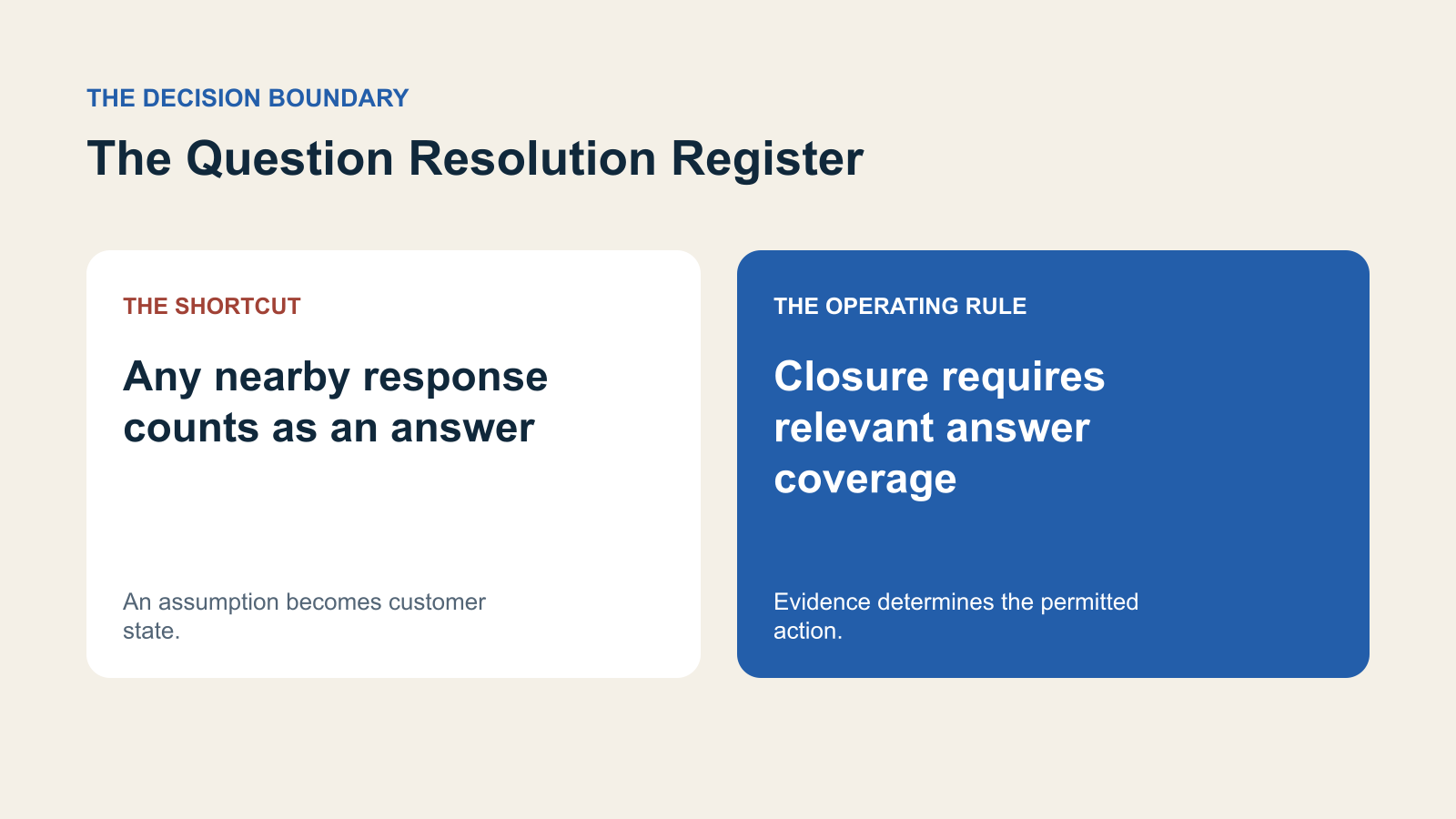
The Question Resolution Register: the wrong shortcut and the evidence-based decision.
The working record behind The Question Resolution Register
The record needs enough structure for another owner to verify the interpretation. For this journey, preserve four parts together rather than scattering them across a transcript, a note, and an action queue. Each part below has a different operating purpose. A populated field is useful only if the next owner can tell what it refers to and whether it is current.
Question meaning, object, and original message
Record the actual information requested and its object. Broad labels such as pricing do not establish whether the customer's specific question was answered.
Answer coverage and supporting approved source
Match answers by relevant coverage. A nearby brochure or acknowledgment may leave the original uncertainty completely unresolved despite an active conversation.
Verification owner and expected update
Assign verification when the answer requires another team. Saying I will check creates an owned obligation rather than closing the question.
Open, partial, answered, withdrawn, or superseded state
Retain partial and withdrawn states. A changed product can retire a question, while a partial explanation should leave its remaining component visible.
Bring the unresolved question into the next conversation
For the maintenance question, record the requested inclusion and route verification to the authorized project owner. Mark the response as pending confirmation. When the approved answer arrives, send it in the customer’s thread and link it to the original question. If it resolves only parking upkeep but not other charges, close only that part of the inquiry.
A suitable clarification or acknowledgment in this illustrative scenario is: “You asked whether parking upkeep is included; that point is still being verified.” The wording is an example to adapt to the approved customer process, not a universal script. Its purpose is to make the next decision clear without claiming that an unverified action has already completed.
An answer also has an authority requirement. A confident rep response may be relevant but unsupported by approved information. Mark the distinction between answered in conversation and verified for the required purpose. If the earlier answer was wrong, a correction should reopen the customer’s uncertainty and reach the people using that fact. Do not let the presence of a prior answer prevent escalation when the customer points out that it conflicts with the document they received.
The Question Resolution Register
Any nearby response counts as an answer. Closure requires relevant answer coverage.
The boundary cases that change the correct action
Rhetorical questions, hypothetical questions, and repeated paraphrases should not inflate the open queue. “Why is this so confusing?” may signal frustration rather than a request for a literal explanation. A customer may withdraw a question after changing product choice. Preserve its history while making the current need explicit.
Start with a sample of stalled conversations and ask a reviewer to list the customer’s unanswered questions independently of the AI. Compare the register with that review. Add owner and expected update time for questions requiring verification. Make the unresolved list available before the next call so the rep opens with useful progress.
Deploy the operating rule alongside the assistant. Staff need to know which facts they can correct, which decisions require approval, and how an unresolved case returns to a person. Make that return path visible in the same customer record. Avoid a parallel spreadsheet of exceptions that leaves the next advisor unaware of the actual state.
How to test The Question Resolution Register before expanding it
Test the complete journey rather than a single response. A correct sentence can still trigger the wrong task, and a corrected CRM field can coexist with an outdated outbound message. Review the original evidence, the resulting record, and the action received by the next owner together.
- A rep replies with unrelated information; the question remains open.
- A partial answer arrives; the unresolved portion is preserved.
- The customer repeats the same question; the existing item is updated rather than duplicated.
Review stalled and successfully progressed journeys side by side. Ask which unanswered question would change the customer’s next decision, rather than assuming every open item has equal commercial importance. Use that assessment to prioritize owner work without hiding lower-priority commitments. After the pilot, inspect whether the assistant helped close specific questions or merely generated better summaries of why the questions remained open.
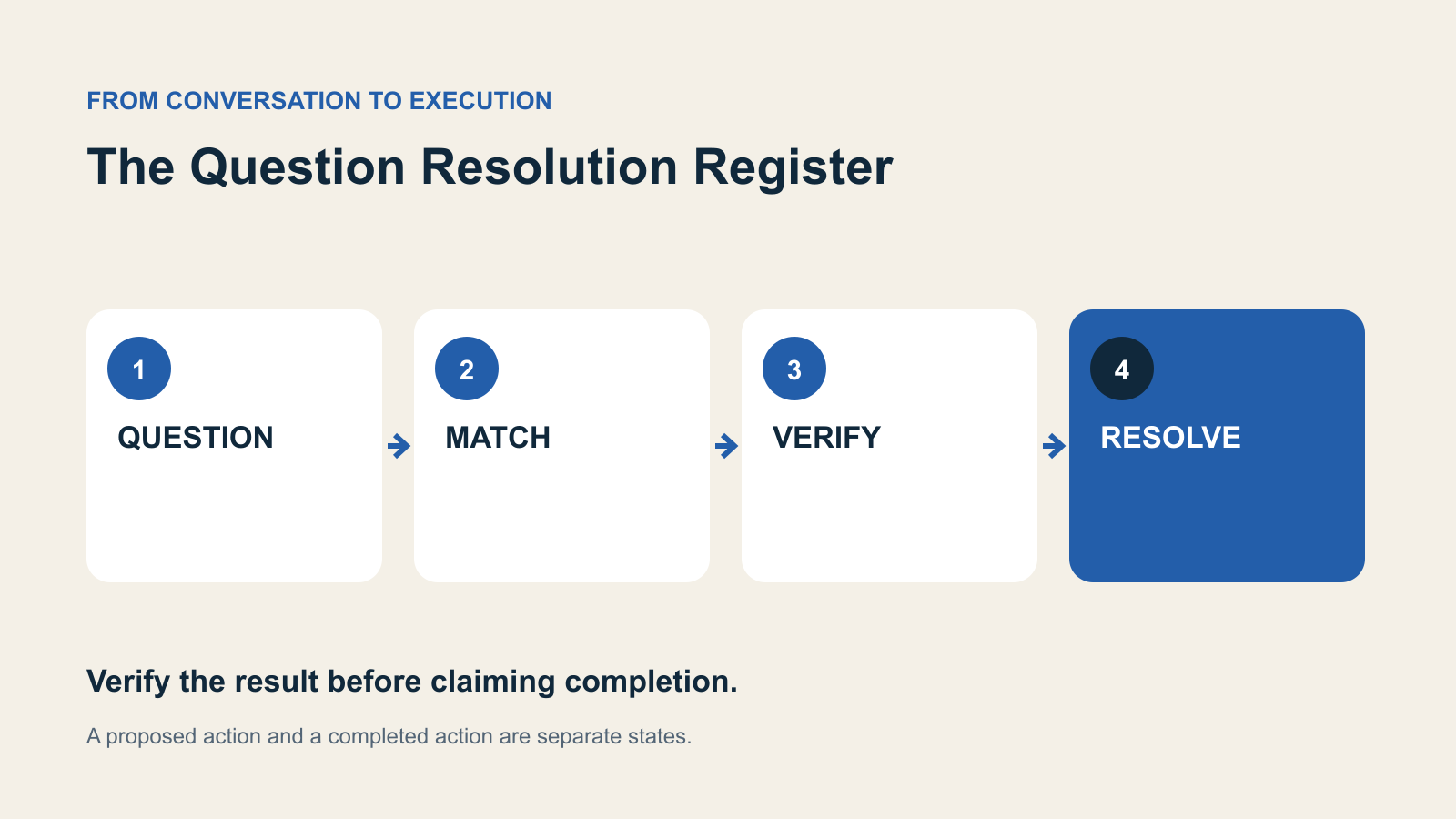
QUESTION → MATCH → VERIFY → RESOLVE: review the state transition, not just the response.
Measure decision accuracy alongside customer effort
Measure unanswered substantive questions, time to an authorized answer, repeated requests for the same information, and falsely closed questions. Keep answer accuracy beside closure speed. An immediate invented answer is a worse result than an honest deferral with a reliable owner.
Use an explicitly illustrative audit to make the denominator clear. Suppose reviewers inspect 40 cases that genuinely require The Question Resolution Register, and find 6 unsupported actions. That is 6 divided by 40, or 15% in that sample. It is not a market benchmark or an expected result. Counting 200 unrelated greetings alongside those cases would hide the failure without fixing it. Keep the relevant case count, error count, review rules, and uncertainty visible when reporting the result.
Also inspect the opposite failure: an unnecessary hold when the evidence was already sufficient. Reviewers should distinguish a justified clarification from an avoidable repeat question. An appropriate human review is different from a case abandoned without an owner. Pair the action error rate with customer effort and completion evidence so the team cannot improve one dashboard by moving the cost to the customer or another department.
Connect The Question Resolution Register with the rest of customer operations
Brixi connects conversation analysis with CRM, buyer intent, AI assistants, voice, WhatsApp, workflows, and human teams. Analysis therefore has an operating destination: a corrected record, a prepared owner, a relevant next action, or a clearly held decision. Teams can use the same customer history to review what was interpreted and whether the resulting work advanced the journey.
For this use case, make the implementation review concrete: ask the Brixi team to walk through the original evidence, the current CRM state, the permitted action, and recovery when that action cannot complete. Validate any required source system, permission rule, and approval path during configuration. The recommended operating design in this article should be demonstrated against the actual deployment rather than assumed from a generic AI feature label.
For the wider operating model, read the conversation analysis guide. The important connection is between interpretation and accountable execution: the same evidence should prepare the assistant, the responsible human, and the next workflow.
What to inspect after the first quarter
At the first monthly review, look for the failure that has moved elsewhere. A cleaner conversation can still leave a stale task or an unowned approval. During the following reviews, sample complete journeys from original evidence to customer-visible outcome. Expand the scope only when the team can explain the remaining exceptions and the responsible owner can recover them without reconstructing the entire thread.
The deeper bet behind The Question Resolution Register
Conversation intelligence becomes operational when it can explain what the customer is still waiting for. The next step is often neither more nurturing nor a stronger pitch. It is resolving the specific uncertainty that has survived every previous reply.
Put The Question Resolution Register into a connected customer workflow
Explore how Brixi connects conversation intelligence, CRM, AI assistants, conversations, workflows, and human teams around a reliable next action.