Why CRM and Conversation Intelligence Still Miss the Deal
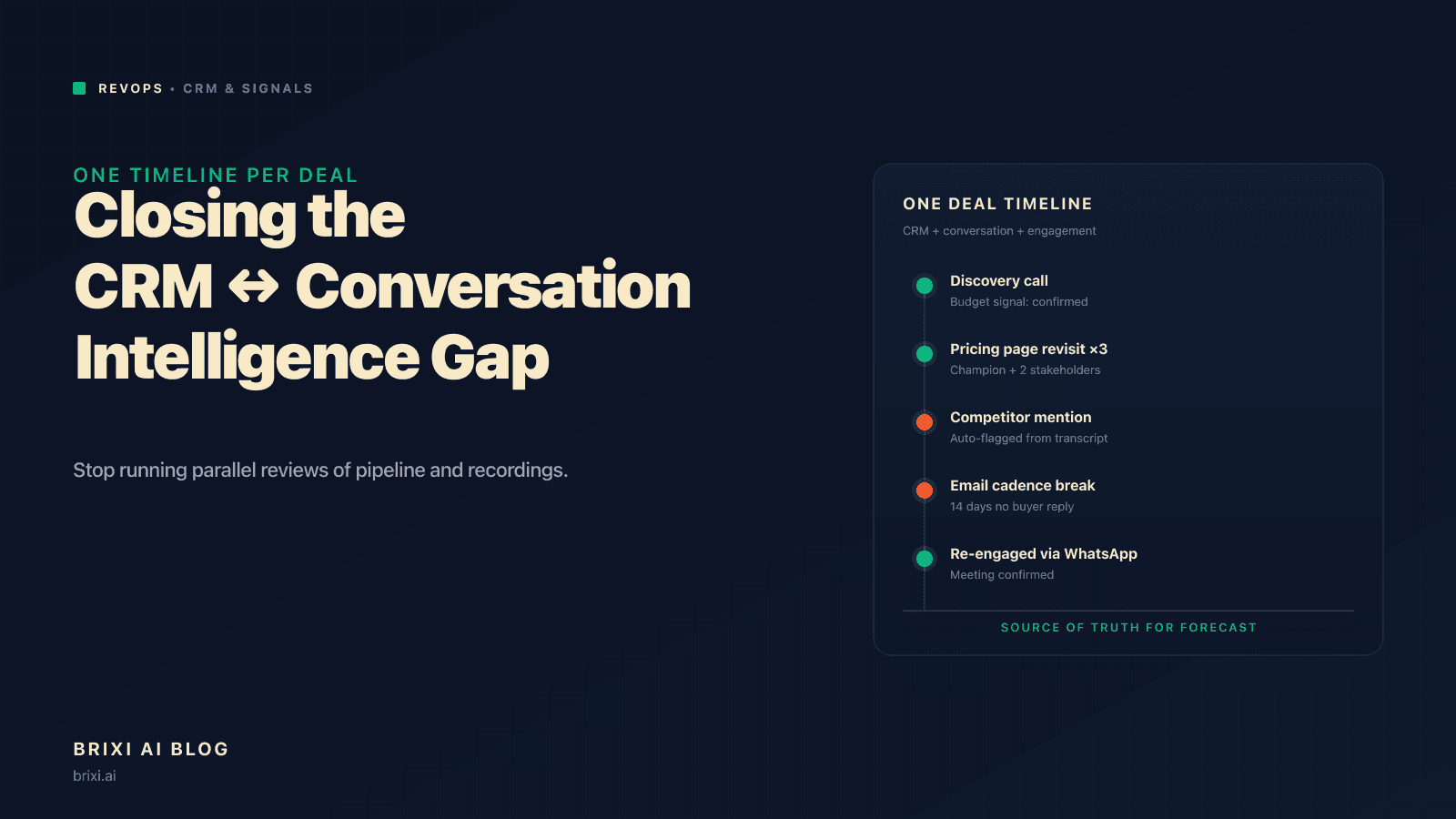
Your CRM logs what reps did. Your call recorder logs what was said. Neither one tells RevOps what is actually moving the deal. Here is how to build the layer that bridges them and why most teams build it in the wrong order.
Madhav runs RevOps for a mid-market B2B SaaS company in Mysuru. His team of twelve carries a 4-crore quarterly target. Six weeks into Q3, his CRM shows nine deals in "Negotiation" and a forecast of 3.2 crore. His conversation intelligence platform shows reps spoke with prospects on all nine. Both numbers look healthy. Then four of those nine slip to next quarter in the final week, and the post-mortem is the same every time: "We had no signal that the deal was cooling."
Madhav is not running a bad RevOps function. He is running two well-maintained systems that were never designed to share a language. The CRM tracks activity. The call recorder tracks speech. The deal lives in the space between them, and that space has no owner.
What is the Deal Drift Register and why does every B2B team have one?
Every B2B sales team, whether it knows it or not, maintains a Deal Drift Register: the invisible running list of deals whose CRM stage says one thing while the actual buyer behavior says another. A deal sits at "Proposal Sent" in the CRM for eighteen days. The conversation intelligence tool shows three calls, each with a healthy talk-listen ratio. But the buyer has not opened the proposal document, the champion has stopped replying to emails, and the last call had a competitor name in it that nobody flagged. The CRM does not know any of this. The call recorder captured the competitor mention but filed it in a transcript no one reviewed.
The Deal Drift Register grows quietly. In deployments we see, it typically holds 20 to 35 percent of the active pipeline at any given point in the quarter. Those are not dead deals. They are deals where real friction has accumulated but no system has surfaced it to the rep or manager in time to act.
Why does CRM conversation intelligence integration fail at the seam?
The CRM was designed for the manager view: pipeline stages, forecast rollup, activity attribution. Conversation intelligence was designed for the coaching view: call quality, talk-listen ratios, objection handling patterns. Neither was designed to answer the question RevOps actually needs answered at deal level: "Is this deal real, and what should happen in the next 48 hours?"
The seam between the two systems is where deals go quiet. A rep finishes a call and logs "Good conversation, following up" in the CRM. The call recorder has a 42-minute transcript with a budget objection at minute 18, a competitor mention at minute 27, and a vague next step at minute 39. The CRM note says nothing about any of that. The RevOps manager reviewing pipeline three days later sees "following up" and moves on.
- CRM stage updates lag by two to five days after conversations have already shifted the deal.
- Conversation intelligence captures speech but not buyer behavior between calls: email open patterns, document revisits, pricing-page return visits.
- Neither system tracks stakeholder spread. A deal where only one contact is engaged looks identical to one where four stakeholders are actively reviewing.
- Reps re-enter context manually under deadline pressure and strip out the nuance that matters.
- Managers review pipeline in the CRM and call recordings in separate tabs, with no joined view and no prompt to reconcile the two.
Is the answer a third system, or a smarter layer on top of what you have?
Here is the contrarian claim worth sitting with: most RevOps teams do not have a data problem. They have a synthesis problem. The CRM contains thousands of activity records. The conversation intelligence platform contains thousands of call hours. The problem is not that the data does not exist; it is that no single view makes the connection visible at the moment a rep or manager needs to act.
Adding a third system makes this worse before it makes it better. It creates a third silo with its own login, its own data model, and its own maintenance burden. The RevOps teams that close the Deal Drift Register most reliably build a synthesis layer on top of the two systems they already own, rather than replacing either one.
A working synthesis layer does three things. First, it reads CRM activity and call transcripts on the same timeline, producing one chronological per-deal view. Second, it extracts structured signals from conversations and writes them back to CRM fields automatically, so the CRM record reflects what was actually said rather than what the rep chose to summarize. Third, it triggers alerts when deal behavior diverges from stage expectations, specifically when buyer-initiated engagement drops while the stage stays the same.
What should a per-deal timeline actually contain for RevOps to trust it?
The per-deal timeline is the core artifact. It is not a log. It is a ranked, annotated view of every signal that has touched a deal, ordered by recency and weighted by buyer intent rather than rep activity. Here is what it should include to be genuinely useful for a pipeline review.
- Every inbound and outbound email, with open and reply timestamps, not just send timestamps.
- Every call, with AI-extracted structured fields: competitor mentions, budget signals, stated objections, decision criteria, and agreed next steps.
- Document engagement data: which stakeholders opened which materials, how many times, and how long they spent on each section.
- Stakeholder map changes: any new contact added to or dropped from the opportunity.
- Days since last buyer-initiated contact, separated from rep-initiated contact. These are very different signals.
- Any keyword from prior calls that has appeared again, indicating a persistent objection or recurring theme.
When Madhav pilots this view on his nine deals in negotiation, three of them immediately surface a pattern: the last buyer-initiated email was seventeen or more days ago, and the last call had a competitor name the rep had not flagged. Those three are the deals that later slip. The timeline does not prevent the slip on its own, but it gives the manager the information to intervene two weeks earlier rather than at end-of-quarter.
The anti-pattern to name and avoid
The most common RevOps anti-pattern here is auditing the timeline after deals slip rather than before. Run a post-mortem on five deals that slipped last quarter using only the signals that existed three weeks before quarter end. In most cases, the Deal Drift Register was already visible in the data. The gap was not in the data collection. It was in when the data was surfaced.
How do you roll out CRM and conversation intelligence integration without a year-long project?
RevOps teams consistently over-engineer this. The instinct is to map every field, negotiate every integration point, and build a complete system before showing anything to the sales team. That approach takes nine to twelve months and arrives after the quarter where it was needed.
The faster path is read-only first. Start by ingesting CRM activity logs and call transcripts into a single analytical layer. Do not write anything back yet. Generate per-deal timelines and use them in one pipeline review meeting. Ask two questions: which deals have the lowest buyer-initiated engagement in the last fourteen days, and which deals had a competitor mention in the last three calls. Those two questions alone change the meeting from a narrative exercise to a signal-backed conversation.
- Phase 1: read-only ingestion of CRM activity and call transcripts. Generate per-deal timelines. No write-back, no new fields, no rep training required.
- Phase 2: use the joined timeline in pipeline review. Track which insights change the forecast call versus the CRM-only view.
- Phase 3: write structured fields back to the CRM from AI extraction: competitor names, stated objections, agreed next steps. Reps validate rather than create.
- Phase 4: trigger alerts when buyer engagement drops below a threshold the team calibrates from its own data, not a vendor benchmark.
- Phase 5: feed the joined timeline into the forecast model so the commit call has evidence, not just stage and gut feel.
The write-back in Phase 3 is where most teams expect resistance from reps. In practice, the resistance is lower than expected because the AI is doing the work the rep hated doing. Reps spend meaningful time every day writing call notes and updating CRM fields. When those fields appear already populated after a call, with an option to edit rather than create, adoption follows quickly.
What changes for a RevOps team after a quarter with full deal visibility?
The first change is in how pipeline reviews run. A review without a joined view is a narrative session where each rep tells their version of each deal and the manager decides how much to trust it. A review with the per-deal timeline takes half the time and focuses on the five deals with the weakest buyer signals, not all fifty on the board.
The second change is in the quality of the closed-loop data. Every deal that closes or slips now has a structured record of what happened in conversations, not just a stage history. That record feeds the next quarter’s scoring model. Over two or three quarters, the team develops a genuine understanding of what early-stage signals predict late-stage close rates for their specific market and deal type.
The third change, and the one that is hardest to quantify but most visible to the team, is that reps stop being CRM data-entry clerks. In deployments, teams commonly report that reps reclaim 30 to 50 minutes per day previously spent on manual call notes and stage updates. That time shifts to actual selling activity: follow-up calls, proposal personalization, stakeholder research.
- Managers run pipeline reviews in focused, signal-led sessions rather than deal-by-deal narratives.
- RevOps gets clean, structured closed-loop data to calibrate scoring, routing, and forecast models each quarter.
- Marketing can see which campaigns produce deals that actually close versus deals that enter pipeline and stall.
- CROs get a forecast they can defend with evidence to finance, not a number backed only by rep confidence.
- New reps ramp faster because the deal timeline shows them exactly what good looks like on a deal that closed.
The deeper bet: why conversation intelligence and CRM must converge for B2B RevOps to mature
Madhav’s problem at the start of Q3 was not that his team lacked data. It was that his forecast model was built on the only structured data available to it: CRM stages and activity counts. That model had no way to penalize a deal where the buyer had gone quiet, because "buyer going quiet" was not a field in the CRM. It lived in a transcript nobody had time to read.
The convergence of CRM and conversation intelligence into a single revenue operations AI layer is not a nice-to-have for teams at scale. It is the prerequisite for any forecast model that is more than a weighted average of subjective stage probabilities. The teams that invest in this convergence now will have three to four quarters of calibrated data before the teams that wait until it becomes obvious.
For Madhav, the proof arrives by the end of Q4. The Deal Drift Register is still there. It always is. But now it has a face: five specific deals, named, ranked by buyer disengagement, each with a clear recommended next step based on what has worked on similar deals that closed. He surfaces two of them in pipeline review on day 12 of the quarter. Both close before day 75. That is not a coincidence. That is what happens when the synthesis layer finally exists.
What would your forecast look like with buyer signals, not just CRM stages?
Brixi joins CRM activity, conversation transcripts, and engagement signals into one per-deal timeline so RevOps teams can act on what is actually happening before deals slip.
See How Brixi WorksFrequently Asked Questions
A call recorder captures and stores transcripts. CRM conversation intelligence integration goes further: it extracts structured signals from those transcripts (competitor names, budget objections, next steps, stakeholder mentions) and writes them back to CRM fields automatically, so the deal record reflects what was actually discussed rather than what the rep chose to summarize. The integration also joins call data with CRM activity and email engagement on a single timeline, enabling signal-based forecasting rather than stage-based forecasting.
Most forecast models rely on CRM stage and rep-reported close probability, both of which are subjective and lag the actual deal reality by days or weeks. When conversation intelligence data is joined to the CRM record, the forecast model gains access to buyer-behavior signals: days since last buyer-initiated contact, competitor mention frequency, objection recurrence, and stakeholder engagement breadth. These signals are leading indicators of close probability in a way that stage alone cannot be. Teams that calibrate their forecast on this joined data set typically see meaningful improvement in commit accuracy within two to three quarters.
The Deal Drift Register is the set of active pipeline deals where the CRM stage and the actual buyer engagement level have diverged. A deal sits in "Negotiation" while the buyer has not initiated contact in three weeks. The stage is optimistic; the signal is not. RevOps teams identify the Deal Drift Register by cross-referencing CRM stage history with buyer-initiated engagement data: inbound emails, document opens, return visits to pricing pages, and call participation rates. Without a joined view, this register is invisible and shows up only in the post-mortem after a slip.
A read-only integration that produces per-deal timelines can be operational in two to four weeks for most teams. This phase requires no field mapping, no rep training, and no write-back permissions on the CRM. The full integration including AI-driven write-back of structured call data to CRM fields and alert configuration typically takes eight to twelve weeks depending on the CRM and the call intelligence platform in use. The fastest path is to start with read-only, prove value in a single pipeline review cycle, and then negotiate the write-back permissions with confidence.