Conversation Analysis That Closes Deals, Not Just Reports
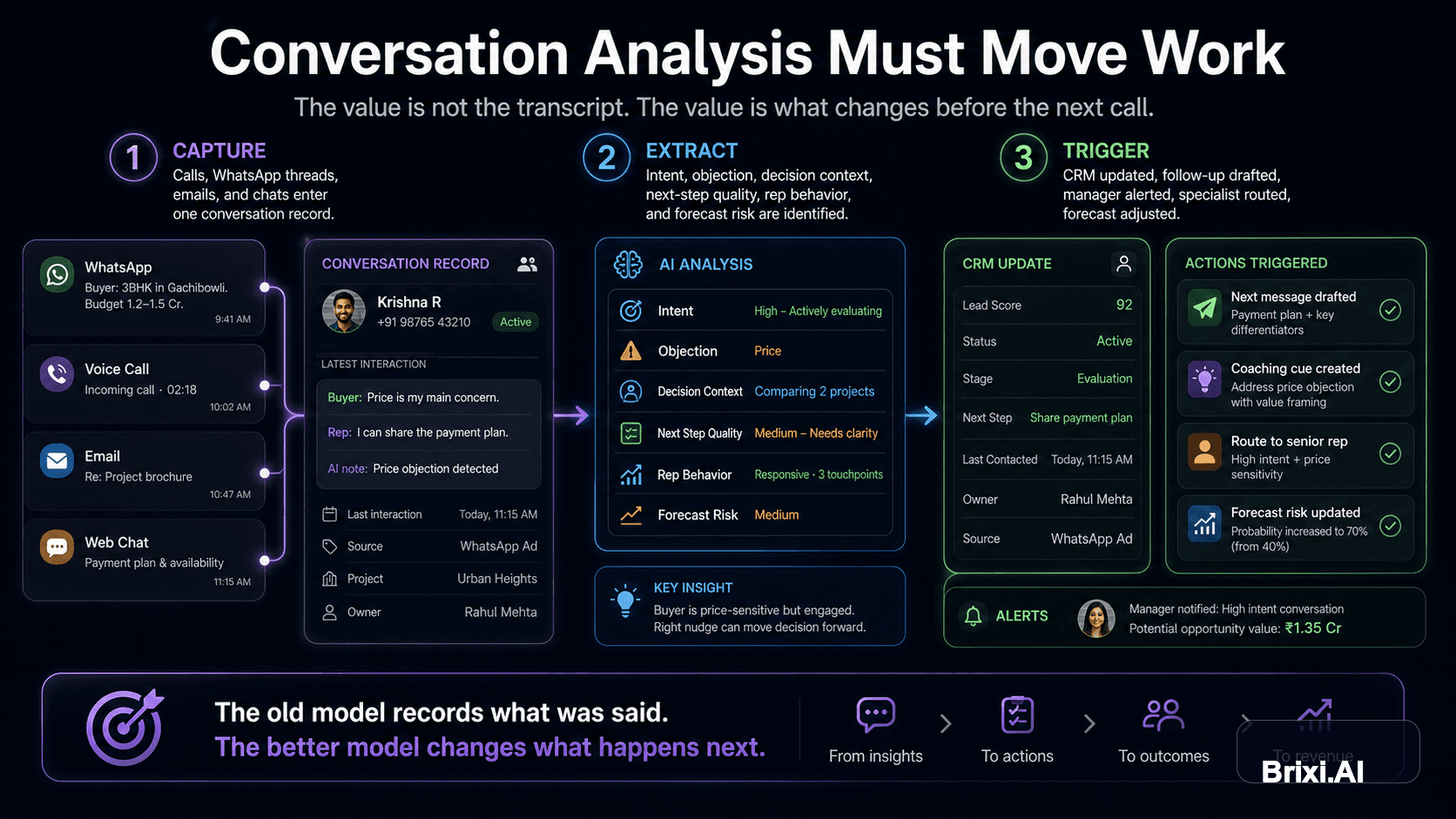
Most conversation analysis tools turn calls and chats into dashboards. Dashboards are useful, but they are too slow to change the deal that is in motion. Revenue intelligence earns its name only when conversation signals change the next message, the next coaching cue, the next route, and the next forecast.
Mira manages a twelve-person inside sales team at a real estate developer in Nashik. Her team handles inquiry calls, WhatsApp threads, and site-visit follow-ups across three projects simultaneously. She bought a conversation recording tool eighteen months ago. Every call is transcribed. Sentiment scores appear in a table. Talk-to-listen ratios are charted weekly. She reviews the dashboard on Sunday mornings before the Monday catch-up.
Two weeks ago, a buyer named Pradeep called, asked three specific questions about subvention schemes, mentioned a competing developer twice, and said he needed a decision by month-end. The call ended without a site visit booked. The transcript was saved. The sentiment score was "neutral." Pradeep received a standard WhatsApp follow-up the next morning: "Thank you for your interest. Please let us know if you have any questions." He did not reply. The deal was lost four days later.
Mira is not using a bad tool. She is using a tool that was designed to measure conversations rather than act on them. That distinction is the entire problem with how most teams deploy conversation analysis today.
The transcript is not the outcome
Conversation analysis creates revenue value only when extracted signals change the next action. Without that, it is documentation with a better interface: useful for audits, wasteful for deals.
What is Signal-to-Action Distance, and why does it kill deals?
The term Signal-to-Action Distance describes how far a useful insight travels before it actually changes someone's behavior. In Mira's setup, the Signal-to-Action Distance is very long: signal is extracted from Pradeep's call, it lands in a dashboard, Mira reviews it days later if at all, then a manual decision needs to happen, a message needs to be drafted, and the rep needs to send it. By that point the buyer has moved on.
Short Signal-to-Action Distance means the signal triggers a behavior change before the next buyer interaction. It does not mean the system replaces human judgment; it means the system reduces the latency between insight and action to near-zero. That latency is where revenue leaks.
Most conversation intelligence platforms are designed to minimize the first half of this problem, which is extracting a clean signal. They transcribe accurately, classify intents reasonably well, and surface summaries that are genuinely readable. The failure is in the second half: they deposit the signal into a dashboard and leave the action to whoever happens to open the dashboard at the right moment.
Why dashboards are the wrong delivery mechanism for live deals
Dashboards are retrospective by design and that is not a flaw; it is a choice. They are built for managers who need to understand patterns across hundreds of conversations over weeks or months. That use case is legitimate for training program design, headcount planning, and territory reviews.
But live deals need intervention while the buyer is still evaluating. The buyer who raised a competitor comparison on Tuesday's call should receive a response that directly addresses it by Wednesday morning, not after the Friday dashboard review. The rep who consistently skips decision-timeline discovery on calls should receive that coaching before the next call this week, not during the next quarterly review.
Here is the contrarian claim that most conversation intelligence vendors do not want you to think about: the dashboard is not a failure of execution; it is a structural mismatch. Sales conversations happen in near real-time. Dashboards operate on a weekly or monthly review cadence. No matter how beautiful the dashboard, it will always be late for the deal in motion.
What conversation analysis should actually extract from each call
To close the Signal-to-Action Distance, a conversation analysis system needs to extract signals that are immediately actionable, not just descriptive. Six signal categories matter most:
- Buyer intent classification: evaluation, urgency, hesitation, low-fit curiosity, or competitor comparison. Not a sentiment score; a behavioral category.
- Objection type and stage: price, timing, trust gap, authority misalignment, implementation concern, or risk perception. Each requires a different response.
- Decision context: stakeholders present and absent, approval path, stated timeline, hard constraints, and decision criteria the buyer actually named.
- Next-step quality: whether the call ended with a specific, time-bound, agreed-upon next action, or a vague "I'll think about it" close.
- Rep behavior gaps: whether discovery, qualification, objection handling, competitor response, and handoff met the team's expected standard for this stage.
- Forecast signal alignment: whether the conversation supports the current pipeline stage and close probability, or contradicts it.
Notice that none of these are sentiment scores, word clouds, or talk ratios. Those metrics are easy to calculate and satisfying to look at, but they do not tell a rep or manager what to do next. Signal-to-Action Distance is long because the extracted signals are the wrong shape for action.
Which four actions should conversation intelligence trigger automatically?
Reducing Signal-to-Action Distance requires the system to move from extracting signals to triggering work. There are four action categories where this is both technically achievable and commercially significant.
The next best message
After any substantive conversation, the follow-up message should be shaped by what was actually said, not by a generic template. A buyer who raised a subvention concern should receive a message that directly addresses subvention options. A buyer who mentioned a competitor should receive a message that acknowledges the comparison without dismissing it. In deployments we see, personalized follow-ups based on conversation signals produce meaningfully higher reply rates than template-based follow-ups sent within the same window.
The next coaching cue
Managers should not wait for a scheduled call review to catch a pattern that is costing deals this week. If a rep consistently accepts vague next steps, mishandles pricing questions, or skips stakeholder discovery on every second call, the system should surface that pattern and attach it to the specific calls where it appeared. That is actionable coaching. A score on a report is not.
The next routing decision
Some conversations reveal that a lead needs a different handler: a senior rep for a large-ticket commercial buyer, a finance specialist for a buyer asking detailed loan questions, a support owner for a buyer who is actually an existing customer with a complaint, or a nurture path for a lead who is twelve months away from a purchase decision. Conversation analysis should trigger that routing automatically. Leaving it buried in a note that the rep may or may not act on is the anti-pattern Mira's team falls into.
The next forecast update
Forecasts should reflect conversation reality, not stage names that were last updated three weeks ago. If a deal in the "proposal sent" stage has a buyer who has not confirmed a decision-maker, has raised a budget objection on two consecutive calls, and ended the last conversation without booking a next step, that deal should not be sitting at seventy percent close probability. Conversation analysis that writes back to the CRM can flag that contradiction automatically.
What does "anti-pattern" mean in a conversation analysis rollout?
Teams that have deployed conversation intelligence tools for more than six months typically fall into one of three anti-patterns that keep their Signal-to-Action Distance long.
The first is the Audit-Only Trap. The team uses the tool exclusively to review calls after a deal is won or lost. The signal arrives after the outcome has already been determined. Useful for training new reps, useless for the pipeline currently in motion.
The second is the Score Fixation. The team builds a call quality score and optimizes for it. Reps learn to produce the behaviors that generate a good score: they ask more discovery questions, they avoid long monologues, they end calls with next steps. But the score is a proxy, and proxies get gamed. The underlying revenue outcome does not necessarily improve.
The third is Notification Fatigue. The team integrates conversation analysis into Slack or CRM and turns on all available alerts. Within two weeks, reps and managers are ignoring the notifications because there are too many and too few are relevant. The system ends up back at dashboard-only mode because the inbox is noise.
Avoiding all three requires a deliberate choice about which signals are worth acting on at all. Not every conversation produces an urgent signal. The system should be selective: fire an alert only when the signal has a clear corresponding action and the window for that action is short.
What changes after a quarter of closing the Signal-to-Action Distance?
Teams that actively reduce Signal-to-Action Distance tend to report the same cluster of changes after sixty to ninety days of consistent operation.
- Follow-up quality improves before coaching improves. When the system drafts context-aware follow-ups, even reps who have not yet been coached send better messages, because the default behavior changes.
- Forecast accuracy improves before win rate improves. The CRM starts reflecting conversation reality sooner, so managers stop over-forecasting deals that have no confirmed next steps.
- Coaching conversations become specific. Instead of "you need to do better discovery," managers can say "on your last four calls you accepted vague timelines. Here are the three calls where that happened." Specificity changes behavior faster than general feedback.
- Routing errors surface as a category. Teams discover that a meaningful percentage of lost deals were misrouted, not mishandled. A senior-rep or specialist conversation at the right moment would have changed the outcome. That is a structural fix, not a training fix.
- The dashboard becomes less important. This sounds counterintuitive, but when signals are acting at the conversation level, managers spend less time reviewing the dashboard because the system is already handling the interventions the dashboard used to surface.
None of these outcomes require perfect AI. They require a system that is consistently fast: signal extracted, action triggered, outcome tracked, loop closed. Most teams find that the consistency of the loop matters more than the sophistication of the signal extraction.
The deeper bet: why Mira's problem is actually a systems architecture problem
Mira did not lose Pradeep's deal because her team lacks skill. They handle dozens of site visits a month. They know subvention schemes. They know how to handle competitor comparisons in conversation. The problem is that none of that knowledge reached Pradeep between Tuesday's call and Wednesday's follow-up. A generic message went out, and the window closed.
Revenue intelligence earns its name when it is embedded in the operating rhythm of the team, not in a reporting layer above it. That means conversation analysis signals must flow into the tools reps already use: the WhatsApp thread, the call prep note, the CRM stage, the next task. The signal has to be in the place where the action happens, at the moment the action needs to happen.
This is a harder architecture to build than a dashboard. It requires the system to understand context at the deal level, not just at the call level. It requires integrations that write back, not just read forward. And it requires someone on the revenue operations side to define which signals matter and what the corresponding action should be, before the pipeline fills up with deals that are already bleeding.
Mira is now rebuilding her process around this architecture. The tool still transcribes every call. But now the transcription feeds into a layer that classifies the signal, matches it to a response template, triggers a WhatsApp draft for the rep to review and send within two hours, and flags the deal for manager review if the signal indicates competitor risk or a missing decision-maker. The Signal-to-Action Distance went from days to under an hour.
The transcript is still saved. The dashboard still exists. But neither is the product anymore. The product is what the next conversation looks like because of what was learned from the last one.
Is your conversation analysis actually changing the next call?
Brixi analyzes WhatsApp, voice, email, and CRM context to surface buyer intent signals, coaching cues, routing triggers, and forecast risk, and acts on them before the buyer moves on.
Explore Buyer Intent EngineFrequently Asked Questions
Conversation analysis in sales uses AI to extract structured signals from calls, chats, emails, and messages. The useful signals are buyer intent classification, objection type, decision context, next-step quality, rep behavior gaps, and forecast alignment. The goal is not transcription or sentiment; it is knowing which action to take before the next buyer interaction.
Call recording captures audio. Transcription converts it to text. Conversation intelligence interprets what the text means for a specific deal in motion: whether the buyer showed urgency or hesitation, whether a competitor was mentioned, whether the next step was confirmed. Useful intelligence produces a recommended action, not just a document.
Yes, and it is one of the faster wins available to revenue operations teams. When conversation signals write back to the CRM automatically, pipeline stages reflect actual buyer behavior rather than rep optimism. Deals with no confirmed decision-maker or no agreed next step get flagged regardless of their stage label. Most teams find forecast accuracy improves within sixty days of closing the feedback loop between conversation analysis and CRM.
Routing all signals into a dashboard and reviewing it on a weekly cadence. By the time a manager opens the dashboard, many of the deals that needed intervention have already moved forward without it. The structural fix is to define which signals require same-day action, build the workflow that delivers those signals to the right person in the right tool, and reserve the dashboard for pattern review across weeks and months rather than deal-level intervention.