The Workflow Glue Tax: Why Autonomous Voice AI Beats Automation Patching
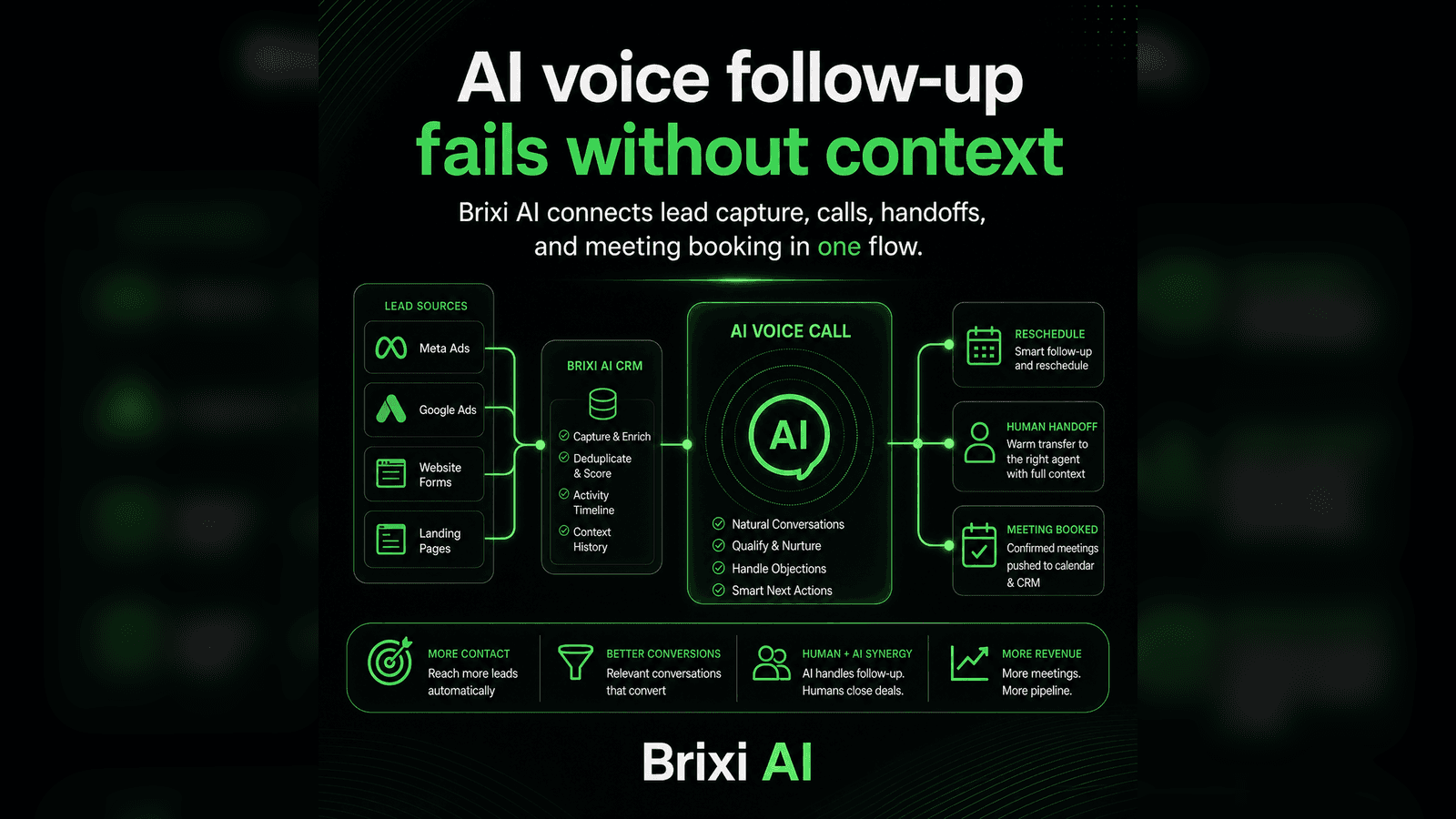
Most voice AI can talk. The hidden bill arrives after the call, when n8n, a consultant, and a chain of webhooks have to carry the outcome into your CRM. That bill is the Workflow Glue Tax, and it is why a connected platform beats a patched one.
The call recording is flawless. It is 7:42 on a Friday night, the kind of call a sales manager would frame and put on the wall. A lead who went quiet at lunch finally picks up. The voice agent qualifies her, learns she wants a callback after her office shift, captures a budget band, and confirms that WhatsApp is the right channel for the details. Clean intent, clean capture, clean close.
By Monday the same lead is a complaint, not a win. She was never assigned. The callback task was never created. The WhatsApp follow-up never fired. Nothing went wrong on the call. Everything went wrong after it, inside an n8n workflow that failed in silence on a CRM field someone had renamed the week before. The buyer spoke clearly. The AI understood her. The stack dropped her on the floor.
Call this the Workflow Glue Tax: the recurring cost of using external automation to make an incomplete voice AI product behave like a complete customer platform. The pitch was automation. What the team actually bought was four products stacked on each other: a voice layer that talks, an automation layer that relays, a maintenance layer that breaks, and a failure-management problem nobody scoped or budgeted for.
Why does the first demo always work and the hundredth call expose the stack?
A demo is judged on the call. Production is judged on everything that happens after it. In the demo, the agent sounds natural, asks the right questions, handles one objection, and lands a clean outcome. That is necessary and it is also the easy part. In customer-facing operations the value lives downstream: what gets updated, who gets notified, what gets scheduled, what gets retried, and whether the next human picks up with full context or from a cold start.
This is where most stacks quietly hand the real work to glue. The voice tool fires a webhook. n8n, Zapier, or Make moves the payload. The CRM takes a field update. A calendar tool takes a booking. WhatsApp takes a template trigger. Slack takes a notification. On a whiteboard it is six tidy boxes connected by arrows. In production it is six things that can fail at 7:42 on a Friday, each owned by someone who is not watching on a Friday.
n8n is not the villain here. It is a genuinely good automation tool for teams who know exactly what they want to connect. The problem starts when glue becomes the operating layer instead of an extension of it. If basic lead capture, CRM updates, rescheduling, routing, reminders, and follow-up all depend on an external chain, the voice AI is not autonomous. It is a demo wearing a workflow diagram.
What are the four line items on the glue tax?
The Workflow Glue Tax is not one charge. It is a recurring invoice with four line items, and only the first one is visible when you buy.
- Build tax: someone designs the flows, maps fields, sets trigger conditions, stores credentials, parses webhook payloads, and documents intent. The first version looks simple because it only handles the happy path you tested on Tuesday.
- Maintenance tax: CRM fields get renamed, a campaign adds a qualification question, a new city adds a timezone, sales ownership rules change. Every change quietly breaks a flow that worked yesterday and was not touched.
- Failure tax: a run times out, an API rejects a value, a duplicate record is created, a meeting books but routes to the wrong owner, a reminder fires twice. Now you need logs, retries, reconciliation, and a way to know which actual customer was affected.
- Operator tax: business users can see that something broke but cannot read payload formats, branch logic, or retry rules. A tool bought to reduce dependence on people creates a new dependence on the one automation specialist who understands the chain.
The first line item is the one in the proposal. The other three arrive after the first campaign goes live, and they do not stop. A team that priced voice AI as a calling tool is now paying, every month, for a small integrations practice it did not mean to start.
Rule The workflow is cheap; the ownership is not
The expensive part is never the workflow itself. It is the ownership around it: building it, maintaining it, catching its failures, and keeping a specialist on call so the chain survives the next time a CRM field changes.
Why can glue move events but not make the decisions a call requires?
A webhook moves an event. It cannot decide what the event meant. Glue is strongest when the input is clean, and real voice calls are the opposite of clean. A caller says "call me later," but later could mean tonight, tomorrow morning, after salary day, or after she speaks with her husband. "I am busy right now" is not "not interested." A customer asks to reschedule, then switches the preferred channel to WhatsApp, then mentions that the actual decision-maker is her father.
None of those are trigger events. They are customer-state changes, and acting on them correctly is interpretation, not routing. The system has to understand what changed, decide what action fits, decide who should own it, and decide whether the next step is a call, a message, a calendar hold, or a human handoff. A branch in a workflow fires on the first condition it matches. A buyer rarely speaks in the order your branches were written.
- Rescheduling: tell "call me later" apart from "move my appointment" and create the right callback or booking, not both.
- Channel preference: continue on WhatsApp or email when the customer asks, instead of forcing every outcome back through the call workflow.
- Urgency: route an angry, confused, or time-sensitive caller differently from a routine follow-up.
- Decision-maker context: remember when the person on the call is gathering details for a spouse, parent, or manager.
- Mid-call changes: update the final outcome when the customer changes direction late, instead of committing to the first branch that matched.
- Partial timing: resolve "next Friday morning" against the real date, timezone, availability, and the channel they agreed to.
This is the real reason patched stacks struggle. The hard problem was never moving data between tools. It was understanding why a sentence on a call should change what the business does next.
Why is failure you cannot see the most expensive kind?
Voice AI is customer-facing, which makes its failures different from a back-office bug. If a nightly report export fails, someone reruns it and no one outside the team ever knows. If a qualified lead never gets her callback, she books with the competitor who did call, and you never learn the deal existed. The cost is not the failed task. It is the missed moment, and missed moments do not show up in an error log.
A serious platform has to know when the next step did not complete. It should keep the call summary, show what action was attempted, surface the exact lead affected, and make recovery a one-click action rather than a forensic exercise. The test is simple: when a follow-up fails, does a salesperson see it inside the lead record they already work from, or does it sit in a webhook log that only a consultant can open?
Managers do not run pipeline reviews from automation logs. They run them from lead records, owner queues, call outcomes, tasks, meetings, and follow-up status. If failure lives outside that operating view, the team finds out from the customer, which is the most expensive place to find out anything.
What is the difference between automation patching and autonomous execution?
Automation patching says: when the call ends, fling the data somewhere else and hope the chain holds. Autonomous execution says: the platform already understood the call, so it already knows the next operational step. That is the whole argument in two sentences, and it is the line a buyer should hold every voice AI vendor to.
Brixi AI is built as a connected customer platform, not a calling tool with integrations bolted on. Voice, CRM, lead context, workflow, reminders, routing, handoff, and omnichannel follow-up share one record from the first ring. When Brixi qualifies a lead, the same system updates context, scores intent, assigns the owner, creates the next task, sets the reminder, and continues the thread on WhatsApp or email. When a caller asks to reschedule, Brixi treats it as a customer-state change, not a generic webhook branch. The call is not an event that has to be glued into the business later. It was always part of the business.
Where does n8n still earn its place?
This is not a case against n8n. It is excellent for the work it was built for: unusual back-office integrations, a custom finance workflow, internal reporting, an enrichment experiment, a one-off connection to a tool that sits outside the customer journey. Used there, it extends what the platform can reach.
The line is simple. Glue should extend the platform, not hold it together. If n8n is required for basic lead handling, rescheduling, CRM updates, reminders, ownership routing, or voice follow-up, the core product is incomplete and the most important workflow you run is sitting on the most fragile part of your stack.
What changes after a quarter?
After ninety days the difference shows up in the operations review, not the demo. There are fewer failed handoffs to explain. Callback promises are tracked instead of remembered. Rescheduled leads stop vanishing into manual notes. Reps inherit context instead of starting cold. Managers can see which calls produced a real next action, not just which calls connected, because the action and the call live on the same record.
The quieter change is who the team waits for. The automation specialist is no longer the bottleneck every time a basic workflow needs to shift. Ops can adjust the customer journey inside the platform. Sales can trust that the outcome is attached to the lead. Leaders can finally judge voice AI by revenue movement instead of by whether the integration chain survived the week.
The deeper bet
How naturally a voice agent speaks is about to stop being a differentiator. Within a year every serious vendor will sound human. The real test, the one that decides which platforms are still standing, is whether the system can finish the customer journey after the call ends without a chain of glue and a specialist to babysit it.
That is the bet behind Brixi AI. Voice is not a separate channel waiting to be wired into the business. It is one part of a connected operating system where understanding, action, ownership, and follow-up move as one. The teams that win the next few years will not be the ones with the smoothest demo. They will be the ones whose Friday-night call is still a deal on Monday morning.
What is the Workflow Glue Tax costing you every month?
Brixi AI connects calls, CRM context, rescheduling, routing, reminders, and omnichannel follow-up in one platform, so conversations turn into completed actions without the glue.
Explore Brixi Voice AIFrequently Asked Questions
You should not need them for core customer workflows. If lead capture, CRM updates, rescheduling, routing, reminders, and follow-up all depend on an external automation tool, the voice AI product is incomplete and you are carrying the Workflow Glue Tax. Glue tools are fine for unusual back-office or one-off integrations, but the customer-facing path should run inside the platform itself.
Because the fragile part is downstream of the conversation, not the conversation itself. CRM fields get renamed, campaigns add questions, ownership rules change, and APIs reject values, and every change can break a webhook chain that was tested only on the happy path. The call still sounds perfect; the outcome silently never reaches your systems, which is the most common and most expensive failure mode.
Use a native, connected platform for the customer journey (qualification, CRM context, scheduling, routing, reminders, omnichannel follow-up) so the call outcome is part of the same record from the start. Use n8n to extend that platform into back-office or custom systems it does not natively reach. The rule is that glue should extend the platform, never hold the core workflow together.
Failures must be visible where the team already works, not buried in an automation log. A reliable platform preserves the call summary, shows the action it attempted, surfaces the exact lead affected, and makes recovery a one-click step. Because voice AI is customer-facing, a missed callback can mean a lost deal, so failure management has to be a built-in part of the operating view rather than an afterthought.