“Not Before August”: Why Negation Matters in AI Qualification

AI qualification needs a Constraint Polarity Check before extracted phrases become CRM fields or recommendations. A mentioned product is not necessarily a preferred product.
Consider a customer saying, “I am not looking for an under-construction property, and I cannot move before August.” A summary lists under-construction interest and an August move. The assistant has captured the topic words and the month. It has reversed the constraints that make those details useful.

The Constraint Polarity Check keeps the customer’s meaning connected to the next action.
AI qualification needs a Constraint Polarity Check before extracted phrases become CRM fields or recommendations. A mentioned product is not necessarily a preferred product. A mentioned date may be a lower bound, an upper bound, or an excluded period rather than an appointment or target.
Topic extraction can reverse a customer’s requirement
Interpret the scope of negatives and qualifiers around the object they modify. “Not above 80” defines a ceiling. “Not only this project” expands the search. “I do not mind the higher floor” removes an objection rather than creating one. Keyword presence cannot distinguish these meanings reliably without the surrounding statement.
Preserve the range as well as the polarity. “Not above 80 lakh before charges” differs from “80 lakh all inclusive.” “No ground floor except in this building” contains an exception scoped to one object. A useful extracted record can express these constraints without flattening them into a bare value. Where the CRM schema cannot represent the nuance, attach an explicit unresolved condition and prevent dependent automation from treating the simplified field as complete truth.
Date boundaries are not scheduled commitments
Polarity errors produce recommendations that seem inexplicably careless. They also distort qualification filters: a ready-to-move buyer may enter a construction nurture sequence, and a date boundary may become a promised visit. Each downstream automation amplifies the original inversion because the structured record looks more authoritative than the source sentence.
The practical failure is specific: keyword presence reverses the requirement. The desired behavior is equally specific: negation stays attached to its object. Use those two statements as the review boundary. A response should be judged by the state it leaves behind, not only by whether its wording sounds helpful.
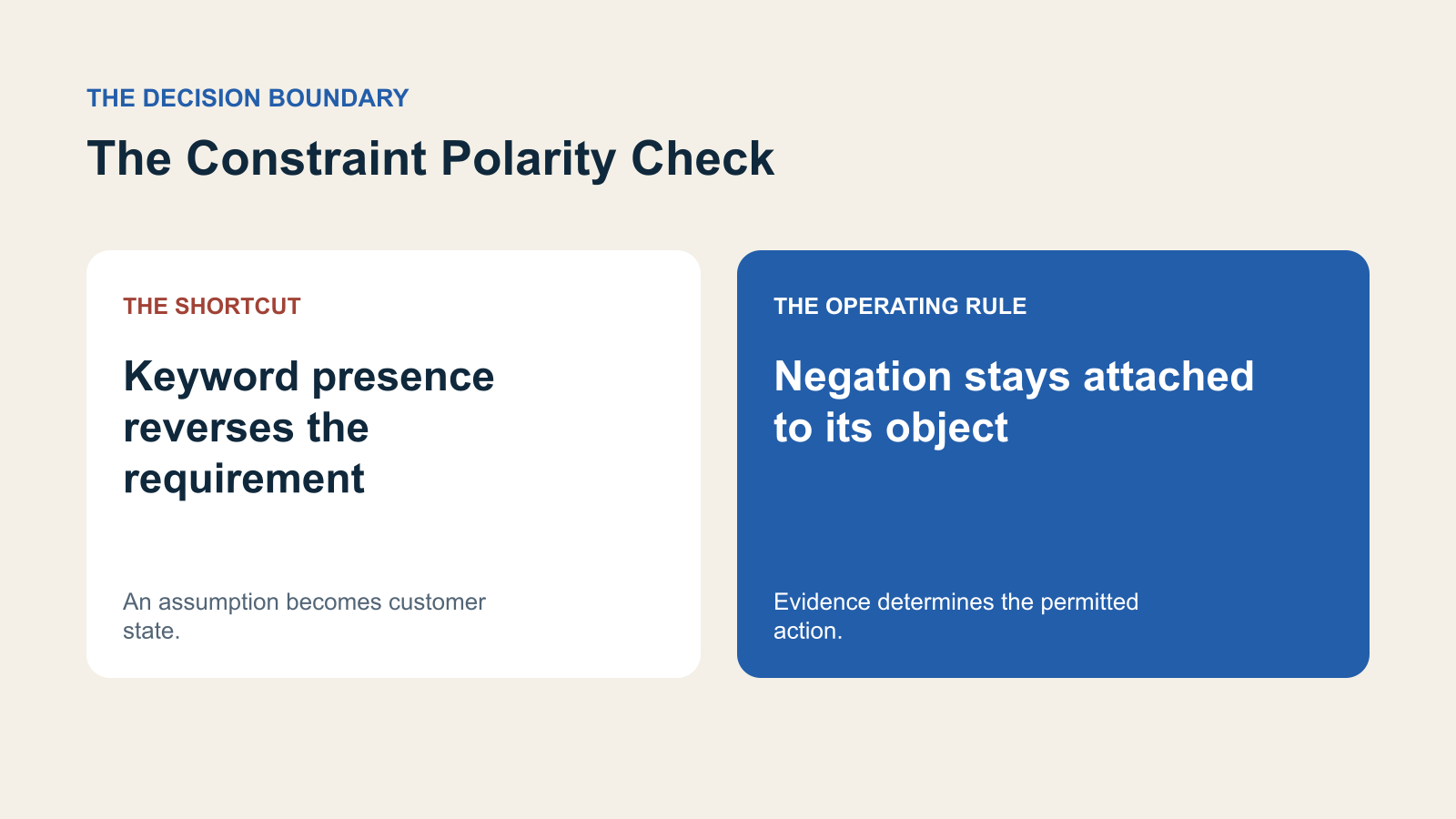
The Constraint Polarity Check: the wrong shortcut and the evidence-based decision.
The working record behind The Constraint Polarity Check
The record needs enough structure for another owner to verify the interpretation. For this journey, preserve four parts together rather than scattering them across a transcript, a note, and an action queue. Each part below has a different operating purpose. A populated field is useful only if the next owner can tell what it refers to and whether it is current.
Target object and polarity
Keep the negative or qualifying expression attached to its object. Mentioning an under-construction property does not establish that it is wanted.
Constraint type: ceiling, floor, exclusion, exception
Represent whether a number is a ceiling, floor, boundary, or target. Similar values can permit very different recommendations and follow-up actions.
Scope, journey, and supporting statement
Preserve exception scope. A condition accepted for an investment search should not silently remove a constraint from the buyer's separate residential requirement.
Confirmed interpretation and permitted action
Confirm the practical interpretation when consequence is high. A short read-back should verify the allowed options rather than recite technical language labels.
Evaluate exclusions as carefully as preferences
Store ready-to-move as a requirement, exclude under-construction options, and represent August as the earliest move period subject to clarification. Before scheduling anything, ask which date within the acceptable range works. If the customer later says under-construction is acceptable only for investment, attach that exception to the investment journey rather than removing the original residential constraint.
A suitable clarification or acknowledgment in this illustrative scenario is: “To confirm, you want ready-to-move options and no move before August?” The wording is an example to adapt to the approved customer process, not a universal script. Its purpose is to make the next decision clear without claiming that an unverified action has already completed.
A read-back should use the customer’s decision language. “So we should exclude under-construction options” is more useful than asking whether a negative polarity label is correct. It gives the customer a chance to correct the practical interpretation. Avoid repeating every clause if only one affects the next action. A focused clarification also reduces the risk that the customer says yes to the general summary while missing the one incorrect constraint buried inside it.
The Constraint Polarity Check
Keyword presence reverses the requirement. Negation stays attached to its object.
The boundary cases that change the correct action
Negatives can be nested, idiomatic, or corrected mid-sentence. “I wouldn’t say no to that” may be tentative interest, not a refusal. If the interpretation changes a consequential action, a short read-back is useful. The assistant should confirm the constraint rather than forcing the customer through a grammar test.
Build a review set from real exclusions, ceilings, date boundaries, and exceptions. Evaluate the structured result and its resulting action, not just the transcript. Keep exclusions visible in the owner brief. A search recommendation should explain why it respects the constraint, particularly when an exception has been approved.
Deploy the operating rule alongside the assistant. Staff need to know which facts they can correct, which decisions require approval, and how an unresolved case returns to a person. Make that return path visible in the same customer record. Avoid a parallel spreadsheet of exceptions that leaves the next advisor unaware of the actual state.
How to test The Constraint Polarity Check before expanding it
Test the complete journey rather than a single response. A correct sentence can still trigger the wrong task, and a corrected CRM field can coexist with an outdated outbound message. Review the original evidence, the resulting record, and the action received by the next owner together.
- Not above 80 is interpreted as a ceiling, not a target price.
- Not before August becomes a date boundary, not a booked visit.
- A conditional exception applies only to its stated journey.
Include exceptions and idioms in review, not only straightforward negatives. Test “not only,” “no later than,” “wouldn’t rule out,” and a mid-sentence correction. Ask reviewers to produce the allowed set of options and compare the assistant’s recommendations against it. A transcript can preserve every word while a downstream filter still inverts the meaning. The qualification test must therefore inspect the actual options proposed to the customer.
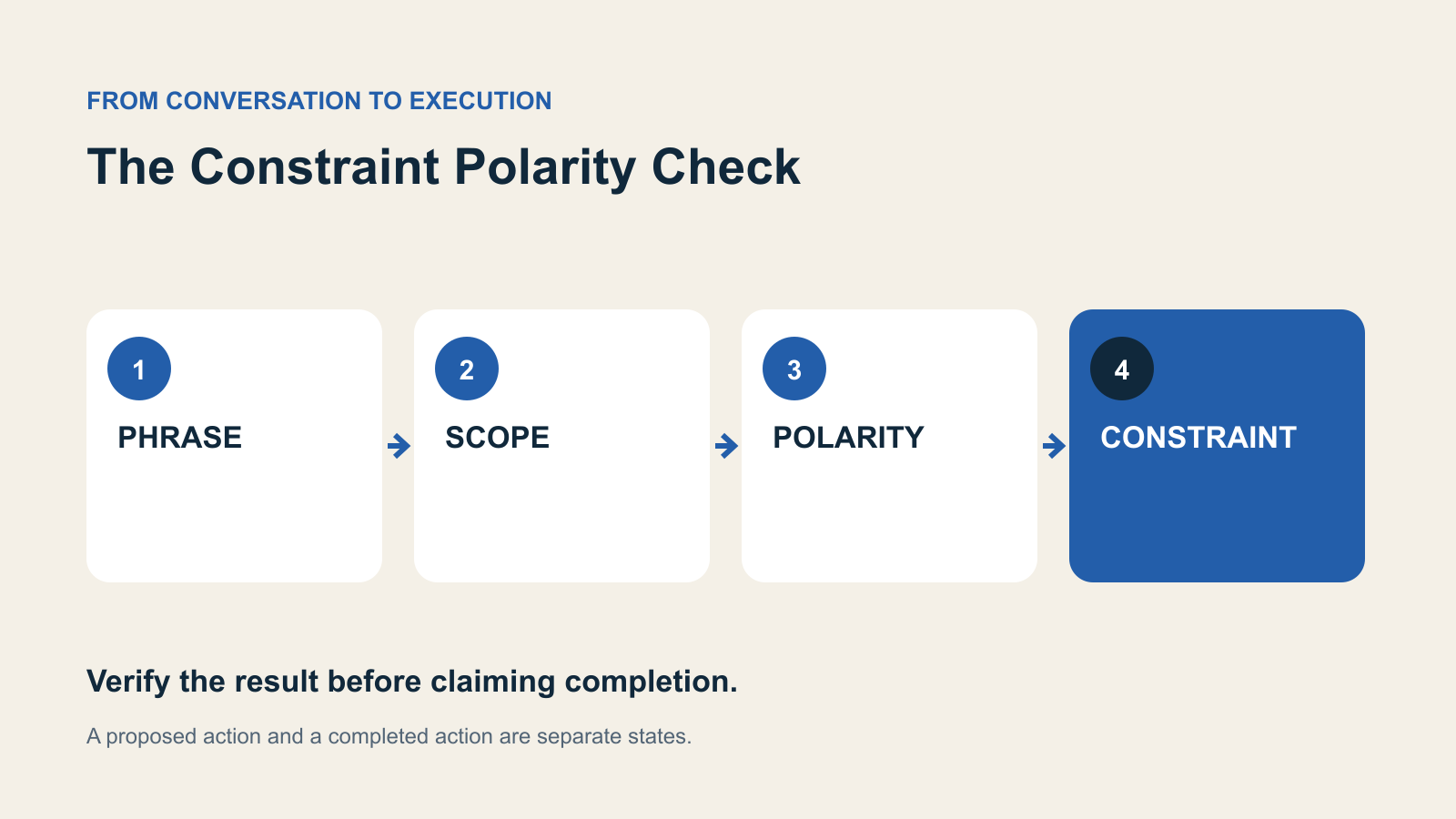
PHRASE → SCOPE → POLARITY → CONSTRAINT: review the state transition, not just the response.
Measure decision accuracy alongside customer effort
Track inverted preferences, excluded options recommended, and dates treated as commitments when they were boundaries. Include positive, negative, and qualified statements in the same evaluation set. A system tested only on “I want X” will hide this failure class.
Use an explicitly illustrative audit to make the denominator clear. Suppose reviewers inspect 40 cases that genuinely require The Constraint Polarity Check, and find 6 unsupported actions. That is 6 divided by 40, or 15% in that sample. It is not a market benchmark or an expected result. Counting 200 unrelated greetings alongside those cases would hide the failure without fixing it. Keep the relevant case count, error count, review rules, and uncertainty visible when reporting the result.
Also inspect the opposite failure: an unnecessary hold when the evidence was already sufficient. Reviewers should distinguish a justified clarification from an avoidable repeat question. An appropriate human review is different from a case abandoned without an owner. Pair the action error rate with customer effort and completion evidence so the team cannot improve one dashboard by moving the cost to the customer or another department.
Connect The Constraint Polarity Check with the rest of customer operations
Brixi connects conversation analysis with CRM, buyer intent, AI assistants, voice, WhatsApp, workflows, and human teams. Analysis therefore has an operating destination: a corrected record, a prepared owner, a relevant next action, or a clearly held decision. Teams can use the same customer history to review what was interpreted and whether the resulting work advanced the journey.
For this use case, make the implementation review concrete: ask the Brixi team to walk through the original evidence, the current CRM state, the permitted action, and recovery when that action cannot complete. Validate any required source system, permission rule, and approval path during configuration. The recommended operating design in this article should be demonstrated against the actual deployment rather than assumed from a generic AI feature label.
For the wider operating model, read the conversation analysis guide. The important connection is between interpretation and accountable execution: the same evidence should prepare the assistant, the responsible human, and the next workflow.
What to inspect after the first quarter
At the first monthly review, look for the failure that has moved elsewhere. A cleaner conversation can still leave a stale task or an unowned approval. During the following reviews, sample complete journeys from original evidence to customer-visible outcome. Expand the scope only when the team can explain the remaining exceptions and the responsible owner can recover them without reconstructing the entire thread.
The deeper bet behind The Constraint Polarity Check
AI qualification will become more valuable as it preserves the shape of customer constraints. Useful personalization includes what the customer has ruled out, what they allow conditionally, and where they have not decided. Accuracy lives in those small words that ordinary summaries often drop.
Put The Constraint Polarity Check into a connected customer workflow
Explore how Brixi connects conversation intelligence, CRM, AI assistants, conversations, workflows, and human teams around a reliable next action.