Reading Buyer Intent Signals in WhatsApp Conversations
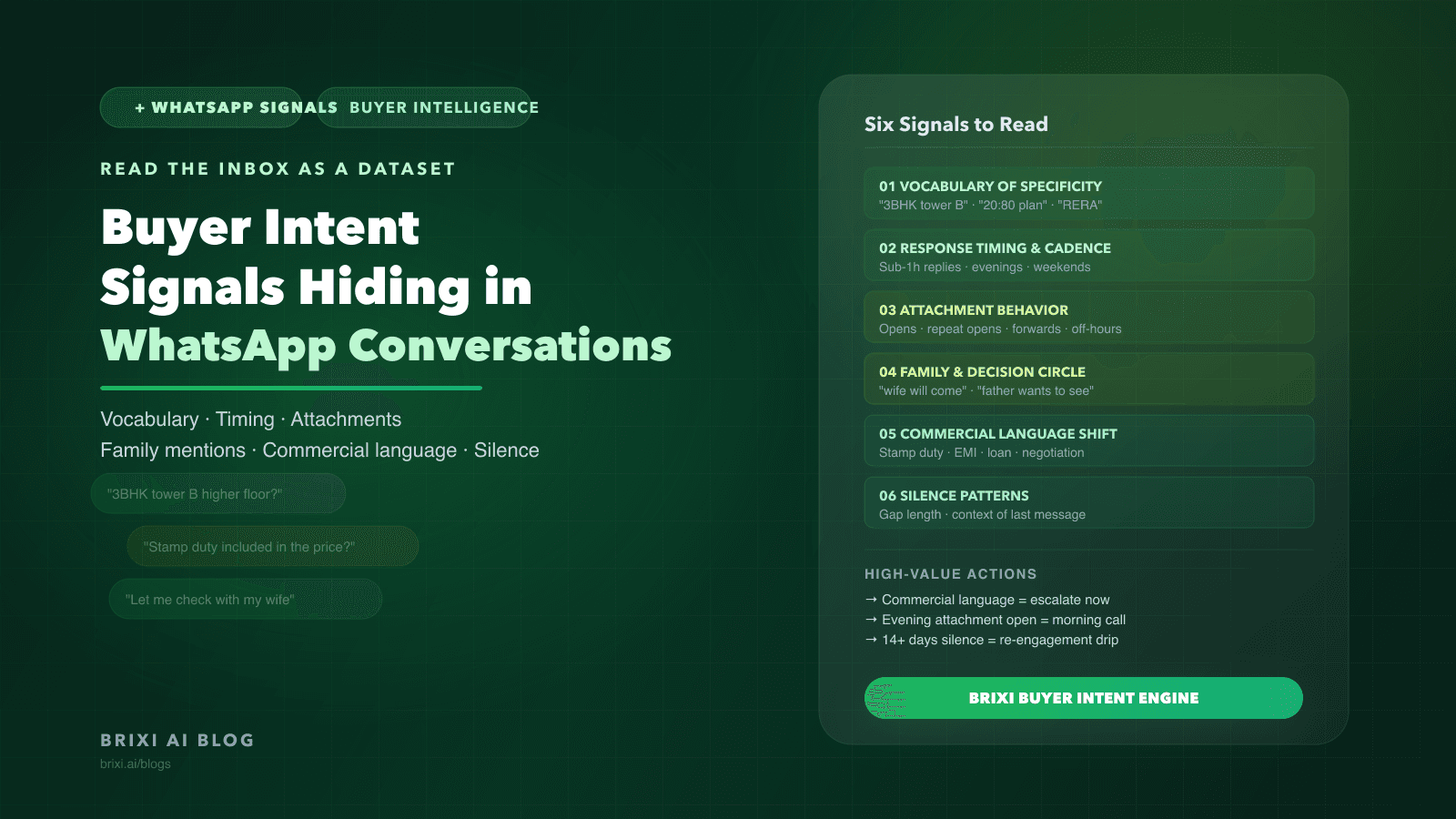
Every real estate sales team is sitting on a rich dataset of buyer intent inside WhatsApp threads. The rep who can read the signals: vocabulary shifts, response cadence, attachment behavior, family mentions, commercial language, closes at a meaningfully higher rate. Here is how to specify those signals, score them, and wire them into your pipeline.
Kunal manages a fourteen-person sales team at a residential developer in Visakhapatnam. One morning he sat down with his top closer and asked her how she decided which WhatsApp leads to call first. She pulled up her phone and pointed at a thread. "This one asked about the 3BHK corner unit on a higher floor, sent me back a question about subvention fifteen minutes after I shared the brochure, and then yesterday evening asked whether the possession date could move." She called that lead before lunch. It booked by 5 PM.
Her junior colleague had that same thread in his queue. He had not called it because it was only eight days old and the buyer had not explicitly asked for a site visit. Same WhatsApp thread, same buyer, two completely different reads. The difference was not personality or charm. It was signal literacy.
This post is about making that signal literacy explicit, transferable, and ultimately automatable. WhatsApp is not just a messaging channel for Indian real estate sales teams. It is the primary record of every buyer interaction, and it contains far more structure than most teams extract from it.
Why does WhatsApp carry more intent data than a CRM note?
A CRM note is what a rep remembers to type after a call. WhatsApp is a verbatim record of what a buyer actually said, when they said it, and how quickly they responded. The buyer did not rehearse the WhatsApp message. The vocabulary they chose, the hour they sent it, the way they followed up on an attachment they received three days ago: all of it is behavioral data. CRM notes compress that data into summary language that loses the signal.
The contrarian claim worth making here: most teams are actually drowning in buyer intent signals and are not using them, while simultaneously paying for lead generation to send more leads into the top of the funnel. The bottleneck is not lead volume. It is signal extraction from the conversations already in progress.
What is the Conversation Pressure Score and why does it matter?
The concept that ties these individual signals together is what we call the Conversation Pressure Score. Not a generic lead score built from form fills and ad clicks. A score built specifically from the texture of the WhatsApp thread itself: the vocabulary the buyer uses, the timing of their replies, the way they engage with materials you send, and the explicit language they shift into as their intent sharpens.
Pressure is the right word because intent in a WhatsApp conversation is cumulative. One fast reply means nothing. One commercial question means little. But sustained responsiveness combined with vocabulary specificity combined with a payment plan question at 9 PM is a coherent pattern that says: this buyer is actively evaluating and moving toward a decision. The Conversation Pressure Score captures that accumulation and makes it visible to every rep, not just the experienced ones.
What does vocabulary specificity signal about real estate buyers?
Casual browsers ask generic questions. "What are the options available?" or "can I know the pricing?" Serious buyers ask with parameters. "What is the current price for a 3BHK in tower B, east-facing, floors ten and above?" The specificity tells you that homework has been done. The buyer has read something, compared something, or talked to someone, and now they are drilling down.
In deployments we see, buyers who use three or more specific parameters in a single WhatsApp thread (unit type, tower or wing, floor preference, view orientation, payment plan variant, RERA or OC status) are deep in the evaluation funnel even if they have not asked for a site visit. A keyword watcher on the thread can flag these automatically.
- Unit and configuration: "3BHK corner unit," "4BHK duplex," "ground-floor with private garden."
- Tower or wing specifics: "tower C," "south block," "A wing facing the lake."
- Floor or view preference: "above the tenth floor," "pool-facing," "away from the main road."
- Payment plan terms: "subvention scheme," "20:80 plan," "construction-linked."
- Regulatory markers: "RERA number," "OC received," "CC approved."
- Timeline anchors: "before school admissions," "possession by March," "registering before year-end."
How does response timing reveal where a buyer actually stands?
Response speed is noisy on its own. A buyer might reply instantly to one message and then disappear for a week. The signal is in the pattern, not the single event. Sustained sub-hour response across five or more exchanges over three or more days is a strong indicator of active evaluation. It means the buyer is keeping the conversation alive, not just reacting to a prompt.
Evening and weekend replies carry additional weight in real estate because home purchase decisions are almost always family decisions. A buyer messaging at 9 PM on a Saturday has probably just had a family conversation about the project. That timing is itself an intent marker and a routing signal: if you can get a call in the next morning, you are entering a warm moment.
- Sustained replies under one hour across multiple days: strong positive, move to top of call queue.
- Evening and weekend replies: strong positive, suggests active family discussion.
- Fast reply after a multi-day gap: moderate positive, worth an immediate outbound call.
- Delayed reply with a detailed question: moderate-to-strong positive, buyer was researching in the interval.
- One-word replies with long pauses between them: weak signal, low engagement depth.
- No inbound messages for fourteen or more days: negative signal, enter re-engagement sequence.
What does attachment behavior tell you that a message never will?
A brochure forwarded as a raw PDF tells you almost nothing after delivery. A microsite link or a tracked document delivered through the WhatsApp Business API tells you when the buyer opened it, whether they came back to it, and at what hour. That behavioral data is often more honest than anything a buyer will say in a message.
Most teams find that attachment open behavior splits cleanly into three groups. Buyers who never open any material are rarely serious evaluators. Buyers who open once and quickly are in early exploration. Buyers who re-open a payment plan or floor plan document two or three times over several days are doing genuine due diligence. The re-open event on a pricing or payment plan document is among the highest-confidence Conversation Pressure Score inputs available.
- Never opened: low engagement, do not allocate senior rep time.
- Opened once, quickly: early exploration, maintain nurture cadence.
- Re-opened same document multiple times: deep evaluation, escalate immediately.
- Opened during evening or weekend hours: family review underway, call the next morning.
- Followed by a WhatsApp question about the document: near-commit signal, same-day call required.
How do family mentions change the entire scoring picture?
Real estate is almost never a solo decision. When a buyer mentions someone else in a WhatsApp thread, the nature of that mention tells you exactly where they are in the decision process and what kind of conversation you should be preparing for.
The most important distinction is between a buyer who mentions a family member generically ("my wife wants to see it") versus one who mentions them by role in a financial context ("my father will co-sign, he wants to review the payment plan"). The second mention signals that the buyer is past emotional consideration and into logistics. Kunal’s closer caught this pattern immediately in the thread she showed him that morning.
- "My wife or husband wants to see the kitchen": family site visit pending, schedule within 48 hours.
- "My parents are coming this weekend": multi-person visit confirmed, flag for senior rep.
- "My CA is reviewing the payment schedule": commercial due diligence active, very strong positive.
- "My builder friend said the OC is delayed for projects like this": external skepticism introduced, address directly.
- No mentions of anyone else across multiple messages: decision process is unclear, worth asking about.
The anti-pattern that kills conversions
The most common mistake in WhatsApp-based sales is treating "let me check with my wife" as a delay or objection. In most Indian real estate contexts it is a positive signal. The buyer has moved from solo evaluation to family consensus-building. The rep who responds by offering a family site visit slot converts at a significantly higher rate than the rep who just says "sure, let me know."
What does commercial language in a thread actually signal?
There is a clean progression in how buyers talk across a long WhatsApp conversation. Early messages are about the product: how many bedrooms, which floor, what amenities. Later messages shift to terms: stamp duty, GST, loan eligibility, token amount, registration process. This vocabulary shift from product to transaction is one of the most reliable late-funnel signals in any real estate pipeline.
The practical implication is routing. A buyer asking about stamp duty calculation or pre-approval eligibility is no longer in qualification. They are in closing. Keeping them in a junior rep’s queue at this stage is where deals are lost. The commercial language shift should trigger an automatic escalation in the Conversation Pressure Score and a same-day senior rep assignment.
- Stamp duty and registration charges: commercial due diligence started, escalate.
- Loan eligibility or EMI calculation: financing work underway, escalate.
- Negotiation language ("is this your best offer," "can you adjust the price"): near-close, senior rep now.
- Booking mechanics ("what is the token amount," "how does the agreement work"): commit phase, senior rep and same-day call.
- Possession flexibility questions ("what if I need to move in by X"): planning for real, very strong positive.
What does silence in a thread actually mean?
Silence is not a neutral state. The context of the silence tells you what kind of re-engagement to run and how urgently. A buyer who went quiet immediately after receiving the payment plan is almost certainly reviewing it with someone. A buyer who went quiet after a site visit with no agreed-upon next step is likely evaluating competing projects.
- Silence after site visit with no next step agreed: evaluating competitors, run a differentiated re-engagement message within five days.
- Silence after payment plan sent: family or CA review underway, wait three to five days before following up.
- Silence broken by a pricing question: commercial evaluation continued independently, treat as hot lead.
- Silence broken by a timeline question: personal circumstances have shifted, high re-engagement priority.
- No inbound activity for fourteen or more days: reduce Conversation Pressure Score, enter re-engagement sequence.
What changes for the team after a quarter of scoring WhatsApp intent?
The first visible change is in the call queue. Instead of ordering leads by creation date or last CRM update, the queue orders by Conversation Pressure Score. The rep who starts their morning calls with the buyer who re-opened the payment plan at 9 PM last night and asked about stamp duty is having a completely different conversation from the rep who calls in creation order.
The second change is in how reps open calls. "I saw you looked at the payment plan yesterday, did you have questions on the construction-linked schedule?" lands differently than "just calling to follow up." The buyer hears that someone is paying attention. Call-answer rates improve when openers are contextual. In teams we work with, this shift in opening style typically lifts connection quality before any process change takes full effect.
The third change is in handoff quality. When a lead escalates from a junior rep to a senior closer, the receiving rep has a Conversation Pressure Score and a signal history, not just a name and a phone number. They know whether the buyer asked about financing, whether the family is involved, whether there is a competing project in the picture. That context makes the first senior rep call substantially more productive.
Is the Conversation Pressure Score actually better than a gut-read?
For a seasoned closer like the rep Kunal showed his morning data to: probably not, for her own leads. She has already internalized these signal patterns. The score is not trying to replace her judgment on her own book.
The score matters for the other twelve reps on Kunal’s team who have not built that pattern recognition yet. It matters for the manager who cannot read every thread personally. It matters for the handoff moment when context needs to transfer between reps without a thirty-minute briefing. It matters for prioritization across two hundred active leads when no human can hold that many threads in working memory.
Kunal’s deeper bet is that the score is not about replacing the best rep’s judgment. It is about giving every rep on the floor access to the pattern recognition that currently lives only in the best rep’s head. That is the real thesis behind instrumenting WhatsApp for buyer intent signals: not smarter software, but a more evenly distributed literacy across the whole team.
What would your pipeline look like if every rep read signals like your best closer?
Brixi reads the Conversation Pressure Score across every WhatsApp thread your team manages: vocabulary specificity, response cadence, attachment opens, family mentions, commercial language shifts. Every rep gets the context of your best closer without the years of floor experience.
See the Buyer Intent EngineFrequently Asked Questions
Six signal types build a consistent picture: specific vocabulary around unit type, tower, floor, and payment plan terms; sustained sub-hour response cadence across multiple days; attachment re-opens especially on pricing and payment plan documents; family or decision-circle mentions; commercial language shifts toward stamp duty, loan eligibility, or negotiation; and silence patterns after key exchanges. Any single signal is noisy. The combination of three or more in a thread is a strong predictor of near-term intent.
Native WhatsApp does not surface attachment open data beyond basic read receipts. To track opens, use the WhatsApp Business API with link-based document delivery rather than raw PDF forwards. This lets you log the first open time, repeat opens, open duration, and off-hours open events. Teams that instrument this layer have a meaningful information advantage because re-open behavior on a payment plan document is one of the highest-confidence intent signals available.
As soon as a buyer uses transaction-specific language: stamp duty, registration charges, loan eligibility, EMI calculation, token amount, or booking process questions. At that point the conversation has moved past qualification into closing. The lead should escalate to a senior rep and receive a same-day call. Leaving a buyer asking about token amounts in a junior rep’s queue is one of the most common causes of late-funnel drop-off in Indian real estate sales.
A basic keyword watcher on the conversation thread can catch vocabulary and commercial language signals manually, and a spreadsheet can track response timing patterns for a small team. The signals that are difficult to capture without tooling are attachment open behavior and the cumulative Conversation Pressure Score across a large number of simultaneous threads. For teams managing more than fifty active WhatsApp conversations, manual tracking of cadence and attachment data becomes unreliable within two to three weeks.