Positive Sentiment Is Not Purchase Intent
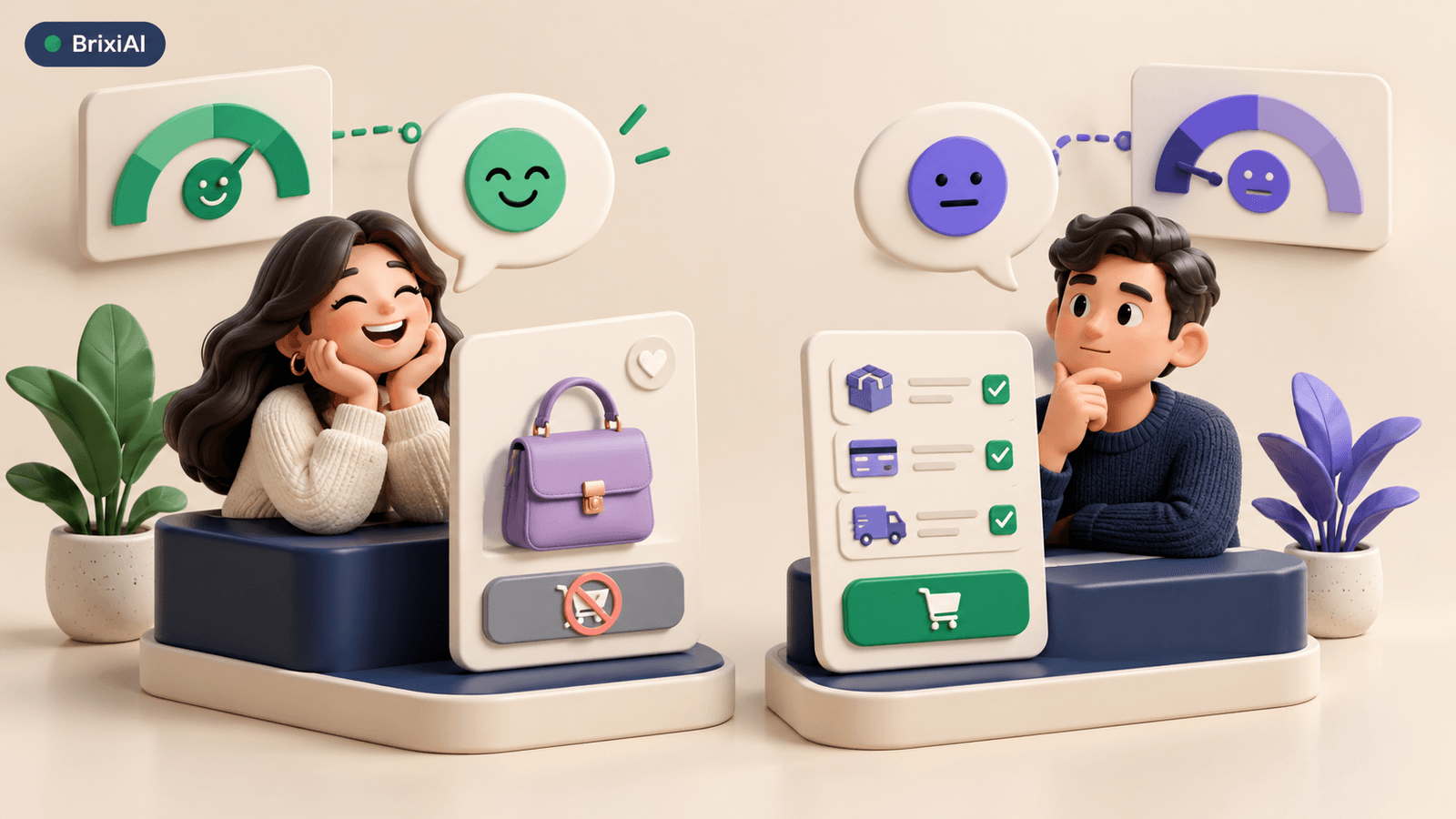
Conversation AI needs a Sentiment Intent Split. Tone describes the interaction; intent describes the customer’s purpose and readiness to act.
Imagine a prospect ending every call with “Sounds great, thanks so much.” Another speaks bluntly, asks difficult questions, and wants the exact approval process. The sentiment dashboard favors the first. The second is treated as a difficult lead. Yet only the second has described a purchase process and a next decision.
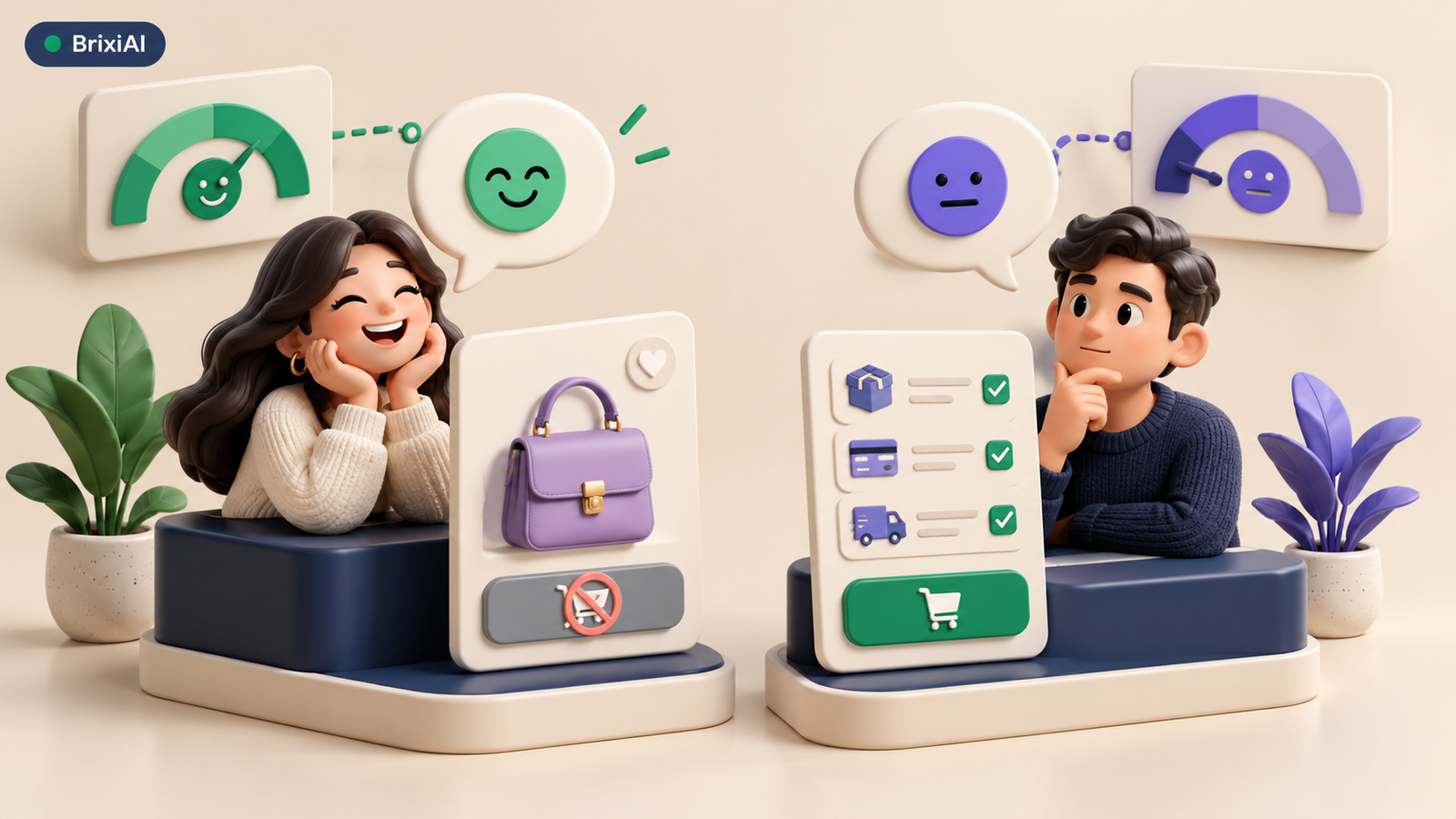
The Sentiment Intent Split keeps the customer’s meaning connected to the next action.
Conversation AI needs a Sentiment Intent Split. Tone describes the interaction; intent describes the customer’s purpose and readiness to act. They can inform each other, but a positive tone should not substitute for evidence of need, authority, conditions, or commitment.
Courtesy is easy to misread as conviction
Extract emotional tone separately from commercial evidence. A polite acknowledgment establishes courtesy, not a buying milestone. A frustrated message can contain an urgent purchase requirement. Review the decision behind the language: what is being evaluated, what blocks progress, who must agree, and which next action the customer has actually requested.
The distinction is most useful when tone and intent disagree. A polite prospect can have no current need. A frustrated buyer can be trying urgently to complete a purchase. A skeptical evaluator can be doing the serious work of checking fit. Show these as different states rather than forcing a single score to average them. The rep can then respond with empathy while preparing the correct business action, instead of using warmth as a shortcut for readiness.
Difficult questions can contain stronger commercial evidence
Tone-based prioritization rewards performative enthusiasm and penalizes direct communicators. Reps spend time on friendly but inactive prospects while a serious buyer waits for a precise answer. Managers then coach for positive sentiment even when useful conversations require honest discussion of trade-offs, limitations, and unresolved conditions.
The practical failure is specific: positive language becomes purchase readiness. The desired behavior is equally specific: emotion and commitment are reviewed separately. Use those two statements as the review boundary. A response should be judged by the state it leaves behind, not only by whether its wording sounds helpful.
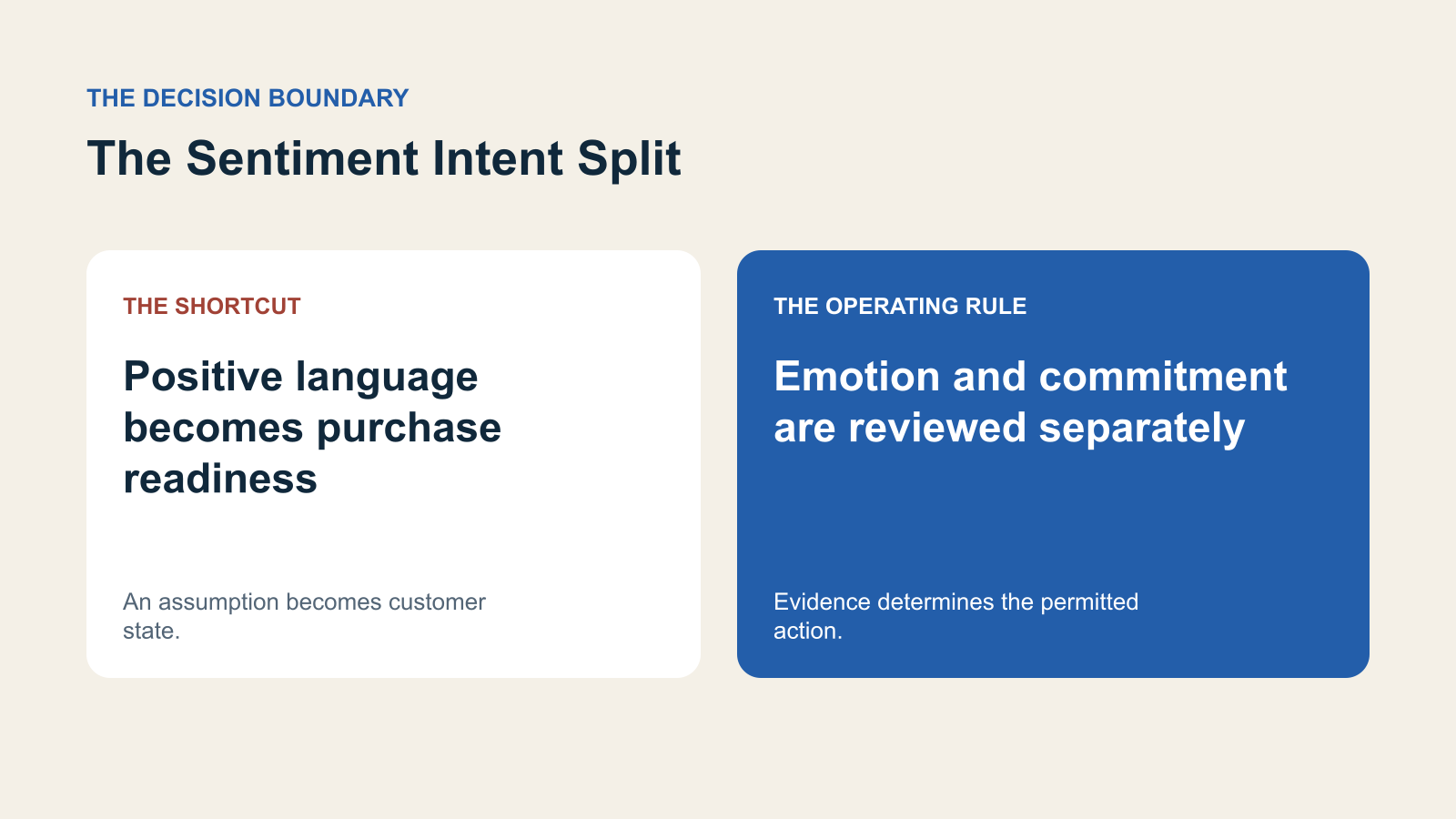
The Sentiment Intent Split: the wrong shortcut and the evidence-based decision.
The working record behind The Sentiment Intent Split
The record needs enough structure for another owner to verify the interpretation. For this journey, preserve four parts together rather than scattering them across a transcript, a note, and an action queue. Each part below has a different operating purpose. A populated field is useful only if the next owner can tell what it refers to and whether it is current.
Interaction tone and emotional cues
Use tone to shape respectful communication. It can signal a relationship concern without establishing purchase readiness or a commercial milestone.
Explicit purpose and decision conditions
Identify the customer's purpose and conditions independently. Strong product evaluation can coexist with skepticism, frustration, or a direct communication style.
Evidence of next-step commitment
Look for the actual requested next step. Courtesy and thanks alone should not become evidence of a buying decision or accepted appointment.
Relationship concern and separate commercial action
Keep service risk and commercial action separate but connected. An explicit dependency matters more than an assumed relationship between negative sentiment and lost intent.
Use tone to shape the response, not replace the decision model
For the friendly prospect, retain a positive interaction label and an unconfirmed buying timeline. For the blunt prospect, capture the requested approval information and the evidence of an active evaluation. Prepare the owner to answer the difficult questions. Neither label should imply that rudeness is valuable or that warmth is meaningless; they simply describe different dimensions.
A suitable clarification or acknowledgment in this illustrative scenario is: “What decision are you trying to make next?” The wording is an example to adapt to the approved customer process, not a universal script. Its purpose is to make the next decision clear without claiming that an unverified action has already completed.
Keep coaching aligned with this separation. If managers reward only positive sentiment, reps may avoid discussing constraints or asking a necessary difficult question. A conversation can become less cheerful while becoming more useful. Review whether the rep clarified a real decision, answered the concern accurately, and agreed a justified next step. The aim is respectful progress. It is not producing a transcript that sounds optimistic when the underlying purchase remains undefined.
The Sentiment Intent Split
Positive language becomes purchase readiness. Emotion and commitment are reviewed separately.
The boundary cases that change the correct action
Negative sentiment can indicate genuine relationship risk and should not be ignored. The point is to avoid turning emotion into a universal readiness score. Regional communication styles, language proficiency, and individual habits can change tone. Do not infer personal traits or demographic characteristics from those differences.
Review a mixed set of friendly non-buyers and demanding buyers. Label tone and action evidence independently before combining anything into an operating view. Ask sales owners which signals would justify a specific next step. Keep the underlying evidence available so the team can disagree with an interpretation without losing the customer’s words.
Deploy the operating rule alongside the assistant. Staff need to know which facts they can correct, which decisions require approval, and how an unresolved case returns to a person. Make that return path visible in the same customer record. Avoid a parallel spreadsheet of exceptions that leaves the next advisor unaware of the actual state.
How to test The Sentiment Intent Split before expanding it
Test the complete journey rather than a single response. A correct sentence can still trigger the wrong task, and a corrected CRM field can coexist with an outdated outbound message. Review the original evidence, the resulting record, and the action received by the next owner together.
- A warm acknowledgment appears without a next step; readiness stays unconfirmed.
- An annoyed buyer requests purchase documents; the action is not ignored because of tone.
- A negative service experience affects buying; the explicit dependency is recorded.
Create evaluation pairs with similar wording but different action evidence. One customer says “great” and leaves no next step; another says “great” and requests the approved agreement. One customer sounds annoyed about repeated calls; another sounds annoyed because the payment link failed while they were trying to proceed. Review the action chosen for each. This tests whether the system reads purpose rather than decorating a tone label with commercial language.
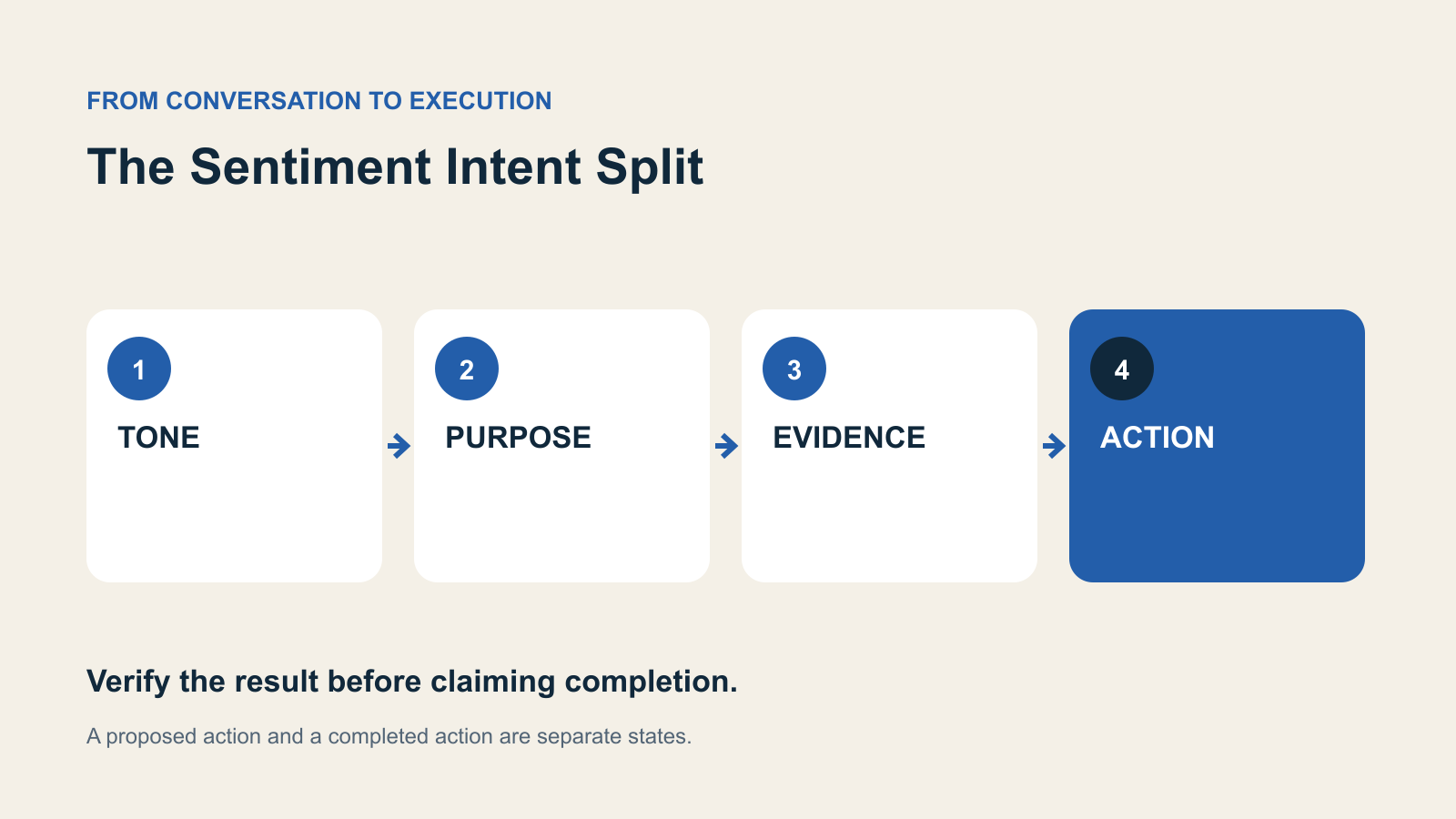
TONE → PURPOSE → EVIDENCE → ACTION: review the state transition, not just the response.
Measure decision accuracy alongside customer effort
Track false high-intent classifications caused by courtesy, serious opportunities deprioritized because of tone, and next actions supported by explicit evidence. Compare categories within the same journey and source. A sentiment distribution alone cannot establish improved qualification.
Use an explicitly illustrative audit to make the denominator clear. Suppose reviewers inspect 40 cases that genuinely require The Sentiment Intent Split, and find 6 unsupported actions. That is 6 divided by 40, or 15% in that sample. It is not a market benchmark or an expected result. Counting 200 unrelated greetings alongside those cases would hide the failure without fixing it. Keep the relevant case count, error count, review rules, and uncertainty visible when reporting the result.
Also inspect the opposite failure: an unnecessary hold when the evidence was already sufficient. Reviewers should distinguish a justified clarification from an avoidable repeat question. An appropriate human review is different from a case abandoned without an owner. Pair the action error rate with customer effort and completion evidence so the team cannot improve one dashboard by moving the cost to the customer or another department.
Connect The Sentiment Intent Split with the rest of customer operations
Brixi connects conversation analysis with CRM, buyer intent, AI assistants, voice, WhatsApp, workflows, and human teams. Analysis therefore has an operating destination: a corrected record, a prepared owner, a relevant next action, or a clearly held decision. Teams can use the same customer history to review what was interpreted and whether the resulting work advanced the journey.
For this use case, make the implementation review concrete: ask the Brixi team to walk through the original evidence, the current CRM state, the permitted action, and recovery when that action cannot complete. Validate any required source system, permission rule, and approval path during configuration. The recommended operating design in this article should be demonstrated against the actual deployment rather than assumed from a generic AI feature label.
For the wider operating model, read the conversation analysis guide. The important connection is between interpretation and accountable execution: the same evidence should prepare the assistant, the responsible human, and the next workflow.
What to inspect after the first quarter
At the first monthly review, look for the failure that has moved elsewhere. A cleaner conversation can still leave a stale task or an unowned approval. During the following reviews, sample complete journeys from original evidence to customer-visible outcome. Expand the scope only when the team can explain the remaining exceptions and the responsible owner can recover them without reconstructing the entire thread.
The deeper bet behind The Sentiment Intent Split
Customer intelligence should help teams understand decisions rather than reward conversational pleasantness. Separating emotion from intention creates space for both empathy and commercial judgment. The assistant can respond respectfully while the platform allocates work according to what the customer is actually trying to do.
Put The Sentiment Intent Split into a connected customer workflow
Explore how Brixi connects conversation intelligence, CRM, AI assistants, conversations, workflows, and human teams around a reliable next action.