Repeat Contacts Can Signal an Unresolved Problem, Not Stronger Engagement
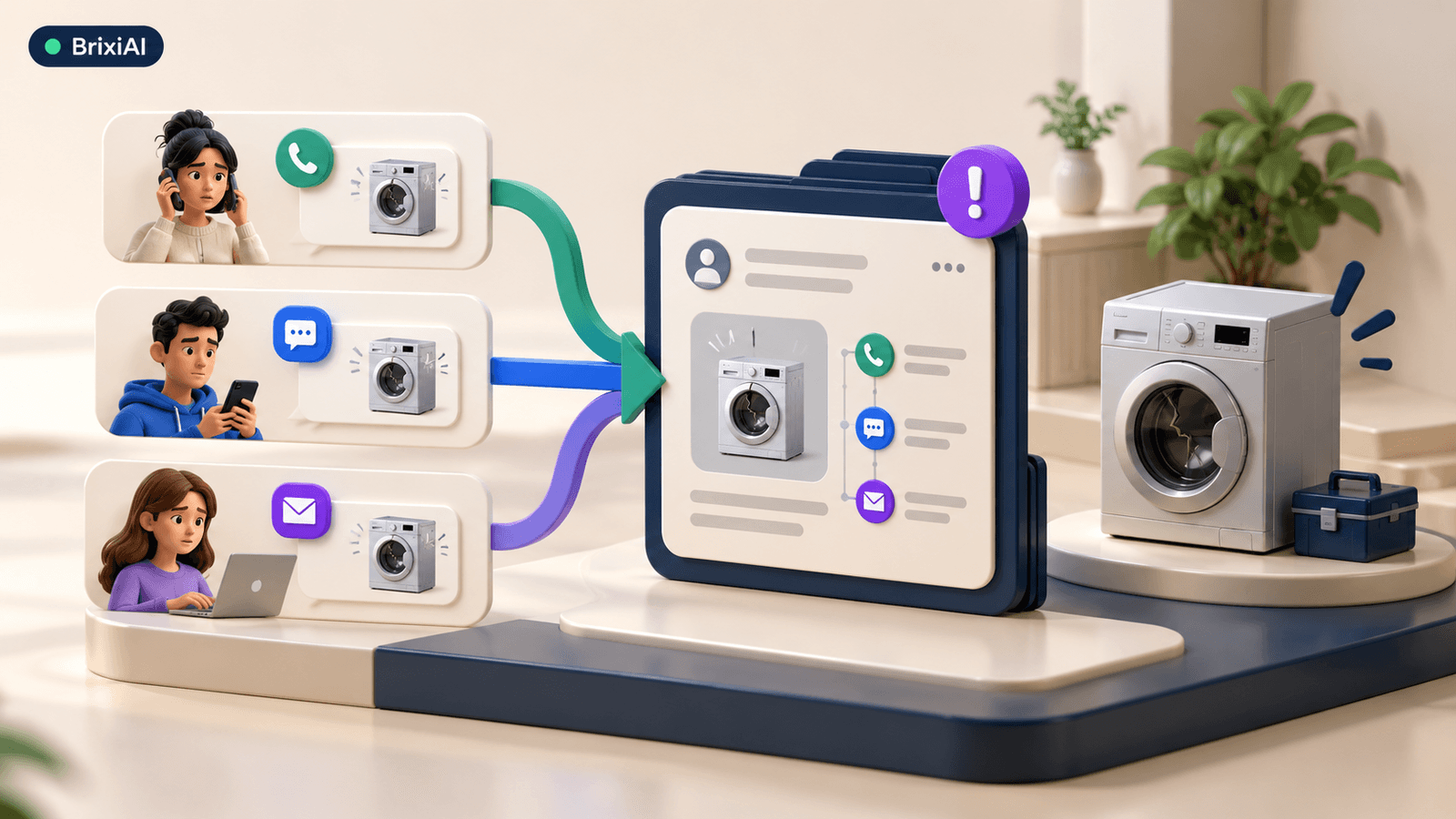
Conversation intelligence should detect the Repeat-Intent Loop: the same unresolved purpose returning across messages or channels. Contact frequency can signal friction rather than enthusiasm.
Consider a customer sending six messages about the same missing invoice. Engagement rises, response time looks excellent, and every acknowledgment is counted as a handled conversation. The customer is not becoming more interested in the brand. They are doing unpaid coordination work because the original request never reached completion.
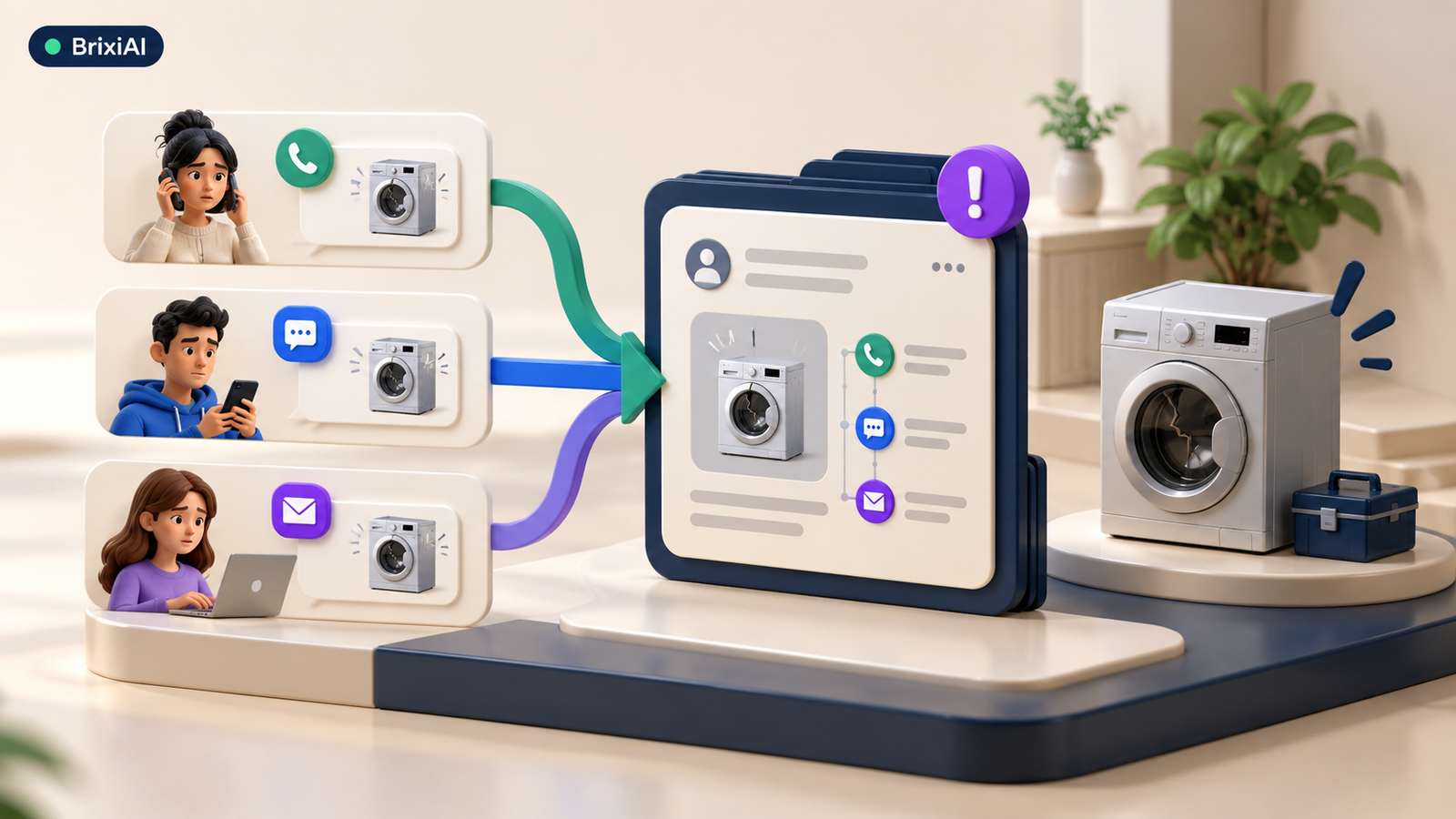
The Repeat-Intent Loop keeps the customer’s meaning connected to the next action.
Conversation intelligence should detect the Repeat-Intent Loop: the same unresolved purpose returning across messages or channels. Contact frequency can signal friction rather than enthusiasm. Interpretation must connect repeated expressions to the underlying request and inspect whether the requested outcome changed.
High engagement can be expensive customer effort
Compare the meaning, business object, and expected outcome of each contact. Link paraphrases to the existing case instead of creating a fresh apparent success. Distinguish repetition caused by a missing answer, failed action, unclear update, or changed requirement. The customer’s wording may change while the underlying obligation remains identical.
Repeated intent needs a customer-visible object. Two contacts about invoice 104 belong together; a later question about invoice 105 may be a separate need. Match purpose and object before deciding that the customer is repeating themselves. Preserve the original request and the promised outcome so a reviewer can see what completion would mean. A generic category such as billing is too broad to establish that several messages concern the same unresolved obligation.
Count underlying purposes before counting successes
Repeated contacts consume staff capacity and distort performance reporting. A team may appear productive because it closes several acknowledgments for one unresolved problem. Marketing may even classify the customer as highly engaged and send an offer. The customer receives more communication while the original work continues to wait.
The practical failure is specific: repeated requests inflate engagement and closure. The desired behavior is equally specific: one underlying problem receives one resolution path. Use those two statements as the review boundary. A response should be judged by the state it leaves behind, not only by whether its wording sounds helpful.
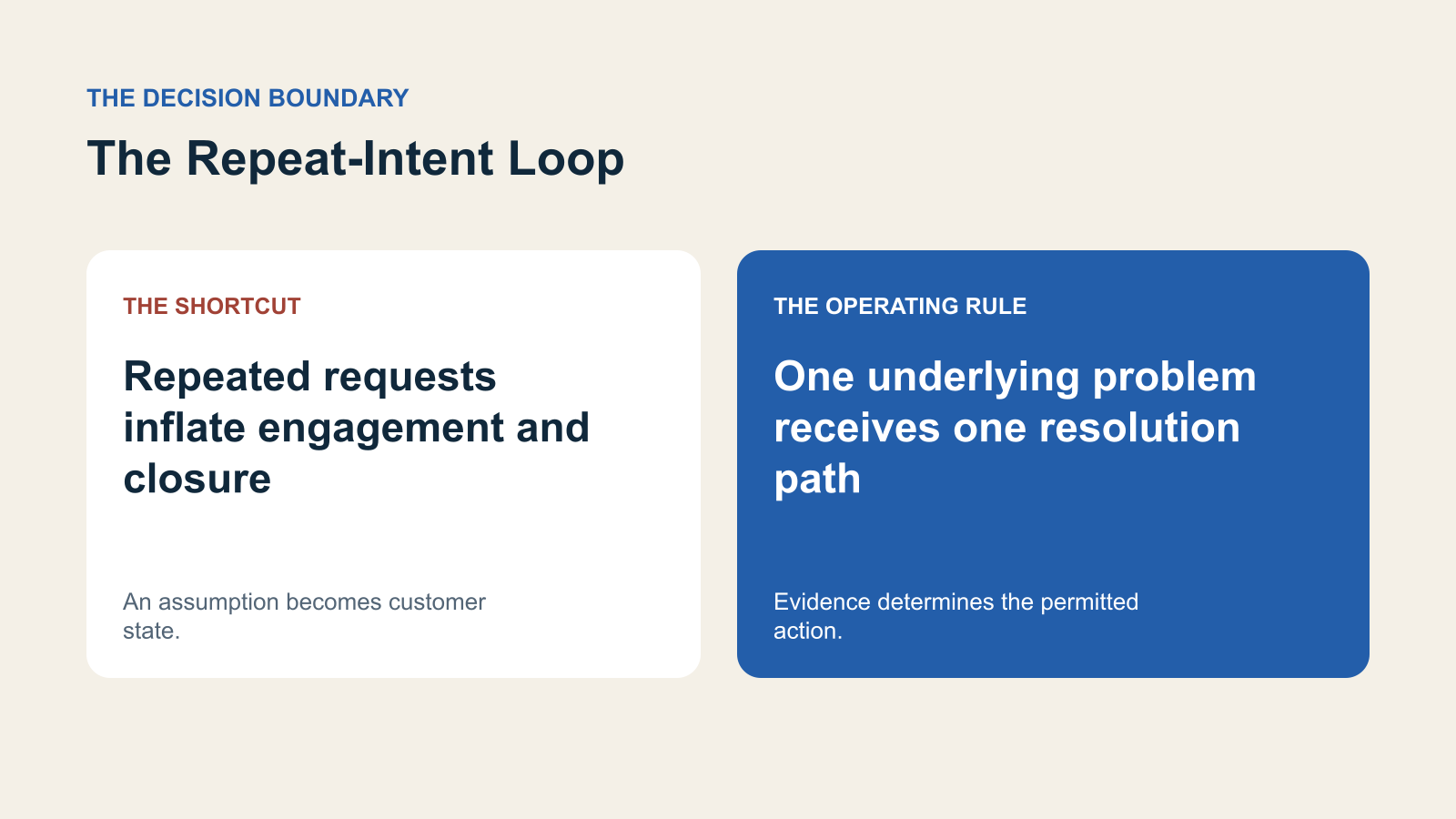
The Repeat-Intent Loop: the wrong shortcut and the evidence-based decision.
The working record behind The Repeat-Intent Loop
The record needs enough structure for another owner to verify the interpretation. For this journey, preserve four parts together rather than scattering them across a transcript, a note, and an action queue. Each part below has a different operating purpose. A populated field is useful only if the next owner can tell what it refers to and whether it is current.
Underlying purpose and business object
Match the business object as well as the general topic. Repeated requests for the same invoice differ from questions about a new one.
Linked contacts, channels, and prior promises
Link previous promises and channels to the same purpose. The customer should not restart the case every time they call instead of messaging.
Current blocker and accountable owner
Show the current blocker and accountable owner. More acknowledgments cannot compensate for an unresolved dependency that never reaches the responsible team.
Customer-visible completion evidence
Require customer-relevant completion evidence. A generated document sent to the wrong destination can leave the original request unresolved despite an internal success label.
Recovery should fix the obligation behind the messages
Link all invoice requests to the same obligation. Show the owner what was promised, which action failed, and what the customer has already been told. Send a meaningful update only when it adds a verified state or a concrete next step. Keep the case open until the correct invoice is available through the agreed channel.
A suitable clarification or acknowledgment in this illustrative scenario is: “You have asked for this invoice already; here is the current verified status.” The wording is an example to adapt to the approved customer process, not a universal script. Its purpose is to make the next decision clear without claiming that an unverified action has already completed.
Recovery should acknowledge the repetition without making another unsupported promise. State what is currently verified, identify the responsible team, and give the update path the business can honor. Avoid asking the customer to submit the same information unless a specific item is genuinely missing or invalid. If the underlying process cannot resolve the request yet, the platform should make that limitation visible internally instead of hiding it behind a series of cheerful acknowledgments.
The Repeat-Intent Loop
Repeated requests inflate engagement and closure. One underlying problem receives one resolution path.
The boundary cases that change the correct action
A repeat mention is not always a repeat failure. Customers may ask about a new invoice, a changed order, or a different household member’s case. Resolve the business object before merging contacts. Likewise, a customer asking for a status update before an agreed deadline may need reassurance rather than a new escalation.
Audit a set of high-contact customers and group their messages by underlying purpose. Identify where internal closure differs from customer completion. Make repeat-intent alerts explain what persisted, not merely how many messages arrived. Give owners a recovery brief with the earlier promises and the current blocker.
Introduce the change in review mode first. The assistant prepares an interpretation and proposed next step while the existing authorized process remains in control. Collect disagreements with a reason, including cases where the reviewer lacks enough evidence to decide. Once the team can distinguish an interpretation mistake from a policy exception, expand only the narrowly defined actions that consistently produce reviewable results.
How to test The Repeat-Intent Loop before expanding it
Begin the evaluation with the business decision, not the quality of the wording. Have a reviewer inspect the original exchange and identify the action it actually permits. Then compare the assistant’s interpretation, saved record, and customer-facing message. These three outputs can disagree even when each appears reasonable in isolation.
- The same invoice is requested in different words; the existing case is reopened or updated.
- A different invoice is mentioned; it is not merged incorrectly.
- A case marked resolved receives the same request; the completion evidence is reviewed.
Inspect repeat contacts that occur after a resolution label. Some reveal a false closure; others reveal that the delivered output was inaccessible or did not address the actual need. A correctly generated invoice sent to the wrong address is not a completed customer journey. Review the completion evidence from the customer’s perspective as well as the internal system. This turns repeat-intent analysis into a diagnostic tool for execution quality.
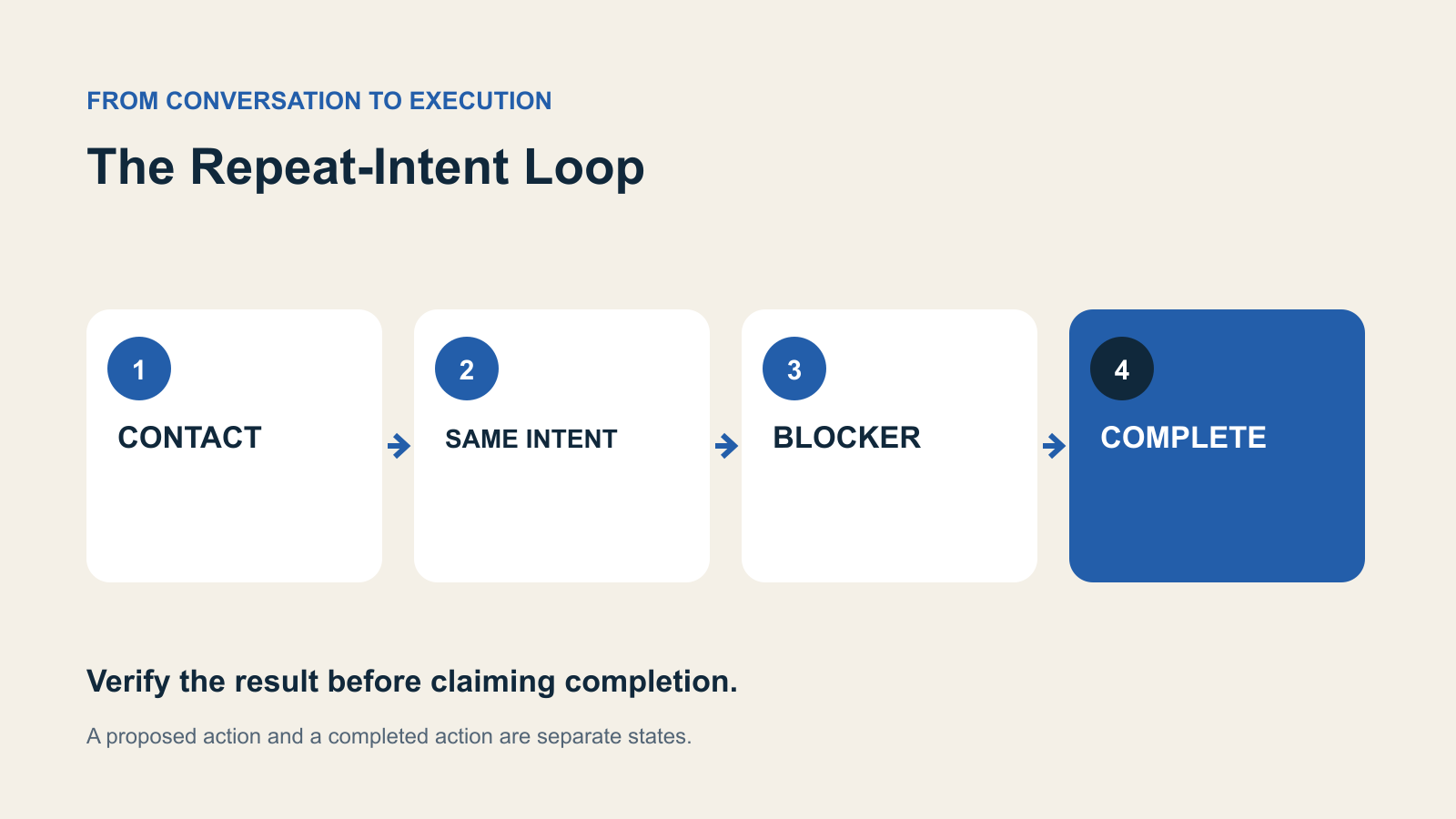
CONTACT → SAME INTENT → BLOCKER → COMPLETE: review the state transition, not just the response.
Measure decision accuracy alongside customer effort
Measure contacts per completed purpose, repeat contacts after claimed resolution, and time spent awaiting an internal dependency. Keep customer effort visible beside staff handling time. Fewer replies are useful only when the customer’s problem is actually resolved; suppressing contact does not repair the loop.
Use an explicitly illustrative audit to make the denominator clear. Suppose reviewers inspect 40 cases that genuinely require The Repeat-Intent Loop, and find 6 unsupported actions. That is 6 divided by 40, or 15% in that sample. It is not a market benchmark or an expected result. Counting 200 unrelated greetings alongside those cases would hide the failure without fixing it. Keep the relevant case count, error count, review rules, and uncertainty visible when reporting the result.
Also inspect the opposite failure: an unnecessary hold when the evidence was already sufficient. Reviewers should distinguish a justified clarification from an avoidable repeat question. An appropriate human review is different from a case abandoned without an owner. Pair the action error rate with customer effort and completion evidence so the team cannot improve one dashboard by moving the cost to the customer or another department.
Connect The Repeat-Intent Loop with the rest of customer operations
Brixi connects conversation analysis with CRM, buyer intent, AI assistants, voice, WhatsApp, workflows, and human teams. Analysis therefore has an operating destination: a corrected record, a prepared owner, a relevant next action, or a clearly held decision. Teams can use the same customer history to review what was interpreted and whether the resulting work advanced the journey.
For this use case, make the implementation review concrete: ask the Brixi team to walk through the original evidence, the current CRM state, the permitted action, and recovery when that action cannot complete. Validate any required source system, permission rule, and approval path during configuration. The recommended operating design in this article should be demonstrated against the actual deployment rather than assumed from a generic AI feature label.
For the wider operating model, read the conversation analysis guide. The important connection is between interpretation and accountable execution: the same evidence should prepare the assistant, the responsible human, and the next workflow.
What to inspect after the first quarter
At the first monthly review, look for the failure that has moved elsewhere. A cleaner conversation can still leave a stale task or an unowned approval. During the following reviews, sample complete journeys from original evidence to customer-visible outcome. Expand the scope only when the team can explain the remaining exceptions and the responsible owner can recover them without reconstructing the entire thread.
The deeper bet behind The Repeat-Intent Loop
AI can improve customer operations by identifying the work customers are forced to repeat. That changes the value of engagement data. A complete platform should use repeated intent to repair execution, not reward itself for generating more interactions around an unfinished obligation.
Put The Repeat-Intent Loop into a connected customer workflow
Explore how Brixi connects conversation intelligence, CRM, AI assistants, conversations, workflows, and human teams around a reliable next action.