“I Might Buy Next Year” Is Not a Confirmed Purchase Timeline

AI memory needs a Modality Marker that preserves whether a statement is definite, preferred, possible, conditional, or explicitly rejected. Extracting a date without its certainty changes the meaning of the conversation.
Consider a prospect discussing three possibilities: moving next year if a transfer is approved, renting nearby if it is delayed, and buying sooner if a family property sells. The AI fills the CRM purchase date with next June. Every follow-up now assumes a settled plan, even though the customer described a set of conditions.

The Modality Marker keeps the customer’s meaning connected to the next action.
AI memory needs a Modality Marker that preserves whether a statement is definite, preferred, possible, conditional, or explicitly rejected. Extracting a date without its certainty changes the meaning of the conversation. A buying timeline is a decision state, not simply the first future month mentioned.
Dates lose meaning when their qualifiers disappear
Keep the event, time expression, condition, and speaker commitment together. “I will visit in June” differs from “I could visit in June” and “June would work only after approval.” If a field cannot represent that distinction, store an unresolved timeline rather than forcing a false exact value into an automation-friendly format.
Different time expressions answer different questions. A preferred possession month concerns product fit. A planned site visit concerns an appointment. An expected approval date concerns a dependency. A possible purchase year concerns a planning horizon. Storing all of them in a generic next-date field creates false equivalence. Give the date a type before normalizing it. The human owner should see what event the time refers to and whether that event is desired, expected, confirmed, or merely discussed.
False precision creates pressure the buyer never requested
False precision creates inappropriate urgency and distorted forecasts. Reps chase a deadline the customer never adopted. Campaigns send closing messages for a speculative milestone. Managers interpret the date as evidence of pipeline readiness. The customer then appears inconsistent when circumstances follow one of the alternatives they already described.
The practical failure is specific: the first mentioned date becomes a commitment. The desired behavior is equally specific: time remains attached to its certainty and conditions. Use those two statements as the review boundary. A response should be judged by the state it leaves behind, not only by whether its wording sounds helpful.
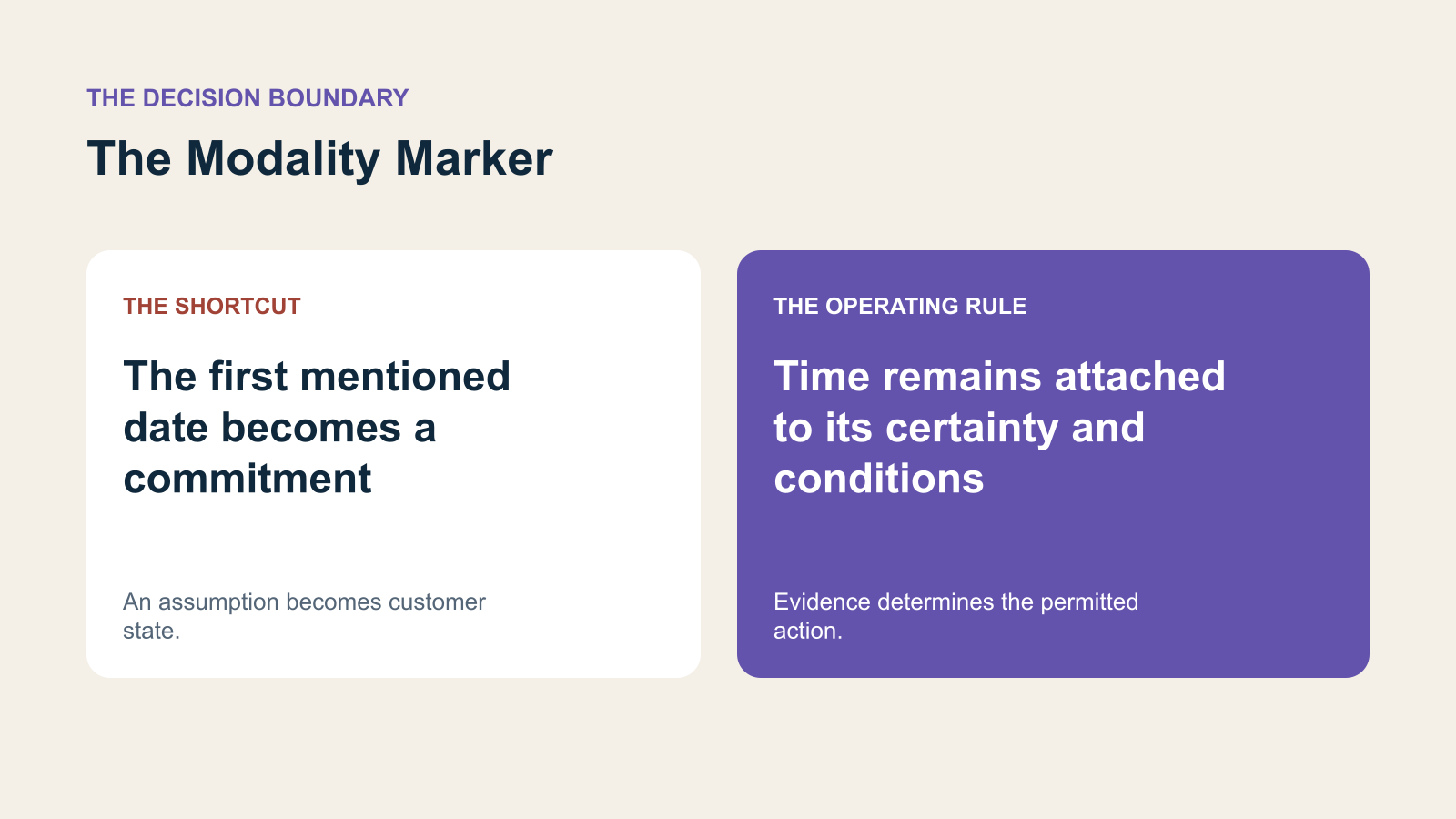
The Modality Marker: the wrong shortcut and the evidence-based decision.
The working record behind The Modality Marker
The record needs enough structure for another owner to verify the interpretation. For this journey, preserve four parts together rather than scattering them across a transcript, a note, and an action queue. Each part below has a different operating purpose. A populated field is useful only if the next owner can tell what it refers to and whether it is current.
Discussed event and time expression
Attach the time expression to its event. A possible purchase period and a preferred viewing date should not occupy the same undifferentiated field.
Modality: definite, preferred, possible, conditional
Preserve words that express certainty. Could, will, ideally, and only if describe different commitments even when they mention the same month.
Dependency and evidence of its current status
Record the dependency and what would establish progress. An expected approval is not evidence that the approval has actually occurred.
Approved review event or next contact date
Agree a useful next review event. That creates an actionable task without converting a speculative final outcome into a fabricated close date.
Automate the review event before the hypothetical outcome
Record the transfer approval as the main condition, the family sale as a possible accelerator, and next year as the current planning horizon. Ask which event would justify the next conversation. Schedule a check aligned with that event or a customer-approved review date. Do not promise that a speculative purchase date will stay correct simply because a reminder can be created for it.
A suitable clarification or acknowledgment in this illustrative scenario is: “Is that a confirmed plan or dependent on the transfer?” The wording is an example to adapt to the approved customer process, not a universal script. Its purpose is to make the next decision clear without claiming that an unverified action has already completed.
The assistant should preserve alternatives without inventing a plan. If the customer says buying is possible after a transfer but renting is possible before it, keep those as conditional paths. Ask which update they want next rather than demanding a firm purchase date. This can produce a practical task today without pretending the final outcome is known. An event-based review is often more respectful than a calendar cadence built around a date the customer never chose.
The Modality Marker
The first mentioned date becomes a commitment. Time remains attached to its certainty and conditions.
The boundary cases that change the correct action
Customers sometimes use tentative language as politeness even when they have a real plan. Others sound decisive while discussing a hypothetical. The assistant should use surrounding evidence and ask a clear confirmation when a date will drive consequential work. The purpose is not to penalize cautious language or equate confidence with commitment.
Review timeline extraction in one sales motion. Add status and condition fields beside the normalized date or period. Test how summaries retain phrases such as only if, not before, perhaps, and ideally. Let the human owner confirm a planning assumption without rewriting it as a customer commitment.
Deploy the operating rule alongside the assistant. Staff need to know which facts they can correct, which decisions require approval, and how an unresolved case returns to a person. Make that return path visible in the same customer record. Avoid a parallel spreadsheet of exceptions that leaves the next advisor unaware of the actual state.
How to test The Modality Marker before expanding it
Test the complete journey rather than a single response. A correct sentence can still trigger the wrong task, and a corrected CRM field can coexist with an outdated outbound message. Review the original evidence, the resulting record, and the action received by the next owner together.
- A customer says might buy next year; no firm close date is inferred.
- A conditional date appears; the condition travels into the rep brief.
- The customer confirms a firm visit date; appointment scheduling uses that explicit commitment.
Review language that sounds similar but implies different obligations: “by June,” “after June,” “ideally June,” and “only if approval comes in June.” Ask what action each phrase permits. Include a later statement that removes the original condition. The current record should change, while the original statement remains available to explain earlier actions. This tests whether memory can handle evolving certainty rather than simply recognizing months and years.
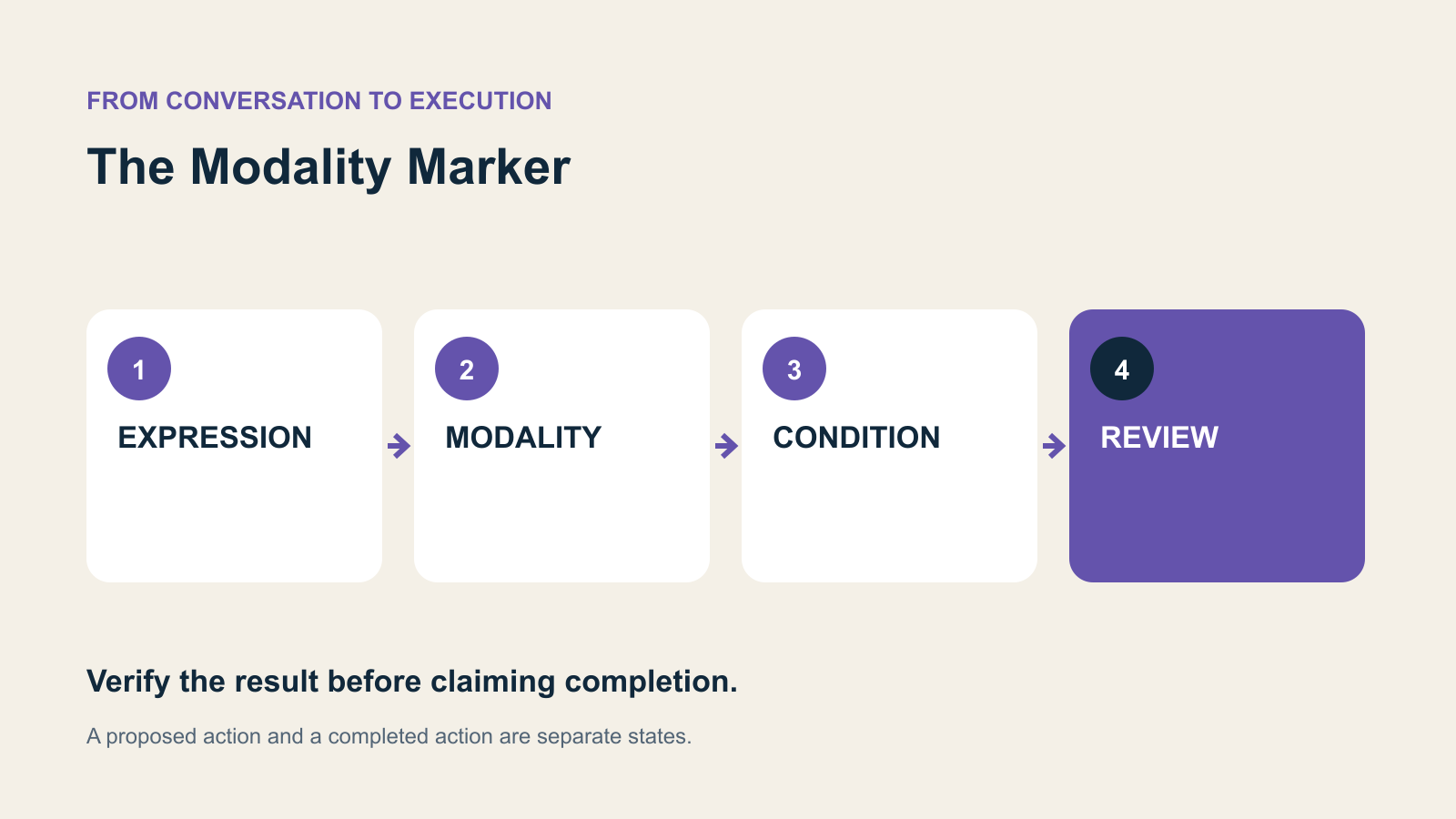
EXPRESSION → MODALITY → CONDITION → REVIEW: review the state transition, not just the response.
Measure decision accuracy alongside customer effort
Count dates recorded without their qualifying conditions, follow-ups sent against hypothetical milestones, and customer corrections of assumed urgency. Track the share of active opportunities with an explicit next review event. More populated date fields are not evidence that the pipeline has become more predictable.
Use an explicitly illustrative audit to make the denominator clear. Suppose reviewers inspect 40 cases that genuinely require The Modality Marker, and find 6 unsupported actions. That is 6 divided by 40, or 15% in that sample. It is not a market benchmark or an expected result. Counting 200 unrelated greetings alongside those cases would hide the failure without fixing it. Keep the relevant case count, error count, review rules, and uncertainty visible when reporting the result.
Also inspect the opposite failure: an unnecessary hold when the evidence was already sufficient. Reviewers should distinguish a justified clarification from an avoidable repeat question. An appropriate human review is different from a case abandoned without an owner. Pair the action error rate with customer effort and completion evidence so the team cannot improve one dashboard by moving the cost to the customer or another department.
Connect The Modality Marker with the rest of customer operations
Brixi brings CRM, AI assistants, conversation history, omnichannel communication, workflows, and team execution into one customer platform. That gives teams a connected place to design memory rules rather than maintaining a different interpretation in every inbox. The business decision, its supporting conversation, the responsible owner, and the resulting action can be reviewed together.
For this use case, make the implementation review concrete: ask the Brixi team to walk through the original evidence, the current CRM state, the permitted action, and recovery when that action cannot complete. Validate any required source system, permission rule, and approval path during configuration. The recommended operating design in this article should be demonstrated against the actual deployment rather than assumed from a generic AI feature label.
For the wider operating model, read the guide to the AI memory gap. The important connection is between interpretation and accountable execution: the same evidence should prepare the assistant, the responsible human, and the next workflow.
What to inspect after the first quarter
After a quarter, the useful evidence is a change in operating behavior: fewer unsupported actions, fewer repeated clarifications, and clearer ownership of unresolved cases. Treat these as questions to investigate, not promised gains. Compare similar journey types and inspect the difficult cases as well as the average. Improvements should survive a new owner, a changed source record, and an ordinary customer correction.
The deeper bet behind The Modality Marker
AI can make CRM more honest by preserving uncertainty rather than concealing it. Teams will plan better when the system distinguishes an aspiration, a dependency, and a commitment. Useful automation coordinates the next justified step instead of manufacturing certainty to satisfy a date field.
Put The Modality Marker into a connected customer workflow
Explore how Brixi connects customer context, CRM, AI assistants, conversations, workflows, and human teams around a reliable next action.