Customer Facts vs AI Assumptions: What Belongs in CRM Memory?

CRM memory needs an Evidence Status Ladder separating explicit statements, verified business facts, contextual interpretations, and unresolved hypotheses. AI can suggest interpretations, but those suggestions should not inherit the authority of customer declarations.
Consider a lead asking whether a project has a payment plan. The AI summary records “budget constrained.” The next rep offers a cheaper property without asking. The buyer was comparing financing options, not declaring an affordability problem. A plausible interpretation has become a fact that shapes the entire relationship.

The Evidence Status Ladder keeps the customer’s meaning connected to the next action.
CRM memory needs an Evidence Status Ladder separating explicit statements, verified business facts, contextual interpretations, and unresolved hypotheses. AI can suggest interpretations, but those suggestions should not inherit the authority of customer declarations. A useful record lets the next owner see both the hypothesis and the evidence behind it.
A plausible interpretation can still be an unsupported fact
Store the customer’s actual statement alongside the extracted field. Label whether the value was directly stated, derived from a trusted system, inferred from behavior, or proposed for human review. Make workflow permissions depend on that status. A low-consequence recommendation may use an inference; a qualification rejection or commercial commitment needs stronger evidence.
A useful evidence label answers a business question, not a model question. “Directly stated by the customer” tells a rep how to use a field. A numerical confidence score alone does not tell the rep whether the value came from a customer, a staff guess, a catalog, or a behavioral pattern. Keep those distinctions visible in the operating view. Where model confidence is available, treat it as another input rather than a substitute for provenance, authority, and current relevance.
Filled fields are not the same as reliable memory
Unsupported assumptions are hard to discover because they often sound reasonable. A rep reads “not the decision-maker” and excludes someone who was only asking on behalf of a colleague once. A manager sees “price objection” and changes the campaign. The analysis becomes self-reinforcing when future questions are framed around the AI’s original guess.
The practical failure is specific: plausible meaning becomes a verified field. The desired behavior is equally specific: every important field shows its evidence status. Use those two statements as the review boundary. A response should be judged by the state it leaves behind, not only by whether its wording sounds helpful.
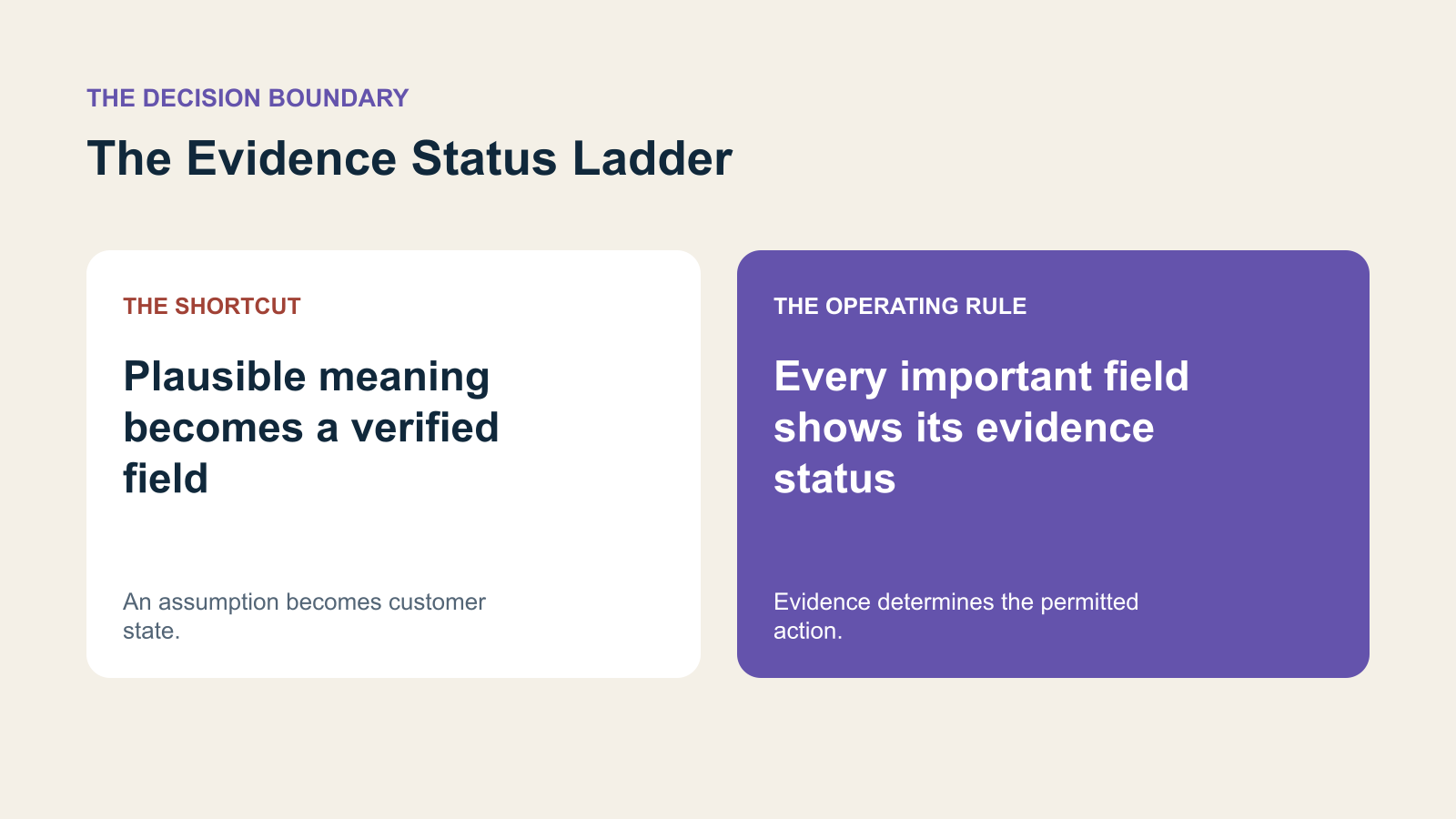
The Evidence Status Ladder: the wrong shortcut and the evidence-based decision.
The working record behind The Evidence Status Ladder
The record needs enough structure for another owner to verify the interpretation. For this journey, preserve four parts together rather than scattering them across a transcript, a note, and an action queue. Each part below has a different operating purpose. A populated field is useful only if the next owner can tell what it refers to and whether it is current.
Original customer statement and source
Preserve the exact statement behind the field. A question about installments supports that question, not a confirmed conclusion about affordability.
Extracted value and evidence category
Label explicit, verified, inferred, and unresolved evidence differently. A confident model score cannot substitute for knowing the origin of the claim.
Reviewer decision and permitted action scope
Let reviewers qualify or reject an inference. Their decision should reach dependent recommendations rather than changing only a cosmetic evidence badge.
Confirmation question and unresolved interpretation
Use a narrow confirmation question when the distinction changes action. Do not ask customers to verify an entire invented profile to repair one assumption.
Action authority should follow evidence strength
For the payment-plan question, record “asked about installment options” as the explicit fact. Keep “may prefer financing flexibility” as an interpretation if it is useful. Ask about the customer’s preferred payment structure before changing property fit. If the customer confirms a hard budget limit, promote that new statement with its source and effective date.
A suitable clarification or acknowledgment in this illustrative scenario is: “Are you comparing payment options or working within a fixed limit?” The wording is an example to adapt to the approved customer process, not a universal script. Its purpose is to make the next decision clear without claiming that an unverified action has already completed.
Promotion from inference to fact should require new evidence, not repetition by downstream systems. If an assistant writes “likely budget constrained” and another tool later summarizes it as “budget constrained,” nothing has been verified. The interpretation has only been copied. Link the confirmation event that actually changes evidence status. The same discipline should apply to human notes: a manager repeating an assumption does not transform it into a customer statement. This prevents the platform from laundering uncertainty into apparent certainty.
The Evidence Status Ladder
Plausible meaning becomes a verified field. Every important field shows its evidence status.
The boundary cases that change the correct action
Behavioral data can be valuable without proving a motive. Several pricing visits establish repeated pricing engagement, not a confirmed discount requirement. A customer may also correct a human-entered field. Evidence status should apply to staff assumptions as well as model output; otherwise the system creates a false distinction between human certainty and machine uncertainty.
Begin with a small set of consequential CRM fields. Define allowed evidence types and the actions each can support. Let reviewers accept, reject, or qualify an inference without losing the original statement. Show clear labels in briefs so advisors do not have to inspect a technical confidence score to understand what remains uncertain.
Start with one team, one journey, and a named owner for exceptions. Keep the first version small enough that staff can inspect every consequential decision. Use disagreement reviews to improve the context and operating rules before increasing automation. A model cannot compensate for an undefined approval process or an owner who never receives the work.
How to test The Evidence Status Ladder before expanding it
A useful review set includes ordinary success, ambiguity, a correction, and a failure after interpretation. Label the expected business state before looking at the assistant’s answer. Otherwise reviewers can be persuaded by fluent wording to accept a decision that the original evidence never supported.
- A pricing question appears; affordability is not recorded as a confirmed limitation.
- A reviewer rejects an inference; its downstream recommendations are reconsidered.
- A customer explicitly confirms a limit; the record includes the supporting statement.
Build a review set containing explicit declarations, indirect hints, behavioral evidence, and contradictory statements. Ask reviewers which actions are justified from each evidence category. The test is not whether the assistant can produce a plausible profile. It is whether the proposed action stays within what the evidence supports. Review sparse records too; leaving an important field unknown can be the correct result when the customer has not supplied the information.
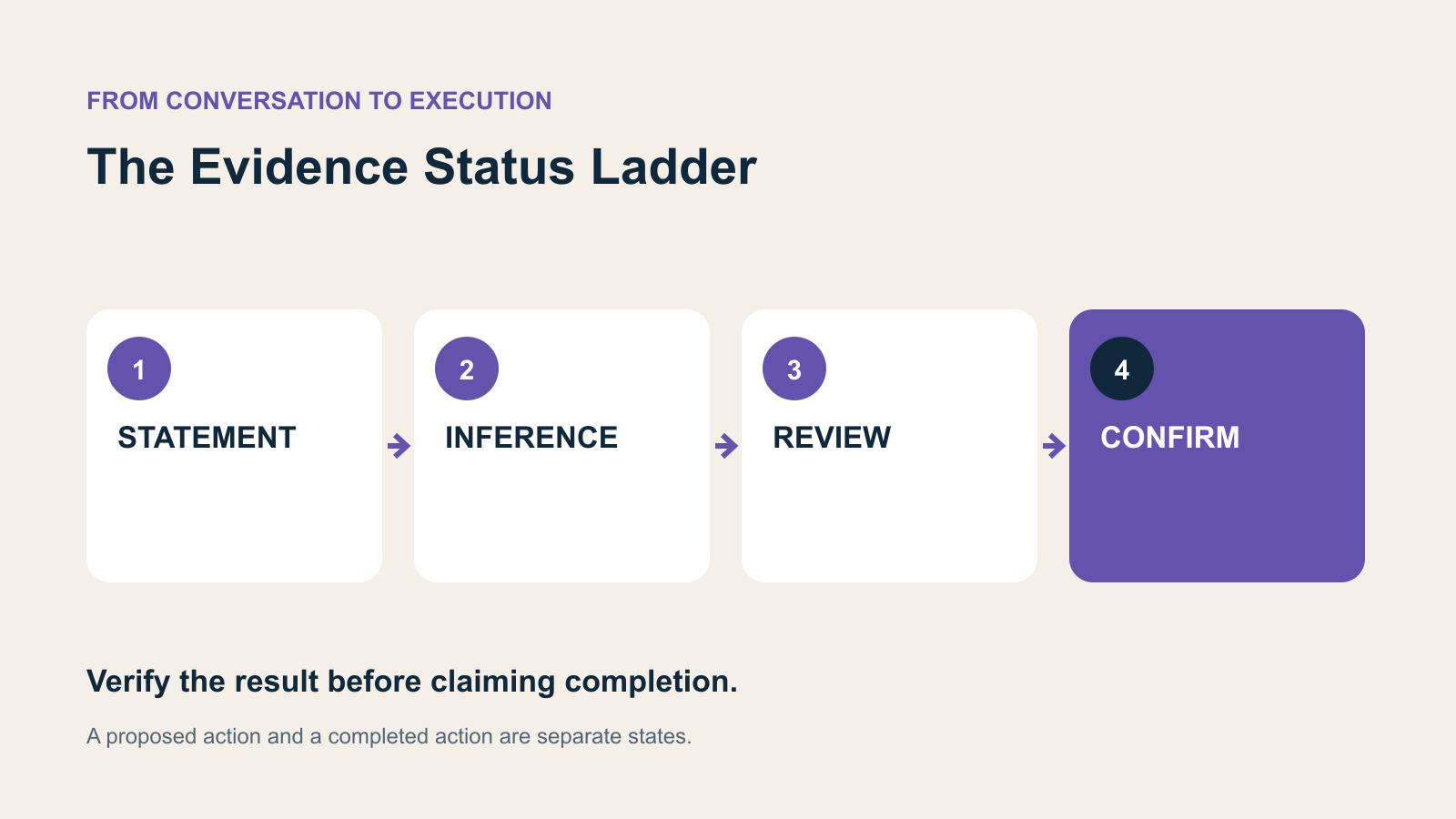
STATEMENT → INFERENCE → REVIEW → CONFIRM: review the state transition, not just the response.
Measure decision accuracy alongside customer effort
Review unsupported fields promoted into verified status, actions taken on unconfirmed assumptions, and useful inferences later validated by customers. Avoid measuring only extraction completion. A record with fewer filled fields can be more operationally useful than a complete-looking record built from guesses.
Use an explicitly illustrative audit to make the denominator clear. Suppose reviewers inspect 40 cases that genuinely require The Evidence Status Ladder, and find 6 unsupported actions. That is 6 divided by 40, or 15% in that sample. It is not a market benchmark or an expected result. Counting 200 unrelated greetings alongside those cases would hide the failure without fixing it. Keep the relevant case count, error count, review rules, and uncertainty visible when reporting the result.
Also inspect the opposite failure: an unnecessary hold when the evidence was already sufficient. Reviewers should distinguish a justified clarification from an avoidable repeat question. An appropriate human review is different from a case abandoned without an owner. Pair the action error rate with customer effort and completion evidence so the team cannot improve one dashboard by moving the cost to the customer or another department.
Connect The Evidence Status Ladder with the rest of customer operations
Brixi brings CRM, AI assistants, conversation history, omnichannel communication, workflows, and team execution into one customer platform. That gives teams a connected place to design memory rules rather than maintaining a different interpretation in every inbox. The business decision, its supporting conversation, the responsible owner, and the resulting action can be reviewed together.
For this use case, make the implementation review concrete: ask the Brixi team to walk through the original evidence, the current CRM state, the permitted action, and recovery when that action cannot complete. Validate any required source system, permission rule, and approval path during configuration. The recommended operating design in this article should be demonstrated against the actual deployment rather than assumed from a generic AI feature label.
For the wider operating model, read the guide to the AI memory gap. The important connection is between interpretation and accountable execution: the same evidence should prepare the assistant, the responsible human, and the next workflow.
What to inspect after the first quarter
After a quarter, the useful evidence is a change in operating behavior: fewer unsupported actions, fewer repeated clarifications, and clearer ownership of unresolved cases. Treat these as questions to investigate, not promised gains. Compare similar journey types and inspect the difficult cases as well as the average. Improvements should survive a new owner, a changed source record, and an ordinary customer correction.
The deeper bet behind The Evidence Status Ladder
The strongest AI CRM will make uncertainty usable. It will preserve the difference between what happened, what was said, and what might be true. That distinction lets teams benefit from interpretation while retaining the customer’s right to define their own situation.
Put The Evidence Status Ladder into a connected customer workflow
Explore how Brixi connects customer context, CRM, AI assistants, conversations, workflows, and human teams around a reliable next action.