Conditional Buying Intent: Understanding “If My Loan Gets Approved”

Conversation intelligence should maintain a Dependency-Aware Intent State. A customer can be strongly interested while unable to complete the next step.
Imagine a buyer saying, “If the bank approves the loan, I can book this month.” The assistant marks the lead ready to book and launches a closing sequence. The buyer keeps replying that approval is pending. Sales interprets the repeated delay as weak seriousness, although the buyer described the dependency clearly on the first call.

The Dependency-Aware Intent State keeps the customer’s meaning connected to the next action.
Conversation intelligence should maintain a Dependency-Aware Intent State. A customer can be strongly interested while unable to complete the next step. Readiness depends on both desire and the state of the stated condition. Neither a generic hot label nor a cold label represents that situation well.
Interest and ability to act can move separately
Extract the intended action, the gating condition, who can confirm it, and what evidence would establish progress. Separate customer confidence about the outcome from verified condition status. “Approval should arrive tomorrow” is an expectation. It is not the bank’s decision and should not be represented as one.
The dependency should have an update source, not just a label. A buyer’s report, a relationship manager’s note, and an authorized business confirmation carry different evidence. Record what the operating process needs before the next action can proceed. The assistant can be useful while a dependency is pending by preparing documents, answering approved questions, or arranging a requested discussion. It should not manufacture progress by repeatedly asking for a booking decision the customer cannot yet make.
The blocker should shape follow-up instead of erasing intent
Ignoring dependencies produces pressure at the wrong moment. Reps repeat the booking pitch instead of helping coordinate an appropriate update. Managers forecast an unconditional close date. If the condition fails, the team may mark the buyer unreliable instead of recording the actual reason the opportunity could not advance.
The practical failure is specific: a conditional promise becomes an unconditional close. The desired behavior is equally specific: interest stays visible while the dependency is tracked. Use those two statements as the review boundary. A response should be judged by the state it leaves behind, not only by whether its wording sounds helpful.
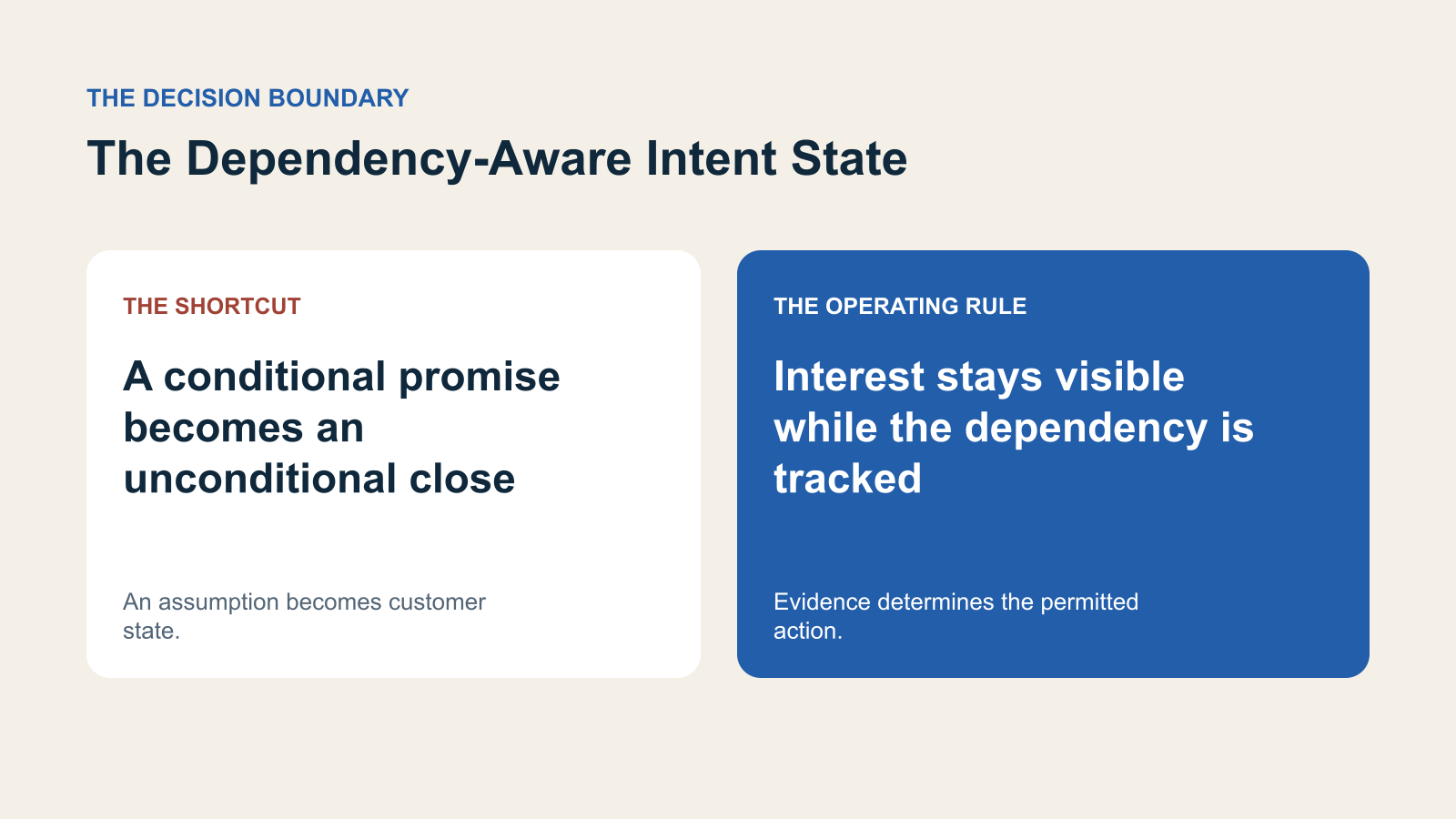
The Dependency-Aware Intent State: the wrong shortcut and the evidence-based decision.
The working record behind The Dependency-Aware Intent State
The record needs enough structure for another owner to verify the interpretation. For this journey, preserve four parts together rather than scattering them across a transcript, a note, and an action queue. Each part below has a different operating purpose. A populated field is useful only if the next owner can tell what it refers to and whether it is current.
Intended purchase action and stated interest
Keep the desired action visible while its condition is pending. A blocked customer can remain seriously interested without being able to commit today.
Gating condition and current verified status
Record the gating event and whether it is expected, reported, or verified. Those states justify different next actions and different wording.
Responsible source and expected update
Identify the source authorized to establish the required status. A confident expectation from one participant is not equivalent to an approved business confirmation.
Permitted interim action and next review
Agree the useful interim action or review event. Repeating a booking pitch cannot satisfy a dependency that the customer has already explained.
Track the condition before advancing the opportunity
Keep the buyer’s interest visible and the booking action blocked by approval. Ask when they expect an update and whether they want to be contacted afterward. Route document questions to the appropriate authorized owner rather than inventing lending guidance. When the buyer reports approval, verify the information required by the business before moving to the next commercial step.
A suitable clarification or acknowledgment in this illustrative scenario is: “What update should we wait for before discussing the booking step?” The wording is an example to adapt to the approved customer process, not a universal script. Its purpose is to make the next decision clear without claiming that an unverified action has already completed.
A dependency can be a commercial signal without being a weakness. Someone explaining the precise condition for a purchase may be easier to help than someone expressing enthusiasm without a plan. Keep the blocker and the interest together. This lets the owner allocate attention to a useful next step rather than treating all delayed opportunities as equal. It also creates a clearer reason to pause outreach when the customer has already explained that no update is available.
The Dependency-Aware Intent State
A conditional promise becomes an unconditional close. Interest stays visible while the dependency is tracked.
The boundary cases that change the correct action
Dependencies can change. The buyer may choose a different lender, add a co-applicant, or decide to postpone regardless of approval. A later message can remove the condition or introduce another one. The system should preserve that evolution instead of treating the first dependency as a permanent explanation for every delay.
Start with one recurring blocker such as finance, internal budget approval, or a linked sale. Define states for unknown, pending, satisfied, failed, and no longer relevant. Give each dependency an update path. The human owner should know what useful action remains available while the final decision is blocked.
Start with one team, one journey, and a named owner for exceptions. Keep the first version small enough that staff can inspect every consequential decision. Use disagreement reviews to improve the context and operating rules before increasing automation. A model cannot compensate for an undefined approval process or an owner who never receives the work.
How to test The Dependency-Aware Intent State before expanding it
A useful review set includes ordinary success, ambiguity, a correction, and a failure after interpretation. Label the expected business state before looking at the assistant’s answer. Otherwise reviewers can be persuaded by fluent wording to accept a decision that the original evidence never supported.
- Loan approval is pending; the system avoids claiming the buyer can book unconditionally.
- An expectation of approval appears; it is not stored as verified approval.
- The buyer removes the condition; the owner reviews the changed path.
Test the transition rather than only the initial classification. Begin with pending approval, introduce an expected update, then provide either confirmation, failure, or a changed plan. The assistant should update the relevant condition and reassess the next action. It should not allow its earlier hot label to overrule a later failure, or let its earlier pending label suppress a newly justified opportunity. Readiness is a state that must be maintained.
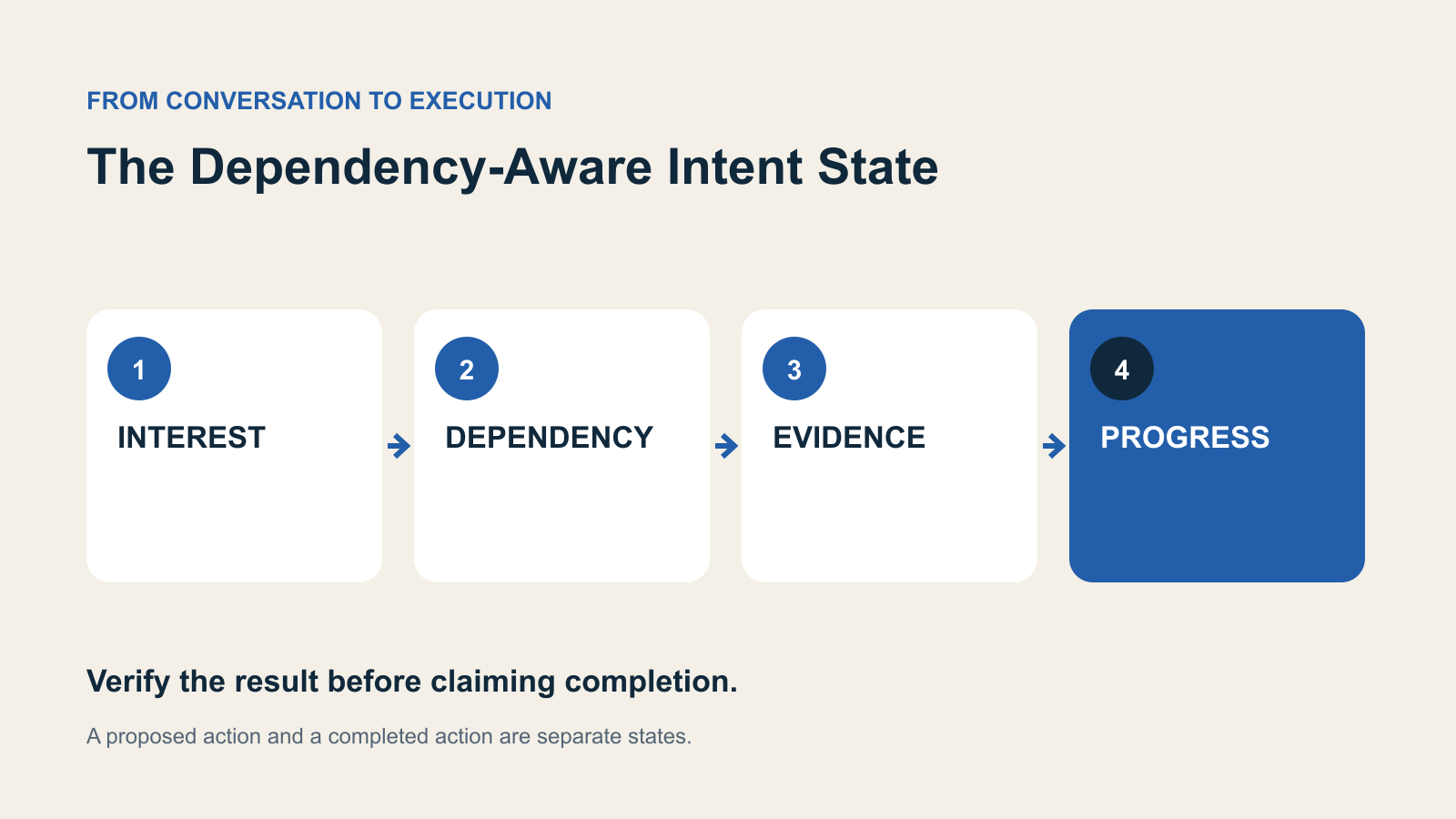
INTEREST → DEPENDENCY → EVIDENCE → PROGRESS: review the state transition, not just the response.
Measure decision accuracy alongside customer effort
Review closing messages sent before a condition was satisfied, opportunities abandoned despite active conditional interest, and time from a verified condition update to the correct next step. Segment by dependency type. A financing delay should not be evaluated against the same progression expectations as an unconditional booking request.
Use an explicitly illustrative audit to make the denominator clear. Suppose reviewers inspect 40 cases that genuinely require The Dependency-Aware Intent State, and find 6 unsupported actions. That is 6 divided by 40, or 15% in that sample. It is not a market benchmark or an expected result. Counting 200 unrelated greetings alongside those cases would hide the failure without fixing it. Keep the relevant case count, error count, review rules, and uncertainty visible when reporting the result.
Also inspect the opposite failure: an unnecessary hold when the evidence was already sufficient. Reviewers should distinguish a justified clarification from an avoidable repeat question. An appropriate human review is different from a case abandoned without an owner. Pair the action error rate with customer effort and completion evidence so the team cannot improve one dashboard by moving the cost to the customer or another department.
Connect The Dependency-Aware Intent State with the rest of customer operations
Brixi connects conversation analysis with CRM, buyer intent, AI assistants, voice, WhatsApp, workflows, and human teams. Analysis therefore has an operating destination: a corrected record, a prepared owner, a relevant next action, or a clearly held decision. Teams can use the same customer history to review what was interpreted and whether the resulting work advanced the journey.
For this use case, make the implementation review concrete: ask the Brixi team to walk through the original evidence, the current CRM state, the permitted action, and recovery when that action cannot complete. Validate any required source system, permission rule, and approval path during configuration. The recommended operating design in this article should be demonstrated against the actual deployment rather than assumed from a generic AI feature label.
For the wider operating model, read the conversation analysis guide. The important connection is between interpretation and accountable execution: the same evidence should prepare the assistant, the responsible human, and the next workflow.
What to inspect after the first quarter
After a quarter, the useful evidence is a change in operating behavior: fewer unsupported actions, fewer repeated clarifications, and clearer ownership of unresolved cases. Treat these as questions to investigate, not promised gains. Compare similar journey types and inspect the difficult cases as well as the average. Improvements should survive a new owner, a changed source record, and an ordinary customer correction.
The deeper bet behind The Dependency-Aware Intent State
Better AI qualification will model readiness as a changing set of conditions. This is more honest than forcing every customer into a single heat score. A connected platform can keep interest alive while coordinating the specific evidence needed for the next decision.
Put The Dependency-Aware Intent State into a connected customer workflow
Explore how Brixi connects conversation intelligence, CRM, AI assistants, conversations, workflows, and human teams around a reliable next action.