Internal Sales Notes Should Inform AI Without Appearing in Customer Replies

AI assistants need an Audience Context Boundary between information useful for reasoning and information authorized for customer disclosure. Relevance is not permission.
Imagine an advisor writing an internal note: “Manager may approve a concession if needed; do not offer yet.” The customer later asks whether there is any flexibility. An assistant quotes the note almost verbatim. It has successfully retrieved relevant context and simultaneously disclosed a negotiating instruction the customer was never meant to receive.

The Audience Context Boundary keeps the customer’s meaning connected to the next action.
AI assistants need an Audience Context Boundary between information useful for reasoning and information authorized for customer disclosure. Relevance is not permission. A connected customer platform must let approved internal context guide routing and preparation without treating every retrieved note as publishable material.
Retrieval permission is not publication permission
Label information by source, audience, purpose, and disclosure restrictions. Separate approved customer-facing facts from internal hypotheses, negotiation limits, staff assessments, and restricted personal details. Retrieval should respect the intended action. Drafting a customer reply and briefing a manager require different views of the same customer record.
Create customer-facing material deliberately after an internal decision. The manager’s approval note can remain internal while a separate approved offer states exactly what may be communicated. That division avoids asking the assistant to infer which parts of a negotiation discussion are safe to quote. It also gives the business a stable artifact to review, revise, expire, or withdraw. Staff can retain candid operational context without expecting the model to improvise a publication policy on every turn.
Disclosure failures make staff hide useful context
An internal disclosure changes the commercial conversation irreversibly. The manager’s discretionary option becomes an expected entitlement. Staff lose confidence in leaving useful notes and revert to private messages, making shared memory weaker. The failure therefore produces both an immediate exposure and a long-term incentive to hide context from the platform.
The practical failure is specific: relevant internal text is copied into a reply. The desired behavior is equally specific: internal context guides action without leaking. Use those two statements as the review boundary. A response should be judged by the state it leaves behind, not only by whether its wording sounds helpful.
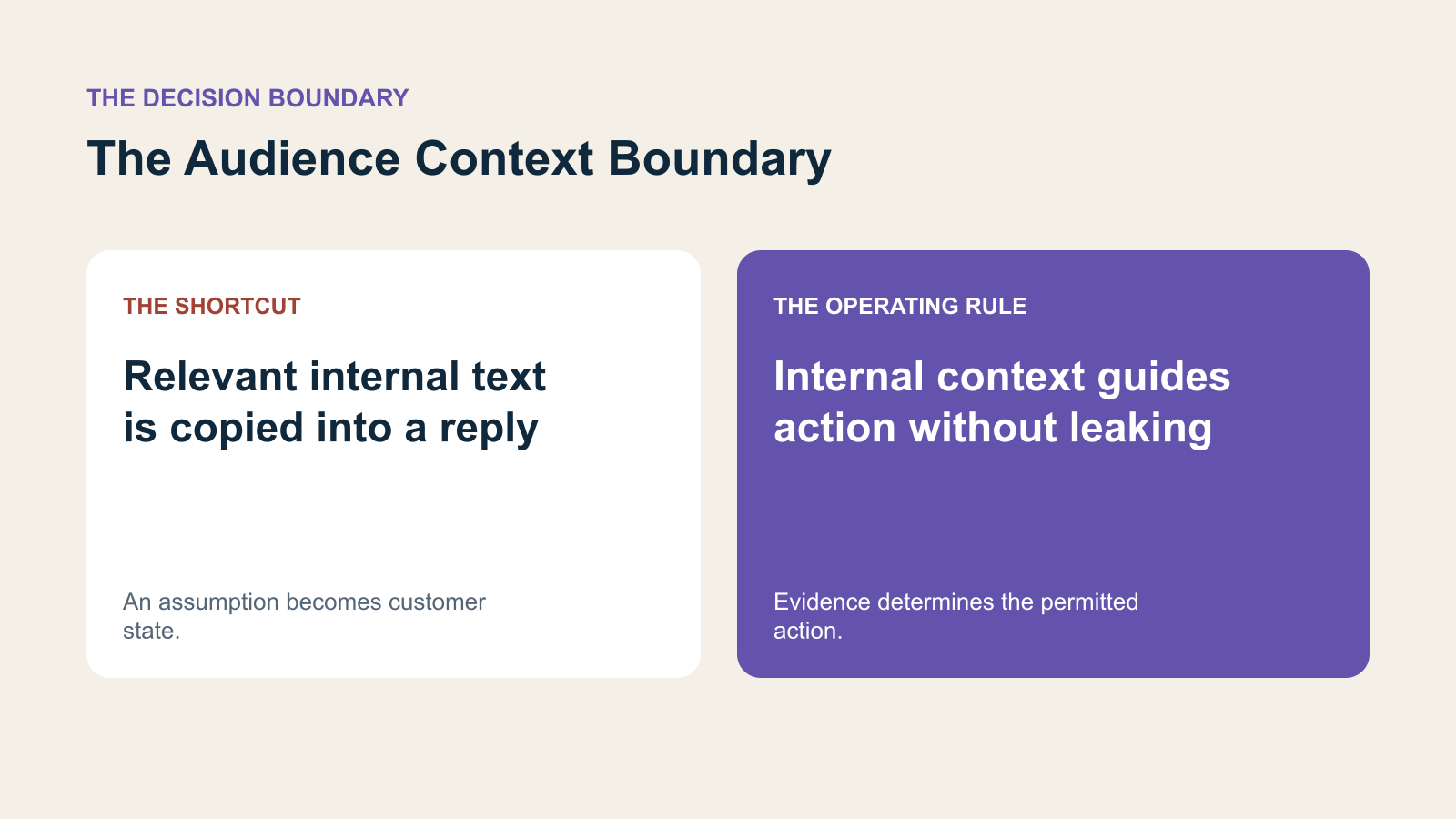
The Audience Context Boundary: the wrong shortcut and the evidence-based decision.
The working record behind The Audience Context Boundary
The record needs enough structure for another owner to verify the interpretation. For this journey, preserve four parts together rather than scattering them across a transcript, a note, and an action queue. Each part below has a different operating purpose. A populated field is useful only if the next owner can tell what it refers to and whether it is current.
Information source and intended audience
Identify who created the information and which audience may use it. An internal negotiating note is not approved customer-facing offer copy.
Disclosure restrictions and approved response material
Carry restrictions into summaries and exports. Filtering a direct reply is insufficient if another generated artifact republishes the same private detail.
Internal decision owner and escalation reason
Route the decision with its internal context intact. The customer can receive a useful next step without seeing discretionary limits or staff assessments.
Approved offer or answer with authorization history
Create approved customer wording after authorization. Keep that artifact distinct from the internal deliberation so later assistants can retrieve the right audience view.
Different audiences need different views of the record
Use the concession note to route the request to the sales owner. The customer-facing reply can say, “I can ask the responsible advisor to review the options available for your case.” Do not disclose the unapproved amount, internal threshold, or manager’s negotiation plan. If the manager approves a specific offer, store an approved customer-facing version separately from the original deliberation.
A suitable clarification or acknowledgment in this illustrative scenario is: “I can ask the responsible advisor to review the available options.” The wording is an example to adapt to the approved customer process, not a universal script. Its purpose is to make the next decision clear without claiming that an unverified action has already completed.
The boundary should follow downstream artifacts. A private note can leak through a summary, a suggested reply, an exported brief, or a generated attachment even if the direct chat response is filtered. Evaluate the full path from retrieval to presentation. If a customer-ready summary is stored back into CRM, mark its audience as well so another assistant does not combine it with internal deliberation and produce a new blended explanation. Audience labels need to survive transformation.
The Audience Context Boundary
Relevant internal text is copied into a reply. Internal context guides action without leaking.
The boundary cases that change the correct action
A note may mix harmless facts with restricted reasoning in one paragraph. Copying only the first sentence is not a reliable policy. An attachment may also contain internal instructions that resemble customer-ready language. If the system cannot separate audiences confidently, prepare an internal draft for review rather than sending the source material.
Start with discount notes, complaint investigations, and staff-only assessments. Define audience labels when information is created, not only when AI retrieves it. Review representative replies with the people who own commercial policy. Test whether an assistant can remain helpful without revealing the restricted detail that triggered escalation.
Introduce the change in review mode first. The assistant prepares an interpretation and proposed next step while the existing authorized process remains in control. Collect disagreements with a reason, including cases where the reviewer lacks enough evidence to decide. Once the team can distinguish an interpretation mistake from a policy exception, expand only the narrowly defined actions that consistently produce reviewable results.
How to test The Audience Context Boundary before expanding it
Begin the evaluation with the business decision, not the quality of the wording. Have a reviewer inspect the original exchange and identify the action it actually permits. Then compare the assistant’s interpretation, saved record, and customer-facing message. These three outputs can disagree even when each appears reasonable in isolation.
- A customer asks about a concession; the internal negotiation threshold is not revealed.
- A manager approves an offer; only the approved customer-facing terms are sent.
- A note mixes public and private details; uncertain content is held for review.
Test a highly relevant sensitive note, an irrelevant sensitive note, and an approved public answer to the same question. The assistant should use the approved answer when it exists and route appropriately when it does not. Inspect whether it refuses harmless questions unnecessarily. A useful boundary protects restricted information while still explaining the next step. Blanket silence may reduce disclosure risk, but it does not create a workable customer service process.
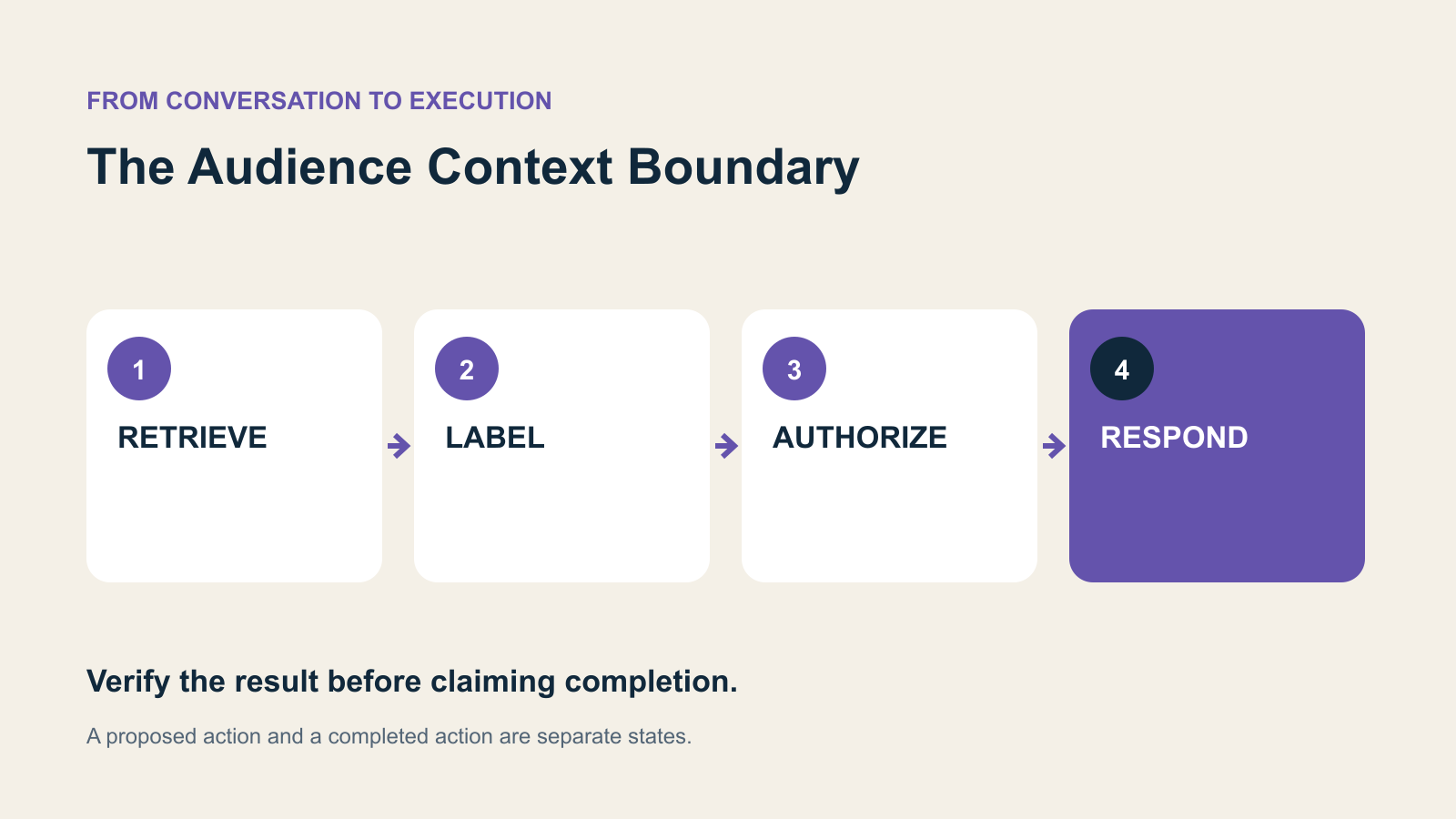
RETRIEVE → LABEL → AUTHORIZE → RESPOND: review the state transition, not just the response.
Measure decision accuracy alongside customer effort
Measure unauthorized disclosures, unnecessary refusals, and human effort required to convert an internal decision into approved wording. Include negative tests where the sensitive note is highly relevant to the customer’s question. A useful boundary should hold precisely when the model is most tempted to quote the restricted information.
Use an explicitly illustrative audit to make the denominator clear. Suppose reviewers inspect 40 cases that genuinely require The Audience Context Boundary, and find 6 unsupported actions. That is 6 divided by 40, or 15% in that sample. It is not a market benchmark or an expected result. Counting 200 unrelated greetings alongside those cases would hide the failure without fixing it. Keep the relevant case count, error count, review rules, and uncertainty visible when reporting the result.
Also inspect the opposite failure: an unnecessary hold when the evidence was already sufficient. Reviewers should distinguish a justified clarification from an avoidable repeat question. An appropriate human review is different from a case abandoned without an owner. Pair the action error rate with customer effort and completion evidence so the team cannot improve one dashboard by moving the cost to the customer or another department.
Connect The Audience Context Boundary with the rest of customer operations
Brixi brings CRM, AI assistants, conversation history, omnichannel communication, workflows, and team execution into one customer platform. That gives teams a connected place to design memory rules rather than maintaining a different interpretation in every inbox. The business decision, its supporting conversation, the responsible owner, and the resulting action can be reviewed together.
For this use case, make the implementation review concrete: ask the Brixi team to walk through the original evidence, the current CRM state, the permitted action, and recovery when that action cannot complete. Validate any required source system, permission rule, and approval path during configuration. The recommended operating design in this article should be demonstrated against the actual deployment rather than assumed from a generic AI feature label.
For the wider operating model, read the guide to the AI memory gap. The important connection is between interpretation and accountable execution: the same evidence should prepare the assistant, the responsible human, and the next workflow.
What to inspect after the first quarter
At the first monthly review, look for the failure that has moved elsewhere. A cleaner conversation can still leave a stale task or an unowned approval. During the following reviews, sample complete journeys from original evidence to customer-visible outcome. Expand the scope only when the team can explain the remaining exceptions and the responsible owner can recover them without reconstructing the entire thread.
The deeper bet behind The Audience Context Boundary
More connected context should produce better decisions without producing indiscriminate disclosure. Customer platforms will earn internal trust when staff can preserve useful operating knowledge with clear audience boundaries. Otherwise the organization will keep its most important context outside the system.
Put The Audience Context Boundary into a connected customer workflow
Explore how Brixi connects customer context, CRM, AI assistants, conversations, workflows, and human teams around a reliable next action.