WhatsApp AI for Rental Applications: Ask Only for What Is Still Missing
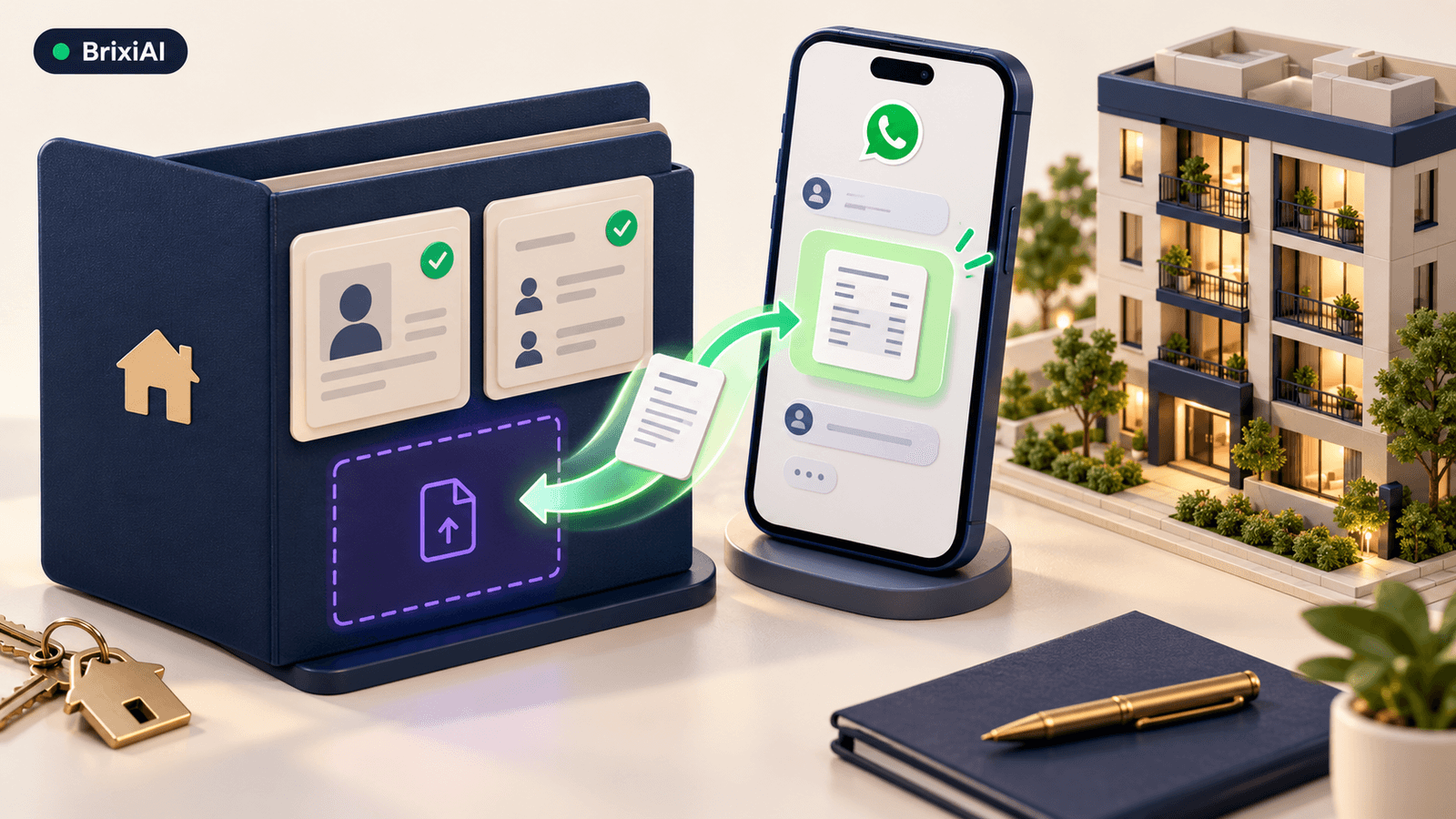
WhatsApp AI for rental applications should calculate an Application Completeness Delta: what the approved process still needs after existing conversation evidence has been reviewed. The value is not a longer qualification script.
Consider a prospective tenant who sends an intended move date by voice, a preferred lease length in text, and household details in a later message. The agent’s application checklist still looks empty because the information arrived outside the form. An assistant sends the entire questionnaire again, and the tenant abandons a process they thought they had already completed.
The Application Completeness Delta keeps the customer’s meaning connected to the next action.
WhatsApp AI for rental applications should calculate an Application Completeness Delta: what the approved process still needs after existing conversation evidence has been reviewed. The value is not a longer qualification script. It is a shorter, accurate request that respects what the applicant has already supplied.
Administrative memory should reduce the number of questions
Map explicit statements to the required checklist with source and confirmation status. Separate missing information from supplied-but-unverified information. Do not infer sensitive attributes or fill gaps from stereotypes. The assistant organizes administrative completeness; it should not invent tenant-selection criteria or decide suitability outside the landlord’s approved process.
The completeness model should distinguish a blank from a conflict. If the applicant supplied two move dates, the assistant should ask which is current rather than request a date as though none was provided. If a document is present but awaiting authorized review, the next step belongs to the reviewer, not another upload request. These small distinctions remove unnecessary work from both sides and help the agent see exactly why an application has stopped progressing.
Completeness and tenant approval are different states
Repeated questions signal disorganization and create inconsistent records. Applicants may provide slightly different wording in each repetition, leaving staff to reconcile avoidable differences. Agents spend time checking message histories instead of resolving the actual missing item. More completed form fields can conceal a customer journey that became harder than necessary.
The practical failure is specific: every applicant receives the whole questionnaire again. The desired behavior is equally specific: the next question targets the actual gap. Use those two statements as the review boundary. A response should be judged by the state it leaves behind, not only by whether its wording sounds helpful.
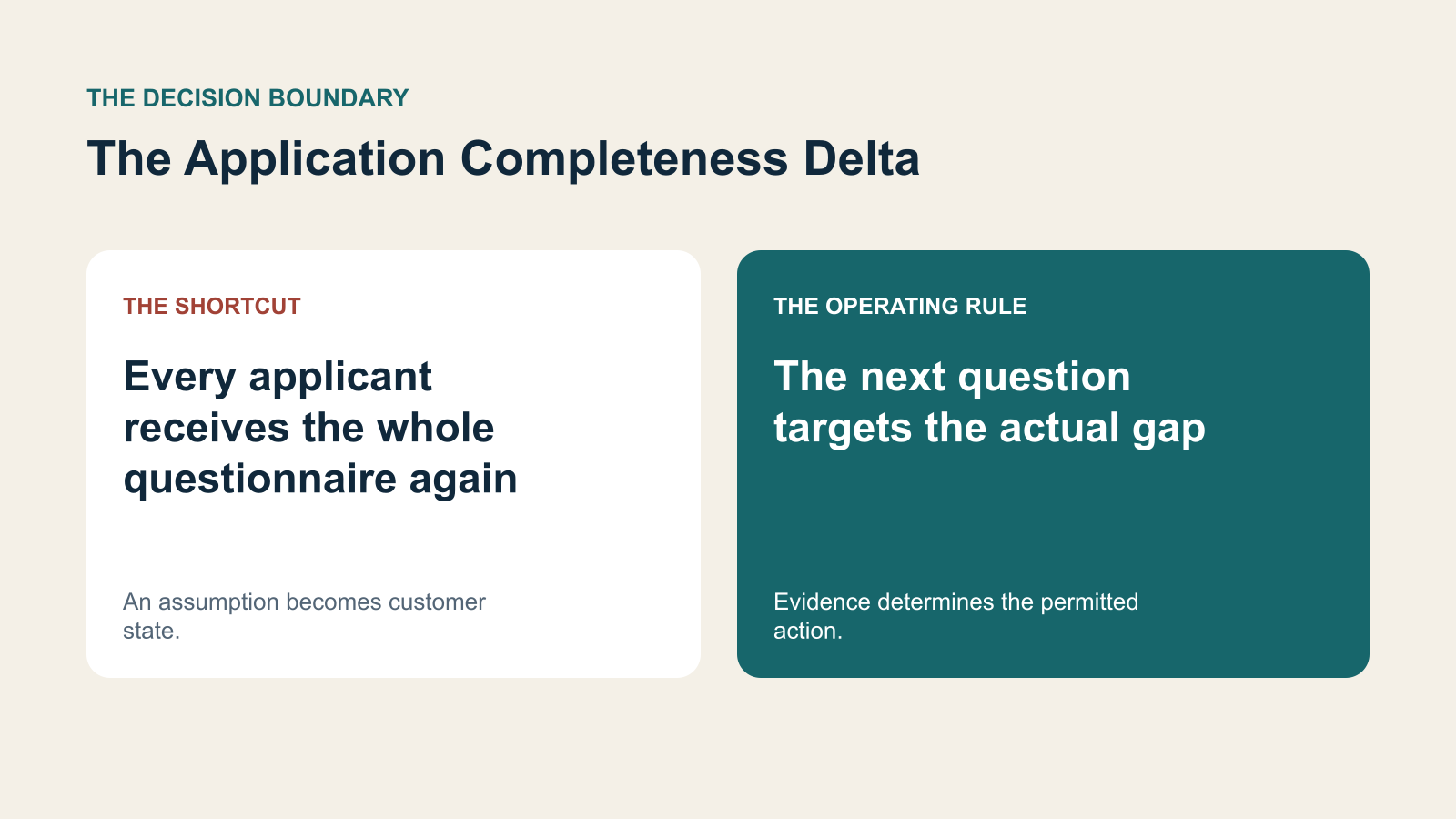
The Application Completeness Delta: the wrong shortcut and the evidence-based decision.
The working record behind The Application Completeness Delta
The record needs enough structure for another owner to verify the interpretation. For this journey, preserve four parts together rather than scattering them across a transcript, a note, and an action queue. Each part below has a different operating purpose. A populated field is useful only if the next owner can tell what it refers to and whether it is current.
Application and property identifiers
Scope the evidence to the correct application. A move date discussed for another property should not automatically populate the current submission.
Approved required-information checklist
Use the approved completeness checklist. Administrative convenience does not justify inventing new selection criteria or collecting unrelated personal information.
Supplied values with source and verification state
Distinguish supplied, verified, conflicting, and missing details. An attached document awaiting review should not trigger another generic upload request.
Missing or conflicting items and review owner
Pass a source-linked application to the authorized reviewer. A complete checklist means ready for review, not approved tenancy or guaranteed acceptance.
Use a source-linked checklist instead of another script
Build a request that acknowledges the move date and lease length, then asks for the one remaining approved detail. If a supplied date is ambiguous, ask for confirmation rather than treating it as absent. When the checklist is complete, pass the application to the authorized reviewer and explain its status without claiming that completeness means approval.
A suitable clarification or acknowledgment in this illustrative scenario is: “We have your move date and lease length; only this detail is still needed.” The wording is an example to adapt to the approved customer process, not a universal script. Its purpose is to make the next decision clear without claiming that an unverified action has already completed.
Use a customer-facing checklist that is specific enough to be useful and limited enough to respect the process. State what has been received, what needs clarification, and what remains under review. Do not expose internal assessments or imply that submitting more personal information improves the chance of acceptance. The assistant’s administrative role is to help the applicant complete the defined process and obtain a clear status from the authorized decision-maker.
The Application Completeness Delta
Every applicant receives the whole questionnaire again. The next question targets the actual gap.
The boundary cases that change the correct action
An applicant may change the intended move date while discussing another property. Scope details to the correct application. Several adults may share a household without sharing permission to disclose every document. Collect only the information required by the approved process and route unusual requests to a person.
Choose one rental application type. Compare the assistant’s completeness assessment with an agent’s review of the same thread. Distinguish present, missing, conflicting, and awaiting verification. Give staff a source-linked checklist so they can review the result quickly and correct any extraction error before contacting the applicant.
Start with one team, one journey, and a named owner for exceptions. Keep the first version small enough that staff can inspect every consequential decision. Use disagreement reviews to improve the context and operating rules before increasing automation. A model cannot compensate for an undefined approval process or an owner who never receives the work.
How to test The Application Completeness Delta before expanding it
A useful review set includes ordinary success, ambiguity, a correction, and a failure after interpretation. Label the expected business state before looking at the assistant’s answer. Otherwise reviewers can be persuaded by fluent wording to accept a decision that the original evidence never supported.
- A date appears in a voice note; the assistant verifies it instead of asking the full questionnaire.
- A new property is discussed; details are not copied to the wrong application.
- The checklist is complete; the system reports ready for review rather than approved.
Test applications assembled across text, voice, and staff notes. Include an outdated detail from another property and a household member’s statement about a different person. Review whether the assistant asks only for the actual missing item. Then inspect the reviewer brief. Saving a message is not the same as making its contents usable, and a completed checklist is not useful if the reviewer cannot verify where the important information came from.
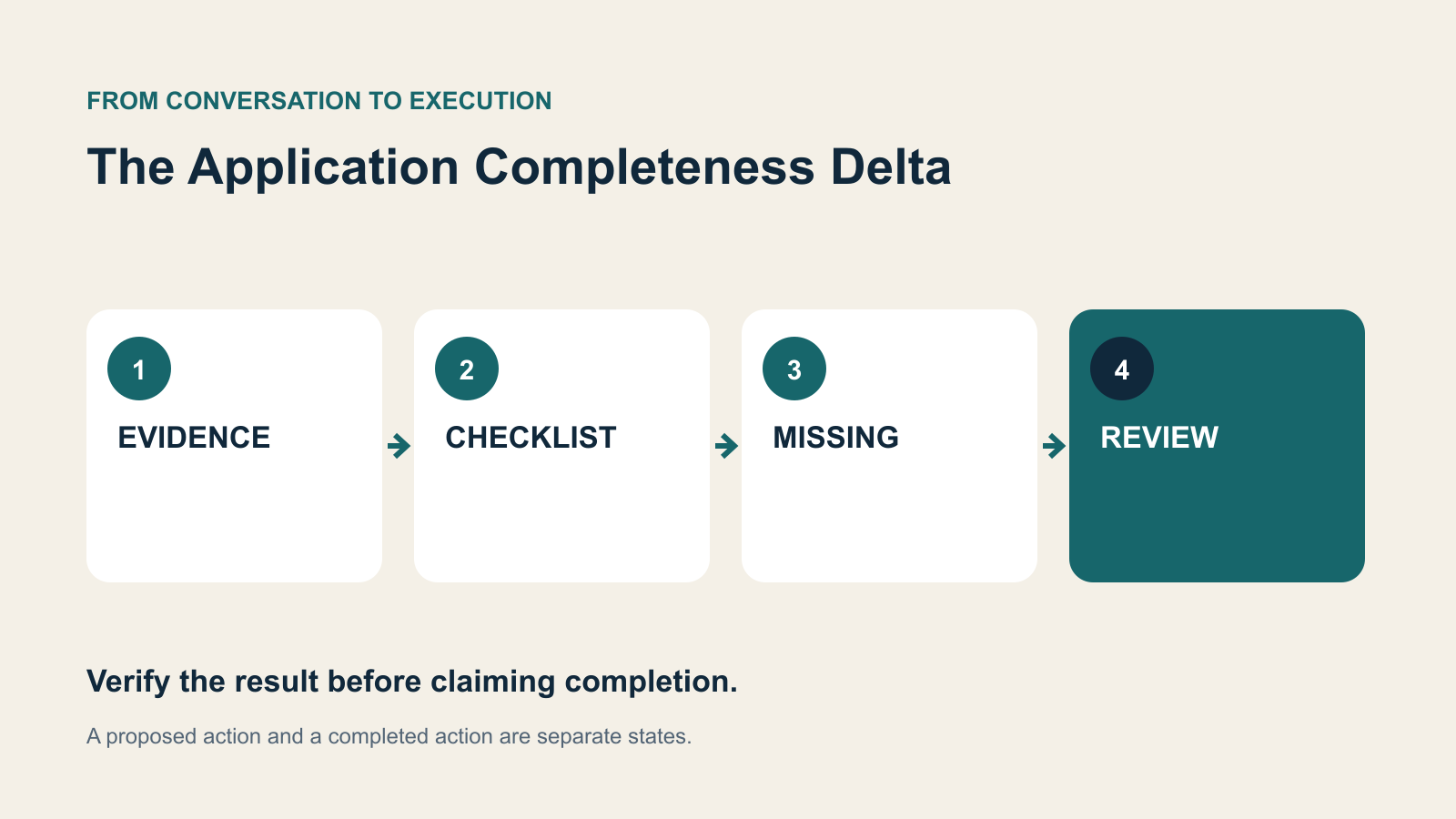
EVIDENCE → CHECKLIST → MISSING → REVIEW: review the state transition, not just the response.
Measure decision accuracy alongside customer effort
Track repeated questions, unsupported autofilled values, applications stalled on genuinely missing items, and applicant effort to finish. Evaluate completeness accuracy separately from selection outcomes. A shorter exchange is useful only when the authorized reviewer receives the required and correctly attributed information.
Use an explicitly illustrative audit to make the denominator clear. Suppose reviewers inspect 40 cases that genuinely require The Application Completeness Delta, and find 6 unsupported actions. That is 6 divided by 40, or 15% in that sample. It is not a market benchmark or an expected result. Counting 200 unrelated greetings alongside those cases would hide the failure without fixing it. Keep the relevant case count, error count, review rules, and uncertainty visible when reporting the result.
Also inspect the opposite failure: an unnecessary hold when the evidence was already sufficient. Reviewers should distinguish a justified clarification from an avoidable repeat question. An appropriate human review is different from a case abandoned without an owner. Pair the action error rate with customer effort and completion evidence so the team cannot improve one dashboard by moving the cost to the customer or another department.
Connect The Application Completeness Delta with the rest of customer operations
Brixi brings AI assistants, CRM, voice, WhatsApp, buyer intent, workflows, and team execution together for real estate teams. The platform connects customer conversations with ownership and follow-through across the property journey. This is more useful than adding an isolated property chatbot: the agent, relationship manager, and operations owner work from connected customer context.
For this use case, make the implementation review concrete: ask the Brixi team to walk through the original evidence, the current CRM state, the permitted action, and recovery when that action cannot complete. Validate any required source system, permission rule, and approval path during configuration. The recommended operating design in this article should be demonstrated against the actual deployment rather than assumed from a generic AI feature label.
For the wider operating model, read the existing AI in real estate guide. The important connection is between interpretation and accountable execution: the same evidence should prepare the assistant, the responsible human, and the next workflow.
What to inspect after the first quarter
At the first monthly review, look for the failure that has moved elsewhere. A cleaner conversation can still leave a stale task or an unowned approval. During the following reviews, sample complete journeys from original evidence to customer-visible outcome. Expand the scope only when the team can explain the remaining exceptions and the responsible owner can recover them without reconstructing the entire thread.
The deeper bet behind The Application Completeness Delta
Real estate AI can improve conversion by removing repetition from the customer’s administrative work. A connected platform remembers what has already been said, identifies what remains uncertain, and prepares the human decision. That is more useful than another bot that asks every applicant the same long list.
Put The Application Completeness Delta into a connected customer workflow
Explore how Brixi connects AI for real estate, CRM, AI assistants, conversations, workflows, and human teams around a reliable next action.