Nonprofit AI: Extract Donor Conditions Without Inventing Commitments

Nonprofit conversation AI needs a Donor Commitment Boundary between a stated preference, a requested condition, an accepted restriction, and a reporting promise. The assistant can organize the conversation and route it to the responsible team.
Imagine a donor writing, “I would like this contribution to support the school program if that is possible.” An assistant records the gift as restricted and sends a confident promise about its use before the organization has reviewed whether it can accept that condition. A thoughtful donor preference has become an operational commitment without authorization.

The Donor Commitment Boundary keeps the customer’s meaning connected to the next action.
Nonprofit conversation AI needs a Donor Commitment Boundary between a stated preference, a requested condition, an accepted restriction, and a reporting promise. The assistant can organize the conversation and route it to the responsible team. It should not decide financial classification or promise outcomes the organization has not approved.
A preference and an accepted condition are different states
Extract the donor’s exact request, the relevant campaign, the certainty of the wording, and any requested acknowledgment or update. Keep the organization’s acceptance separate. A donor asking about program use is not necessarily imposing a condition, while a clear condition cannot be ignored simply because a generic donation form lacks the field.
The gift reference matters as much as the donor identity. A person can support several campaigns with different expectations. A preference attached to one contribution should not automatically govern every future donation. Keep the request, the organization’s acceptance, and any later change linked to the relevant gift or approved commitment. This gives fundraising, program, and finance teams a shared context without letting a broad profile note silently redefine unrelated contributions.
Automated acknowledgment should not create policy
Misclassification can produce inappropriate acknowledgments, disappointed donors, and reconciliation work for program and finance staff. An automated promise may be repeated in later messages as though it were established policy. The trust cost emerges when the donor asks for an update and the team discovers that no one accepted or assigned the obligation.
The practical failure is specific: a donor preference becomes an unapproved promise. The desired behavior is equally specific: accepted commitments retain source and authority. Use those two statements as the review boundary. A response should be judged by the state it leaves behind, not only by whether its wording sounds helpful.
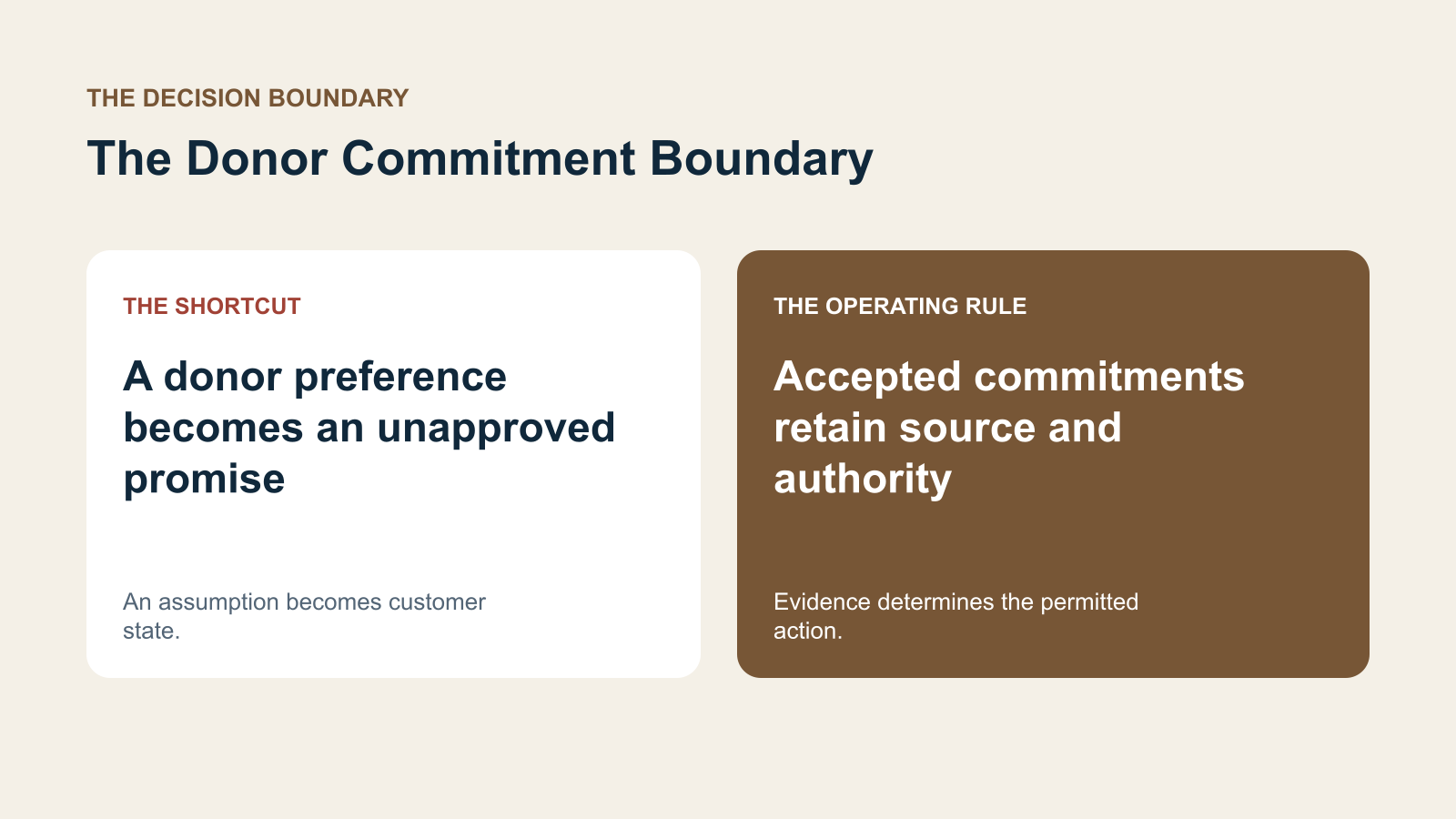
The Donor Commitment Boundary: the wrong shortcut and the evidence-based decision.
The working record behind The Donor Commitment Boundary
The record needs enough structure for another owner to verify the interpretation. For this journey, preserve four parts together rather than scattering them across a transcript, a note, and an action queue. Each part below has a different operating purpose. A populated field is useful only if the next owner can tell what it refers to and whether it is current.
Donor, gift, and campaign references
Link the statement to the relevant donor, gift, and campaign. A preference for one contribution should not silently govern every future donation.
Exact preference or requested condition
Preserve the exact requested condition and its certainty. If possible and only for this purpose do not express the same organizational obligation.
Authorized acceptance and approved wording
Keep authorized acceptance separate from extraction. A careful acknowledgment can route the request without promising a financial classification or unapproved program outcome.
Reporting obligation, owner, and completion evidence
Assign any accepted reporting commitment with a completion event. Warm wording should not create an obligation that program and finance teams never receive.
Record the commitment only after authorized acceptance
Acknowledge the preference without claiming acceptance. Route the request with the original wording to the authorized fundraising or finance owner. Once the organization confirms what it can accept, communicate the approved terms and record any reporting commitment with an owner and due event. If it cannot accept the request, let the responsible team explain the available options.
A suitable clarification or acknowledgment in this illustrative scenario is: “I will ask the responsible team to confirm whether that request can be accepted.” The wording is an example to adapt to the approved customer process, not a universal script. Its purpose is to make the next decision clear without claiming that an unverified action has already completed.
Reporting promises need their own completion criteria. “We will keep you updated” is too vague to operate if the donor expects a particular report or milestone. The authorized team should define what can be promised and who will provide it. AI can prepare that decision and track the accepted obligation. It should not invent impact claims, beneficiary details, or precise delivery dates to produce a warm acknowledgment. Respectful communication is compatible with clear limits.
The Donor Commitment Boundary
A donor preference becomes an unapproved promise. Accepted commitments retain source and authority.
The boundary cases that change the correct action
A donor may change the requested purpose, contribute through an employer, or discuss several campaigns. Preserve the correct subject and gift reference. Avoid inferring charitable intent or personal circumstances beyond what the donor stated. Sensitive financial and beneficiary details should follow the organization’s approved access and retention rules.
Start with donor questions that contain words such as only, prefer, if possible, or please report back. Review how the assistant classifies them against the organization’s real acceptance process. Separate conversational extraction from accounting or legal decisions. Give the human owner a concise brief with the exact condition and unanswered question.
Deploy the operating rule alongside the assistant. Staff need to know which facts they can correct, which decisions require approval, and how an unresolved case returns to a person. Make that return path visible in the same customer record. Avoid a parallel spreadsheet of exceptions that leaves the next advisor unaware of the actual state.
How to test The Donor Commitment Boundary before expanding it
Test the complete journey rather than a single response. A correct sentence can still trigger the wrong task, and a corrected CRM field can coexist with an outdated outbound message. Review the original evidence, the resulting record, and the action received by the next owner together.
- The donor expresses a preference; no unapproved restriction is promised.
- An accepted condition exists; later summaries preserve its scope.
- A donor asks for an update; the owner and actual commitment are visible.
Review examples containing a soft preference, an explicit condition, an accepted condition, and a requested change after acceptance. Ask which statements are safe for the assistant to make at each stage. Inspect the records used by program and finance staff as well as the donor-facing reply. A careful message does not solve the problem if a background field still labels an unreviewed request as an accepted organizational commitment.
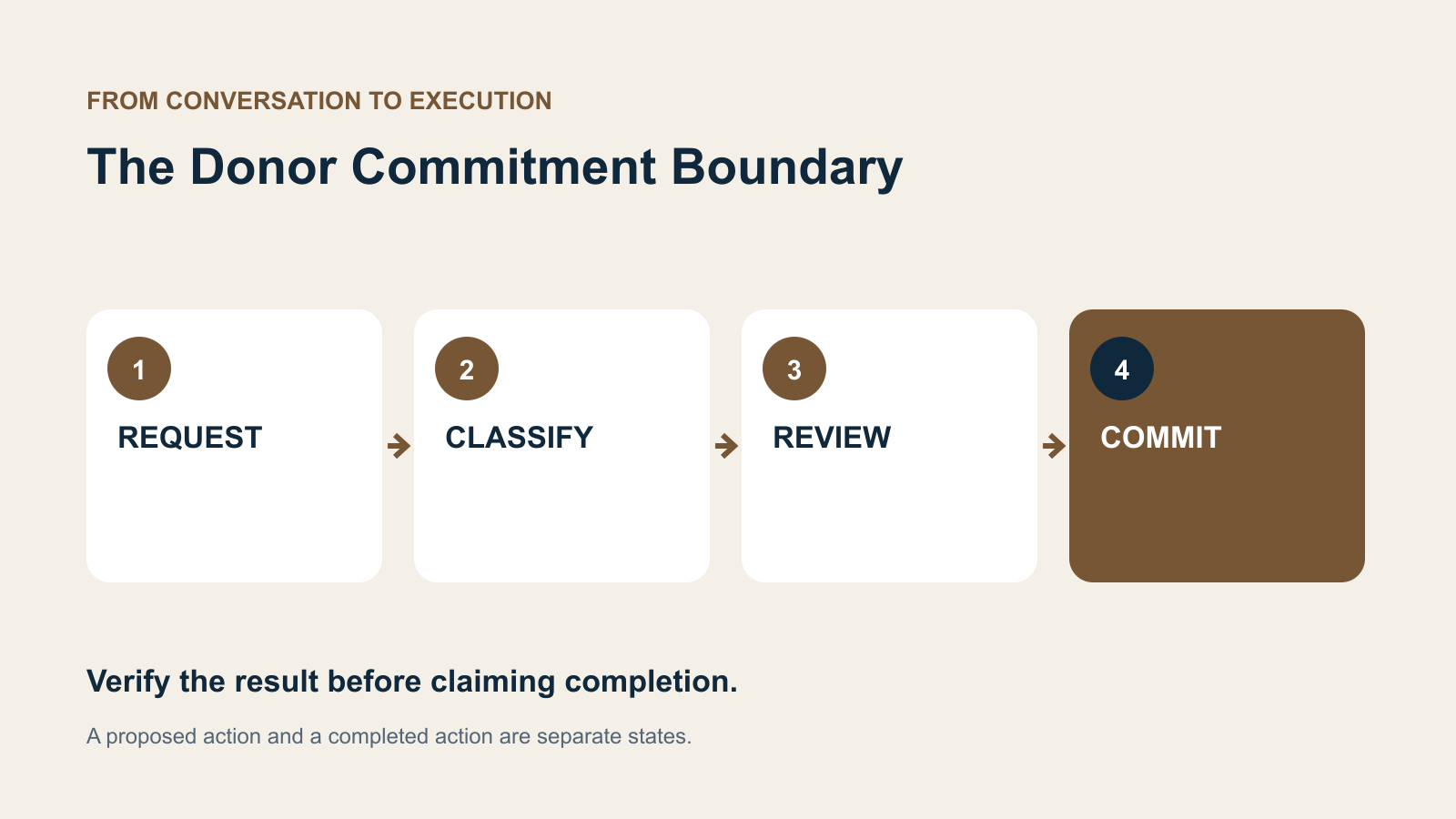
REQUEST → CLASSIFY → REVIEW → COMMIT: review the state transition, not just the response.
Measure decision accuracy alongside customer effort
Track unapproved promises, donor preferences misrepresented as accepted restrictions, and accepted reporting obligations left without an owner. Review donor corrections and staff reconciliation effort. More detailed AI notes are valuable only when they preserve the organization’s actual commitments.
Use an explicitly illustrative audit to make the denominator clear. Suppose reviewers inspect 40 cases that genuinely require The Donor Commitment Boundary, and find 6 unsupported actions. That is 6 divided by 40, or 15% in that sample. It is not a market benchmark or an expected result. Counting 200 unrelated greetings alongside those cases would hide the failure without fixing it. Keep the relevant case count, error count, review rules, and uncertainty visible when reporting the result.
Also inspect the opposite failure: an unnecessary hold when the evidence was already sufficient. Reviewers should distinguish a justified clarification from an avoidable repeat question. An appropriate human review is different from a case abandoned without an owner. Pair the action error rate with customer effort and completion evidence so the team cannot improve one dashboard by moving the cost to the customer or another department.
Connect The Donor Commitment Boundary with the rest of customer operations
Brixi is a complete AI-native customer platform combining assistants, CRM, voice, WhatsApp, omnichannel context, intelligence, workflows, and human execution. These capabilities let teams connect what a customer says with a governed business process. The assistant handles interpretation within configured boundaries, while the responsible team retains the decisions that require policy authority or professional judgment.
For this use case, make the implementation review concrete: ask the Brixi team to walk through the original evidence, the current CRM state, the permitted action, and recovery when that action cannot complete. Validate any required source system, permission rule, and approval path during configuration. The recommended operating design in this article should be demonstrated against the actual deployment rather than assumed from a generic AI feature label.
For the wider operating model, read the AI workflow examples. The important connection is between interpretation and accountable execution: the same evidence should prepare the assistant, the responsible human, and the next workflow.
What to inspect after the first quarter
After a quarter, the useful evidence is a change in operating behavior: fewer unsupported actions, fewer repeated clarifications, and clearer ownership of unresolved cases. Treat these as questions to investigate, not promised gains. Compare similar journey types and inspect the difficult cases as well as the average. Improvements should survive a new owner, a changed source record, and an ordinary customer correction.
The deeper bet behind The Donor Commitment Boundary
Nonprofit AI should help organizations remember precisely what they have promised. A connected customer platform can support respectful donor communication while keeping authority with the appropriate people. The result is continuity between the conversation, the accepted commitment, and the team responsible for fulfilling it.
Put The Donor Commitment Boundary into a connected customer workflow
Explore how Brixi connects applied conversation AI, CRM, AI assistants, conversations, workflows, and human teams around a reliable next action.