Price Objections Need the Exact Offer Behind the Conversation

Conversation intelligence needs an Objection Reference Link between a customer’s reaction and the exact offer they evaluated. A price objection without amount, scope, version, and comparison context is too weak to guide a discount or product decision.
Imagine a manager reviewing calls tagged “too expensive.” Some customers saw the base price, others saw the all-inclusive quote, and one reacted to a competitor’s screenshot. The dashboard groups them as one pricing problem. The team discounts the wrong offer because the objection was extracted without the commercial object it described.

The Objection Reference Link keeps the customer’s meaning connected to the next action.
Conversation intelligence needs an Objection Reference Link between a customer’s reaction and the exact offer they evaluated. A price objection without amount, scope, version, and comparison context is too weak to guide a discount or product decision. The label may be correct while its operational interpretation is wrong.
An objection label needs a commercial object
Resolve the referenced quote and the component under discussion before classifying the concern. Separate total price, recurring charge, upfront amount, excluded service, and perceived value. Preserve what the customer compared it with. The assistant should not assume that the most recent internal quote is the price behind a reply to an older document.
The comparison unit should be explicit. A customer can reject a monthly charge while accepting the one-time price, or object to the total after seeing an unexpected component. Store the amount type, period, and included scope with the reaction. This makes later analysis more useful than a list of price phrases. It also lets a manager inspect whether a perceived pricing issue is really a communication issue, a version mismatch, or a product-fit concern.
Mixed quote versions create false pricing patterns
Unscoped objections encourage blanket discounts and misleading loss analysis. Managers believe a project is overpriced when the real issue is an unexpected charge or a misunderstood installment. Reps lose the opportunity to answer a precise question because the CRM reduces several different concerns to one dropdown value.
The practical failure is specific: every price phrase becomes the same discount signal. The desired behavior is equally specific: the objection names its exact commercial reference. Use those two statements as the review boundary. A response should be judged by the state it leaves behind, not only by whether its wording sounds helpful.
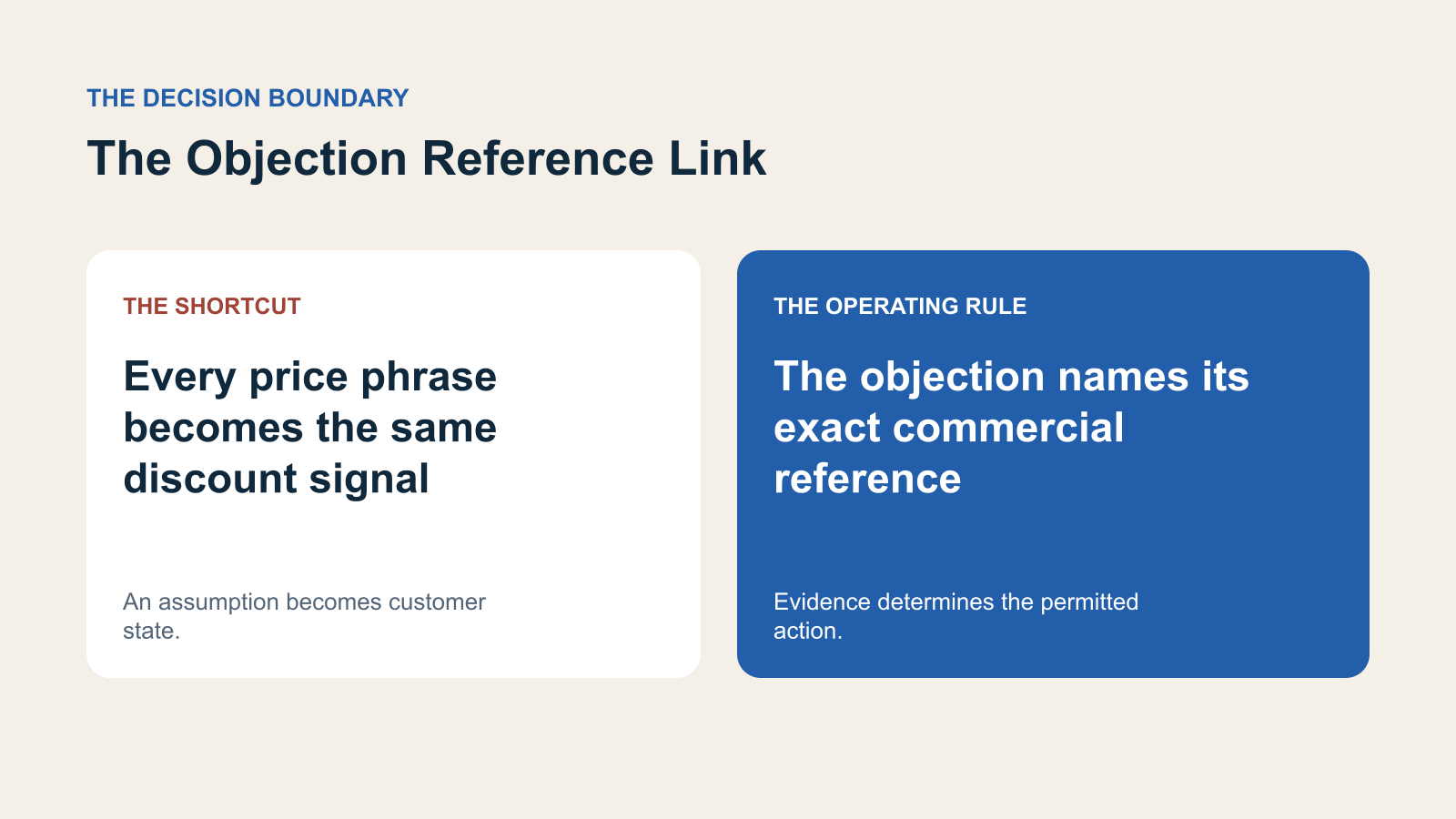
The Objection Reference Link: the wrong shortcut and the evidence-based decision.
The working record behind The Objection Reference Link
The record needs enough structure for another owner to verify the interpretation. For this journey, preserve four parts together rather than scattering them across a transcript, a note, and an action queue. Each part below has a different operating purpose. A populated field is useful only if the next owner can tell what it refers to and whether it is current.
Referenced offer, amount, and version
Identify the quote the customer actually evaluated. A newer internal amount cannot silently replace an older explicitly referenced offer in the objection record.
Component or scope under objection
Separate total, recurring, upfront, and component concerns. One broad price label cannot support the same response for these different commercial questions.
Customer comparison and stated concern
Preserve the customer's stated comparison without certifying it. A competitor screenshot may explain the concern while remaining unverified and differently scoped.
Approved response, owner, and revised offer history
Link any revised offer to a new response. Do not move an old rejection onto the new version and distort later pricing analysis.
Resolve the reference before choosing a concession
When the buyer says “that is too high,” identify the referenced offer and ask which part is causing difficulty if the conversation does not make it clear. Record the stated concern against that version. Prepare the advisor with the approved scope and the unresolved comparison. Keep any revised offer separate so the original objection remains interpretable later.
A suitable clarification or acknowledgment in this illustrative scenario is: “Is the concern the total amount, the upfront payment, or an included item?” The wording is an example to adapt to the approved customer process, not a universal script. Its purpose is to make the next decision clear without claiming that an unverified action has already completed.
Do not erase the original objection after a revised offer. Keep the old reaction attached to the old proposal and record the customer’s response to the new one separately. Otherwise a successful renegotiation can make historical analysis look as though the revised price was rejected. The resulting feedback loop pushes teams toward another unnecessary discount. Versioned reactions preserve what the customer evaluated at each stage and what changed the decision, if anything.
The Objection Reference Link
Every price phrase becomes the same discount signal. The objection names its exact commercial reference.
The boundary cases that change the correct action
Customers can object to value without rejecting affordability. They may also mention a competitor amount with materially different inclusions. A complaint about an unexpected fee can be about trust as much as price. Do not choose a single cause simply because the reporting system allows only one tag; preserve the evidence and distinguish primary from possible concerns.
Review a sample of price-tagged conversations alongside the actual offers. Add reference fields before changing scoring or coaching. Ask whether each tag could justify a specific next action. If the manager cannot tell which amount was rejected, the record needs more context rather than a stronger sentiment score.
Deploy the operating rule alongside the assistant. Staff need to know which facts they can correct, which decisions require approval, and how an unresolved case returns to a person. Make that return path visible in the same customer record. Avoid a parallel spreadsheet of exceptions that leaves the next advisor unaware of the actual state.
How to test The Objection Reference Link before expanding it
Test the complete journey rather than a single response. A correct sentence can still trigger the wrong task, and a corrected CRM field can coexist with an outdated outbound message. Review the original evidence, the resulting record, and the action received by the next owner together.
- A reply quotes an old offer; the objection stays attached to that version.
- The customer objects to a fee; the base product price is not marked rejected automatically.
- A competitor comparison differs in scope; the difference is shown to the reviewer.
Test an old quoted reply, an all-inclusive offer, a base-price advertisement, and a competitor comparison. Review whether the assistant identifies the commercial object before assigning a concern. Then ask a manager to choose a next action using only the generated brief. If the manager still needs to ask which offer the customer saw, the intelligence has not finished its most basic job.
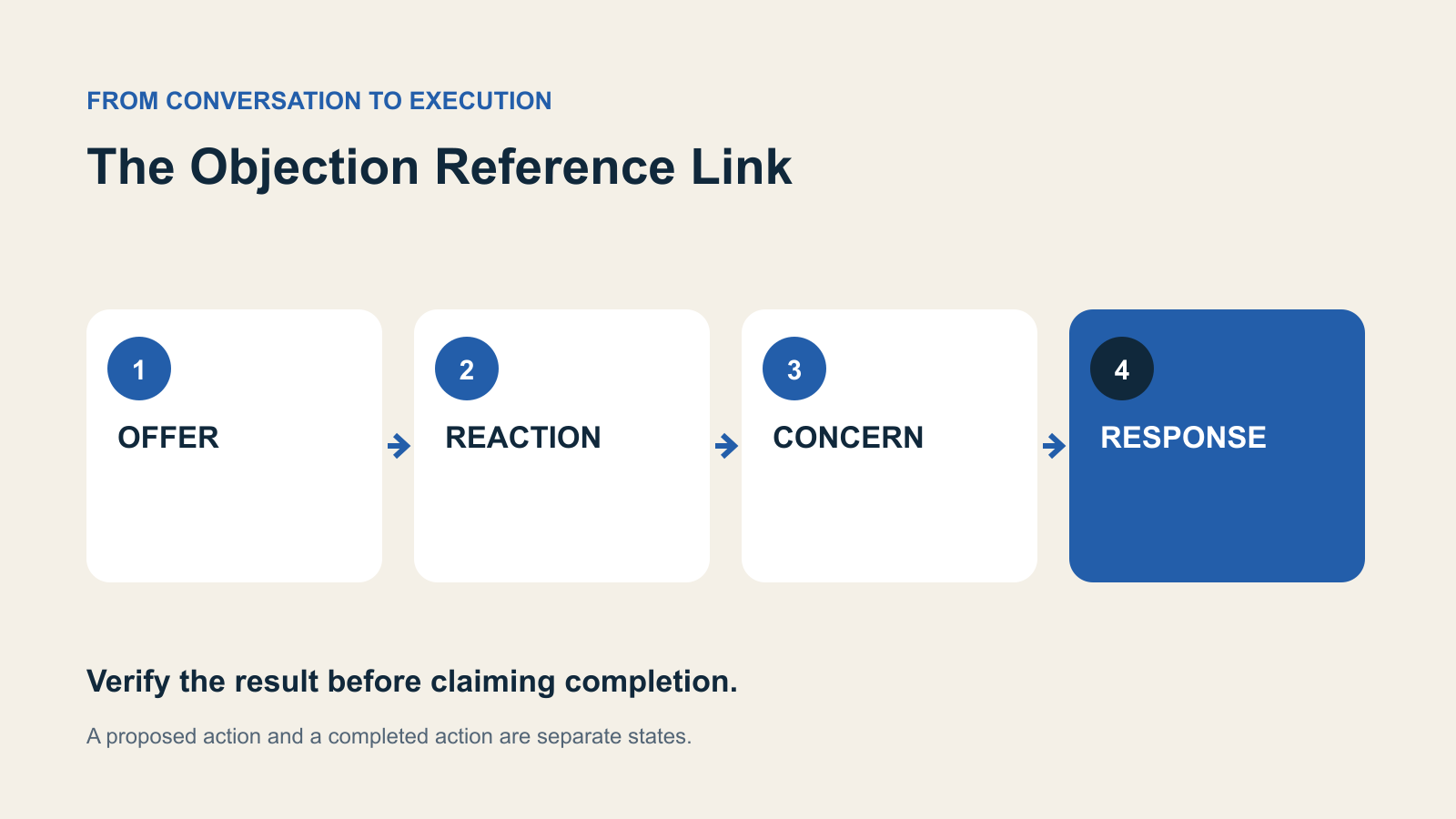
OFFER → REACTION → CONCERN → RESPONSE: review the state transition, not just the response.
Measure decision accuracy alongside customer effort
Track objections linked to a verified offer, concern categories corrected after review, and discounts proposed without a supported price reference. Compare like scopes when analyzing patterns. Mixing base prices with all-inclusive quotes produces a trend that may be numerically precise and commercially meaningless.
Use an explicitly illustrative audit to make the denominator clear. Suppose reviewers inspect 40 cases that genuinely require The Objection Reference Link, and find 6 unsupported actions. That is 6 divided by 40, or 15% in that sample. It is not a market benchmark or an expected result. Counting 200 unrelated greetings alongside those cases would hide the failure without fixing it. Keep the relevant case count, error count, review rules, and uncertainty visible when reporting the result.
Also inspect the opposite failure: an unnecessary hold when the evidence was already sufficient. Reviewers should distinguish a justified clarification from an avoidable repeat question. An appropriate human review is different from a case abandoned without an owner. Pair the action error rate with customer effort and completion evidence so the team cannot improve one dashboard by moving the cost to the customer or another department.
Connect The Objection Reference Link with the rest of customer operations
Brixi connects conversation analysis with CRM, buyer intent, AI assistants, voice, WhatsApp, workflows, and human teams. Analysis therefore has an operating destination: a corrected record, a prepared owner, a relevant next action, or a clearly held decision. Teams can use the same customer history to review what was interpreted and whether the resulting work advanced the journey.
For this use case, make the implementation review concrete: ask the Brixi team to walk through the original evidence, the current CRM state, the permitted action, and recovery when that action cannot complete. Validate any required source system, permission rule, and approval path during configuration. The recommended operating design in this article should be demonstrated against the actual deployment rather than assumed from a generic AI feature label.
For the wider operating model, read the conversation analysis guide. The important connection is between interpretation and accountable execution: the same evidence should prepare the assistant, the responsible human, and the next workflow.
What to inspect after the first quarter
After a quarter, the useful evidence is a change in operating behavior: fewer unsupported actions, fewer repeated clarifications, and clearer ownership of unresolved cases. Treat these as questions to investigate, not promised gains. Compare similar journey types and inspect the difficult cases as well as the average. Improvements should survive a new owner, a changed source record, and an ordinary customer correction.
The deeper bet behind The Objection Reference Link
Conversation intelligence becomes commercially useful when language is connected to the thing being evaluated. Better tags alone will not improve pricing decisions. Teams need a shared record of the offer, the reaction, and the next justified action across AI, CRM, and human negotiation.
Put The Objection Reference Link into a connected customer workflow
Explore how Brixi connects conversation intelligence, CRM, AI assistants, conversations, workflows, and human teams around a reliable next action.