Two People on One Call: How Voice AI Should Track Who Said What

Voice AI needs a Participant Decision Map when several people share a call. The system should preserve who expressed each requirement, whether they agree, and who is authorized for the next decision.
Imagine a couple calling about a rental. One says the commute is the main priority. The other says a ground-floor unit is essential. The assistant compresses both into “prefers ground floor near work” without establishing whose office or which requirement can change. A useful joint conversation becomes a misleading single-person profile.

The Participant Decision Map keeps the customer’s meaning connected to the next action.
Voice AI needs a Participant Decision Map when several people share a call. The system should preserve who expressed each requirement, whether they agree, and who is authorized for the next decision. Combining voices into one summary should not erase unresolved differences.
Speaker labels do not establish decision roles
Separate participant identification from technical speaker labels. A label such as speaker two does not establish that person’s name or role. Ask only the identification needed for the task, then attach preferences and commitments to their actual subject. Where attribution remains uncertain, retain the uncertainty rather than manufacturing a neat household consensus.
Participant roles can be temporary and task-specific. One person may coordinate viewing times while another decides the budget. Do not assign universal authority from a single exchange. Ask who should confirm the next action when that distinction matters. A readable brief can preserve separate roles without exposing a technical speaker graph to the customer. For the advisor, the useful information is who requested the feature, who accepted the appointment, and which decision remains open.
A joint conversation can contain unresolved disagreement
Merged preferences lead to poor recommendations and repeated discovery. One participant hears a requirement treated as optional even though they described it as essential. Another is recorded as agreeing to a visit that only their partner proposed. The team then interprets disagreement as a late objection rather than information it already had.
The practical failure is specific: several voices become an invented consensus. The desired behavior is equally specific: each requirement retains its speaker and agreement state. Use those two statements as the review boundary. A response should be judged by the state it leaves behind, not only by whether its wording sounds helpful.
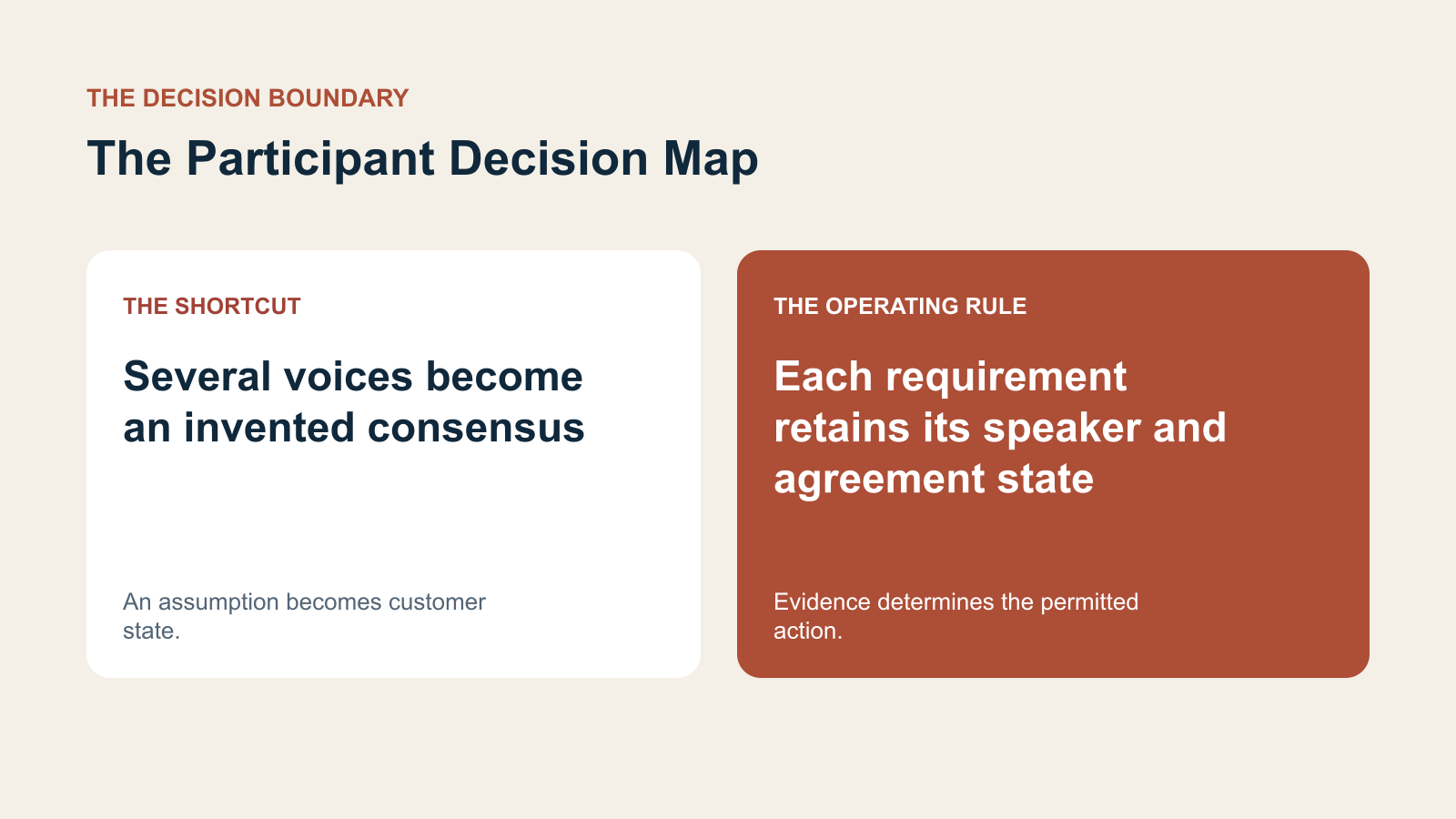
The Participant Decision Map: the wrong shortcut and the evidence-based decision.
The working record behind The Participant Decision Map
The record needs enough structure for another owner to verify the interpretation. For this journey, preserve four parts together rather than scattering them across a transcript, a note, and an action queue. Each part below has a different operating purpose. A populated field is useful only if the next owner can tell what it refers to and whether it is current.
Participants, stated roles, and attribution certainty
Separate technical speaker labels from known roles. Speaker two is not automatically the buyer, payer, or person authorized to approve the next action.
Requirements attached to the correct person
Attach requirements to the correct participant. Commute preferences and access needs should not be averaged into an invented single-person profile.
Agreement, disagreement, and unresolved trade-offs
Preserve disagreement until resolved. Silence from one participant does not establish consensus about a time, requirement, or commercial choice.
Authorized next action and required attendees
Confirm the people required for the next step. A proposed viewing should respect each relevant attendee's availability or the verified delegation to a coordinator.
Confirm shared commitments before recording consensus
Reflect the two needs explicitly: one participant is prioritizing commute, and the other needs ground-floor access. Ask whether both are non-negotiable for the shortlist. Before booking, confirm who will attend and whether the proposed time works for the relevant people. Store any remaining disagreement as open decision context, not a resolved preference.
A suitable clarification or acknowledgment in this illustrative scenario is: “Should the shortlist satisfy both of those requirements?” The wording is an example to adapt to the approved customer process, not a universal script. Its purpose is to make the next decision clear without claiming that an unverified action has already completed.
Agreement should be explicit where the action requires it. Silence from the second participant does not necessarily mean consent. If attendance requires both people, confirm both availability constraints. If the buyer authorizes one person to coordinate scheduling, retain that delegation and its scope. This reduces repeated questions later while avoiding the assumption that every participant’s statement automatically binds everyone else on the call.
The Participant Decision Map
Several voices become an invented consensus. Each requirement retains its speaker and agreement state.
The boundary cases that change the correct action
Participants can interrupt, hand the phone over, or speak on behalf of an absent person. Do not assume the loudest speaker is the buyer or approver. Shared conversation also does not grant unrestricted permission to disclose information from each participant’s separate prior history. Use only context appropriate to the current discussion.
Choose a multi-person journey such as property or education. Review calls with a participant-aware brief showing statements, roles, agreement, and open issues. Test whether a human advisor can continue without rediscovering who wanted what. Keep the brief short enough to use, with source segments for consequential statements.
Introduce the change in review mode first. The assistant prepares an interpretation and proposed next step while the existing authorized process remains in control. Collect disagreements with a reason, including cases where the reviewer lacks enough evidence to decide. Once the team can distinguish an interpretation mistake from a policy exception, expand only the narrowly defined actions that consistently produce reviewable results.
How to test The Participant Decision Map before expanding it
Begin the evaluation with the business decision, not the quality of the wording. Have a reviewer inspect the original exchange and identify the action it actually permits. Then compare the assistant’s interpretation, saved record, and customer-facing message. These three outputs can disagree even when each appears reasonable in isolation.
- Two people state different requirements; the summary preserves both.
- A participant proposes a time; the other person’s availability is not assumed.
- A phone handover occurs; later statements are not blindly attributed to the first speaker.
Review the final brief with a person who did not hear the call. Ask them to describe each participant’s requirement and the next justified action. If they infer a consensus that the recording does not support, the brief is too compressed. Add cases with unnamed speakers and uncertain attribution. A useful assistant can say that a requirement was expressed but its speaker needs confirmation, instead of manufacturing a name or household preference to complete the record.
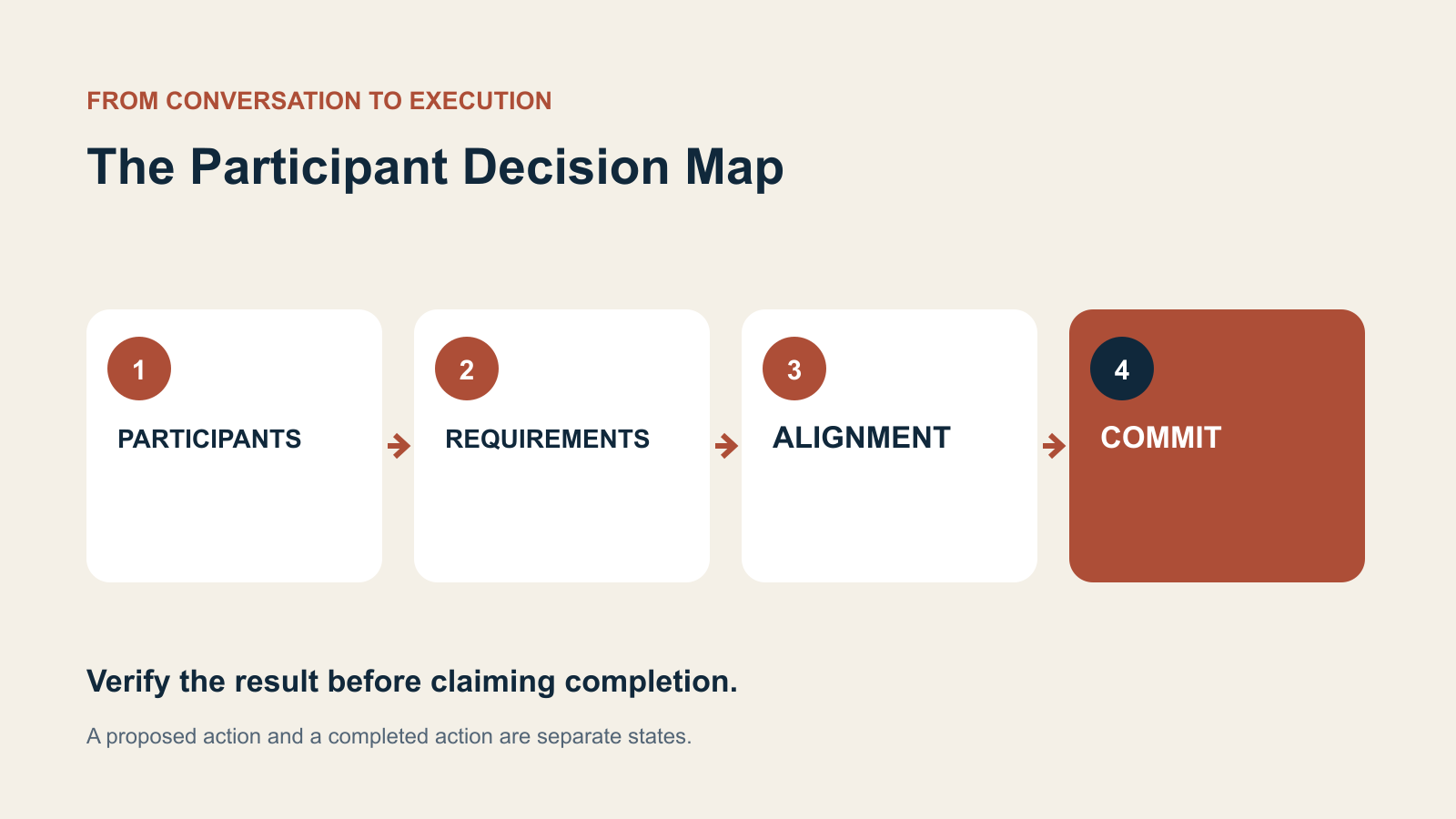
PARTICIPANTS → REQUIREMENTS → ALIGNMENT → COMMIT: review the state transition, not just the response.
Measure decision accuracy alongside customer effort
Track misattributed requirements, commitments assigned to the wrong participant, and disagreements incorrectly summarized as consensus. Review whether clarifications reduce repeated questioning. Speaker-count accuracy alone does not establish that the business meaning was assigned correctly.
Use an explicitly illustrative audit to make the denominator clear. Suppose reviewers inspect 40 cases that genuinely require The Participant Decision Map, and find 6 unsupported actions. That is 6 divided by 40, or 15% in that sample. It is not a market benchmark or an expected result. Counting 200 unrelated greetings alongside those cases would hide the failure without fixing it. Keep the relevant case count, error count, review rules, and uncertainty visible when reporting the result.
Also inspect the opposite failure: an unnecessary hold when the evidence was already sufficient. Reviewers should distinguish a justified clarification from an avoidable repeat question. An appropriate human review is different from a case abandoned without an owner. Pair the action error rate with customer effort and completion evidence so the team cannot improve one dashboard by moving the cost to the customer or another department.
Connect The Participant Decision Map with the rest of customer operations
Brixi treats Voice AI as part of a complete AI-native customer platform. Calls connect with CRM memory, WhatsApp, workflow execution, qualification, routing, and the human team. The operating benefit is that a phone event can be reviewed beside the customer state and the next action, instead of requiring an operator to reconcile a dialer, a transcript archive, and a separate task queue.
For this use case, make the implementation review concrete: ask the Brixi team to walk through the original evidence, the current CRM state, the permitted action, and recovery when that action cannot complete. Validate any required source system, permission rule, and approval path during configuration. The recommended operating design in this article should be demonstrated against the actual deployment rather than assumed from a generic AI feature label.
For the wider operating model, read the anatomy of a Voice AI agent. The important connection is between interpretation and accountable execution: the same evidence should prepare the assistant, the responsible human, and the next workflow.
What to inspect after the first quarter
At the first monthly review, look for the failure that has moved elsewhere. A cleaner conversation can still leave a stale task or an unowned approval. During the following reviews, sample complete journeys from original evidence to customer-visible outcome. Expand the scope only when the team can explain the remaining exceptions and the responsible owner can recover them without reconstructing the entire thread.
The deeper bet behind The Participant Decision Map
Customer platforms will need to understand decision groups while respecting the people inside them. Voice AI can help coordinate a shared conversation, but only if it preserves individual requirements and actual agreement. A single customer journey should not require a fictional single voice.
Put The Participant Decision Map into a connected customer workflow
Explore how Brixi connects Voice AI, CRM, AI assistants, conversations, workflows, and human teams around a reliable next action.