Automotive AI: Turn a Customer’s Repair Approval Into an Exact Work Instruction

Automotive conversation AI needs a Repair Authorization Map that connects customer approval to specific work items and the current estimate version. General agreement should not become blanket authorization.
Consider a service advisor sending an estimate with brake work, a diagnostic check, and an optional cleaning package. The customer replies, “Do the necessary work, skip the extra.” An assistant marks the full estimate approved because it detects an affirmative response. The technician starts a job the customer intended to decline.

The Repair Authorization Map keeps the customer’s meaning connected to the next action.
Automotive conversation AI needs a Repair Authorization Map that connects customer approval to specific work items and the current estimate version. General agreement should not become blanket authorization. The assistant’s useful job is to resolve scope and prepare a precise instruction for the service team.
A positive reply does not approve every line item
Keep required recommendations, optional items, prices, estimate revisions, and approval evidence separate. Interpret the customer’s reply against the actual line items. Where necessary and optional are unclear, route clarification to the authorized service advisor. AI should not determine mechanical necessity or override the workshop’s professional judgment.
Line-item approval needs a stable reference to the work described. A renamed task, revised amount, or added component can change what the customer is being asked to authorize. Keep the approved estimate version visible to the advisor and technician. If the wording changes materially, obtain the required fresh decision rather than assuming a previous general approval covers it. The assistant should make the difference easy to understand without inventing mechanical judgments.
The technician needs scope, not a sentiment label
Incorrect approval creates billing disputes, wasted parts, and interruptions on the workshop floor. A technician may follow the recorded instruction correctly while the underlying authorization is wrong. The customer experiences the failure as unauthorized work, not a language-model classification issue.
The practical failure is specific: a general yes approves every estimate item. The desired behavior is equally specific: each work instruction has exact authorization. Use those two statements as the review boundary. A response should be judged by the state it leaves behind, not only by whether its wording sounds helpful.
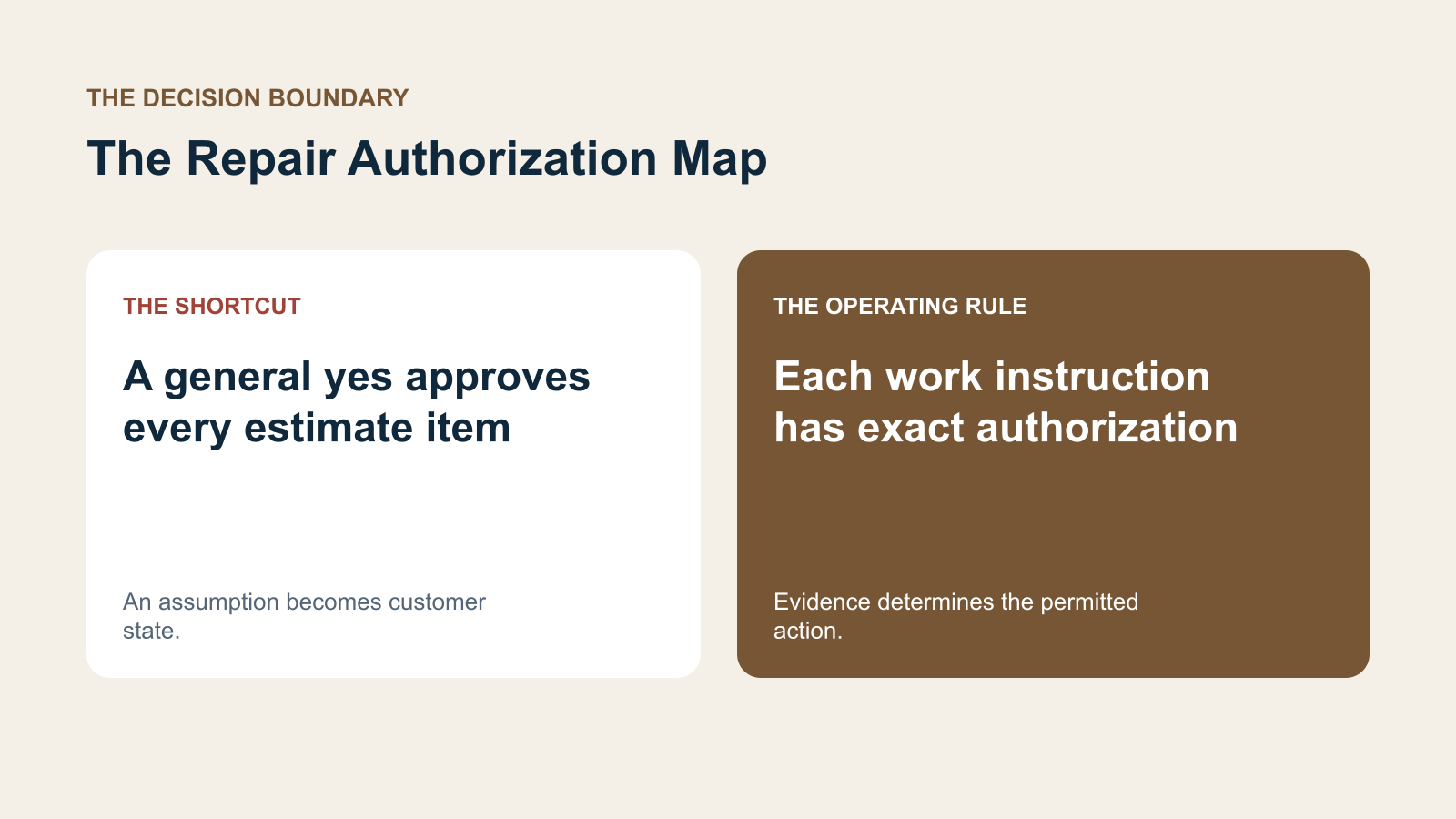
The Repair Authorization Map: the wrong shortcut and the evidence-based decision.
The working record behind The Repair Authorization Map
The record needs enough structure for another owner to verify the interpretation. For this journey, preserve four parts together rather than scattering them across a transcript, a note, and an action queue. Each part below has a different operating purpose. A populated field is useful only if the next owner can tell what it refers to and whether it is current.
Vehicle, estimate, and line-item versions
Keep the vehicle, estimate, and line-item version together. Similar task names across revisions may describe different work or prices.
Accepted, declined, and unresolved work
Record accepted, declined, and pending work independently. A general affirmative should not turn optional items into authorized technician instructions.
Customer authority and explicit approval evidence
Verify approval authority and retain the actual customer response. The person replying, paying, and owning the vehicle may have different roles.
Technician instruction and later change requests
Release only the authorized scope and review later changes. New inspection findings should follow the workshop's approved additional-authorization process.
Additional findings need a new authorization decision
Hold the ambiguous approval and ask which listed items the customer wants to authorize, using the advisor’s approved explanation of the work. Record accepted, declined, and pending items separately. Send the technician the authorized scope and version. If inspection reveals additional work, open a new approval request rather than treating the initial response as permission for every later finding.
A suitable clarification or acknowledgment in this illustrative scenario is: “Which of these listed items would you like to authorize?” The wording is an example to adapt to the approved customer process, not a universal script. Its purpose is to make the next decision clear without claiming that an unverified action has already completed.
The technician brief should identify permitted work, declined work, and items still awaiting approval. A generic note such as customer agreed leaves too much room for interpretation. Include relevant spending or timing conditions through the workshop’s approved process. If the customer later withdraws or narrows approval, coordinate the change with actual work state. The assistant must not claim a task was stopped if the technician has already completed it or a human review is required.
The Repair Authorization Map
A general yes approves every estimate item. Each work instruction has exact authorization.
The boundary cases that change the correct action
A customer may set a spending cap instead of approving named items. The business needs an approved rule for whether and how that cap authorizes work. Another person may be paying while the vehicle owner approves repairs. Preserve roles and do not infer authority from whoever replies first.
Start with estimate approval and a small line-item schema. Compare AI interpretations with advisor review before release to the workshop. Test revised estimates, partial approvals, spending caps, and withdrawn instructions. Link completion and billing to the authorized scope so a correct conversation record remains useful downstream.
Deploy the operating rule alongside the assistant. Staff need to know which facts they can correct, which decisions require approval, and how an unresolved case returns to a person. Make that return path visible in the same customer record. Avoid a parallel spreadsheet of exceptions that leaves the next advisor unaware of the actual state.
How to test The Repair Authorization Map before expanding it
Test the complete journey rather than a single response. A correct sentence can still trigger the wrong task, and a corrected CRM field can coexist with an outdated outbound message. Review the original evidence, the resulting record, and the action received by the next owner together.
- The customer approves only two items; other work remains unapproved.
- The estimate changes; previous approval is not silently extended.
- A spending cap is ambiguous; the advisor clarifies before work is released.
Test partial approval, a vague instruction to do necessary work, a new finding after inspection, and a customer changing their decision. Review the messages alongside the released work order and invoice. An accurate approval summary is not sufficient if the workshop receives a broader instruction. The complete test follows the customer’s authorization into physical execution and verifies that later billing reflects the work actually approved and performed.
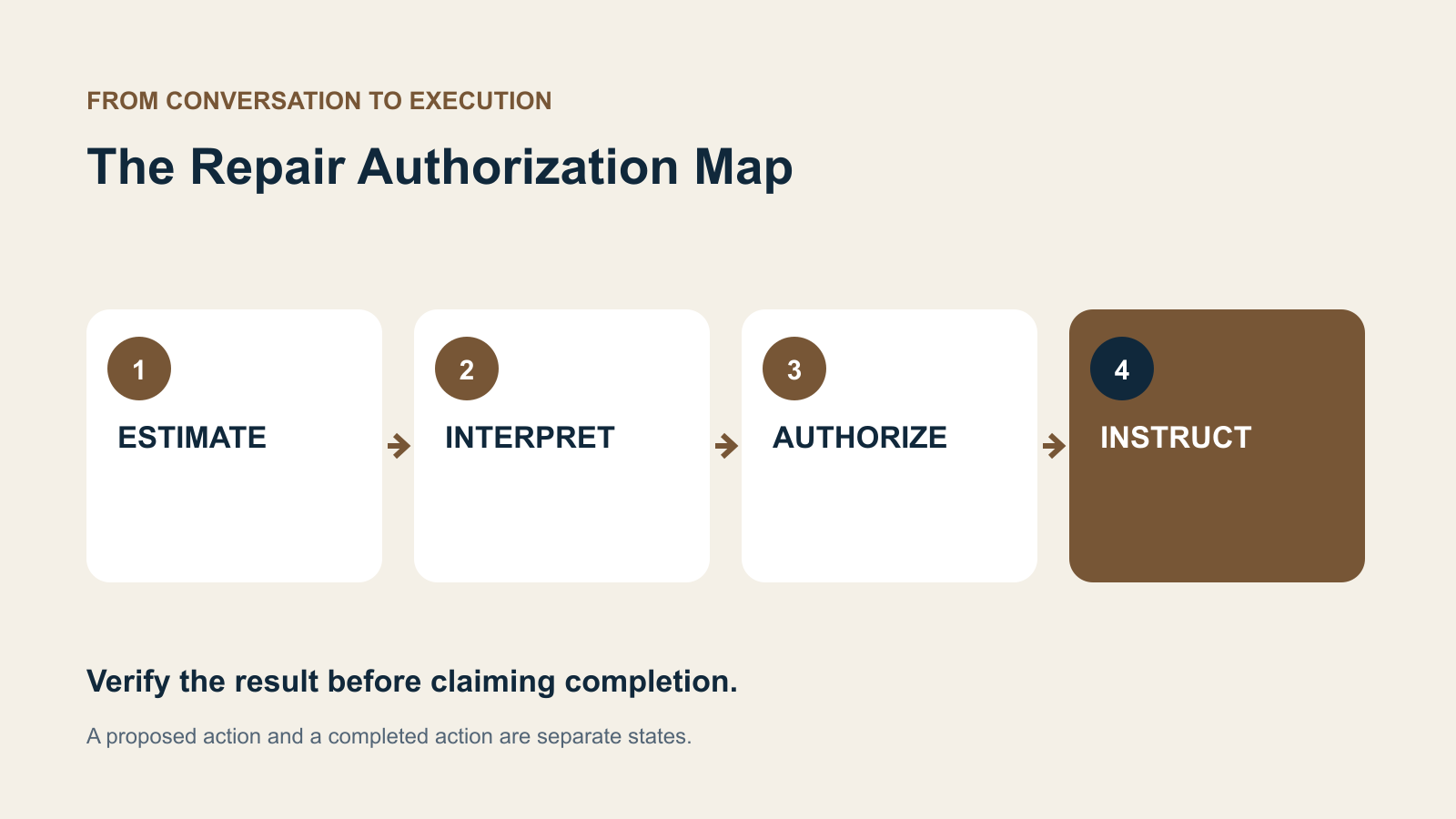
ESTIMATE → INTERPRET → AUTHORIZE → INSTRUCT: review the state transition, not just the response.
Measure decision accuracy alongside customer effort
Track line items performed without matching authorization, repeated approval requests, and disputes caused by estimate-version mismatch. Review whether the technician could identify the exact permitted work without opening every message. Approval speed matters only alongside scope correctness.
Use an explicitly illustrative audit to make the denominator clear. Suppose reviewers inspect 40 cases that genuinely require The Repair Authorization Map, and find 6 unsupported actions. That is 6 divided by 40, or 15% in that sample. It is not a market benchmark or an expected result. Counting 200 unrelated greetings alongside those cases would hide the failure without fixing it. Keep the relevant case count, error count, review rules, and uncertainty visible when reporting the result.
Also inspect the opposite failure: an unnecessary hold when the evidence was already sufficient. Reviewers should distinguish a justified clarification from an avoidable repeat question. An appropriate human review is different from a case abandoned without an owner. Pair the action error rate with customer effort and completion evidence so the team cannot improve one dashboard by moving the cost to the customer or another department.
Connect The Repair Authorization Map with the rest of customer operations
Brixi is a complete AI-native customer platform combining assistants, CRM, voice, WhatsApp, omnichannel context, intelligence, workflows, and human execution. These capabilities let teams connect what a customer says with a governed business process. The assistant handles interpretation within configured boundaries, while the responsible team retains the decisions that require policy authority or professional judgment.
For this use case, make the implementation review concrete: ask the Brixi team to walk through the original evidence, the current CRM state, the permitted action, and recovery when that action cannot complete. Validate any required source system, permission rule, and approval path during configuration. The recommended operating design in this article should be demonstrated against the actual deployment rather than assumed from a generic AI feature label.
For the wider operating model, read the AI workflow examples. The important connection is between interpretation and accountable execution: the same evidence should prepare the assistant, the responsible human, and the next workflow.
What to inspect after the first quarter
After a quarter, the useful evidence is a change in operating behavior: fewer unsupported actions, fewer repeated clarifications, and clearer ownership of unresolved cases. Treat these as questions to investigate, not promised gains. Compare similar journey types and inspect the difficult cases as well as the average. Improvements should survive a new owner, a changed source record, and an ordinary customer correction.
The deeper bet behind The Repair Authorization Map
Service AI becomes valuable when interpretation reaches the physical job accurately. A complete customer platform connects the estimate, customer conversation, advisor decision, technician brief, and follow-up. That preserves human expertise while removing ambiguity from the coordination around it.
Put The Repair Authorization Map into a connected customer workflow
Explore how Brixi connects applied conversation AI, CRM, AI assistants, conversations, workflows, and human teams around a reliable next action.