Property Counteroffers Need AI That Knows Which Terms Are Still Active

AI property negotiation support needs an Active Offer Envelope: a complete set of terms from one authorized proposal. Individual terms cannot be mixed across versions simply because each appeared somewhere in the conversation.
Consider a resale negotiation with three messages: the seller proposes one amount, the buyer counters with a different completion date, and the seller later changes the included furniture. The assistant summarizes the lowest price and earliest date together. Nobody offered that combination, but the resulting message looks like an agreed deal.

The Active Offer Envelope keeps the customer’s meaning connected to the next action.
AI property negotiation support needs an Active Offer Envelope: a complete set of terms from one authorized proposal. Individual terms cannot be mixed across versions simply because each appeared somewhere in the conversation. Agreement requires acceptance of a coherent offer, not a collection of favorable fragments.
A negotiation is not a bag of interchangeable facts
Link amount, conditions, inclusions, deadlines, and proposer to the same version. Identify which counteroffer replaces or leaves open an earlier proposal. Track whether a response accepts, rejects, or changes only part of the offer. Ambiguous acknowledgments should trigger clarification rather than a statement that the parties have agreed.
A proposal needs a whole-state view. If the seller accepts the amount but changes the completion date, that may create a counterproposal rather than acceptance of the buyer’s complete offer. The assistant should preserve the distinction in its brief and leave the approval decision with the authorized participants. Do not force the exchange into accepted or rejected when the actual state is partial agreement with remaining conditions. That intermediate state is often the most useful context for the agent.
Correct extraction can still produce a false deal
Invented agreement damages trust on both sides. The seller believes the agent conceded something without authority. The buyer believes the company withdrew a promise. Human brokers then reconstruct the thread while deadlines pass. The assistant may have extracted every individual fact correctly and still assembled a transaction nobody authorized.
The practical failure is specific: favorable fragments become an invented agreement. The desired behavior is equally specific: each proposed deal remains a coherent term bundle. Use those two statements as the review boundary. A response should be judged by the state it leaves behind, not only by whether its wording sounds helpful.
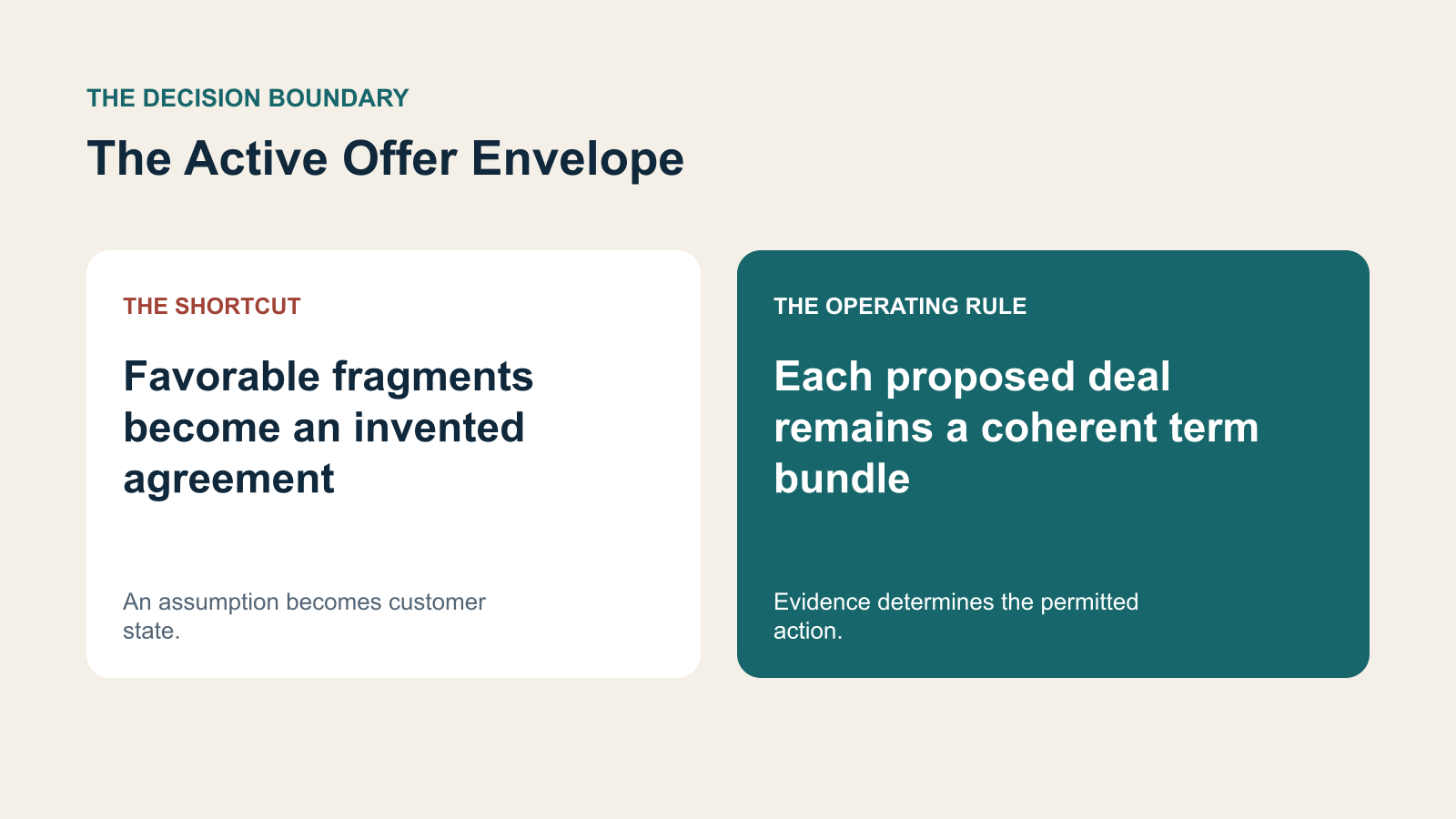
The Active Offer Envelope: the wrong shortcut and the evidence-based decision.
The working record behind The Active Offer Envelope
The record needs enough structure for another owner to verify the interpretation. For this journey, preserve four parts together rather than scattering them across a transcript, a note, and an action queue. Each part below has a different operating purpose. A populated field is useful only if the next owner can tell what it refers to and whether it is current.
Proposal identifier, author, and authority
Identify the proposer and verified authority for each offer. Relaying a position is not automatically permission to accept terms on another party's behalf.
Complete term bundle and source messages
Keep the complete term bundle together. Amount, inclusions, dates, and conditions from different proposals must not be assembled into a fictional agreement.
Expiry, replacement, and acceptance state
Track replacement, expiry, and acceptance distinctly. A late reference may need renewed review rather than an automatic claim that agreement has occurred.
Open differences and required human decision
Show the remaining differences to the responsible agent. Partial agreement should stay visible without collapsing into an unsupported accepted or rejected label.
Preserve each complete proposal until the parties decide
Present the current seller proposal as one bundle and the buyer’s latest response as another. Explain the differences in plain language and ask the authorized party to confirm the intended terms. Keep the next action as review or negotiation until the business’s required acceptance process is complete. Do not label a casual message as a legally binding agreement.
A suitable clarification or acknowledgment in this illustrative scenario is: “Are you accepting this complete proposal or changing one of its terms?” The wording is an example to adapt to the approved customer process, not a universal script. Its purpose is to make the next decision clear without claiming that an unverified action has already completed.
Expiry should be treated as a commercial condition requiring current review. A buyer’s late reply may be a request to revive an offer rather than valid acceptance under the business’s process. The assistant should identify the reference and route the question, not make a legal determination. Keep the difference between proposed terms and terms the business is currently willing to honor visible before any payment, reservation, or public statement follows.
The Active Offer Envelope
Favorable fragments become an invented agreement. Each proposed deal remains a coherent term bundle.
The boundary cases that change the correct action
Two counteroffers may cross before either party sees the other. An expired offer may be referenced later. A representative may relay a position without authority to accept it. The assistant must preserve those distinctions and route uncertain authority or contractual questions to the responsible human professional.
Choose a negotiation-support workflow with explicit human approval. Assign identifiers to proposals and connect every term to its source. Review the generated comparison before sending. Test crossed offers, partial acceptance, deadline extensions, and changes in the authorized representative.
Start with one team, one journey, and a named owner for exceptions. Keep the first version small enough that staff can inspect every consequential decision. Use disagreement reviews to improve the context and operating rules before increasing automation. A model cannot compensate for an undefined approval process or an owner who never receives the work.
How to test The Active Offer Envelope before expanding it
A useful review set includes ordinary success, ambiguity, a correction, and a failure after interpretation. Label the expected business state before looking at the assistant’s answer. Otherwise reviewers can be persuaded by fluent wording to accept a decision that the original evidence never supported.
- Different versions contain different benefits; the assistant does not combine them.
- Counteroffers cross; neither is represented as acceptance of the other.
- A representative relays a proposal; authority is checked before recording agreement.
Test crossed messages in different orders. Deliver the buyer’s revision before the seller’s earlier reply, then reverse the arrival order. The current summary should still preserve authorship and proposal relationships rather than treating the last processed message as universal authority. Review complete term bundles with the human agent. The useful output is a clear map of open differences, not a confident statement of agreement assembled from incompatible fragments.
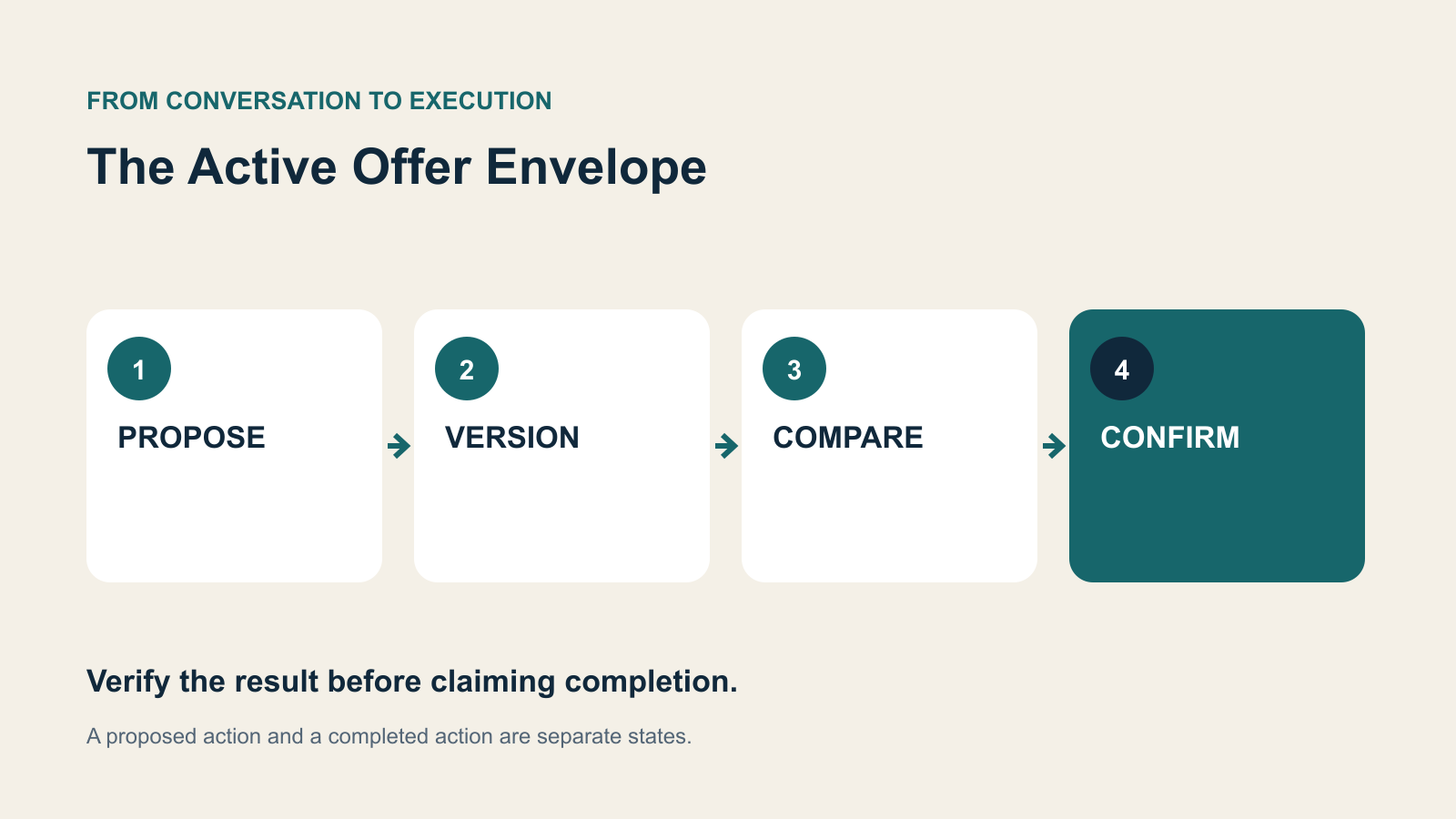
PROPOSE → VERSION → COMPARE → CONFIRM: review the state transition, not just the response.
Measure decision accuracy alongside customer effort
Track terms combined from incompatible versions, statements of agreement without evidence, and time spent reconstructing the active position. Review whether the AI brief helps the agent ask the next precise question. The target is reliable negotiation support, not autonomous agreement creation.
Use an explicitly illustrative audit to make the denominator clear. Suppose reviewers inspect 40 cases that genuinely require The Active Offer Envelope, and find 6 unsupported actions. That is 6 divided by 40, or 15% in that sample. It is not a market benchmark or an expected result. Counting 200 unrelated greetings alongside those cases would hide the failure without fixing it. Keep the relevant case count, error count, review rules, and uncertainty visible when reporting the result.
Also inspect the opposite failure: an unnecessary hold when the evidence was already sufficient. Reviewers should distinguish a justified clarification from an avoidable repeat question. An appropriate human review is different from a case abandoned without an owner. Pair the action error rate with customer effort and completion evidence so the team cannot improve one dashboard by moving the cost to the customer or another department.
Connect The Active Offer Envelope with the rest of customer operations
Brixi brings AI assistants, CRM, voice, WhatsApp, buyer intent, workflows, and team execution together for real estate teams. The platform connects customer conversations with ownership and follow-through across the property journey. This is more useful than adding an isolated property chatbot: the agent, relationship manager, and operations owner work from connected customer context.
For this use case, make the implementation review concrete: ask the Brixi team to walk through the original evidence, the current CRM state, the permitted action, and recovery when that action cannot complete. Validate any required source system, permission rule, and approval path during configuration. The recommended operating design in this article should be demonstrated against the actual deployment rather than assumed from a generic AI feature label.
For the wider operating model, read the existing AI in real estate guide. The important connection is between interpretation and accountable execution: the same evidence should prepare the assistant, the responsible human, and the next workflow.
What to inspect after the first quarter
At the first monthly review, look for the failure that has moved elsewhere. A cleaner conversation can still leave a stale task or an unowned approval. During the following reviews, sample complete journeys from original evidence to customer-visible outcome. Expand the scope only when the team can explain the remaining exceptions and the responsible owner can recover them without reconstructing the entire thread.
The deeper bet behind The Active Offer Envelope
Conversational AI will help property teams most when it protects the integrity of negotiated meaning. A connected CRM and communication platform can retain the full path from proposal to decision. That reduces memory disputes while leaving commercial authority with the people entitled to exercise it.
Put The Active Offer Envelope into a connected customer workflow
Explore how Brixi connects AI for real estate, CRM, AI assistants, conversations, workflows, and human teams around a reliable next action.