The Call Dropped During Booking. What Did the Voice AI Actually Complete?
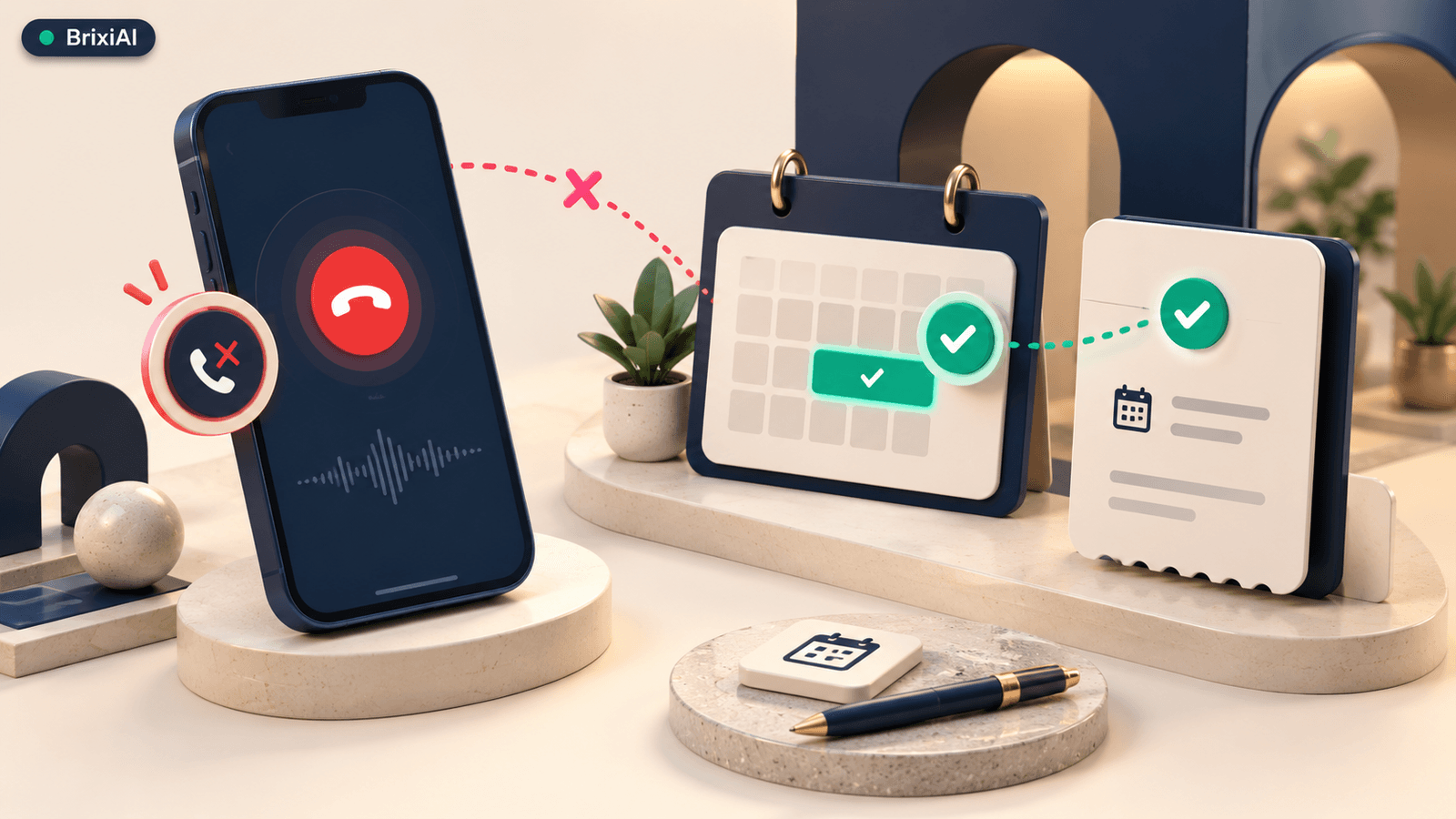
Voice AI needs a Conversation Action Split between what was said, what was requested, and what the business system completed. A dropped call cannot establish either successful booking or no booking.
Consider a customer choosing a Thursday appointment. The assistant starts creating the booking, the line disconnects, and the customer hears no confirmation. The booking service may have completed the action even though the call failed. A retry creates another slot because the next assistant assumes nothing happened.
The Conversation Action Split keeps the customer’s meaning connected to the next action.
Voice AI needs a Conversation Action Split between what was said, what was requested, and what the business system completed. A dropped call cannot establish either successful booking or no booking. Recovery must inspect the authoritative action state before issuing another request or telling the customer what happened.
A failed call does not establish a failed booking
Give each intended booking a stable request reference. Track proposed, submitted, confirmed, failed, and unknown states separately. Store the business system’s result when available. If a request times out, reconcile by its reference before retrying. A transcript ending before confirmation is evidence about the conversation, not definitive evidence about the transaction.
The recovery record needs to survive the call session. Store the request reference and known action state in the operating system rather than relying on an in-memory conversation summary. The next assistant or human should see that a booking was attempted and whether reconciliation is still required. Otherwise a restart looks like a fresh request and repeats the same uncertainty. Durable references make the recovery path inspectable without requiring staff to infer the state from the last spoken sentence.
Unknown outcomes need reconciliation before retries
Unreconciled retries consume scarce capacity and create contradictory reminders. Staff may cancel the wrong duplicate or tell the customer they failed to attend an appointment they never knew existed. Reporting then counts several bookings from one intention and several failures from one interrupted call.
The practical failure is specific: call failure is assumed to mean action failure. The desired behavior is equally specific: recovery checks the authoritative booking state. Use those two statements as the review boundary. A response should be judged by the state it leaves behind, not only by whether its wording sounds helpful.
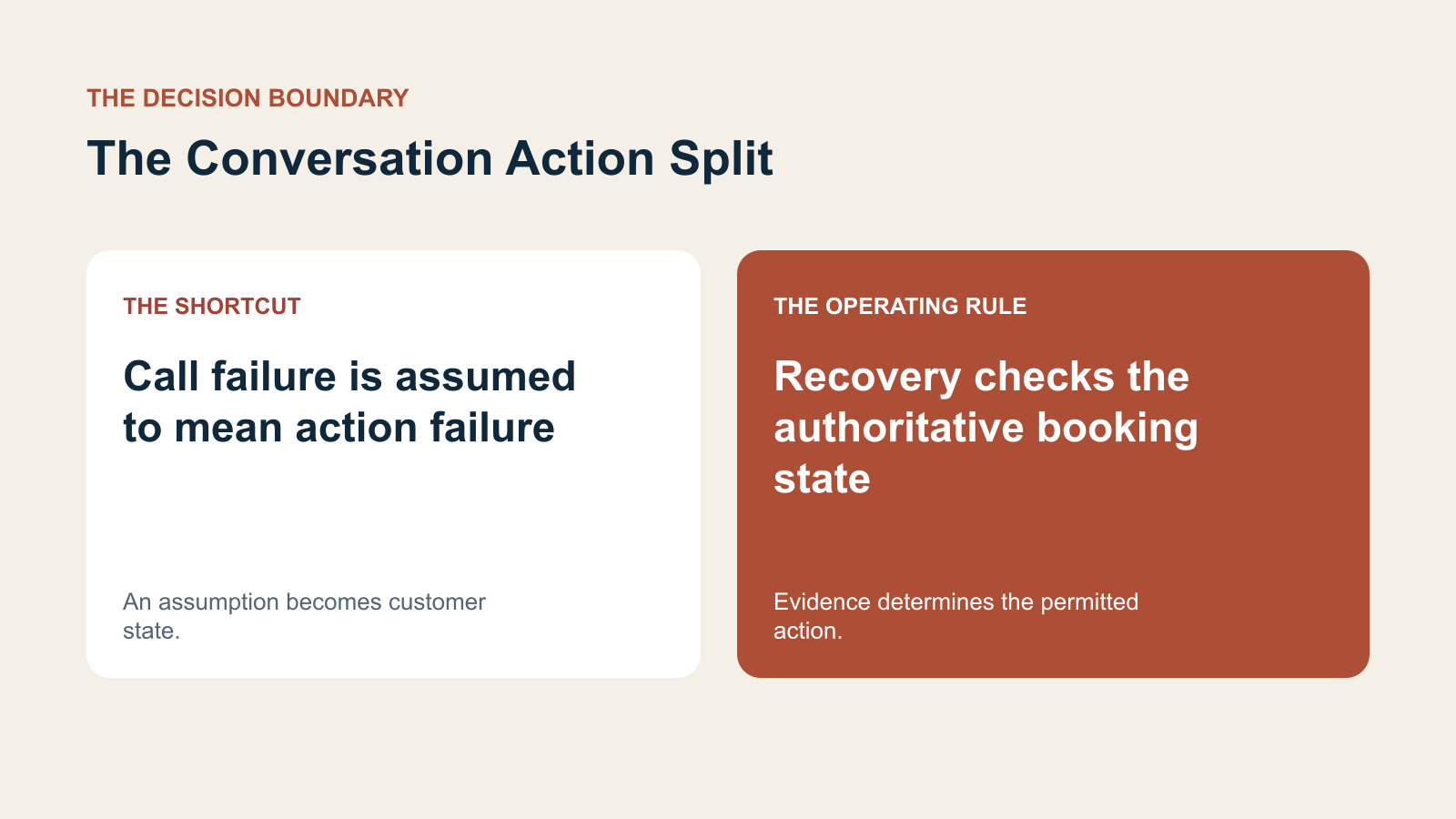
The Conversation Action Split: the wrong shortcut and the evidence-based decision.
The working record behind The Conversation Action Split
The record needs enough structure for another owner to verify the interpretation. For this journey, preserve four parts together rather than scattering them across a transcript, a note, and an action queue. Each part below has a different operating purpose. A populated field is useful only if the next owner can tell what it refers to and whether it is current.
Stable booking request reference
Use a stable request reference across recovery. A restarted call should be able to locate the attempted action instead of creating a fresh duplicate.
Action state and authoritative result
Preserve unknown state when execution is unresolved. A timeout is not reliable evidence that a booking either succeeded or failed.
Call termination point and confirmation delivery
Separate the action result from delivery of its confirmation. The booking may exist even when the customer never heard the final spoken details.
Reconciliation owner and customer’s current intention
Assign reconciliation and confirm the customer's current intention. A technically safe retry can still be wrong if the customer booked elsewhere after disconnection.
Confirm what the system did, not what the transcript suggests
On recovery, check whether the Thursday request exists. If confirmed, send or read the verified details through an allowed channel. If absent and retry is safe, recheck availability and customer intent before creating it. If the state is unknown, explain that confirmation is being checked and assign an owner rather than making a confident claim in either direction.
A suitable clarification or acknowledgment in this illustrative scenario is: “I am checking whether the Thursday booking completed before making another request.” The wording is an example to adapt to the approved customer process, not a universal script. Its purpose is to make the next decision clear without claiming that an unverified action has already completed.
Customer communication should distinguish completion from notification. The booking may be confirmed while the spoken acknowledgment was interrupted. In that case, the useful next step is verified notification, not another booking. Conversely, the assistant may have said it was checking availability before the request failed. That is not a confirmation. Reviewing both the business result and the delivered message makes it possible to repair the actual gap without creating a second one.
The Conversation Action Split
Call failure is assumed to mean action failure. Recovery checks the authoritative booking state.
The boundary cases that change the correct action
A booking can complete and later be changed by another staff member. The retry should inspect the current state, not just an old success response. The customer may also have booked elsewhere after disconnection. Before recreating an absent request, establish that they still want the appointment.
Simulate disconnections before submission, during processing, after confirmation, and during the spoken confirmation. Review the action record and customer message together. Make unknown outcomes visible to the operations team, with a reconciliation path and a deadline. Recovery should be a designed workflow rather than a generic new call.
Introduce the change in review mode first. The assistant prepares an interpretation and proposed next step while the existing authorized process remains in control. Collect disagreements with a reason, including cases where the reviewer lacks enough evidence to decide. Once the team can distinguish an interpretation mistake from a policy exception, expand only the narrowly defined actions that consistently produce reviewable results.
How to test The Conversation Action Split before expanding it
Begin the evaluation with the business decision, not the quality of the wording. Have a reviewer inspect the original exchange and identify the action it actually permits. Then compare the assistant’s interpretation, saved record, and customer-facing message. These three outputs can disagree even when each appears reasonable in isolation.
- The line drops after booking success; the retry does not create another appointment.
- Submission times out; the system reconciles before repeating the action.
- The customer no longer wants the appointment; recovery respects the changed intention.
Use deliberate failure timing in the evaluation. Interrupt before a request, during an unknown response, immediately after success, and while the confirmation is being read. Repeat the recovery with the same request reference. Verify that the customer receives one current outcome and that capacity is not consumed twice. Add a later human edit to establish that recovery reads current state rather than blindly replaying the original successful response.
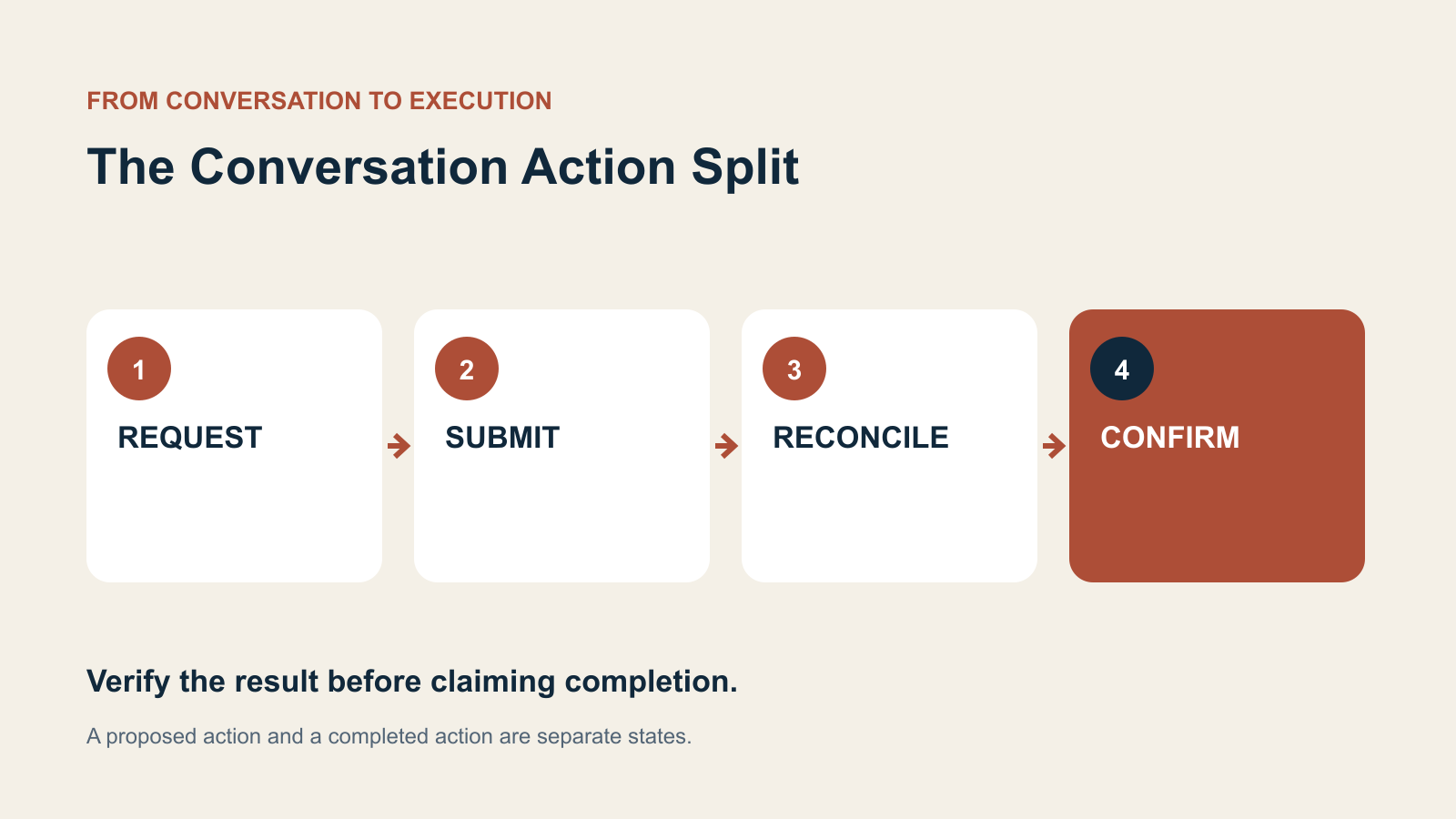
REQUEST → SUBMIT → RECONCILE → CONFIRM: review the state transition, not just the response.
Measure decision accuracy alongside customer effort
Track duplicate bookings after retries, confirmations sent without verified state, and time to reconcile unknown outcomes. Separate technical call failure from business-action failure. A call can fail while the booking succeeds, and a call can finish while the booking has never completed.
Use an explicitly illustrative audit to make the denominator clear. Suppose reviewers inspect 40 cases that genuinely require The Conversation Action Split, and find 6 unsupported actions. That is 6 divided by 40, or 15% in that sample. It is not a market benchmark or an expected result. Counting 200 unrelated greetings alongside those cases would hide the failure without fixing it. Keep the relevant case count, error count, review rules, and uncertainty visible when reporting the result.
Also inspect the opposite failure: an unnecessary hold when the evidence was already sufficient. Reviewers should distinguish a justified clarification from an avoidable repeat question. An appropriate human review is different from a case abandoned without an owner. Pair the action error rate with customer effort and completion evidence so the team cannot improve one dashboard by moving the cost to the customer or another department.
Connect The Conversation Action Split with the rest of customer operations
Brixi treats Voice AI as part of a complete AI-native customer platform. Calls connect with CRM memory, WhatsApp, workflow execution, qualification, routing, and the human team. The operating benefit is that a phone event can be reviewed beside the customer state and the next action, instead of requiring an operator to reconcile a dialer, a transcript archive, and a separate task queue.
For this use case, make the implementation review concrete: ask the Brixi team to walk through the original evidence, the current CRM state, the permitted action, and recovery when that action cannot complete. Validate any required source system, permission rule, and approval path during configuration. The recommended operating design in this article should be demonstrated against the actual deployment rather than assumed from a generic AI feature label.
For the wider operating model, read the anatomy of a Voice AI agent. The important connection is between interpretation and accountable execution: the same evidence should prepare the assistant, the responsible human, and the next workflow.
What to inspect after the first quarter
After a quarter, the useful evidence is a change in operating behavior: fewer unsupported actions, fewer repeated clarifications, and clearer ownership of unresolved cases. Treat these as questions to investigate, not promised gains. Compare similar journey types and inspect the difficult cases as well as the average. Improvements should survive a new owner, a changed source record, and an ordinary customer correction.
The deeper bet behind The Conversation Action Split
Reliable Voice AI will coordinate conversations with durable business actions. Fluency is useful, but the customer ultimately needs a truthful answer about what was done. A complete platform can connect call history, action evidence, customer updates, and human recovery into one accountable journey.
Put The Conversation Action Split into a connected customer workflow
Explore how Brixi connects Voice AI, CRM, AI assistants, conversations, workflows, and human teams around a reliable next action.