AI for Plot Inquiries: Documented Answers vs Unverified Sales Claims

AI for plot inquiries needs a Property Answer Register that connects each consequential statement to an approved source or an explicit verification task. Conversation fluency cannot establish property facts.
Consider a plot buyer asking about road access, utilities, and an approval document. Three team members answer from memory in separate conversations. The assistant merges their statements into one confident response. The buyer receives a polished explanation with no clear source, current document version, or owner willing to verify it.

The Property Answer Register keeps the customer’s meaning connected to the next action.
AI for plot inquiries needs a Property Answer Register that connects each consequential statement to an approved source or an explicit verification task. Conversation fluency cannot establish property facts. The assistant should make it easier to obtain a defensible answer, not make uncertain information sound settled.
A convincing answer still needs a source
Classify the question and retrieve only the relevant approved material. Preserve document identity, version, applicable parcel or project, and the person responsible for interpretation. Mark missing or conflicting evidence. Route legal, regulatory, or technical conclusions to qualified professionals instead of generating definitive advice from informal sales notes.
Build the answer register around the question a buyer is actually asking. A brochure mentioning utilities may not answer whether a particular connection is available for the selected parcel. An approval document may not support the interpretation the salesperson attached to it. Preserve the source, scope, and approved explanation separately. The assistant can then identify an evidence gap instead of treating the existence of a vaguely relevant document as a completed answer.
Document scope matters as much as document availability
Unverified answers create trust problems that ordinary response metrics do not capture. A fast reply may later require a correction after the buyer has relied on it. Staff repeat explanations across channels, and managers cannot determine which source supported the original statement. More messages then create more apparent certainty without resolving the evidence gap.
The practical failure is specific: informal statements become certified-sounding facts. The desired behavior is equally specific: consequential answers retain evidence and an owner. Use those two statements as the review boundary. A response should be judged by the state it leaves behind, not only by whether its wording sounds helpful.
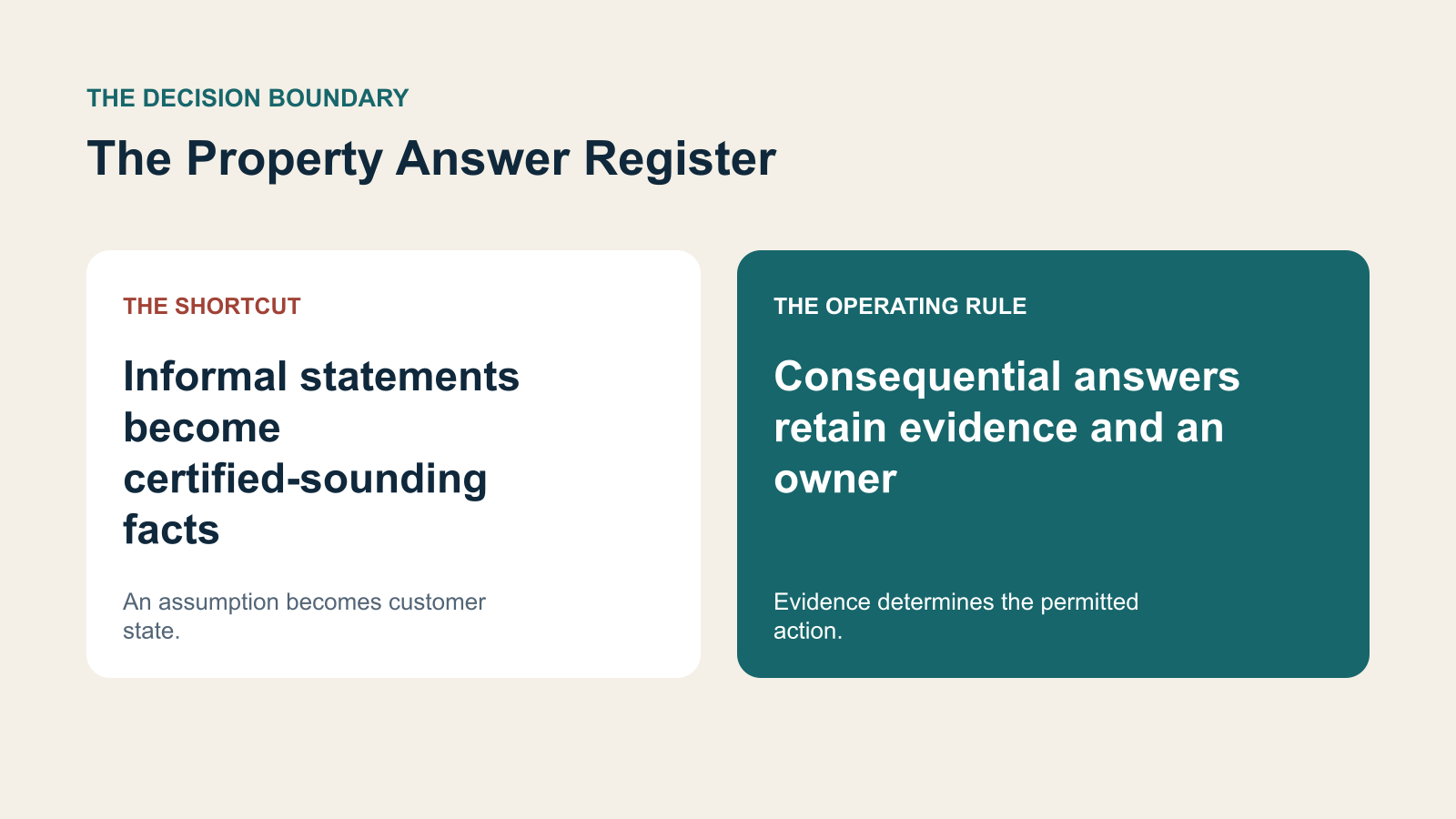
The Property Answer Register: the wrong shortcut and the evidence-based decision.
The working record behind The Property Answer Register
The record needs enough structure for another owner to verify the interpretation. For this journey, preserve four parts together rather than scattering them across a transcript, a note, and an action queue. Each part below has a different operating purpose. A populated field is useful only if the next owner can tell what it refers to and whether it is current.
Buyer question and exact property scope
Identify the exact parcel or project and the buyer's actual question. A broad topic label cannot establish which evidence would answer it.
Approved source, version, and validity review
Retain the approved source and applicable scope. A genuine document for another parcel does not verify the selected property's claim.
Unverified claims and conflicting information
Mark conflicting and unsupported statements visibly. The existence of several similar sales notes should not turn informal repetition into authority.
Professional or project owner and response status
Route interpretation to the appropriate professional or source owner. AI can shorten evidence collection without certifying legal, regulatory, or technical conclusions.
Use AI to shorten verification rather than bypass it
For the access question, provide the approved descriptive information and identify what remains to be verified. For the document question, route the current relevant document through the authorized process and assign the interpretation to the appropriate professional. Keep the buyer’s open questions visible so the next call addresses them rather than restarting a generic pitch.
A suitable clarification or acknowledgment in this illustrative scenario is: “This point needs confirmation from the approved project source.” The wording is an example to adapt to the approved customer process, not a universal script. Its purpose is to make the next decision clear without claiming that an unverified action has already completed.
An uncertain answer can still be helpful. Explain what the approved material establishes, what it does not establish, and who will verify the remaining point. Give the customer a specific next step through the business’s process. Avoid vague language that sounds like a guarantee while technically containing a caveat. The operating owner should review consequential wording, especially when the buyer is making a decision that depends on the answer.
The Property Answer Register
Informal statements become certified-sounding facts. Consequential answers retain evidence and an owner.
The boundary cases that change the correct action
A document can be genuine but apply to a different parcel or an earlier project phase. A sales note can quote a professional without including the limits of that explanation. The assistant should retain scope and avoid extending a source beyond what it actually establishes. When evidence conflicts, explain that verification is underway.
Start with the questions that most often affect buyer confidence. Assign a source owner, review interval, and escalation path for each answer category. Review sample replies against the underlying materials before enabling customer-facing automation. Make source changes invalidate affected drafts or trigger revalidation.
Deploy the operating rule alongside the assistant. Staff need to know which facts they can correct, which decisions require approval, and how an unresolved case returns to a person. Make that return path visible in the same customer record. Avoid a parallel spreadsheet of exceptions that leaves the next advisor unaware of the actual state.
How to test The Property Answer Register before expanding it
Test the complete journey rather than a single response. A correct sentence can still trigger the wrong task, and a corrected CRM field can coexist with an outdated outbound message. Review the original evidence, the resulting record, and the action received by the next owner together.
- A document concerns another parcel; the assistant does not use it as proof.
- Two notes conflict; a verification task is created instead of a blended answer.
- The approved source changes; pending replies are reviewed before sending.
Test answers against closely related but wrong sources: another parcel, another phase, an older revision, and an informal staff explanation. Ask a reviewer to identify the minimum evidence required for the proposed response. Inspect whether the assistant distinguishes a source retrieval from a completed verification. The result should make the professional review easier, not give a salesperson an authoritative-looking answer that no qualified owner has approved.
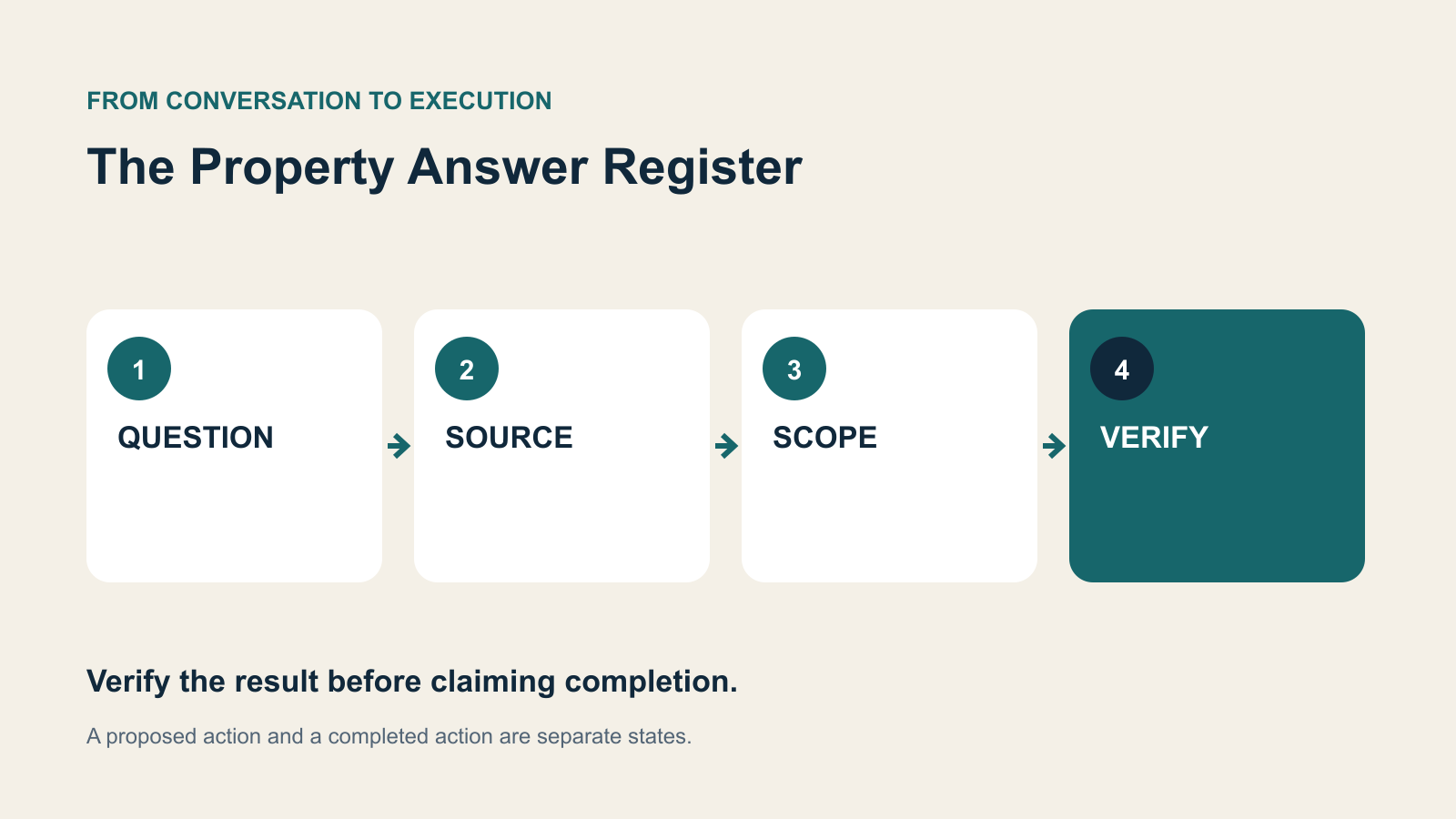
QUESTION → SOURCE → SCOPE → VERIFY: review the state transition, not just the response.
Measure decision accuracy alongside customer effort
Track unsupported property statements, wrong-project document references, time to verified answers, and questions repeatedly reopened after a correction. Do not count an answer as successful merely because it was accepted by the customer. The evidence should support the answer independently of the customer’s reaction.
Use an explicitly illustrative audit to make the denominator clear. Suppose reviewers inspect 40 cases that genuinely require The Property Answer Register, and find 6 unsupported actions. That is 6 divided by 40, or 15% in that sample. It is not a market benchmark or an expected result. Counting 200 unrelated greetings alongside those cases would hide the failure without fixing it. Keep the relevant case count, error count, review rules, and uncertainty visible when reporting the result.
Also inspect the opposite failure: an unnecessary hold when the evidence was already sufficient. Reviewers should distinguish a justified clarification from an avoidable repeat question. An appropriate human review is different from a case abandoned without an owner. Pair the action error rate with customer effort and completion evidence so the team cannot improve one dashboard by moving the cost to the customer or another department.
Connect The Property Answer Register with the rest of customer operations
Brixi brings AI assistants, CRM, voice, WhatsApp, buyer intent, workflows, and team execution together for real estate teams. The platform connects customer conversations with ownership and follow-through across the property journey. This is more useful than adding an isolated property chatbot: the agent, relationship manager, and operations owner work from connected customer context.
For this use case, make the implementation review concrete: ask the Brixi team to walk through the original evidence, the current CRM state, the permitted action, and recovery when that action cannot complete. Validate any required source system, permission rule, and approval path during configuration. The recommended operating design in this article should be demonstrated against the actual deployment rather than assumed from a generic AI feature label.
For the wider operating model, read the existing AI in real estate guide. The important connection is between interpretation and accountable execution: the same evidence should prepare the assistant, the responsible human, and the next workflow.
What to inspect after the first quarter
At the first monthly review, look for the failure that has moved elsewhere. A cleaner conversation can still leave a stale task or an unowned approval. During the following reviews, sample complete journeys from original evidence to customer-visible outcome. Expand the scope only when the team can explain the remaining exceptions and the responsible owner can recover them without reconstructing the entire thread.
The deeper bet behind The Property Answer Register
Property AI will earn trust by organizing authority as well as information. A complete customer platform can connect the question, the supporting material, the responsible expert, and the resulting action. That creates useful continuity without pretending an assistant can certify a property claim.
Put The Property Answer Register into a connected customer workflow
Explore how Brixi connects AI for real estate, CRM, AI assistants, conversations, workflows, and human teams around a reliable next action.