Background Speech Should Not Become a Voice AI Customer Instruction
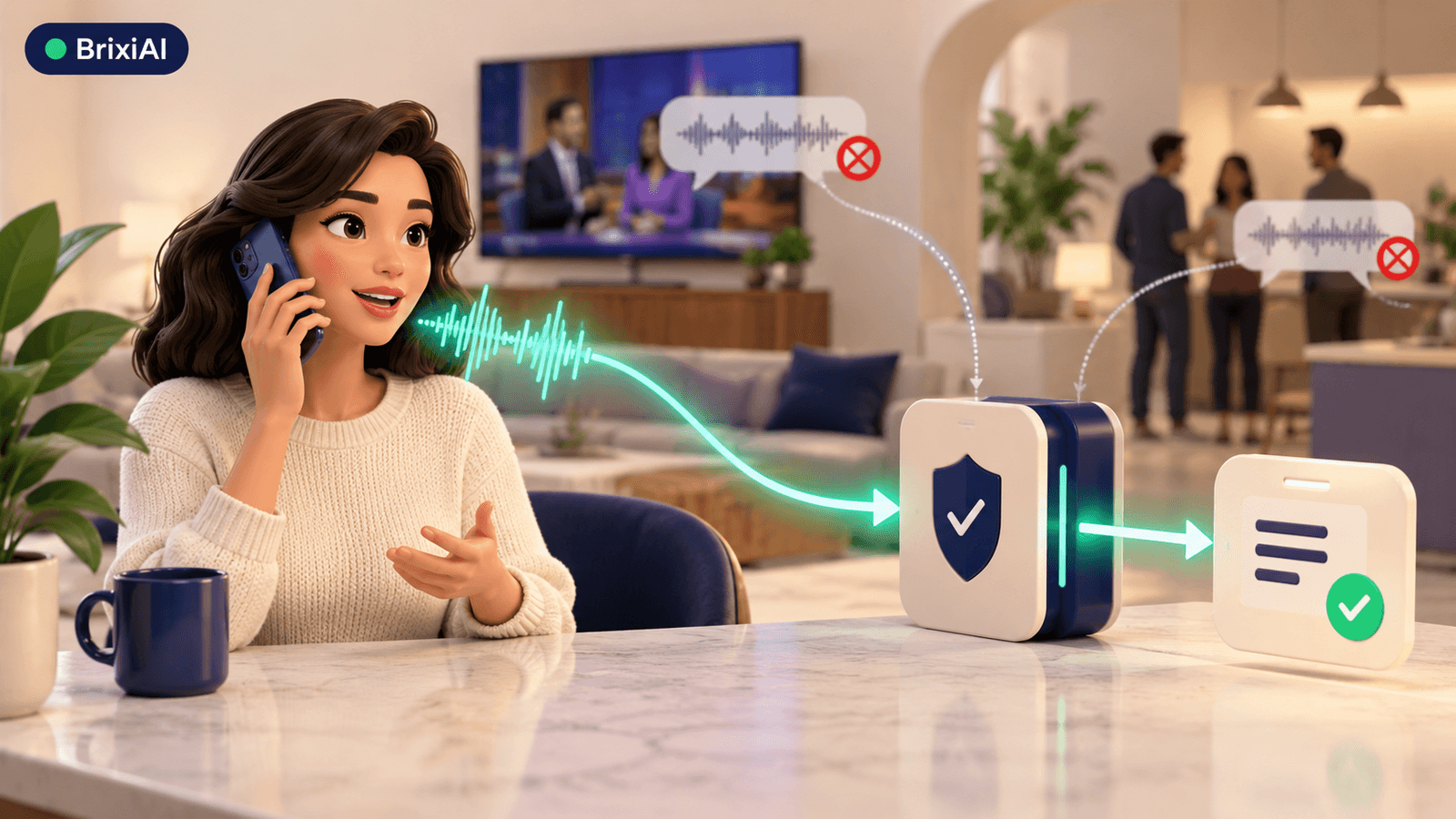
Voice AI needs an Instruction Source Gate before consequential actions. Detected speech is not automatically an instruction from the authorized participant.
Consider a customer speaking with an assistant while a colleague nearby says, “Cancel it, we’re leaving.” The assistant interprets the background phrase as a cancellation request for the customer’s appointment. The person on the call was asking for directions and never intended to cancel anything.
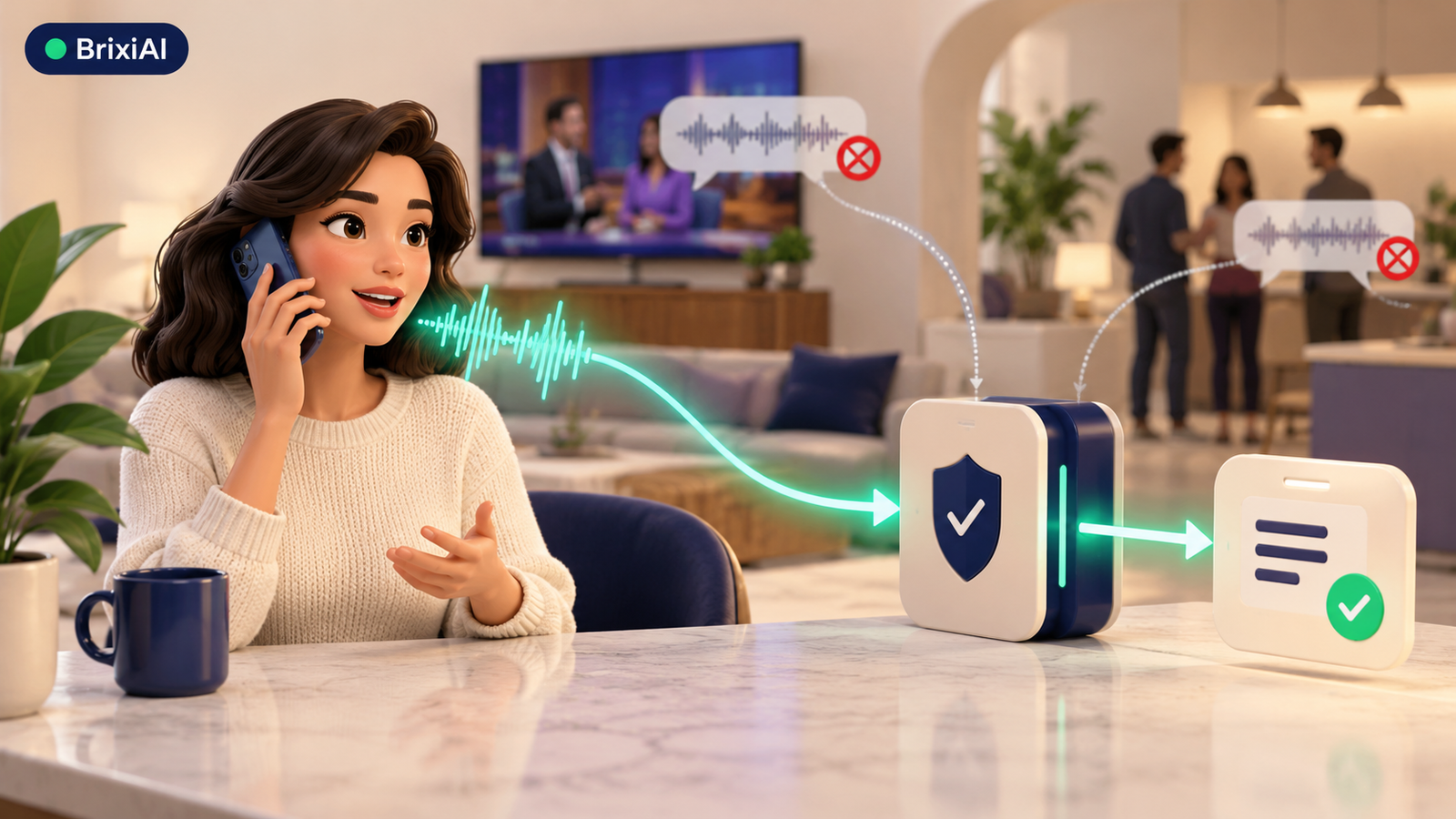
The Instruction Source Gate keeps the customer’s meaning connected to the next action.
Voice AI needs an Instruction Source Gate before consequential actions. Detected speech is not automatically an instruction from the authorized participant. The assistant must distinguish usable conversational evidence from uncertain background audio and ask for confirmation when the source or meaning could change the action.
Recognized speech is not always an authorized request
Use available audio and turn information as evidence without claiming that speaker separation is perfect. Identify whether the apparent instruction fits the active conversation and whether the intended speaker confirms it. Treat uncertain background phrases as unverified. A loud utterance can be irrelevant, while a quiet correction from the actual caller may matter.
Action risk should determine the confirmation boundary. A brief acknowledgment may be harmless, while cancelling an appointment changes a scarce resource. Build the policy around the consequence of misattribution. Do not require the assistant to prove the identity of every background voice before continuing a routine conversation. Instead, hold consequential instructions whose source is uncertain and ask the active participant a narrow question that resolves the decision.
A convincing transcript can preserve the wrong source
Source errors are especially disruptive because the transcript can look decisive. An operator sees “cancel it” and assumes the customer requested cancellation. A later complaint becomes a dispute about a recording rather than an obvious system mistake. If the assistant also sends a confirmation, the wrong action acquires a convincing documentary trail.
The practical failure is specific: any recognized imperative becomes an action. The desired behavior is equally specific: consequential instructions have a verified source. Use those two statements as the review boundary. A response should be judged by the state it leaves behind, not only by whether its wording sounds helpful.
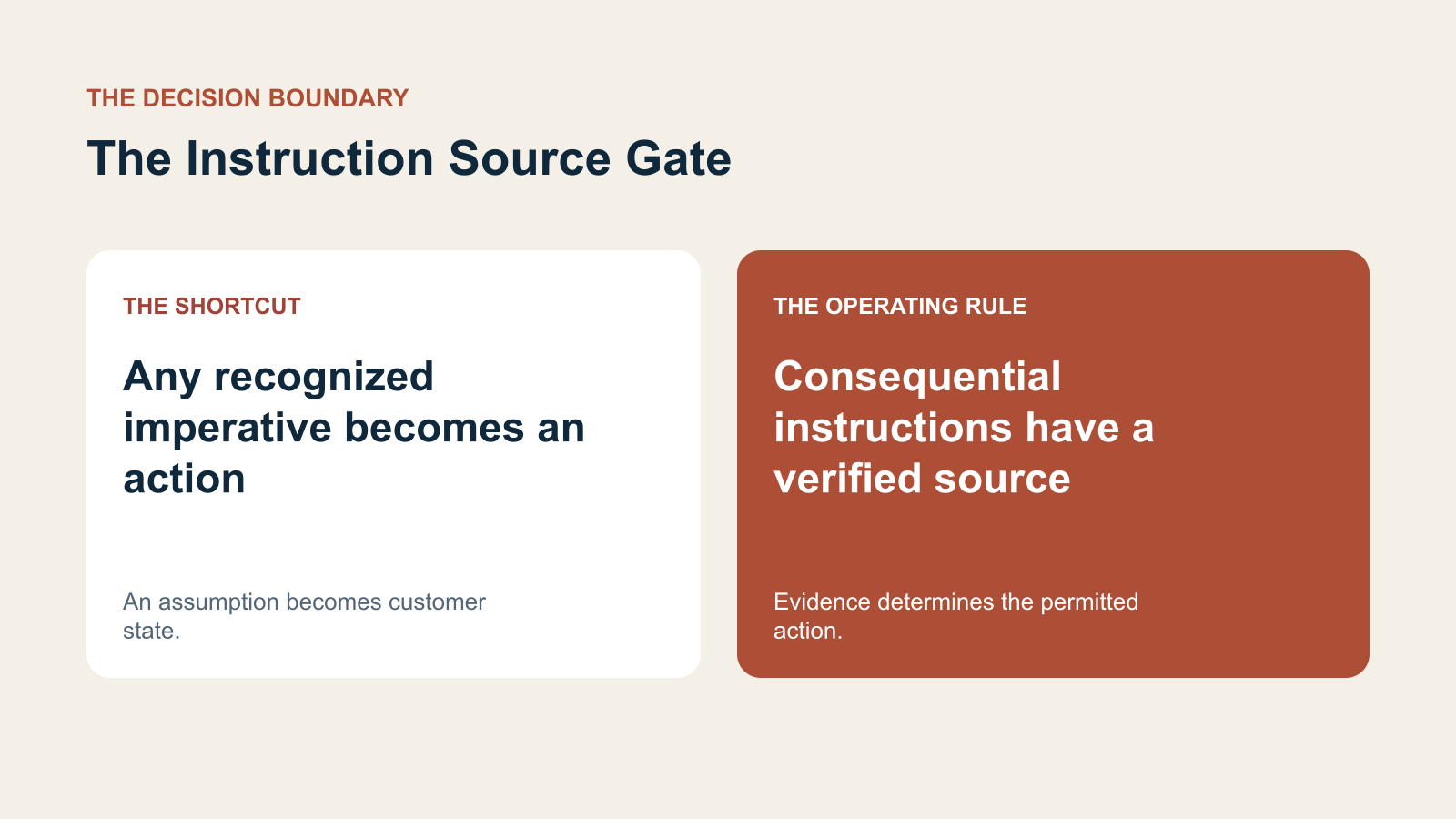
The Instruction Source Gate: the wrong shortcut and the evidence-based decision.
The working record behind The Instruction Source Gate
The record needs enough structure for another owner to verify the interpretation. For this journey, preserve four parts together rather than scattering them across a transcript, a note, and an action queue. Each part below has a different operating purpose. A populated field is useful only if the next owner can tell what it refers to and whether it is current.
Active participant and speaker-source evidence
Preserve evidence about the active participant without assuming perfect speaker separation. A loud background voice may be unrelated to the customer interaction.
Apparent instruction and affected object
Identify the affected object and consequence. Cancelling a scarce appointment requires a stronger source check than acknowledging a harmless conversational phrase.
Clarification result and authority state
Ask the intended participant to confirm ambiguous instructions. An authorized repetition can resolve uncertainty without making every background sound an automatic command.
Action decision and supporting call segment
Keep uncertain speech out of durable preferences. Later summaries should not turn an unverified background phrase into an apparently confirmed customer request.
Confirm the instruction before changing customer state
Pause before cancelling and ask the active participant, “Did you want to cancel the appointment, or were you asking for the address?” If the customer confirms they only need directions, retain the appointment. Record the uncertain source for diagnostic review without adding it as a customer preference or instruction.
A suitable clarification or acknowledgment in this illustrative scenario is: “Were you asking me to cancel the appointment?” The wording is an example to adapt to the approved customer process, not a universal script. Its purpose is to make the next decision clear without claiming that an unverified action has already completed.
Keep uncertain background content out of durable customer preferences. A television advertisement mentioning a price should not change the buyer’s budget. A colleague’s instruction should not become an account-level opt-out without the appropriate process. Source uncertainty needs to travel with the extracted phrase. Otherwise the assistant may behave cautiously during the call while a later summarizer strips away the uncertainty and turns the same phrase into an apparently confirmed instruction.
The Instruction Source Gate
Any recognized imperative becomes an action. Consequential instructions have a verified source.
The boundary cases that change the correct action
A caller may intentionally invite a second participant to speak. That does not mean every voice on the line has equal authority for every action. Clarify who is making the request when changing payment details, appointments, or contact instructions. If the connection is too noisy for a reliable decision, move to an approved confirmation path or human owner.
Include background television, office conversation, speakerphone exchanges, and intentional second speakers in the evaluation set. Test whether the assistant asks a short relevant clarification before irreversible or scarce-resource actions. Review the action record, not only whether the speech transcript included the correct words.
Start with one team, one journey, and a named owner for exceptions. Keep the first version small enough that staff can inspect every consequential decision. Use disagreement reviews to improve the context and operating rules before increasing automation. A model cannot compensate for an undefined approval process or an owner who never receives the work.
How to test The Instruction Source Gate before expanding it
A useful review set includes ordinary success, ambiguity, a correction, and a failure after interpretation. Label the expected business state before looking at the assistant’s answer. Otherwise reviewers can be persuaded by fluent wording to accept a decision that the original evidence never supported.
- Background speech says cancel; no cancellation occurs without confirmation.
- The caller intentionally invites another participant; the role is clarified.
- Noise prevents verification; the assistant uses a permitted fallback instead of guessing.
Evaluate realistic noise, not just clean recordings with a second voice added at the end. Include overlapping conversation, distant speech, a speakerphone handover, and the customer explicitly repeating a background suggestion as their own instruction. The last case matters: the system should be able to proceed when the authorized participant confirms the request. Safety through permanent refusal is not useful coordination; the goal is a reliable route from uncertainty to an allowed action.
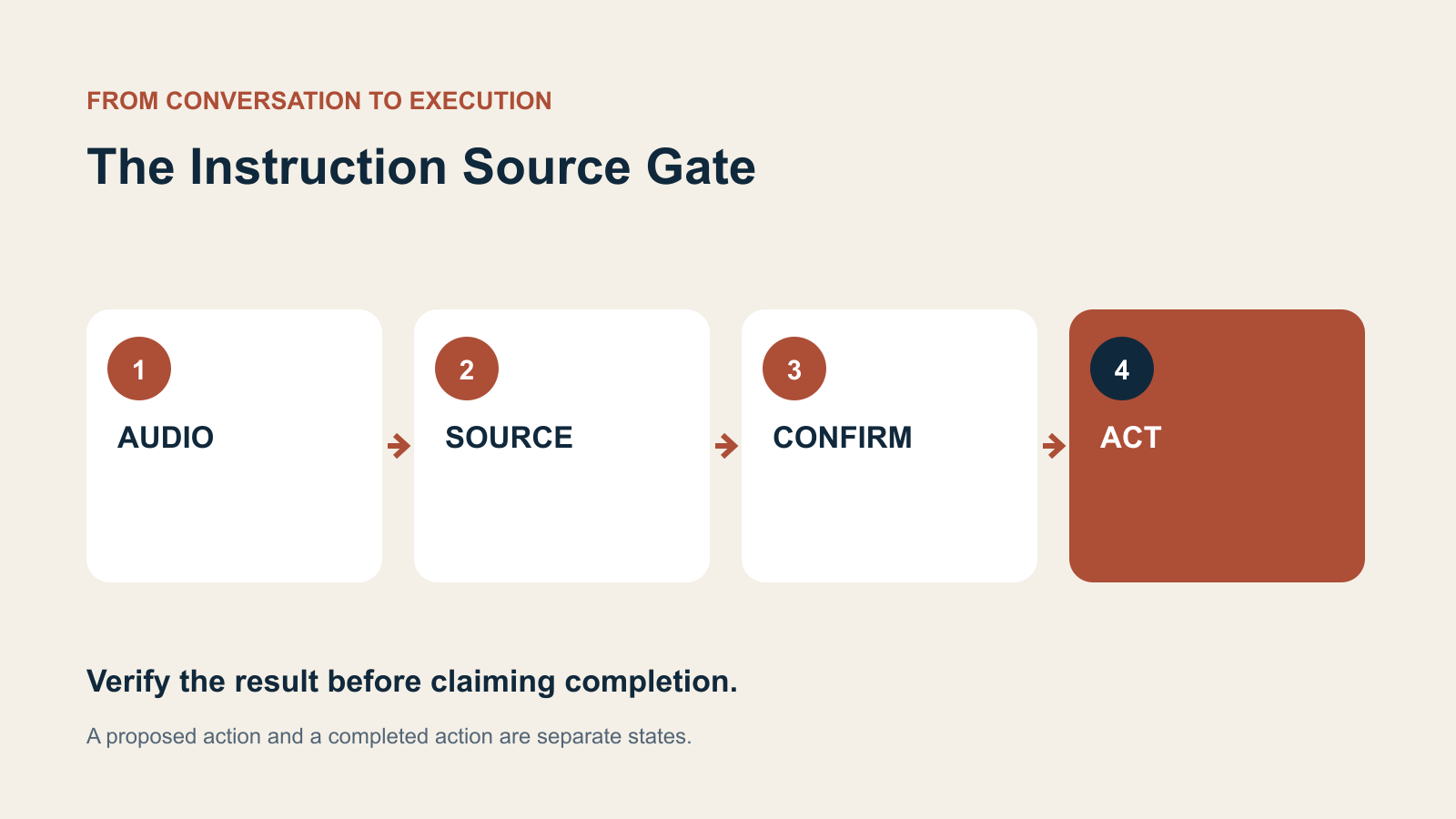
AUDIO → SOURCE → CONFIRM → ACT: review the state transition, not just the response.
Measure decision accuracy alongside customer effort
Track actions triggered by unverified background speech, legitimate instructions missed, and unnecessary source checks during clear single-speaker calls. Evaluate by action consequence. A harmless acknowledgment and a cancelled reservation should not carry the same error weight.
Use an explicitly illustrative audit to make the denominator clear. Suppose reviewers inspect 40 cases that genuinely require The Instruction Source Gate, and find 6 unsupported actions. That is 6 divided by 40, or 15% in that sample. It is not a market benchmark or an expected result. Counting 200 unrelated greetings alongside those cases would hide the failure without fixing it. Keep the relevant case count, error count, review rules, and uncertainty visible when reporting the result.
Also inspect the opposite failure: an unnecessary hold when the evidence was already sufficient. Reviewers should distinguish a justified clarification from an avoidable repeat question. An appropriate human review is different from a case abandoned without an owner. Pair the action error rate with customer effort and completion evidence so the team cannot improve one dashboard by moving the cost to the customer or another department.
Connect The Instruction Source Gate with the rest of customer operations
Brixi treats Voice AI as part of a complete AI-native customer platform. Calls connect with CRM memory, WhatsApp, workflow execution, qualification, routing, and the human team. The operating benefit is that a phone event can be reviewed beside the customer state and the next action, instead of requiring an operator to reconcile a dialer, a transcript archive, and a separate task queue.
For this use case, make the implementation review concrete: ask the Brixi team to walk through the original evidence, the current CRM state, the permitted action, and recovery when that action cannot complete. Validate any required source system, permission rule, and approval path during configuration. The recommended operating design in this article should be demonstrated against the actual deployment rather than assumed from a generic AI feature label.
For the wider operating model, read the anatomy of a Voice AI agent. The important connection is between interpretation and accountable execution: the same evidence should prepare the assistant, the responsible human, and the next workflow.
What to inspect after the first quarter
After a quarter, the useful evidence is a change in operating behavior: fewer unsupported actions, fewer repeated clarifications, and clearer ownership of unresolved cases. Treat these as questions to investigate, not promised gains. Compare similar journey types and inspect the difficult cases as well as the average. Improvements should survive a new owner, a changed source record, and an ordinary customer correction.
The deeper bet behind The Instruction Source Gate
Reliable conversational AI needs to understand the social boundary of a conversation. Hearing words is only one input. A complete customer platform must retain who could authorize an instruction, what evidence established that authority, and why the resulting action was allowed.
Put The Instruction Source Gate into a connected customer workflow
Explore how Brixi connects Voice AI, CRM, AI assistants, conversations, workflows, and human teams around a reliable next action.