NRI Property Conversations: Separating Buyer and Local Representative Instructions

AI support for NRI property conversations needs a Representation Context Map. It should distinguish buyer preferences, representative observations, delegated actions, and decisions still reserved for the buyer.
Imagine an overseas buyer asking a relative to inspect a property locally. The relative dislikes the balcony and tells the agent to exclude the unit. The buyer later asks why it disappeared from the shortlist. The assistant treated an inspection observation as a final instruction from the person making the purchase.

The Representation Context Map keeps the customer’s meaning connected to the next action.
AI support for NRI property conversations needs a Representation Context Map. It should distinguish buyer preferences, representative observations, delegated actions, and decisions still reserved for the buyer. Shared context is useful only when the source and authority of each instruction remain visible.
Proximity to the property does not establish decision authority
Record who is speaking, whose interests the statement concerns, and which task has been delegated. Viewing a property does not automatically confer authority to change budget, accept terms, or remove options. Capture observations as evidence for the buyer unless explicit approved instructions establish a different role.
Representative access should follow the task. Someone arranging a local inspection may need location, access instructions, and the features the buyer wants checked. They may not need the buyer’s private financial discussion or negotiation range. Prepare separate brief views when necessary. The platform can maintain one coordinated journey while giving each participant the information needed for their part, rather than copying the entire overseas buyer conversation into a family thread.
Shared memory needs participant-specific boundaries
Authority confusion causes unnecessary shortlist changes, contradictory instructions to agents, and repeated calls across time zones. The buyer spends the next conversation repairing decisions they did not make. Staff may then retreat to separate private threads, weakening the very shared memory that was meant to coordinate the purchase.
The practical failure is specific: a local observation becomes the buyer’s final instruction. The desired behavior is equally specific: authority stays attached to each participant and action. Use those two statements as the review boundary. A response should be judged by the state it leaves behind, not only by whether its wording sounds helpful.
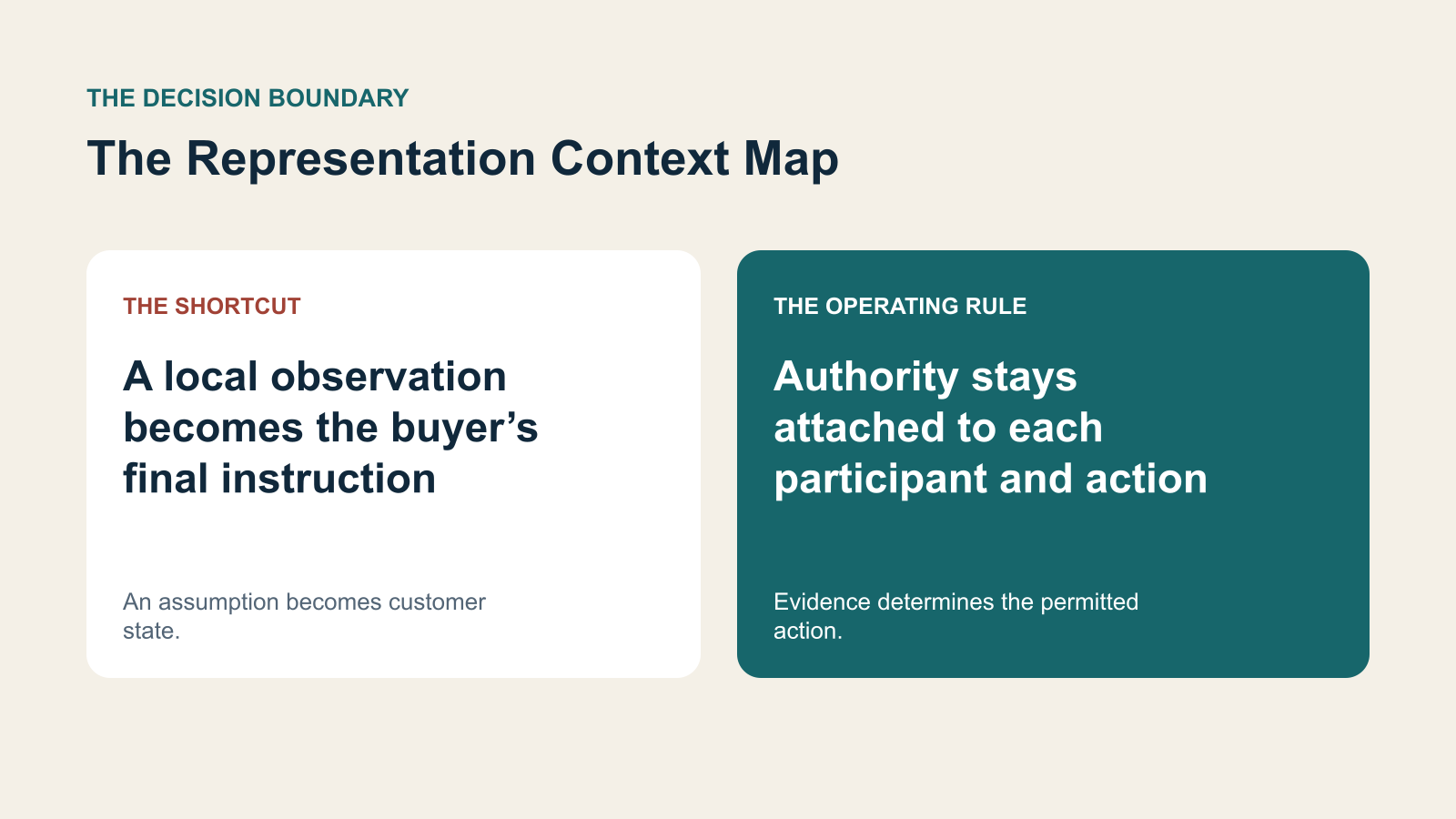
The Representation Context Map: the wrong shortcut and the evidence-based decision.
The working record behind The Representation Context Map
The record needs enough structure for another owner to verify the interpretation. For this journey, preserve four parts together rather than scattering them across a transcript, a note, and an action queue. Each part below has a different operating purpose. A populated field is useful only if the next owner can tell what it refers to and whether it is current.
Buyer, representative, and confirmed relationship
Identify the buyer and representative separately. A local inspection role does not automatically establish authority over budget, shortlist, or commercial decisions.
Delegated task and verified decision scope
Record the verified scope of delegation. The assistant should coordinate permitted tasks without extending family relationship into unrestricted decision authority.
Observation source and buyer response
Keep observations distinct from buyer instructions. A representative's concern can inform review while the buyer decides whether it changes the requirement.
Time zone, contact preference, and approved recipients
Prepare participant-appropriate updates and schedules. Private financial context and availability should not be copied indiscriminately between the buyer and local representative.
Turn local observations into prepared buyer decisions
Keep the relative’s balcony observation attached to the inspected unit. Send the buyer a concise factual update through the agreed channel and ask whether it changes their preference. Schedule any required discussion with explicit local dates and time zones. Record the buyer’s resulting instruction separately from the original inspection note.
A suitable clarification or acknowledgment in this illustrative scenario is: “Should I record this as an inspection observation for the buyer to review?” The wording is an example to adapt to the approved customer process, not a universal script. Its purpose is to make the next decision clear without claiming that an unverified action has already completed.
Time-zone handling should preserve the actual person’s availability. The representative’s local Saturday visit and the buyer’s overseas review call are different events. Confirm the relevant local dates and time zones in the approved scheduling process. Do not convert the representative’s availability into the buyer’s. If the buyer wants to join remotely, record that requirement explicitly so the local agent knows the visit is also a live decision-support interaction.
The Representation Context Map
A local observation becomes the buyer’s final instruction. Authority stays attached to each participant and action.
The boundary cases that change the correct action
The representative may have formal authority for some actions, but the assistant should follow the business’s verified process rather than infer authority from family relationship. Private financial information shared by the buyer may not be appropriate for the representative’s briefing. Coordinate the journey without treating all participants as interchangeable.
Map participant roles during onboarding. Define who receives viewing updates, who can request another inspection, and who confirms commercial decisions. Include role and source labels in every AI briefing. When authority is unclear, prepare the decision for the responsible person rather than executing it from an inferred relationship.
Introduce the change in review mode first. The assistant prepares an interpretation and proposed next step while the existing authorized process remains in control. Collect disagreements with a reason, including cases where the reviewer lacks enough evidence to decide. Once the team can distinguish an interpretation mistake from a policy exception, expand only the narrowly defined actions that consistently produce reviewable results.
How to test The Representation Context Map before expanding it
Begin the evaluation with the business decision, not the quality of the wording. Have a reviewer inspect the original exchange and identify the action it actually permits. Then compare the assistant’s interpretation, saved record, and customer-facing message. These three outputs can disagree even when each appears reasonable in isolation.
- A representative dislikes a feature; the unit is not removed without buyer authority.
- A private budget note exists; it is not copied to every participant.
- A buyer confirms an instruction; the source and affected options are recorded.
Review a scenario where the representative observes a concern, the buyer rejects that concern as unimportant, and the agent later prepares a shortlist. The buyer’s current instruction should control the shortlist while the observation remains available as context. Include a representative with verified authority for one limited action. The system should use that authority within its scope without extending it to unrelated commercial decisions.
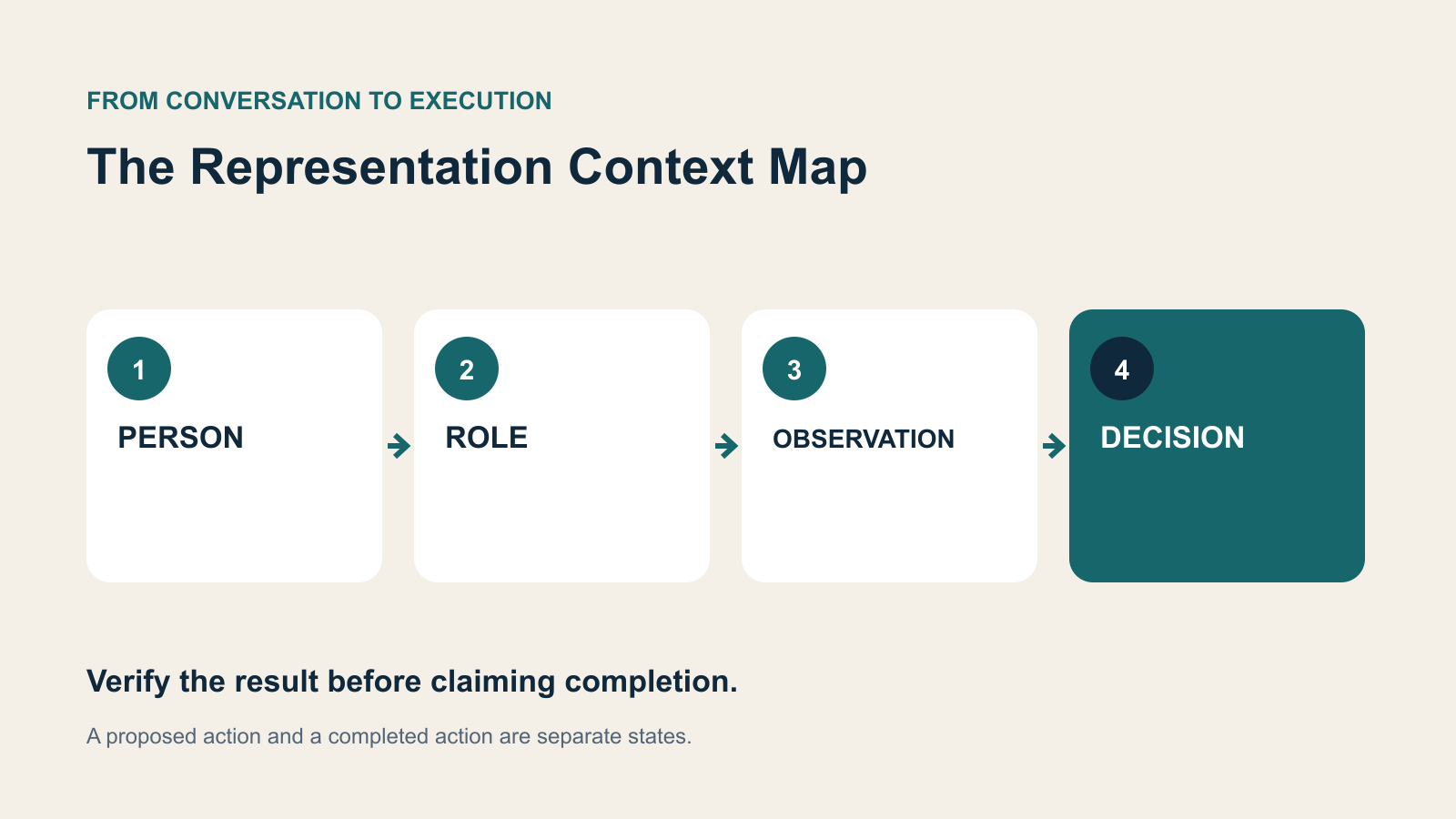
PERSON → ROLE → OBSERVATION → DECISION: review the state transition, not just the response.
Measure decision accuracy alongside customer effort
Track buyer decisions incorrectly attributed to representatives, repeated clarification across participants, and actions taken without the required approval. Evaluate time-zone mistakes separately from interpretation mistakes. Faster local response has little value if it changes the buyer’s instructions incorrectly.
Use an explicitly illustrative audit to make the denominator clear. Suppose reviewers inspect 40 cases that genuinely require The Representation Context Map, and find 6 unsupported actions. That is 6 divided by 40, or 15% in that sample. It is not a market benchmark or an expected result. Counting 200 unrelated greetings alongside those cases would hide the failure without fixing it. Keep the relevant case count, error count, review rules, and uncertainty visible when reporting the result.
Also inspect the opposite failure: an unnecessary hold when the evidence was already sufficient. Reviewers should distinguish a justified clarification from an avoidable repeat question. An appropriate human review is different from a case abandoned without an owner. Pair the action error rate with customer effort and completion evidence so the team cannot improve one dashboard by moving the cost to the customer or another department.
Connect The Representation Context Map with the rest of customer operations
Brixi brings AI assistants, CRM, voice, WhatsApp, buyer intent, workflows, and team execution together for real estate teams. The platform connects customer conversations with ownership and follow-through across the property journey. This is more useful than adding an isolated property chatbot: the agent, relationship manager, and operations owner work from connected customer context.
For this use case, make the implementation review concrete: ask the Brixi team to walk through the original evidence, the current CRM state, the permitted action, and recovery when that action cannot complete. Validate any required source system, permission rule, and approval path during configuration. The recommended operating design in this article should be demonstrated against the actual deployment rather than assumed from a generic AI feature label.
For the wider operating model, read the existing AI in real estate guide. The important connection is between interpretation and accountable execution: the same evidence should prepare the assistant, the responsible human, and the next workflow.
What to inspect after the first quarter
After a quarter, the useful evidence is a change in operating behavior: fewer unsupported actions, fewer repeated clarifications, and clearer ownership of unresolved cases. Treat these as questions to investigate, not promised gains. Compare similar journey types and inspect the difficult cases as well as the average. Improvements should survive a new owner, a changed source record, and an ordinary customer correction.
The deeper bet behind The Representation Context Map
Cross-border property coordination needs relationship-aware AI. The platform should make distance easier to manage without flattening the people involved. Connected memory, voice, WhatsApp, and workflows can prepare decisions while preserving who is entitled to make them.
Put The Representation Context Map into a connected customer workflow
Explore how Brixi connects AI for real estate, CRM, AI assistants, conversations, workflows, and human teams around a reliable next action.