Voice AI Should Read Back Critical Numbers Before Saving Them
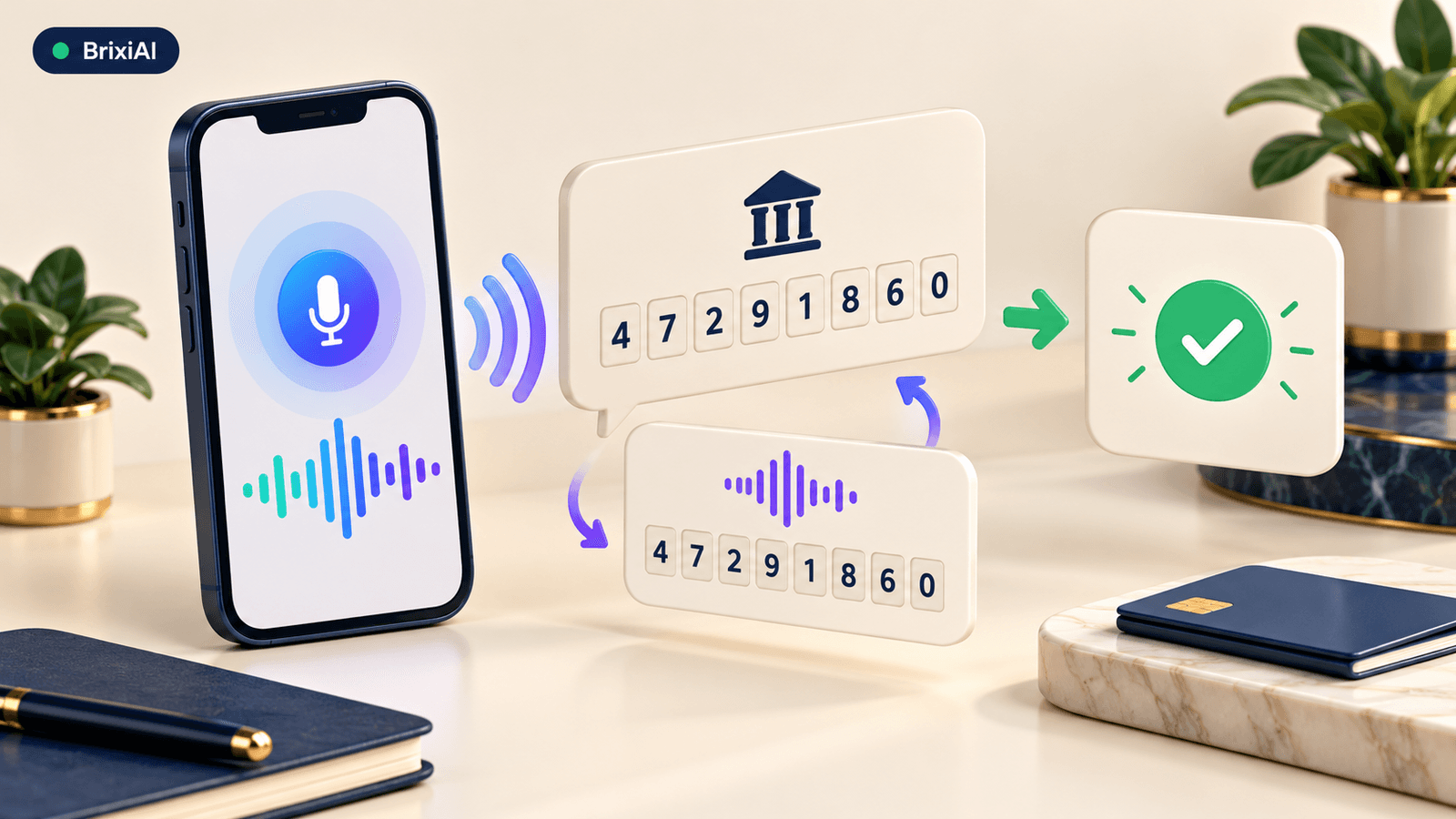
Voice AI needs a Consequential Field Read-Back for values whose small errors create large operational failures. Phone numbers, unit identifiers, quantities, and quoted amounts deserve context-specific confirmation.
Imagine a customer giving a callback number from a noisy station. One digit is unclear, but the transcript looks plausible. The assistant saves it without confirmation. Every later attempt goes to a stranger, and the original customer appears unreachable. The mistake occupies one character and changes the entire recovery path.
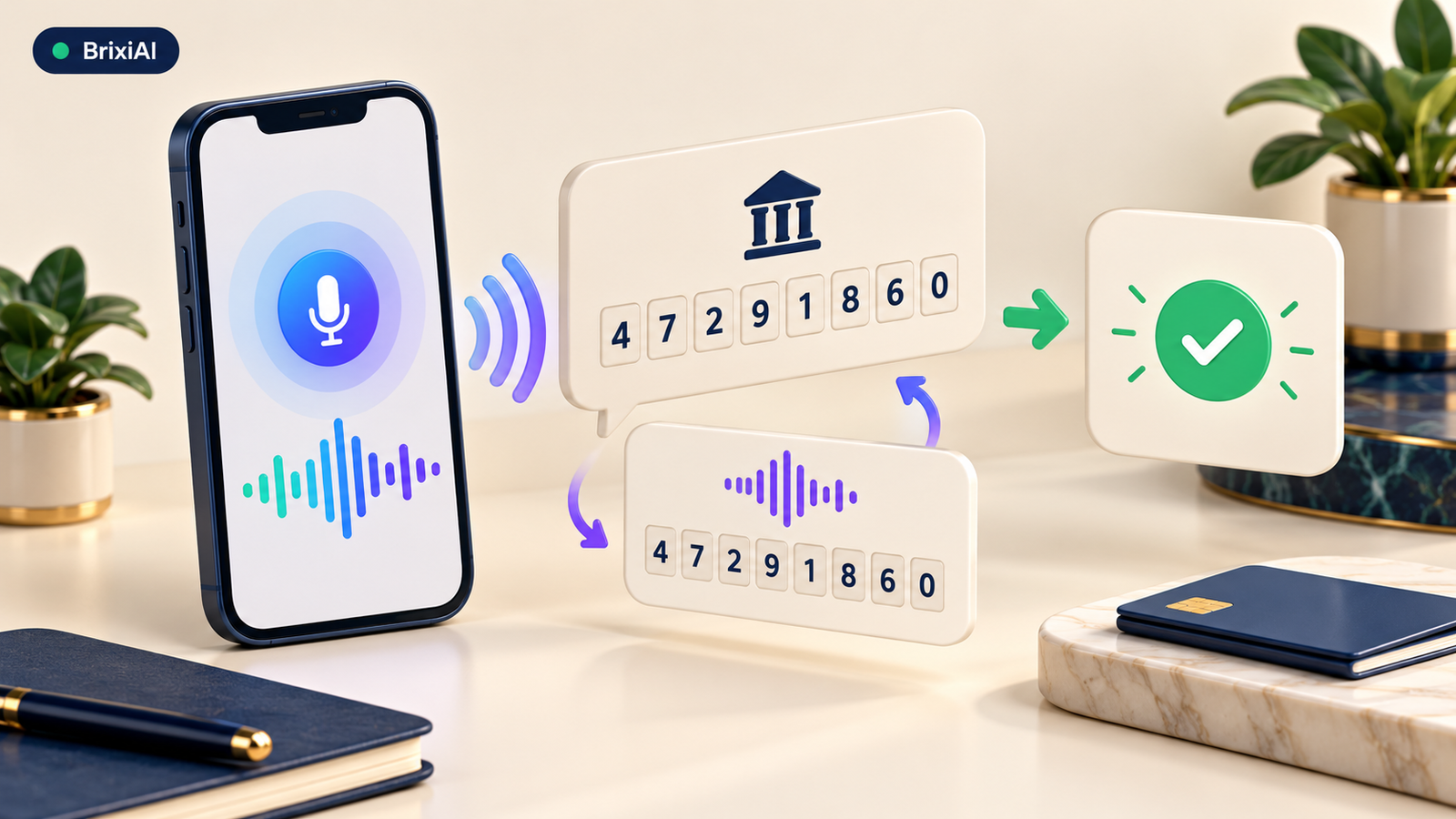
The Consequential Field Read-Back keeps the customer’s meaning connected to the next action.
Voice AI needs a Consequential Field Read-Back for values whose small errors create large operational failures. Phone numbers, unit identifiers, quantities, and quoted amounts deserve context-specific confirmation. The purpose is to verify important meaning without forcing customers to approve every harmless word in the transcript.
Format validation cannot verify what the caller intended
Classify fields by consequence and reversibility. Preserve the recognized value as provisional until the required confirmation is complete. Read digits or structured components in an understandable form, ask whether the value is correct, and apply any correction before writing the final field. Validate format, but do not mistake a valid format for a correct value.
Confirmation effort should follow consequence. Mishearing a casual count in a general question may not justify a formal read-back. Mishearing a callback number or unit identifier can send later work to the wrong person or asset. Define the critical fields for the specific journey and make their provisional status visible. This keeps the experience natural while giving staff confidence that the values used for consequential work passed the required verification step.
One wrong digit can look like a customer problem
A wrong digit can break callbacks, deliveries, reservations, and attribution. The error often survives because the resulting field passes basic validation. Staff blame poor contactability or customer inconsistency while the actual source was a short unverified recognition result. Repeating the same wrong value across channels makes it look increasingly authoritative.
The practical failure is specific: plausible digits become permanent customer data. The desired behavior is equally specific: critical values are confirmed before use. Use those two statements as the review boundary. A response should be judged by the state it leaves behind, not only by whether its wording sounds helpful.
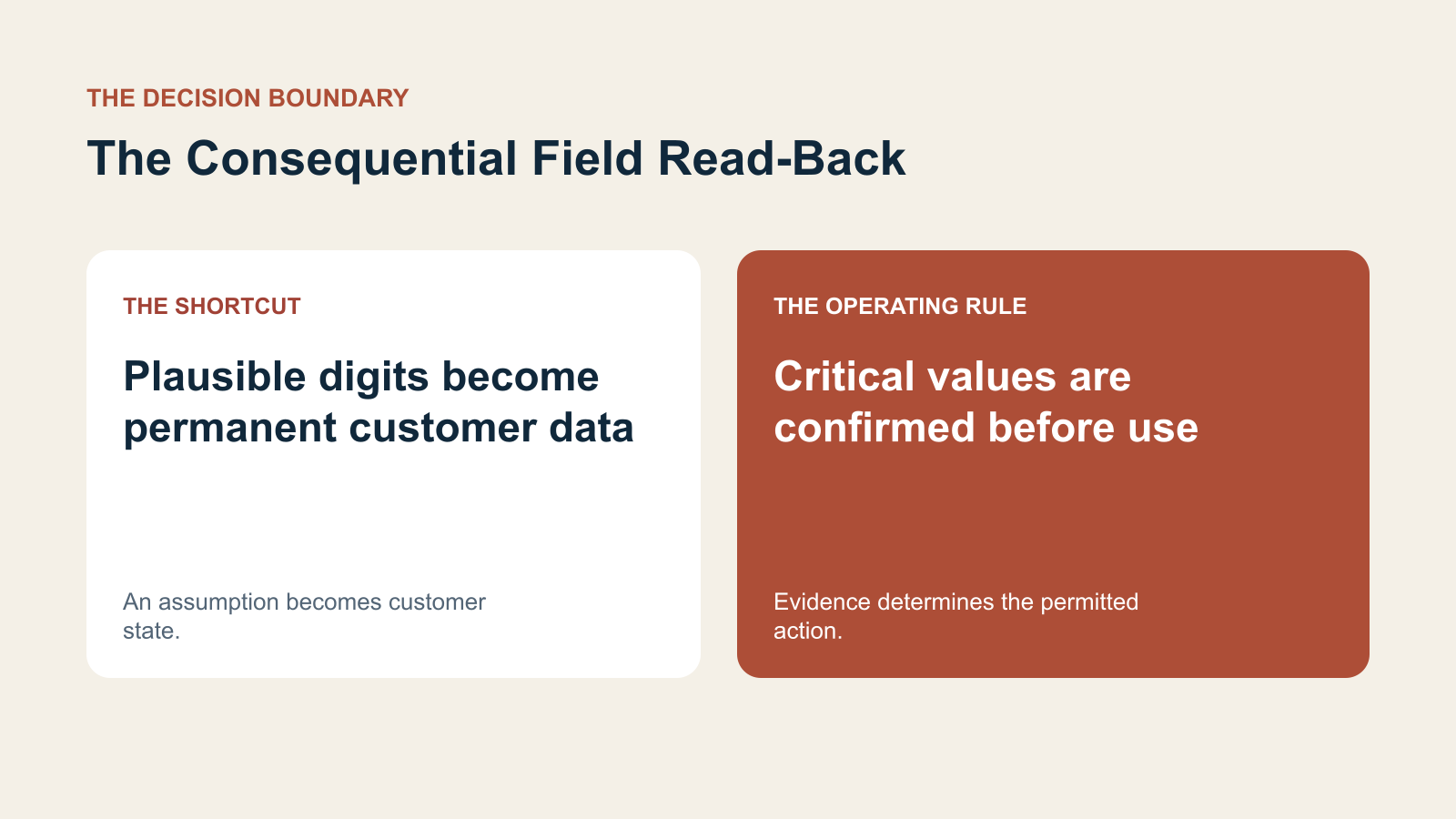
The Consequential Field Read-Back: the wrong shortcut and the evidence-based decision.
The working record behind The Consequential Field Read-Back
The record needs enough structure for another owner to verify the interpretation. For this journey, preserve four parts together rather than scattering them across a transcript, a note, and an action queue. Each part below has a different operating purpose. A populated field is useful only if the next owner can tell what it refers to and whether it is current.
Field purpose and consequence level
Define which field errors change the business outcome. Critical identifiers and ordinary conversational numbers should not automatically receive identical confirmation treatment.
Provisional recognized value
Keep uncertain recognition provisional. Passing a formatting rule establishes plausibility, not that the captured value matches what the customer intended.
Customer-confirmed value and correction history
Store the final confirmed correction. An interruption during read-back should reach the saved field rather than remain isolated in a later transcript sentence.
Validation result and permitted downstream uses
Check every dependent task uses the confirmed value. Correcting the contact record is insufficient when an earlier callback job still holds the wrong number.
Use read-back where an error changes the outcome
For the callback number, repeat the number in manageable groups using the business’s approved interaction style. If the customer corrects the final digits, update only the appropriate field and read the corrected version once. Keep the original recognized candidate for restricted diagnostic review if retention rules permit it, but use only the confirmed value for new tasks.
A suitable clarification or acknowledgment in this illustrative scenario is: “Let me read that number back before I save it.” The wording is an example to adapt to the approved customer process, not a universal script. Its purpose is to make the next decision clear without claiming that an unverified action has already completed.
A correction can arrive while the assistant is speaking. If the customer interrupts with “no, the last digit is eight,” the response should update the pending value rather than continue reading a stale number. The exact interaction depends on the voice system, but the business requirement is straightforward: only the final confirmed value may direct downstream action. Do not let an early recognition result remain active simply because a later transcript contains the correction elsewhere.
The Consequential Field Read-Back
Plausible digits become permanent customer data. Critical values are confirmed before use.
The boundary cases that change the correct action
A customer may decline to repeat details or may need a different channel for precision. Offer an approved text confirmation path rather than guessing. Do not read sensitive identifiers aloud where the workflow requires a different verification method. The appropriate read-back depends on the field and business policy, not a universal rule that more repetition is always safer.
Identify the few numeric fields that most often break downstream work. Define when confirmation is mandatory, how corrections are recorded, and what happens when confirmation fails. Review recognition and action outcomes together. Test deliberately similar digits, interruptions during read-back, and corrections delivered after an initial yes.
Deploy the operating rule alongside the assistant. Staff need to know which facts they can correct, which decisions require approval, and how an unresolved case returns to a person. Make that return path visible in the same customer record. Avoid a parallel spreadsheet of exceptions that leaves the next advisor unaware of the actual state.
How to test The Consequential Field Read-Back before expanding it
Test the complete journey rather than a single response. A correct sentence can still trigger the wrong task, and a corrected CRM field can coexist with an outdated outbound message. Review the original evidence, the resulting record, and the action received by the next owner together.
- One digit is uncertain; the value remains provisional until confirmed.
- The customer corrects only the last group; the final saved value reflects it.
- A number passes format validation but is rejected in read-back; it is not used for outreach.
Review field-level accuracy separately from overall transcript quality. A call can be transcribed very well and still fail because the one critical digit was wrong. Include similar-sounding numbers, long identifiers, mixed-language amounts, and delayed corrections in the test set. Inspect the final saved value and every task that uses it. A corrected transcript is not sufficient if the callback job was created before the correction and never refreshed.
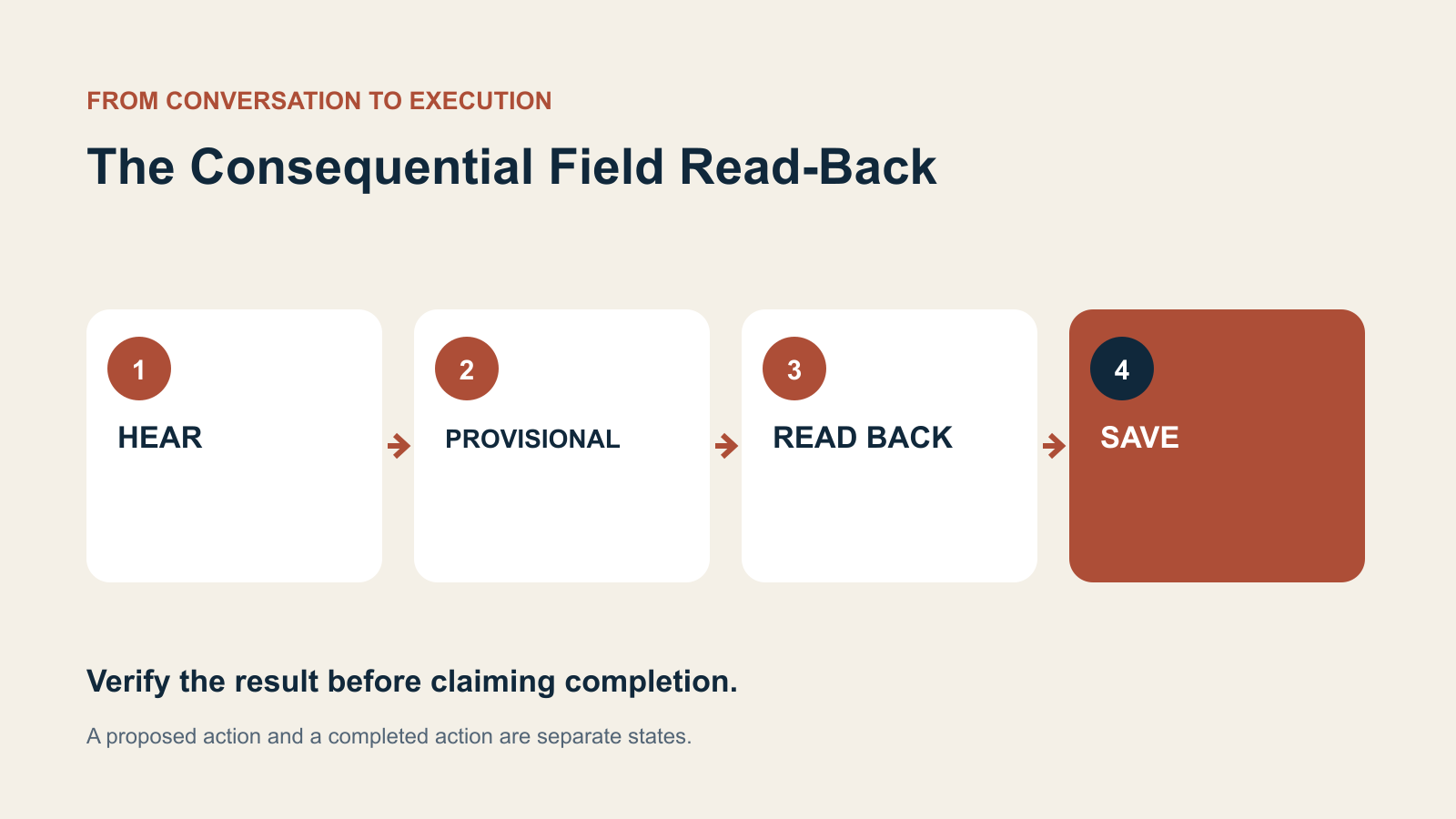
HEAR → PROVISIONAL → READ BACK → SAVE: review the state transition, not just the response.
Measure decision accuracy alongside customer effort
Track consequential-field error rates, corrections captured during read-back, and downstream failures caused by valid-looking wrong values. Pair accuracy with customer effort. A process that rereads every number several times can become unusable even if its error rate improves.
Use an explicitly illustrative audit to make the denominator clear. Suppose reviewers inspect 40 cases that genuinely require The Consequential Field Read-Back, and find 6 unsupported actions. That is 6 divided by 40, or 15% in that sample. It is not a market benchmark or an expected result. Counting 200 unrelated greetings alongside those cases would hide the failure without fixing it. Keep the relevant case count, error count, review rules, and uncertainty visible when reporting the result.
Also inspect the opposite failure: an unnecessary hold when the evidence was already sufficient. Reviewers should distinguish a justified clarification from an avoidable repeat question. An appropriate human review is different from a case abandoned without an owner. Pair the action error rate with customer effort and completion evidence so the team cannot improve one dashboard by moving the cost to the customer or another department.
Connect The Consequential Field Read-Back with the rest of customer operations
Brixi treats Voice AI as part of a complete AI-native customer platform. Calls connect with CRM memory, WhatsApp, workflow execution, qualification, routing, and the human team. The operating benefit is that a phone event can be reviewed beside the customer state and the next action, instead of requiring an operator to reconcile a dialer, a transcript archive, and a separate task queue.
For this use case, make the implementation review concrete: ask the Brixi team to walk through the original evidence, the current CRM state, the permitted action, and recovery when that action cannot complete. Validate any required source system, permission rule, and approval path during configuration. The recommended operating design in this article should be demonstrated against the actual deployment rather than assumed from a generic AI feature label.
For the wider operating model, read the anatomy of a Voice AI agent. The important connection is between interpretation and accountable execution: the same evidence should prepare the assistant, the responsible human, and the next workflow.
What to inspect after the first quarter
At the first monthly review, look for the failure that has moved elsewhere. A cleaner conversation can still leave a stale task or an unowned approval. During the following reviews, sample complete journeys from original evidence to customer-visible outcome. Expand the scope only when the team can explain the remaining exceptions and the responsible owner can recover them without reconstructing the entire thread.
The deeper bet behind The Consequential Field Read-Back
Voice AI quality will be measured by the reliability of the records it creates. A small confirmation at the right boundary can protect an entire customer journey. Connected context lets the platform spend that effort where mistakes matter rather than treating every token equally.
Put The Consequential Field Read-Back into a connected customer workflow
Explore how Brixi connects Voice AI, CRM, AI assistants, conversations, workflows, and human teams around a reliable next action.