Using AI to Compare Approved Commercial Lease Offers Across Versions

AI commercial lease comparison needs a Commercial Terms Difference Map. It should organize approved business terms and highlight missing or changed information without presenting itself as legal advice.
Imagine a business comparing two office offers. The headline rent is lower in the second, but the fit-out period, deposit, included services, and escalation schedule differ. The assistant summarizes only monthly rent and calls the second offer cheaper. The tenant’s decision-maker later finds that the comparison ignored the terms the team had been negotiating.

The Commercial Terms Difference Map keeps the customer’s meaning connected to the next action.
AI commercial lease comparison needs a Commercial Terms Difference Map. It should organize approved business terms and highlight missing or changed information without presenting itself as legal advice. A readable comparison is valuable only when the source version and scope of every term remain visible.
A cheaper headline can hide a different scope
Extract corresponding commercial fields from the approved offers and label unmatched items. Preserve units, periods, inclusions, and conditions. Do not normalize away a difference that changes meaning, such as per-seat versus per-area pricing or a concession available only for a longer term. Route unclear contractual language to the responsible professional.
Normalize only when the underlying meanings match. A monthly amount and an annual amount can be displayed on a common basis if the approved calculation is clear, but that does not make different included services equivalent. Keep both the original term and the normalized presentation visible. If the comparison requires assumptions, identify them as assumptions for review. A table that hides uncertainty is less useful than a smaller table that accurately shows what is known.
Missing terms should remain visibly missing
A shallow comparison can steer a buyer toward an unsuitable choice and create avoidable renegotiation. Sales may describe a concession as unconditional, while operations plans around a different occupancy date. Staff then spend time explaining an AI summary that appeared more definitive than the underlying documents.
The practical failure is specific: headline rent substitutes for the whole offer. The desired behavior is equally specific: commercial differences retain their conditions and sources. Use those two statements as the review boundary. A response should be judged by the state it leaves behind, not only by whether its wording sounds helpful.
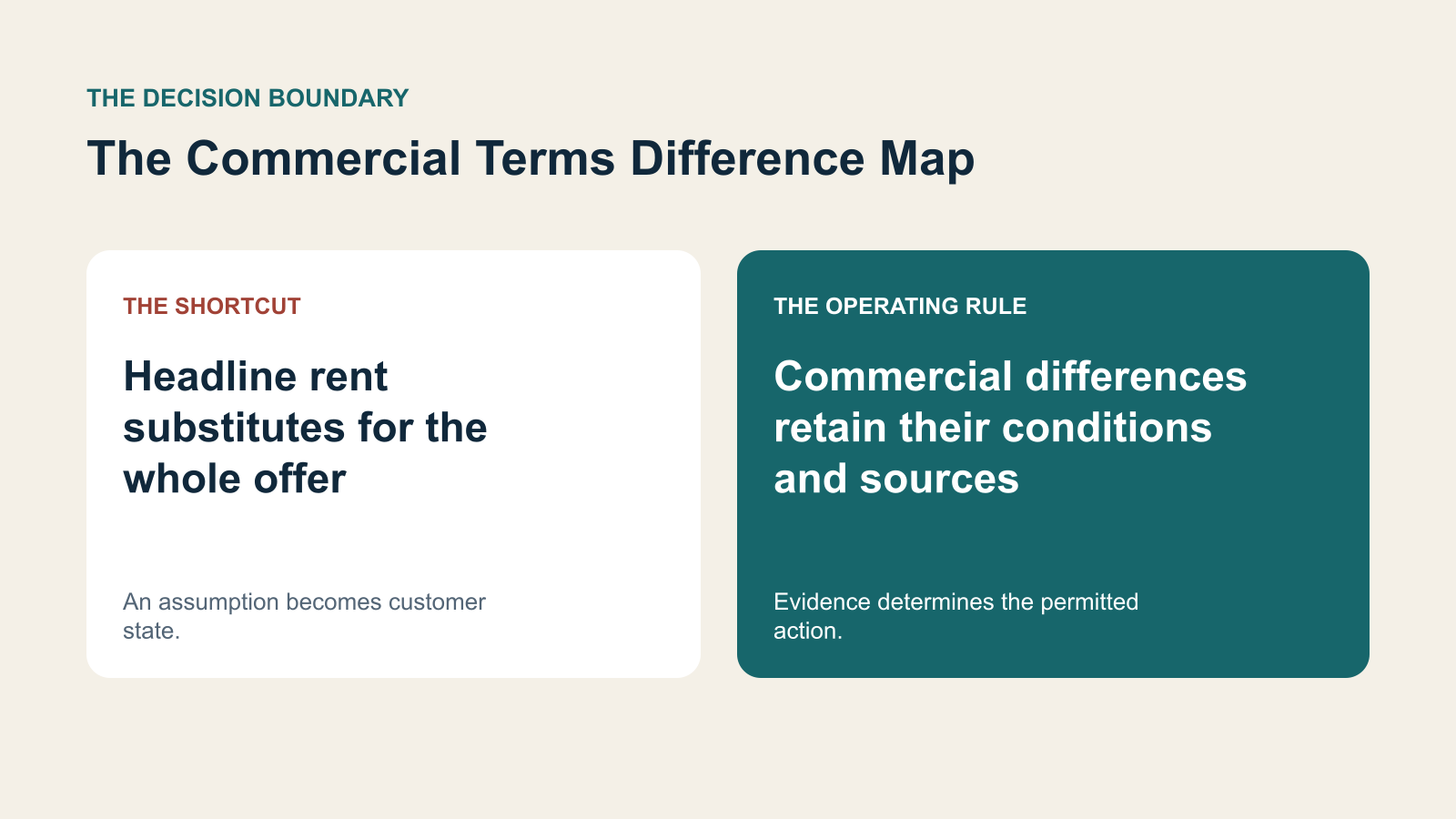
The Commercial Terms Difference Map: the wrong shortcut and the evidence-based decision.
The working record behind The Commercial Terms Difference Map
The record needs enough structure for another owner to verify the interpretation. For this journey, preserve four parts together rather than scattering them across a transcript, a note, and an action queue. Each part below has a different operating purpose. A populated field is useful only if the next owner can tell what it refers to and whether it is current.
Property, offer version, and approval status
Preserve which property and approved version each term describes. A draft concession cannot enter a customer comparison as a finalized commercial offer.
Commercial term, unit, period, and source
Keep units, periods, inclusions, and conditions attached. Normalizing a number should not hide differences that change the commercial scope.
Changed, missing, and conditional items
Show unknown and unmatched items explicitly. Missing service-charge information is not equivalent to zero cost or an included service.
Customer criteria and professional review owner
Use the customer's priorities to prepare review. The assistant organizes differences without making legal equivalence claims or a universal recommendation to sign.
Use AI to prepare the negotiation, not invent contractual certainty
Create a side-by-side business comparison with the exact version and date of each offer. Mark headline rent, deposit, agreed term, fit-out period, services, and open conditions. Explain differences without ranking the offers unless the customer’s decision criteria and approved calculation method support it. Ask which trade-offs matter before proposing the next discussion.
A suitable clarification or acknowledgment in this illustrative scenario is: “Which of these commercial trade-offs matters most to your decision?” The wording is an example to adapt to the approved customer process, not a universal script. Its purpose is to make the next decision clear without claiming that an unverified action has already completed.
The customer’s criteria should guide the discussion without changing the source terms. A tenant prioritizing occupancy timing may evaluate a higher headline rent differently from a tenant prioritizing initial cash outlay. AI can organize these trade-offs and prepare questions for the advisor. It should not invent a universal best offer or present a commercial summary as a substitute for qualified review of the actual lease documents.
The Commercial Terms Difference Map
Headline rent substitutes for the whole offer. Commercial differences retain their conditions and sources.
The boundary cases that change the correct action
Drafts may contain unapproved terms or inconsistent units. An attachment from the customer may be incomplete or belong to another property. Missing information should appear as missing, not zero or included. An apparent change in wording should not be called a legal equivalence without qualified review.
Begin with a small approved comparison schema and sample offers checked by the commercial team. Require a source reference for every extracted term. Review changes between revisions before refreshing the customer-facing comparison. Keep a human approval step where the explanation could influence negotiation or contractual understanding.
Start with one team, one journey, and a named owner for exceptions. Keep the first version small enough that staff can inspect every consequential decision. Use disagreement reviews to improve the context and operating rules before increasing automation. A model cannot compensate for an undefined approval process or an owner who never receives the work.
How to test The Commercial Terms Difference Map before expanding it
A useful review set includes ordinary success, ambiguity, a correction, and a failure after interpretation. Label the expected business state before looking at the assistant’s answer. Otherwise reviewers can be persuaded by fluent wording to accept a decision that the original evidence never supported.
- One offer omits a service charge; the field is marked unknown rather than included.
- A draft contains a concession; approval is checked before customer presentation.
- Units differ between offers; the comparison explains the mismatch.
Use a reviewer-approved reference comparison and introduce deliberate differences: a missing service charge, an unapproved concession, a changed term, and a different area basis. Inspect whether the assistant flags each mismatch before generating a recommendation. Review the source links after document revisions. The comparison should refresh from the approved version rather than continuing to cite an older attachment because its wording is easier to extract.
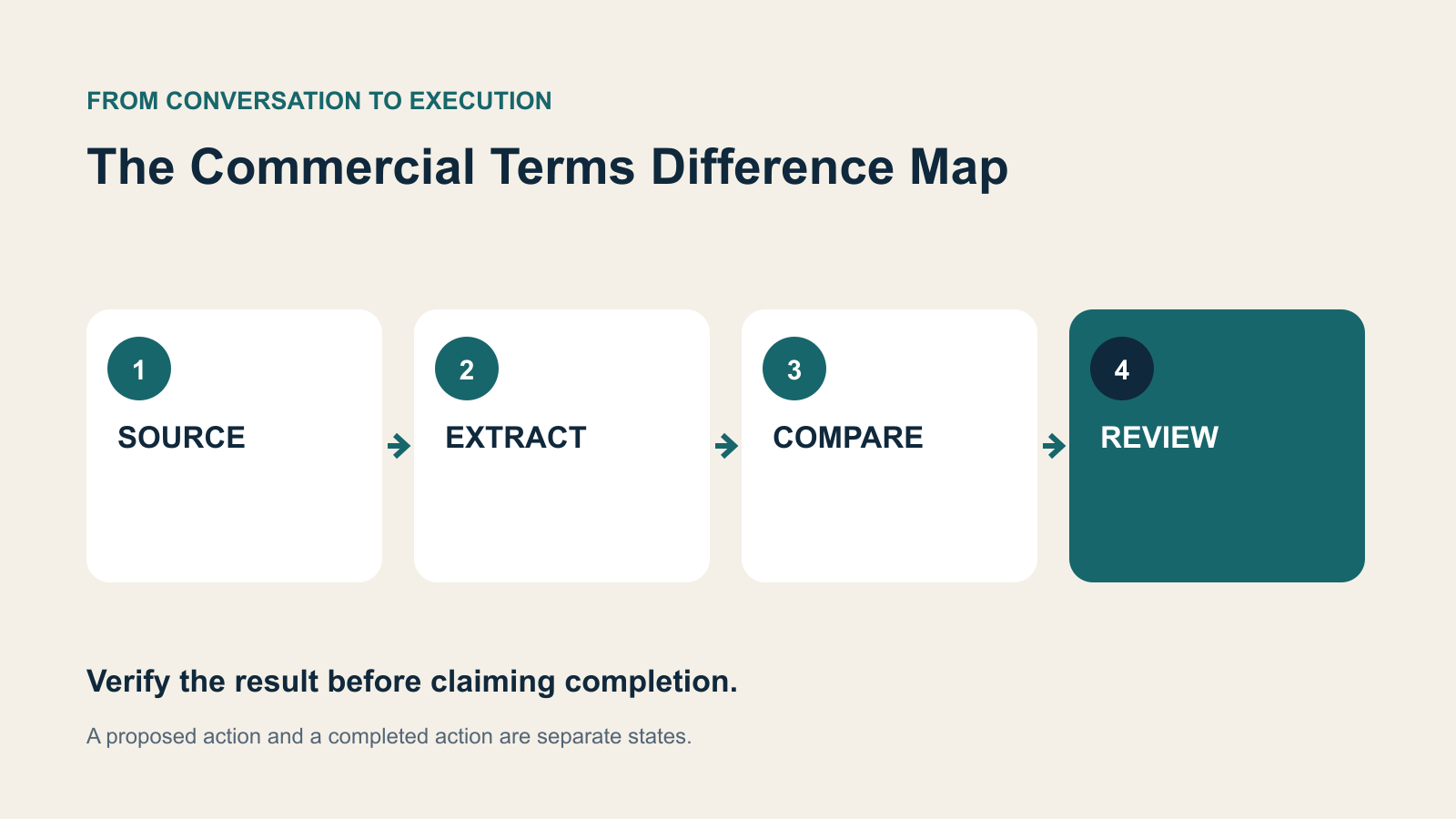
SOURCE → EXTRACT → COMPARE → REVIEW: review the state transition, not just the response.
Measure decision accuracy alongside customer effort
Measure incorrect term extraction, missing conditions concealed by the summary, and version mismatches. Track the time the commercial team spends preparing a reliable comparison, but keep that alongside correctness. A faster table that compares different scopes is not a useful outcome.
Use an explicitly illustrative audit to make the denominator clear. Suppose reviewers inspect 40 cases that genuinely require The Commercial Terms Difference Map, and find 6 unsupported actions. That is 6 divided by 40, or 15% in that sample. It is not a market benchmark or an expected result. Counting 200 unrelated greetings alongside those cases would hide the failure without fixing it. Keep the relevant case count, error count, review rules, and uncertainty visible when reporting the result.
Also inspect the opposite failure: an unnecessary hold when the evidence was already sufficient. Reviewers should distinguish a justified clarification from an avoidable repeat question. An appropriate human review is different from a case abandoned without an owner. Pair the action error rate with customer effort and completion evidence so the team cannot improve one dashboard by moving the cost to the customer or another department.
Connect The Commercial Terms Difference Map with the rest of customer operations
Brixi brings AI assistants, CRM, voice, WhatsApp, buyer intent, workflows, and team execution together for real estate teams. The platform connects customer conversations with ownership and follow-through across the property journey. This is more useful than adding an isolated property chatbot: the agent, relationship manager, and operations owner work from connected customer context.
For this use case, make the implementation review concrete: ask the Brixi team to walk through the original evidence, the current CRM state, the permitted action, and recovery when that action cannot complete. Validate any required source system, permission rule, and approval path during configuration. The recommended operating design in this article should be demonstrated against the actual deployment rather than assumed from a generic AI feature label.
For the wider operating model, read the existing AI in real estate guide. The important connection is between interpretation and accountable execution: the same evidence should prepare the assistant, the responsible human, and the next workflow.
What to inspect after the first quarter
At the first monthly review, look for the failure that has moved elsewhere. A cleaner conversation can still leave a stale task or an unowned approval. During the following reviews, sample complete journeys from original evidence to customer-visible outcome. Expand the scope only when the team can explain the remaining exceptions and the responsible owner can recover them without reconstructing the entire thread.
The deeper bet behind The Commercial Terms Difference Map
AI can make property decisions clearer by organizing evidence before negotiation. The complete platform connects documents, conversation priorities, CRM state, and the responsible advisor. The opportunity is an informed next discussion rather than an automated verdict about which lease a customer should sign.
Put The Commercial Terms Difference Map into a connected customer workflow
Explore how Brixi connects AI for real estate, CRM, AI assistants, conversations, workflows, and human teams around a reliable next action.