WhatsApp AI and Property Reservations: When a Temporary Unit Hold Expires

Property reservation AI needs a Reservation State Check before confirming any action based on an earlier hold. A conversation records what was offered; the inventory system establishes the current reservation state.
Imagine a buyer returning to a WhatsApp thread after a temporary unit hold expires. They write, “I’ll proceed with the one you reserved.” The assistant confirms the unit from yesterday’s conversation. The inventory owner has already released it and another buyer is discussing a reservation. Memory is accurate about the past and wrong about what can happen now.

The Reservation State Check keeps the customer’s meaning connected to the next action.
Property reservation AI needs a Reservation State Check before confirming any action based on an earlier hold. A conversation records what was offered; the inventory system establishes the current reservation state. The assistant must reconcile them rather than treat a historical promise as permanent availability.
Historical availability is not current reservation authority
Associate the hold with a unit identifier, owner, expiry, conditions, and authoritative current status. Recheck before extending, confirming, or releasing it. Separate a customer’s intention to proceed from a successfully renewed hold. If the status cannot be verified, state that availability is being checked instead of implying exclusivity.
A hold record should explain its conditions in language the customer can understand. The expiry time, required next action, and meaning of a pending request should be clear. Do not imply that sending a message alone extends the hold unless the approved process actually does so. An assistant can promptly acknowledge the intention to proceed while checking whether the condition for a reservation has been met. This separates a responsive conversation from an unsupported inventory promise.
Scarce inventory needs a state check at commitment time
Expired-hold mistakes create competing expectations around a scarce physical asset. Sales teams may each believe the unit belongs to their buyer. Managers then negotiate an avoidable trust dispute. The wrong confirmation can also trigger payment requests or document collection before the business has established that the reservation is possible.
The practical failure is specific: yesterday’s hold becomes today’s guaranteed unit. The desired behavior is equally specific: every reservation claim uses current state. Use those two statements as the review boundary. A response should be judged by the state it leaves behind, not only by whether its wording sounds helpful.
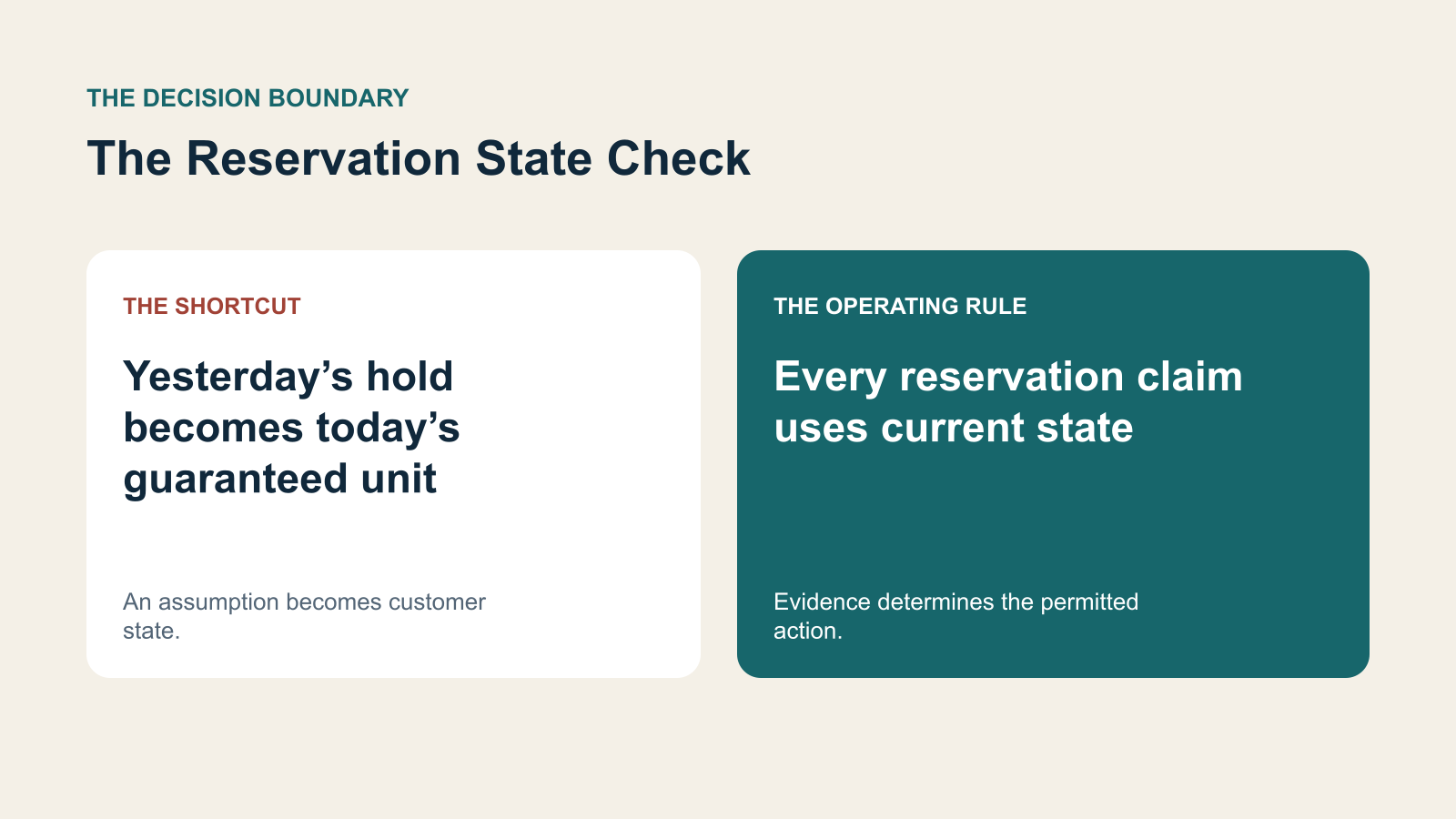
The Reservation State Check: the wrong shortcut and the evidence-based decision.
The working record behind The Reservation State Check
The record needs enough structure for another owner to verify the interpretation. For this journey, preserve four parts together rather than scattering them across a transcript, a note, and an action queue. Each part below has a different operating purpose. A populated field is useful only if the next owner can tell what it refers to and whether it is current.
Unit and hold identifiers
Use the exact unit and reservation reference. A remembered preference does not establish an active hold on that physical asset.
Expiry, conditions, and authorized owner
Preserve expiry and conditions in customer-readable form. A late message should not silently renew a hold unless the approved process permits it.
Current authoritative reservation status
Recheck authoritative status before committing. Concurrent conversations cannot each establish exclusive availability from their own separate histories.
Verified action result and customer confirmation
Confirm only the completed action result. A manager's approved extension still needs the corresponding recorded reservation update before success is communicated.
Confirmation should follow the recorded reservation result
Acknowledge the buyer’s reference and check the unit’s current status. If available, follow the approved process for a new or extended hold and communicate the actual conditions. If unavailable, explain that the earlier hold expired and prepare appropriate alternatives with the owner. Do not claim the original unit is secured while the check is pending.
A suitable clarification or acknowledgment in this illustrative scenario is: “I am checking whether that unit can still be held for you.” The wording is an example to adapt to the approved customer process, not a universal script. Its purpose is to make the next decision clear without claiming that an unverified action has already completed.
Concurrent requests need a single authoritative outcome. If two conversations concern the same unit, their separate histories do not create separate rights to reserve it. The assistant should request the allowed inventory action and use its result. If the action fails because another valid hold exists, communicate the verified state and prepare the authorized owner. Avoid language suggesting that the assistant is still holding the unit personally while another process has already allocated it.
The Reservation State Check
Yesterday’s hold becomes today’s guaranteed unit. Every reservation claim uses current state.
The boundary cases that change the correct action
Two buyers may respond at nearly the same time. The assistant must rely on the authoritative reservation mechanism rather than whichever conversation it processes first. A manager may authorize an extension, but that decision still needs a recorded inventory update. A message saying extended does not itself establish the extension.
Define the states proposed, held, expired, released, confirmed, and unknown. Make customer-facing wording depend on a successful state check. Test hold expiry during a conversation and simultaneous requests from separate owners. Preserve the exact result and reference used for confirmation.
Start with one team, one journey, and a named owner for exceptions. Keep the first version small enough that staff can inspect every consequential decision. Use disagreement reviews to improve the context and operating rules before increasing automation. A model cannot compensate for an undefined approval process or an owner who never receives the work.
How to test The Reservation State Check before expanding it
A useful review set includes ordinary success, ambiguity, a correction, and a failure after interpretation. Label the expected business state before looking at the assistant’s answer. Otherwise reviewers can be persuaded by fluent wording to accept a decision that the original evidence never supported.
- The buyer accepts after expiry; availability is rechecked before confirmation.
- Two requests compete; neither is confirmed from conversation memory alone.
- An extension is approved; the recorded inventory state is updated before messaging success.
Exercise expiry during the workflow rather than only before it starts. Let the hold be valid when the customer replies and expired when the assistant reaches the confirmation step. Review which status controlled the message. Then introduce a manager-approved extension and confirm that it is reflected in the authoritative record before the assistant reports success. This catches the gap between an internal decision and a completed inventory update.
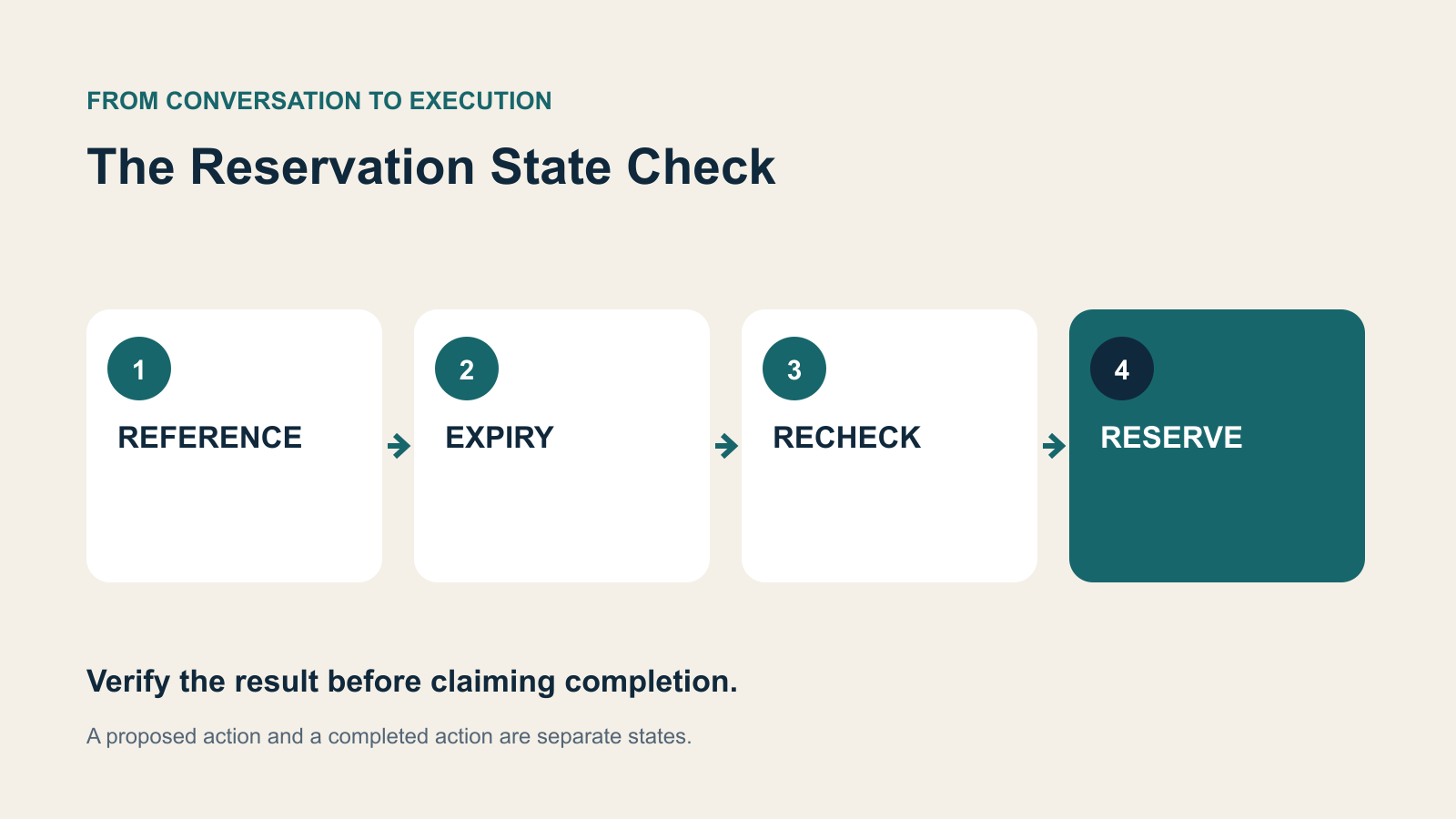
REFERENCE → EXPIRY → RECHECK → RESERVE: review the state transition, not just the response.
Measure decision accuracy alongside customer effort
Track confirmations issued against expired holds, competing reservations, and time to reconcile unknown availability. Separate lost availability from AI interpretation failure. The assistant may handle an unavailable unit correctly even when the buyer is disappointed; accuracy is not the same as always producing a favorable answer.
Use an explicitly illustrative audit to make the denominator clear. Suppose reviewers inspect 40 cases that genuinely require The Reservation State Check, and find 6 unsupported actions. That is 6 divided by 40, or 15% in that sample. It is not a market benchmark or an expected result. Counting 200 unrelated greetings alongside those cases would hide the failure without fixing it. Keep the relevant case count, error count, review rules, and uncertainty visible when reporting the result.
Also inspect the opposite failure: an unnecessary hold when the evidence was already sufficient. Reviewers should distinguish a justified clarification from an avoidable repeat question. An appropriate human review is different from a case abandoned without an owner. Pair the action error rate with customer effort and completion evidence so the team cannot improve one dashboard by moving the cost to the customer or another department.
Connect The Reservation State Check with the rest of customer operations
Brixi brings AI assistants, CRM, voice, WhatsApp, buyer intent, workflows, and team execution together for real estate teams. The platform connects customer conversations with ownership and follow-through across the property journey. This is more useful than adding an isolated property chatbot: the agent, relationship manager, and operations owner work from connected customer context.
For this use case, make the implementation review concrete: ask the Brixi team to walk through the original evidence, the current CRM state, the permitted action, and recovery when that action cannot complete. Validate any required source system, permission rule, and approval path during configuration. The recommended operating design in this article should be demonstrated against the actual deployment rather than assumed from a generic AI feature label.
For the wider operating model, read the existing AI in real estate guide. The important connection is between interpretation and accountable execution: the same evidence should prepare the assistant, the responsible human, and the next workflow.
What to inspect after the first quarter
After a quarter, the useful evidence is a change in operating behavior: fewer unsupported actions, fewer repeated clarifications, and clearer ownership of unresolved cases. Treat these as questions to investigate, not promised gains. Compare similar journey types and inspect the difficult cases as well as the average. Improvements should survive a new owner, a changed source record, and an ordinary customer correction.
The deeper bet behind The Reservation State Check
AI real estate selling must connect conversational memory to live operating state. The complete platform becomes useful at the boundary between what a buyer remembers and what the business can currently honor. Reliable checking protects trust better than a confident instant confirmation.
Put The Reservation State Check into a connected customer workflow
Explore how Brixi connects AI for real estate, CRM, AI assistants, conversations, workflows, and human teams around a reliable next action.