Payment Screenshots Are Evidence to Review, Not Proof of Payment

WhatsApp AI can help interpret payment screenshots without treating image recognition as financial verification. The Payment Evidence Gap is the distance between what an uploaded artifact appears to show and what the authorized payment record confirms.
Consider a customer sending a transfer screenshot at 8:42 pm with “Paid, please confirm my booking.” The image shows an amount and a transaction reference. The assistant marks the installment received, unlocks the reservation, and sends a receipt. Finance checks the actual payment record the next morning and cannot find a matching settlement.

The Payment Evidence Gap keeps the customer’s meaning connected to the next action.
WhatsApp AI can help interpret payment screenshots without treating image recognition as financial verification. The Payment Evidence Gap is the distance between what an uploaded artifact appears to show and what the authorized payment record confirms. Customer acknowledgment and payment confirmation must remain separate states.
Reading an amount does not verify receipt of funds
Extract candidate details such as amount, displayed date, reference, beneficiary, and visible status. Keep those details attributed to the image. Compare them through the approved reconciliation process, using the payment system or authorized finance review as the authority. An image marked successful may still be incomplete, unrelated, duplicated, or insufficient to establish that the business received funds.
The reconciliation case should identify the obligation being paid. Amount alone is insufficient when a customer has several installments, orders, or invoices with similar values. A useful candidate match includes the expected obligation, reference, date, and relevant payer details within the approved process. Keep a difference visible when the payer and customer are not the same person. The assistant can collect the information needed for review without deciding that a superficially similar payment settles a particular account.
False confirmation creates downstream obligations
Premature payment confirmation creates work that is difficult to unwind politely. Operations releases inventory, sales tells the buyer the transaction is complete, and finance inherits an apparent discrepancy. An incorrectly issued receipt can circulate beyond the original conversation. The failure is a state transition made from weak evidence, not simply an OCR mistake.
The practical failure is specific: image arrival marks payment complete. The desired behavior is equally specific: authoritative reconciliation controls confirmation. Use those two statements as the review boundary. A response should be judged by the state it leaves behind, not only by whether its wording sounds helpful.
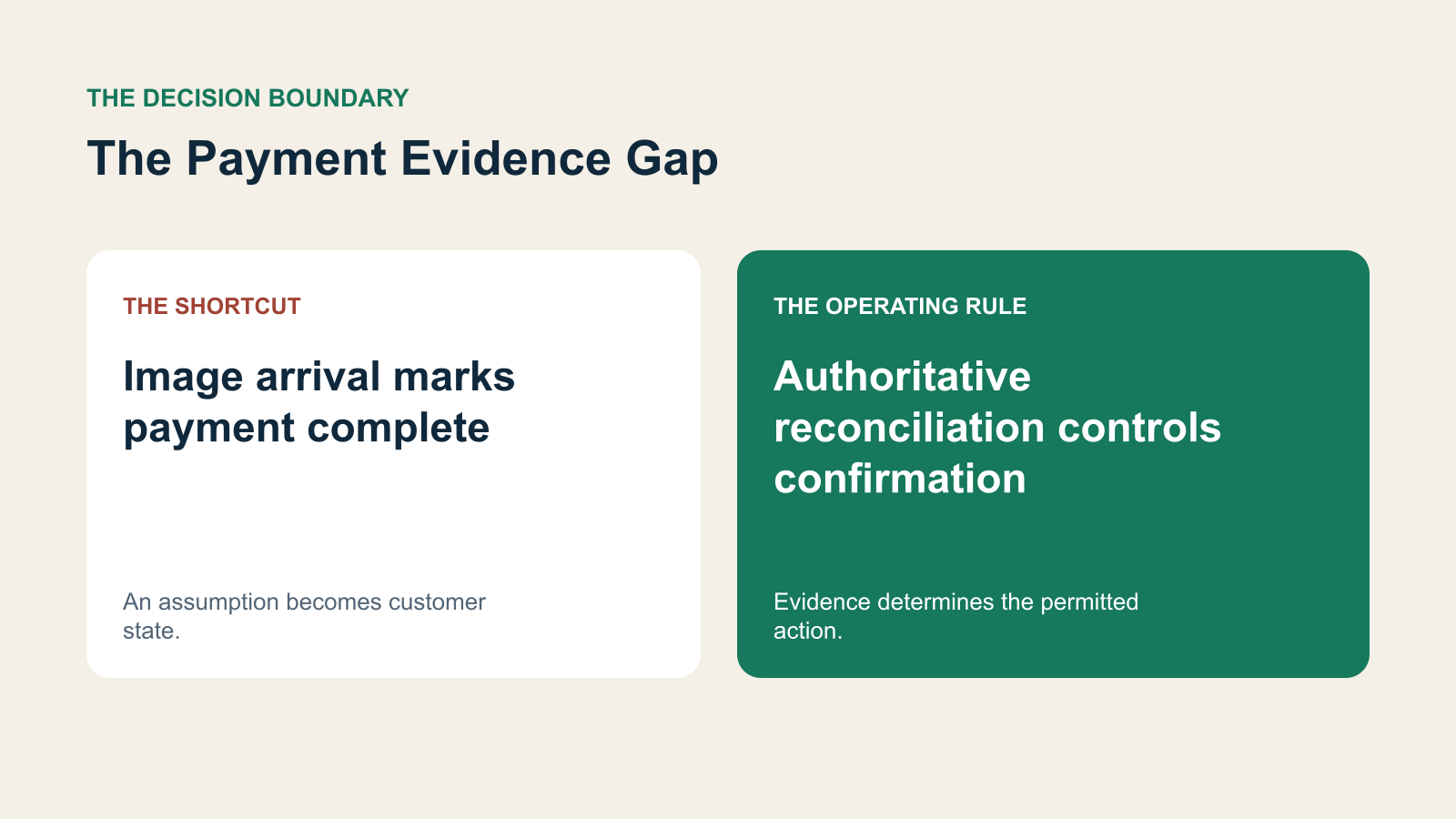
The Payment Evidence Gap: the wrong shortcut and the evidence-based decision.
The working record behind The Payment Evidence Gap
The record needs enough structure for another owner to verify the interpretation. For this journey, preserve four parts together rather than scattering them across a transcript, a note, and an action queue. Each part below has a different operating purpose. A populated field is useful only if the next owner can tell what it refers to and whether it is current.
Screenshot identifier and extracted candidate details
Store extracted details as candidates from the image. Visibility of an amount or reference does not establish receipt of the funds.
Customer obligation and expected amount
Match the specific obligation, not merely the account. Similar installment amounts can otherwise make a technically accurate extraction settle the wrong balance.
Authoritative reconciliation result and reviewer
Use the approved payment system or finance owner for confirmation. Preserve unmatched and partially matched states instead of forcing a successful result.
Receipt identifier and downstream release status
Issue downstream releases only from confirmed state. Reusing the reconciliation reference helps prevent duplicate screenshots from producing repeated receipts or inventory actions.
Acknowledgment should be fast and confirmation should be authoritative
Acknowledge receipt of the screenshot and say that payment is being verified. Create or update a reconciliation case tied to the actual customer obligation. If the authorized system confirms the amount and reference, record that confirmation and send the approved receipt. If details differ, ask for the specific missing information or route the case to finance without accusing the customer.
A suitable clarification or acknowledgment in this illustrative scenario is: “We have received the screenshot and are checking the payment.” The wording is an example to adapt to the approved customer process, not a universal script. Its purpose is to make the next decision clear without claiming that an unverified action has already completed.
Wording matters because customers distinguish acknowledgment from acceptance less clearly than finance teams do. “We received your screenshot” describes the artifact. “Your payment is confirmed” describes a verified business event. Choose one deliberately. Include a realistic next update expectation defined by the team, and make a delayed verification visible to its owner. Do not create a precise promise that the finance process cannot meet. The customer needs a reliable explanation of what is happening, especially outside normal working hours.
The Payment Evidence Gap
Image arrival marks payment complete. Authoritative reconciliation controls confirmation.
The boundary cases that change the correct action
A partial payment should not settle the full obligation. A screenshot for a previous installment should not clear the next one. Two uploads of the same reference should not generate two receipts. Mask unnecessary financial details in staff summaries and follow the business’s access and retention rules. The assistant needs enough context to route the case, not a permanent archive of every visible account detail.
Map the states received, verification pending, matched, unmatched, and reviewed. Specify which system or role can move a case into confirmed payment. Make downstream tasks depend on that authoritative state rather than the presence of an attachment. Give customers a clear next update so verification does not become unexplained silence.
Introduce the change in review mode first. The assistant prepares an interpretation and proposed next step while the existing authorized process remains in control. Collect disagreements with a reason, including cases where the reviewer lacks enough evidence to decide. Once the team can distinguish an interpretation mistake from a policy exception, expand only the narrowly defined actions that consistently produce reviewable results.
How to test The Payment Evidence Gap before expanding it
Begin the evaluation with the business decision, not the quality of the wording. Have a reviewer inspect the original exchange and identify the action it actually permits. Then compare the assistant’s interpretation, saved record, and customer-facing message. These three outputs can disagree even when each appears reasonable in isolation.
- A duplicate screenshot arrives; the existing reconciliation case is reused.
- The amount is partial; the remaining obligation stays open.
- The image says successful but no authoritative match exists; payment remains pending verification.
Test successful matches, partial payments, duplicate uploads, similar amounts across invoices, and transactions that remain unmatched. Review whether any downstream release occurred from the screenshot event rather than the authoritative confirmation. Include the case where finance corrects an earlier match. The assistant must reflect the corrected state through the approved customer process instead of continuing to rely on its own prior confirmation as evidence.
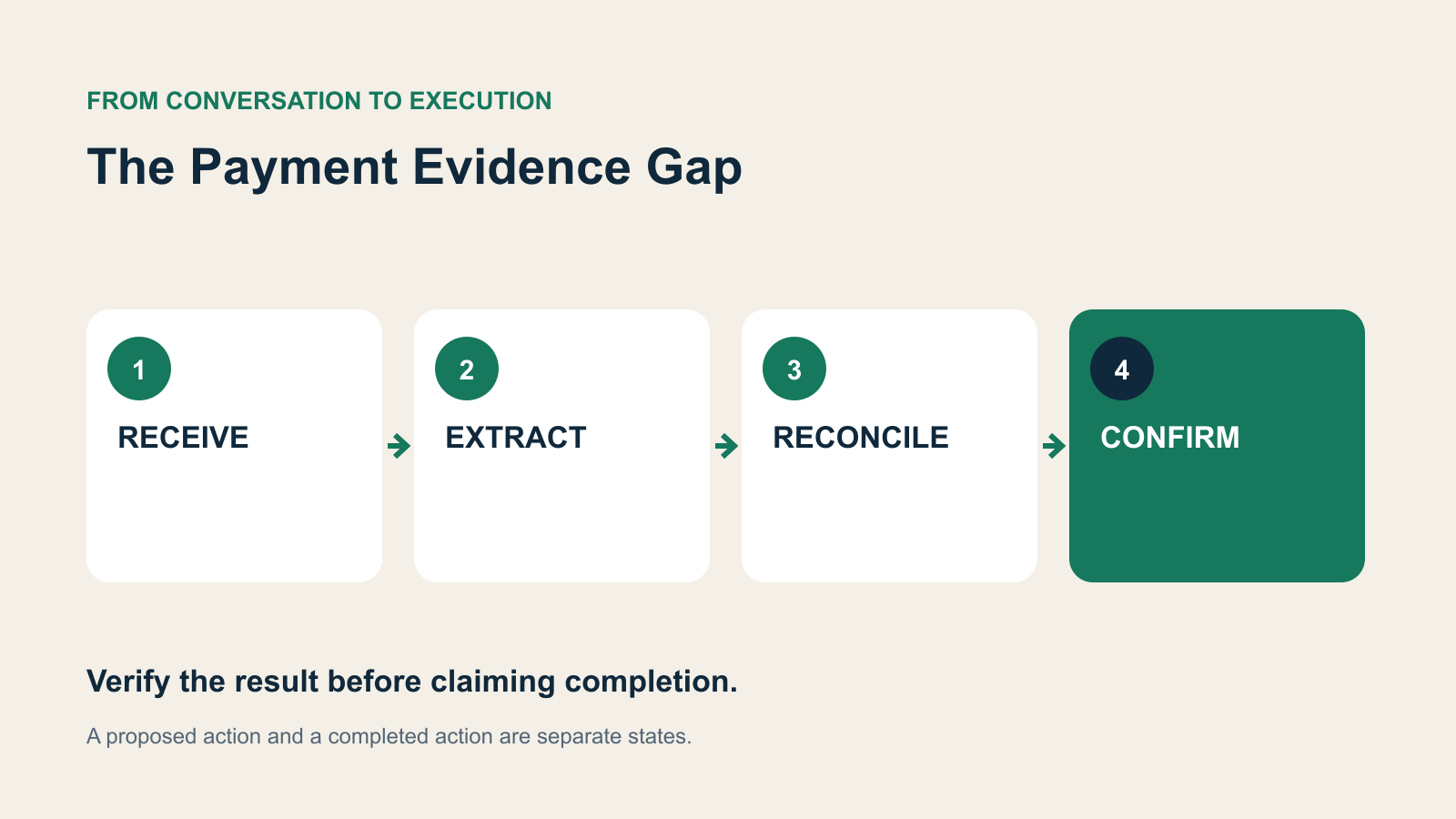
RECEIVE → EXTRACT → RECONCILE → CONFIRM: review the state transition, not just the response.
Measure decision accuracy alongside customer effort
Measure false confirmations, duplicate receipt attempts, unmatched references, and time to verified acknowledgment. Separate extraction accuracy from reconciliation accuracy. The assistant can correctly read every character and still make the wrong decision if it matches the screenshot to the wrong installment or customer.
Use an explicitly illustrative audit to make the denominator clear. Suppose reviewers inspect 40 cases that genuinely require The Payment Evidence Gap, and find 6 unsupported actions. That is 6 divided by 40, or 15% in that sample. It is not a market benchmark or an expected result. Counting 200 unrelated greetings alongside those cases would hide the failure without fixing it. Keep the relevant case count, error count, review rules, and uncertainty visible when reporting the result.
Also inspect the opposite failure: an unnecessary hold when the evidence was already sufficient. Reviewers should distinguish a justified clarification from an avoidable repeat question. An appropriate human review is different from a case abandoned without an owner. Pair the action error rate with customer effort and completion evidence so the team cannot improve one dashboard by moving the cost to the customer or another department.
Connect The Payment Evidence Gap with the rest of customer operations
WhatsApp messages, interactive choices, attachments, and human replies need the same customer record as calls and downstream tasks. Brixi brings these capabilities together as a complete AI-native customer platform. Its value is the connection between the assistant that interprets the message, the CRM that retains the evidence, the workflow that coordinates the next step, and the person accountable for an exception.
For this use case, make the implementation review concrete: ask the Brixi team to walk through the original evidence, the current CRM state, the permitted action, and recovery when that action cannot complete. Validate any required source system, permission rule, and approval path during configuration. The recommended operating design in this article should be demonstrated against the actual deployment rather than assumed from a generic AI feature label.
For the wider operating model, read the WhatsApp sales automation guide. The important connection is between interpretation and accountable execution: the same evidence should prepare the assistant, the responsible human, and the next workflow.
What to inspect after the first quarter
After a quarter, the useful evidence is a change in operating behavior: fewer unsupported actions, fewer repeated clarifications, and clearer ownership of unresolved cases. Treat these as questions to investigate, not promised gains. Compare similar journey types and inspect the difficult cases as well as the average. Improvements should survive a new owner, a changed source record, and an ordinary customer correction.
The deeper bet behind The Payment Evidence Gap
Useful financial conversation AI will accelerate evidence handling while preserving the authority of the underlying transaction record. The best customer experience is a prompt acknowledgment followed by a reliable confirmation. Speed earns trust only when the state behind the message is defensible.
Put The Payment Evidence Gap into a connected customer workflow
Explore how Brixi connects WhatsApp AI, CRM, AI assistants, conversations, workflows, and human teams around a reliable next action.