AI Agents Need Memory, Ownership, and Permission to Act
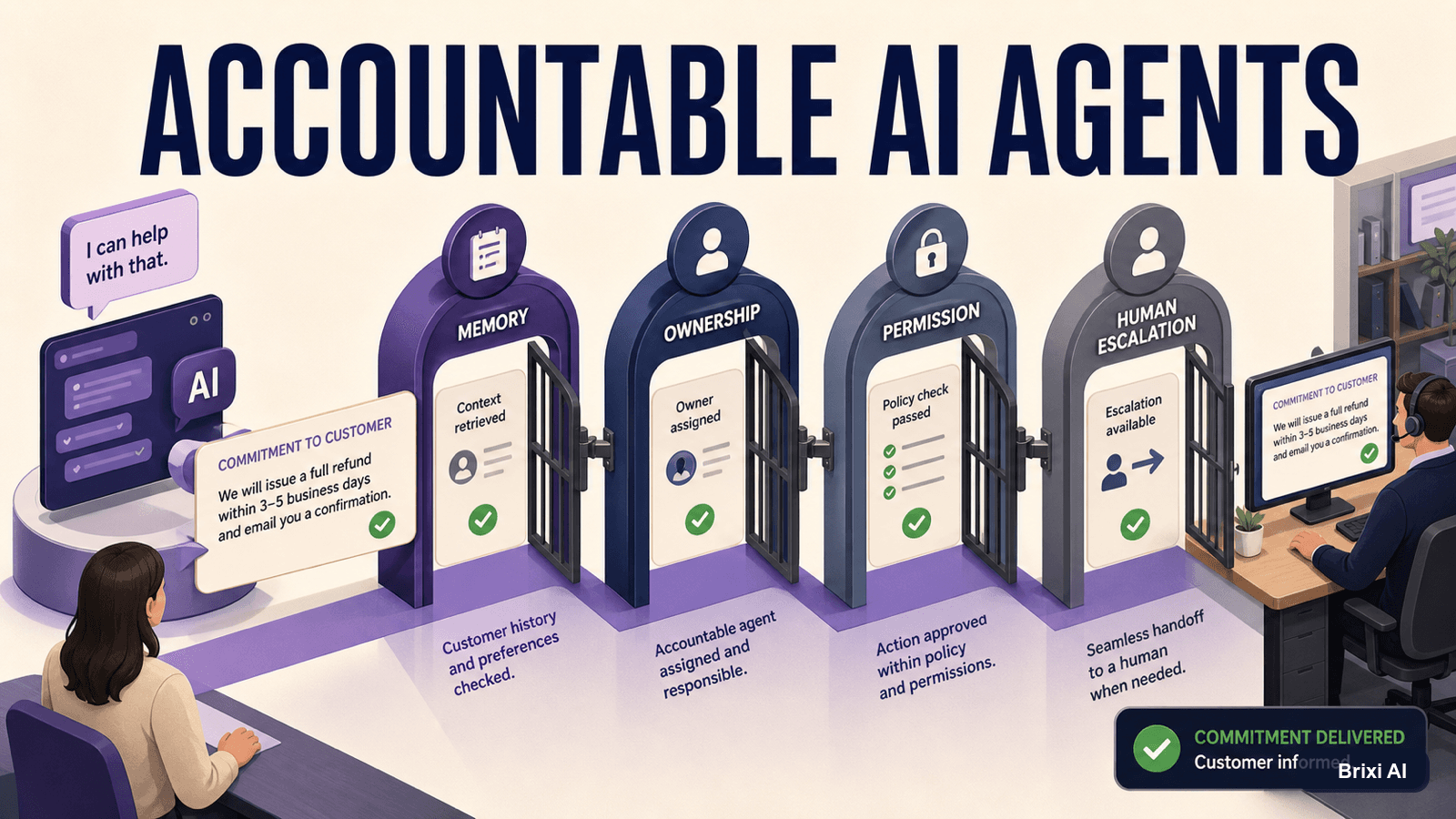
A fluent AI response is not the same as completed customer work. Reliable agents need shared memory, an accountable owner, permission boundaries, and a clear escalation contract.
At 11:18 on Wednesday, an AI assistant tells a prospect that a specialist will call within thirty minutes. The response is polite, accurate, and reassuring. No task is created. No owner is assigned. Ninety minutes later, the prospect buys from a competitor.
The assistant completed the conversation but failed the customer outcome. This is the Agent Completion Illusion: treating a good answer as completed work when the organization still owes an action.
The Agent Completion Illusion hides behind fluent answers
Language quality is visible, so teams optimize it first. Operational reliability is distributed across systems, so it receives less attention. The result is an agent that sounds capable but cannot carry responsibility across the journey.
A production agent needs four foundations: memory of the relationship, ownership of the outcome, permission to perform defined actions, and escalation rules for moments that require human judgment.
Memory must represent commitments, not transcripts alone
A transcript records words. Operational memory records what those words mean for future work: preferred time, promised callback, budget boundary, decision maker, unresolved objection, consent state, and next step.
Without structured memory, the next agent or person must reread the entire history. Most will not. They will ask the customer to repeat details, miss the promise, or choose a generic follow-up.
- Customer preferences and consent
- Open commitments and deadlines
- Qualification, intent, urgency, and risk
- Previous owners, actions, and outcomes
Ownership must survive channel and team changes
An agent can initiate work, but someone or some system must remain accountable for completion. Ownership cannot disappear when the customer moves from web chat to voice or when the assigned rep goes offline.
Good design distinguishes conversation ownership from outcome ownership. The AI may handle the current exchange while a sales owner remains responsible for the opportunity and a manager owns the escalation clock.
Permission boundaries turn autonomy into controlled execution
Agents should not receive unrestricted access simply because they can interpret a request. Each action needs a policy: what the agent may do, which data it may use, when confirmation is required, and what must be reviewed.
Routine scheduling, qualification, reminders, and record updates can be highly autonomous. Discounts, sensitive complaints, financial commitments, and unusual exceptions should route to people with full context.
- Safe autonomous actions
- Confirmation-required actions
- Human-review actions
- Prohibited actions with explicit fallback
Fluency is not completion
A customer-facing agent is reliable only when its answer, action, ownership, and audit trail agree.
Brixi gives agents an operating environment, not an empty chat box
Brixi connects AI assistants with CRM memory, conversations, workflows, routing, permissions, and human teams. Agents can interpret intent and complete approved next steps inside the same customer context.
When the agent reaches a boundary, it hands off the reason, evidence, and recommended action. The person does not start from a blank screen, and the final outcome becomes available to the next channel.
- Shared customer and commitment memory
- Action-level permission boundaries
- Persistent ownership and SLA tracking
- Context-rich escalation and audit history
After a quarter, measure resolved outcomes instead of conversations
Conversation count and containment rate can reward the wrong behavior. An agent may contain a conversation by ending it without completing the work. The stronger measure follows the promised outcome to completion.
A quarter of production data reveals which intents resolve safely, where escalations wait, which promises are missed, and which permissions should expand or contract.
- Higher completed-action rate
- Lower promise-to-task failure
- Faster escalations with complete context
- Clearer evidence for expanding agent autonomy
The deeper bet is accountable autonomy
AI agents will become ordinary participants in customer operations. The durable advantage will not come from the most human-sounding bot. It will come from agents that can be trusted with bounded responsibility.
Memory, ownership, permission, and escalation form the operating contract. Once that contract is explicit, AI can take on more work without making the organization harder to control.
Give AI agents a real operating contract
See how Brixi connects agent decisions with customer memory, permissions, workflows, and human accountability.
Book an AI operations demoFrequently Asked Questions
Agent memory is structured customer context such as preferences, commitments, intent, risk, ownership, and prior outcomes, not merely a transcript archive.
Classify actions as autonomous, confirmation-required, human-review, or prohibited. Apply the least authority necessary and keep an audit trail.
Track resolved customer outcomes and completed promised actions alongside conversation quality, response time, escalation quality, and policy compliance.