The Summary Drift Problem: When AI Keeps Summarizing Its Own Summaries

AI conversation memory needs an Evidence Refresh Point: a deliberate return to original supporting messages when a consequential fact is reused or revised. A summary is a navigation aid, not an independent witness.
Imagine a customer journey lasting several months. The first summary says the buyer is considering a property if school access works. A later summary shortens that to “school location important.” Another turns it into “prefers this school district.” By the fourth handoff, the condition has become a preference and the unresolved question has vanished.

The Evidence Refresh Point keeps the customer’s meaning connected to the next action.
AI conversation memory needs an Evidence Refresh Point: a deliberate return to original supporting messages when a consequential fact is reused or revised. A summary is a navigation aid, not an independent witness. Repeated compression can lose qualifiers even when every individual version sounds sensible.
A summary is not a new source of truth
Associate important summary claims with their underlying evidence and distinguish direct facts from interpretation. When a new message challenges a claim, retrieve the original statement instead of editing only the latest compressed version. Preserve unresolved questions and explicit exclusions as structured items so they do not depend entirely on prose surviving another summarization pass.
Not every sentence in a summary needs the same treatment. Stable, low-consequence background can remain compact, while action-driving facts need recoverable evidence. Prioritize budget constraints, accepted offers, explicit exclusions, identity relationships, and unresolved promises. This keeps the memory design practical. Requiring a detailed citation for every greeting creates clutter, but allowing an unsupported accepted-offer claim creates a commercial risk. The evidence policy should follow consequence and the likelihood that the fact will be reused.
Compression failures become confident customer mistakes
Drift is expensive because it is difficult to spot. Each new owner receives a clean briefing and assumes the previous owner verified it. The buyer experiences a team confidently remembering something they never said. Managers cannot diagnose the error from the current summary alone, and manual reconstruction becomes necessary at exactly the moment the customer is frustrated.
The practical failure is specific: a summary becomes the source for another certainty. The desired behavior is equally specific: consequential claims can return to original evidence. Use those two statements as the review boundary. A response should be judged by the state it leaves behind, not only by whether its wording sounds helpful.
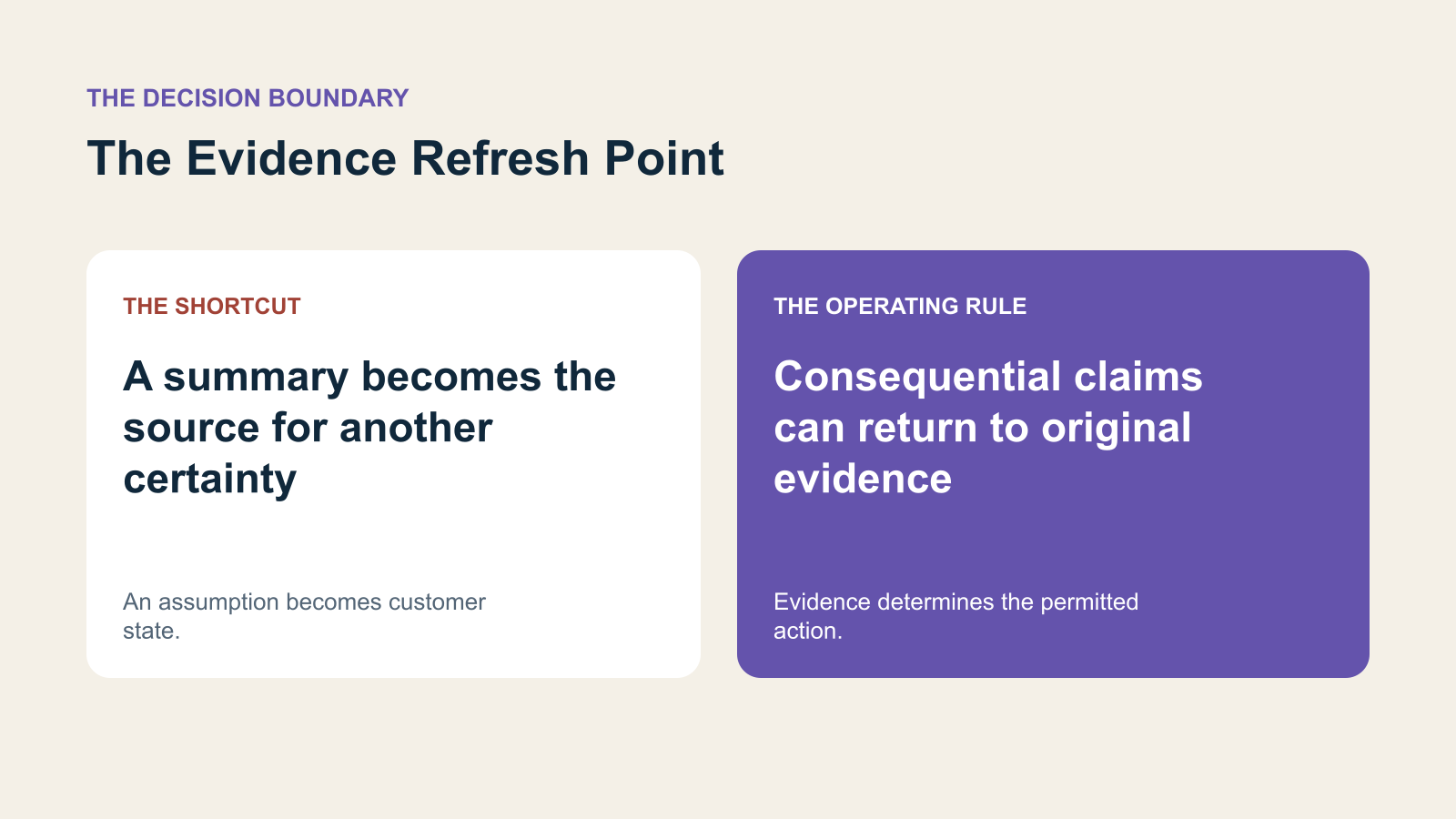
The Evidence Refresh Point: the wrong shortcut and the evidence-based decision.
The working record behind The Evidence Refresh Point
The record needs enough structure for another owner to verify the interpretation. For this journey, preserve four parts together rather than scattering them across a transcript, a note, and an action queue. Each part below has a different operating purpose. A populated field is useful only if the next owner can tell what it refers to and whether it is current.
Summary claim and supporting original messages
Link important claims to original evidence. A prior AI summary can help navigation but cannot independently verify the statement it inherited.
Fact status, qualifiers, and unresolved conditions
Retain conditions and exclusions as current decision context. A technically true shorter sentence may still omit the qualifier that changes the next action.
Summary version and previous changes
Keep summary changes inspectable. A new owner should be able to see when a condition disappeared or an inference became stated as fact.
Refresh trigger, reviewer, and current decision
Refresh evidence when consequential reuse requires it. Check identity, journey, source age, and corrections rather than blindly trusting the first retrieved statement.
Refresh the evidence when the fact drives an action
For the school question, retain the original condition and the unanswered verification task. A new advisor should see “purchase depends on acceptable school access; confirmation pending,” with a link to the exchange. If the customer later resolves it, update the condition using that new evidence. Do not infer resolution because several weeks passed without another mention.
A suitable clarification or acknowledgment in this illustrative scenario is: “This requirement was conditional; has it now been resolved?” The wording is an example to adapt to the approved customer process, not a universal script. Its purpose is to make the next decision clear without claiming that an unverified action has already completed.
Drift can also enter through omission. A summary may contain no false sentence but remove the one condition that made the rest accurate. Review whether the compressed record retains what would change the next action. In the school example, “school access important” is true yet insufficient. It omits that the purchase depends on verification. Compare the decision a rep would make from the summary with the decision justified by the original exchange. That reveals meaning loss that sentence-level accuracy misses.
The Evidence Refresh Point
A summary becomes the source for another certainty. Consequential claims can return to original evidence.
The boundary cases that change the correct action
Original evidence is not automatically current. A source message may be old, corrected, or tied to a different project. An evidence refresh must check identity, journey, time, and supersession. It should also respect access and retention rules. The solution is targeted evidence retrieval, not sending an unlimited transcript to every assistant and every employee.
Choose the small set of facts that most often drive consequential actions. Require evidence links for them and mark unsupported inherited claims for review. Compare summaries across handoffs using the original conversation as the reference. Test specifically for missing negation, conditions, rejected options, and third-party attribution.
Start with one team, one journey, and a named owner for exceptions. Keep the first version small enough that staff can inspect every consequential decision. Use disagreement reviews to improve the context and operating rules before increasing automation. A model cannot compensate for an undefined approval process or an owner who never receives the work.
How to test The Evidence Refresh Point before expanding it
A useful review set includes ordinary success, ambiguity, a correction, and a failure after interpretation. Label the expected business state before looking at the assistant’s answer. Otherwise reviewers can be persuaded by fluent wording to accept a decision that the original evidence never supported.
- A conditional statement passes through several summaries; the condition remains visible.
- A new correction arrives; original and correcting evidence are compared.
- A summary has no supporting source; its claim is not promoted into verified status.
Test several handoffs rather than one summary. Ask each stage to prepare the next owner’s brief, then compare the final result with the original evidence. Do not let later summaries cite earlier summaries as independent support. Introduce a correction halfway through and verify that the refreshed evidence changes the current interpretation. This evaluation is closer to the life of a long property or B2B journey than a single clean demonstration.
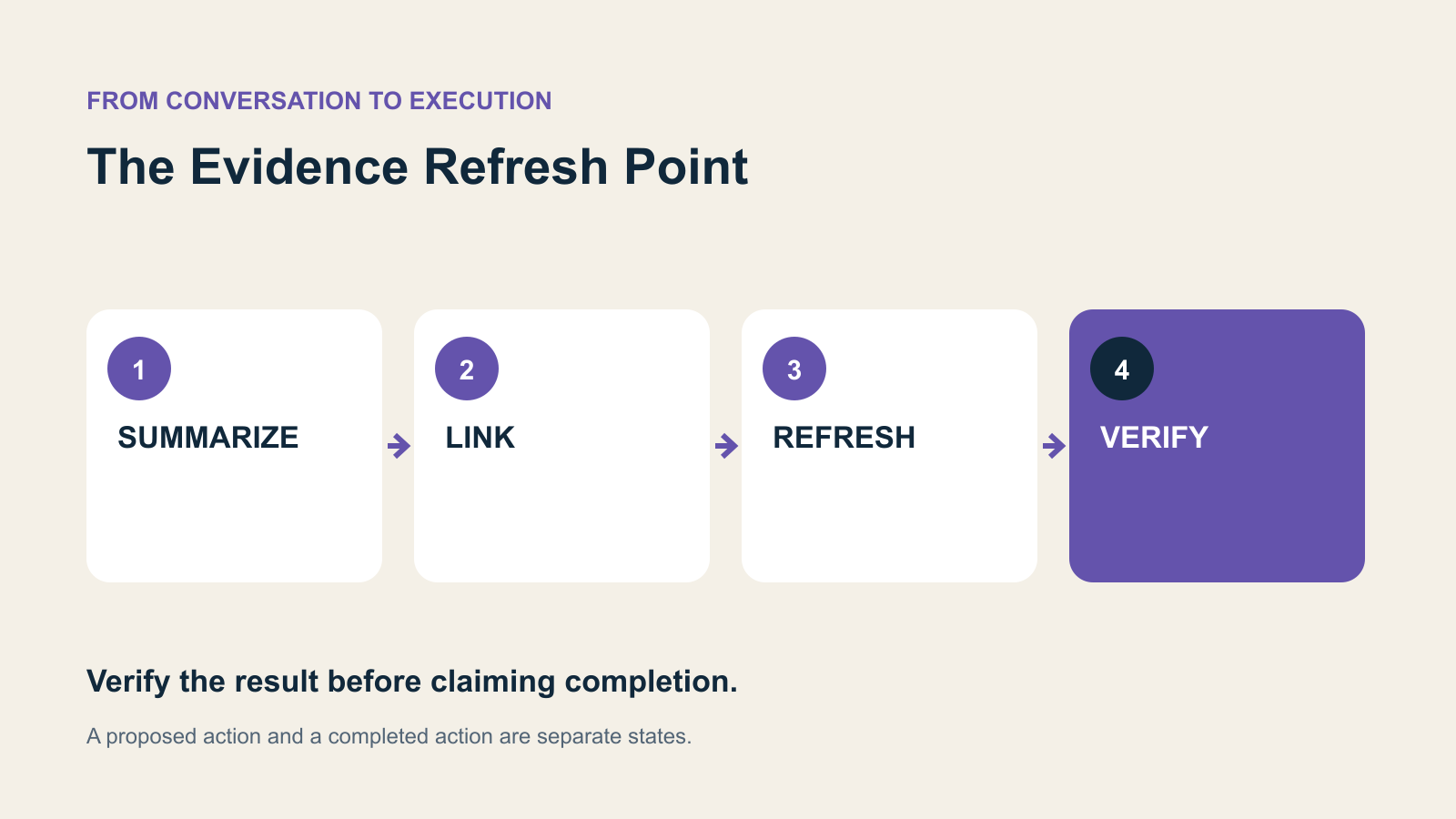
SUMMARIZE → LINK → REFRESH → VERIFY: review the state transition, not just the response.
Measure decision accuracy alongside customer effort
Measure unsupported summary claims, qualifiers lost across revisions, and time required for a new owner to verify a consequential statement. Sample long-running journeys rather than only fresh conversations. A system can appear accurate on the first summary while deteriorating after several cycles of compression.
Use an explicitly illustrative audit to make the denominator clear. Suppose reviewers inspect 40 cases that genuinely require The Evidence Refresh Point, and find 6 unsupported actions. That is 6 divided by 40, or 15% in that sample. It is not a market benchmark or an expected result. Counting 200 unrelated greetings alongside those cases would hide the failure without fixing it. Keep the relevant case count, error count, review rules, and uncertainty visible when reporting the result.
Also inspect the opposite failure: an unnecessary hold when the evidence was already sufficient. Reviewers should distinguish a justified clarification from an avoidable repeat question. An appropriate human review is different from a case abandoned without an owner. Pair the action error rate with customer effort and completion evidence so the team cannot improve one dashboard by moving the cost to the customer or another department.
Connect The Evidence Refresh Point with the rest of customer operations
Brixi brings CRM, AI assistants, conversation history, omnichannel communication, workflows, and team execution into one customer platform. That gives teams a connected place to design memory rules rather than maintaining a different interpretation in every inbox. The business decision, its supporting conversation, the responsible owner, and the resulting action can be reviewed together.
For this use case, make the implementation review concrete: ask the Brixi team to walk through the original evidence, the current CRM state, the permitted action, and recovery when that action cannot complete. Validate any required source system, permission rule, and approval path during configuration. The recommended operating design in this article should be demonstrated against the actual deployment rather than assumed from a generic AI feature label.
For the wider operating model, read the guide to the AI memory gap. The important connection is between interpretation and accountable execution: the same evidence should prepare the assistant, the responsible human, and the next workflow.
What to inspect after the first quarter
At the first monthly review, look for the failure that has moved elsewhere. A cleaner conversation can still leave a stale task or an unowned approval. During the following reviews, sample complete journeys from original evidence to customer-visible outcome. Expand the scope only when the team can explain the remaining exceptions and the responsible owner can recover them without reconstructing the entire thread.
The deeper bet behind The Evidence Refresh Point
Useful memory will combine compact navigation with recoverable evidence. The goal is not a longer summary or a larger archive. It is an operating record that can explain why the team believes something and return to the customer’s actual words when that belief matters.
Put The Evidence Refresh Point into a connected customer workflow
Explore how Brixi connects customer context, CRM, AI assistants, conversations, workflows, and human teams around a reliable next action.