Conversation Context Across Channels: The Real Omnichannel Advantage
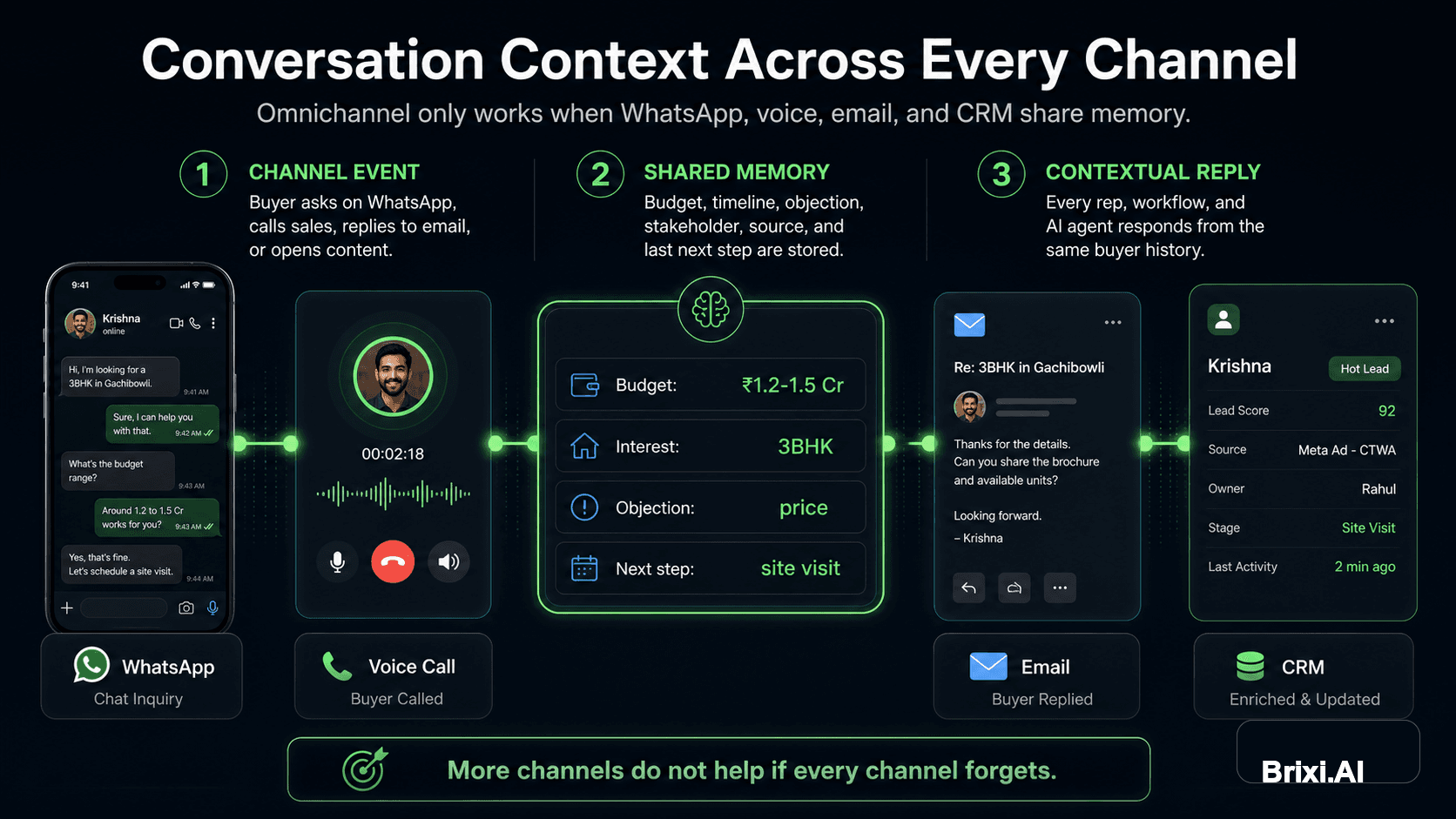
Most teams think omnichannel means being reachable on WhatsApp, voice, email, and web chat. Reachability is the easy part. The hard part is shared conversation context: every channel remembering what the buyer told you, so the relationship compounds instead of resets.
Naina runs a sales team at a mid-size real estate developer in Faridabad. In March, a buyer named Rahul first messaged on WhatsApp asking about a 3BHK on a specific floor. The team responded promptly. Two days later, Rahul called on a tracked number. The voice agent picked up, confirmed interest, and said someone would follow up. The next morning, a rep called Rahul back and asked: "So sir, what exactly are you looking for?" Rahul had already told three different surfaces. He answered again, politely, but he never booked a site visit.
Naina pulled the data. Her team was active on four channels. Response time was under two minutes. Channel coverage looked excellent. And yet the buyer experience was fragmented at every handoff. The problem was not presence. It was memory.
What is Conversation Continuity Debt, and why does it compound?
Every time a buyer repeats context they have already shared, a small trust cost accumulates. In isolation, each reset feels like a minor inconvenience. Across three or four interactions on different channels, it adds up to what sales teams in high-ticket categories experience as "warm leads going cold for no reason." That accumulated cost is what we call Conversation Continuity Debt.
Conversation Continuity Debt is not a CRM problem. It is a memory architecture problem. Most CRMs store structured fields: name, phone, stage, deal value. They do not store what the buyer actually said about their timeline, their objection to the price, the name of the family member who has veto power, or the competing project they mentioned on a call. That unstructured layer is exactly where the relationship lives, and it is exactly what gets lost at every channel boundary.
The contrarian truth here is uncomfortable: adding more channels without fixing cross-channel context actively harms conversion. Most operators assume more touchpoints means more chances to close. In practice, each additional channel that lacks shared conversation memory is another surface where the buyer can feel ignored. The number of channels is not the variable. The depth of shared memory is.
Where does conversation context break most often across channels?
The breakdown points are predictable once you map them. They cluster at handoffs, specifically at the moments when a buyer moves from one channel to another or from an automated system to a human.
- WhatsApp to voice call: the buyer calls after a chat thread, but the inbound agent or auto-attendant has no summary of what was discussed. The buyer re-introduces themselves.
- Voice call to email follow-up: the call captures a specific objection or requirement, but the follow-up email is a generic sequence that ignores it entirely.
- Ad click to CRM record: the campaign creative carried a specific promise or product variant, but nothing about it appears in the rep's lead record.
- AI assistant to human handoff: the human receives a raw transcript instead of a structured brief with the three things that matter most.
- Returning buyer to new inquiry: a buyer who engaged six months ago is routed through a first-touch flow and treated as brand new.
- Inbound call to WhatsApp re-engagement: the automated re-engagement message is generic, ignoring what the buyer said on the call that day.
Each of these is a named anti-pattern, not a one-off glitch. They happen by default because the tools handling each channel were designed to operate independently. Fixing them requires a deliberate memory layer that sits above the channels and makes context available before any response is generated.
Why is a CRM record alone not enough to maintain buyer context?
This is the question most teams get wrong. The assumption is that a well-maintained CRM record solves the context problem. It does not, for a structural reason: CRM fields are designed for reporting and pipeline management, not for conversation continuity.
A CRM record tells you that Rahul is in the "Interested" stage, that he is looking at a 3BHK, and that his budget is under 80 lakhs. It does not tell you that he mentioned his mother-in-law will visit the site before any decision is made, that he pushed back on the east-facing unit specifically, or that he said he wants to close before his kid's school admission deadline in June. That context, the kind that makes a follow-up message feel personal rather than automated, lives in conversations. Not in fields.
To maintain conversation context across channels, teams need three things operating together. First, buyer identity resolution: the ability to link a WhatsApp number, a call record, an email reply, and a web form submission to the same person without requiring a login. Second, structured conversation extraction: pulling out product interest, urgency signals, objections, decision-maker names, and promised next steps from the raw transcript. Third, retrieval before response: surfacing the relevant context to the rep, the AI agent, or the workflow before the next message goes out.
The real omnichannel gap is not channel coverage
Being reachable on five channels is distribution. Remembering what happened across those five channels before every reply is operations. Buyers feel the second one immediately, even if they cannot name it.
How does cross-channel conversation memory change the sales motion?
When conversation context is shared across channels, the sales motion shifts from repetitive qualification to progressive deepening. Each touchpoint starts from where the last one ended. The buyer experiences a relationship that accumulates rather than one that keeps resetting.
In practice, this changes several specific behaviors. A WhatsApp message sent after a call can reference what the buyer said on the call, by name. An inbound call from a buyer who already messaged can be routed to the rep who handled the original inquiry, with a brief showing what was discussed. An AI voice agent calling back a warm lead can open with the buyer's stated preference, not a generic introduction. A human rep picking up a handoff from an AI assistant gets a structured brief, not a 45-minute transcript to skim.
These are not small UX improvements. In high-ticket categories like real estate, lending, and edtech, in-person visits and enrollment decisions often turn on whether the buyer feels genuinely understood. Conversation Continuity Debt erodes that feeling at every channel boundary. Shared conversation memory restores it.
What does the omnichannel CRM architecture look like when it works?
The architecture that eliminates Conversation Continuity Debt has four layers, and most teams are missing at least two of them.
- Unified identity layer: links the same buyer across WhatsApp, phone, email, and web without requiring manual merging. This is the foundation. Without it, every other layer operates on partial data.
- Conversation extraction engine: processes voice transcripts, chat threads, and email replies to pull structured signals: product interest, budget range, objections, urgency markers, stakeholder names, promised next steps.
- Context retrieval API: makes the relevant conversation history available to whatever system is about to respond, whether that is a CRM workflow, an AI assistant, or a human rep's interface.
- Feedback loop back to the CRM: updates the lead record automatically as new signals emerge, so the structured data stays current without requiring manual data entry from reps.
The layer most teams underinvest in is the third one. Extraction is increasingly handled by AI transcription and summarization. Identity resolution is improving. But retrieval, the actual surfacing of context at the moment of response, is where most setups still fall apart. Context that exists somewhere in a system but is not surfaced before the next reply does not reduce Conversation Continuity Debt. It just sits in a database.
What changes after a quarter of shared conversation context?
Teams that implement cross-channel conversation memory typically see the effects in three areas, usually within 60 to 90 days of consistent operation.
First, warm lead conversion improves. Buyers who engaged on one channel and were followed up on a second channel with accurate context convert at higher rates than those who went through a reset. The mechanism is straightforward: they spend less of the conversation re-establishing what they already said and more of it moving toward a decision.
Second, rep qualification time drops. When a rep picks up a lead that already has extracted context from prior conversations, the opening qualification loop is shorter. In deployments we see, reps consistently cite this as one of the most immediate productivity changes.
Third, AI agent quality improves visibly. Voice AI agents and WhatsApp automation that operate with full conversation history generate responses that feel contextually appropriate. The "did you just ignore everything I said" failure mode becomes rare rather than routine.
There is also a less visible fourth effect: rep morale. Reps who are equipped with context before a call are less likely to open with a question the buyer finds insulting. That changes how the rep feels about the quality of the leads they are working, which in turn affects how hard they work them.
What is the deeper bet behind building conversation context infrastructure?
When Naina fixed the handoff problem in her team, the immediate result was a higher site visit rate from warm leads. But the deeper result was structural. Her team had stopped treating each channel as a separate interaction and started treating the buyer relationship as a single continuous thread that happened to touch different surfaces.
That shift has a compounding effect that goes beyond any individual conversion metric. A buyer who experiences consistent context retention across multiple touchpoints builds a different kind of trust with the brand. They feel remembered. That feeling is not easily manufactured by the next competitor who messages them. It is built through repeated interactions that demonstrate continuity.
The deeper bet is that in any category where the buying decision takes multiple interactions across multiple channels, the team that eliminates Conversation Continuity Debt has a structural advantage that is difficult to replicate quickly. It is not a feature. It is the operating model.
Omnichannel presence is table stakes. Shared conversation context across channels is the actual moat. Most teams have the channels. Very few have the memory.
Does your team carry Conversation Continuity Debt across channels?
Brixi unifies WhatsApp, voice, email, and CRM data so every channel works from the same buyer memory. No more resets at handoffs.
Explore the Buyer Intent EngineFrequently Asked Questions
Conversation context across channels is the shared memory of what a buyer has said, asked, objected to, and agreed to across every channel they have touched, whether that is WhatsApp, a voice call, email, or a web form. It matters for sales because buyers in high-ticket categories like real estate, lending, and edtech make decisions across multiple touchpoints. When each touchpoint treats the buyer as a new lead, trust erodes and warm leads go cold. When each touchpoint builds on what came before, the relationship compounds and conversion improves.
A CRM is necessary but not sufficient. CRM fields capture structured data like stage, budget, and contact details. They do not capture the unstructured conversation layer: the objection a buyer raised on a call, the family member they mentioned as a decision-maker, or the deadline they shared on WhatsApp. To maintain cross-channel conversation context, teams need conversation extraction, identity resolution across channels, and context retrieval before every rep interaction or automated response.
Multi-channel CRM means the team is reachable on multiple channels, each tracked separately. Omnichannel CRM means all those channels share a unified buyer record, with conversation history accessible across tools. The practical difference is that in an omnichannel CRM setup, a rep opening a call can see the WhatsApp thread, the AI voice summary, and the web inquiry in a single view, with key signals already extracted. In a multi-channel setup, those records exist in different systems and the rep starts from scratch.
The most common failure at the AI to human handoff is the human receiving a raw transcript rather than a structured brief. The fix requires conversation extraction that surfaces the three to five most relevant signals before the human picks up: buyer name and prior channel history, stated product interest, key objection or hesitation, urgency signals, and any promised next step. When the handoff brief is structured rather than raw, rep response quality improves immediately and the buyer does not have to re-establish what they already shared with the AI.