Customers Send Five Short Messages. WhatsApp AI Should Understand One Request.
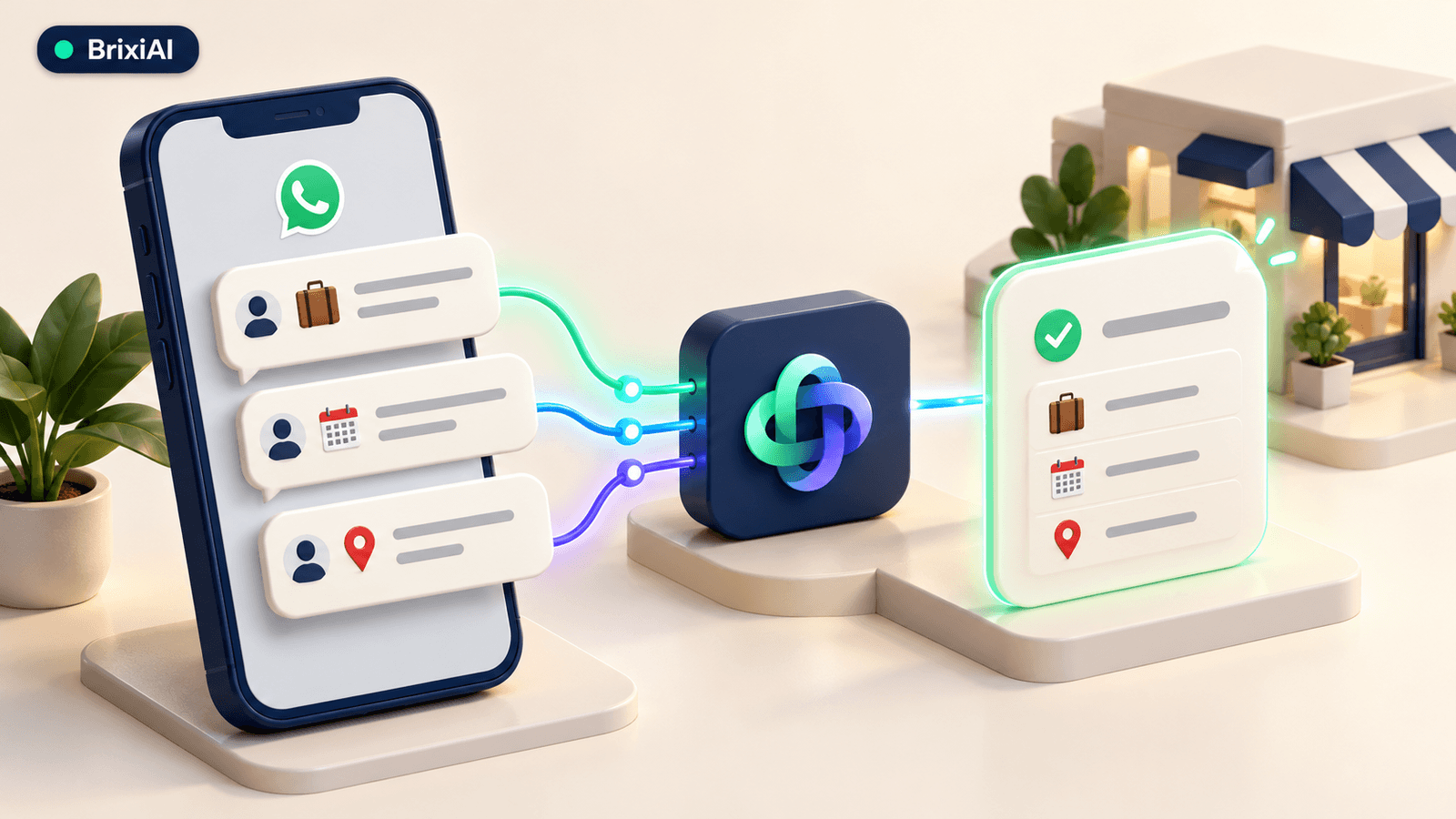
WhatsApp AI should assemble fragmented messages into a coherent request before choosing its answer. The Message Assembly Window is a bounded pause for related incoming fragments, followed by one interpretation of the complete turn.
Imagine a rental inquiry arriving as five messages: “Looking for a flat.” “Two bedrooms.” “Near the metro.” “Not above 35k.” “Actually furnished if possible.” The assistant replies after the first line and asks for bedroom count. By the time its second reply arrives, the customer has already supplied the answer twice. An instant response has made a simple exchange slower.
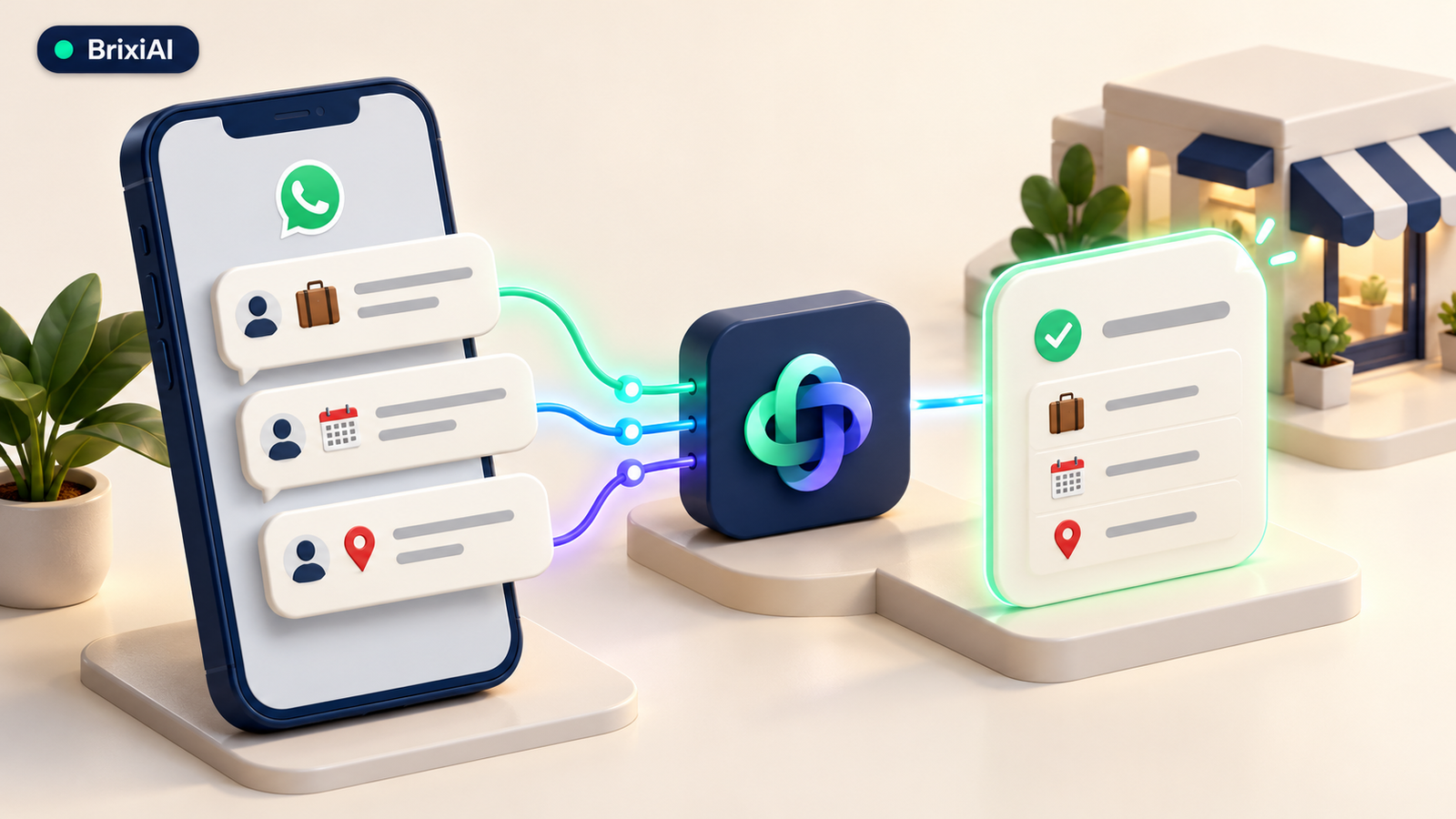
The Message Assembly Window keeps the customer’s meaning connected to the next action.
WhatsApp AI should assemble fragmented messages into a coherent request before choosing its answer. The Message Assembly Window is a bounded pause for related incoming fragments, followed by one interpretation of the complete turn. The goal is conversational completeness without making urgent customers wait behind an arbitrary timer.
A message boundary is not a thought boundary
Message delivery boundaries and conversational turn boundaries are different things. Customers type in fragments, add corrections, and separate hard constraints from preferences across several sends. Preserve arrival order and distinguish an addition from a replacement. “Actually 40k if furnished” changes the relationship between price and furnishing; it should not create two unrelated budgets in CRM.
The assembly rule should account for meaning as well as timing. Several consecutive messages can belong to separate requests, while a delayed message can complete an earlier thought. Preserve a link to the active question and note whether each fragment adds a field, corrects a field, or introduces another purpose. Do not merge everything sent within a short period into one bag of keywords. In the rental example, “not furnished” followed by “sorry, furnished” is a revision, while “my colleague needs a studio” creates another subject and likely another journey.
Premature responses create contradictory customer records
Reply-per-message automation multiplies unnecessary prompts. It can also launch actions from incomplete information: an unfurnished shortlist goes out before the final preference arrives, then a second sequence recommends different units. An advisor inherits the contradictions and spends the next call establishing which requirement is real. The cost is repeated interpretation, not merely a crowded inbox.
The practical failure is specific: one reply for every message. The desired behavior is equally specific: one useful answer to the complete request. Use those two statements as the review boundary. A response should be judged by the state it leaves behind, not only by whether its wording sounds helpful.
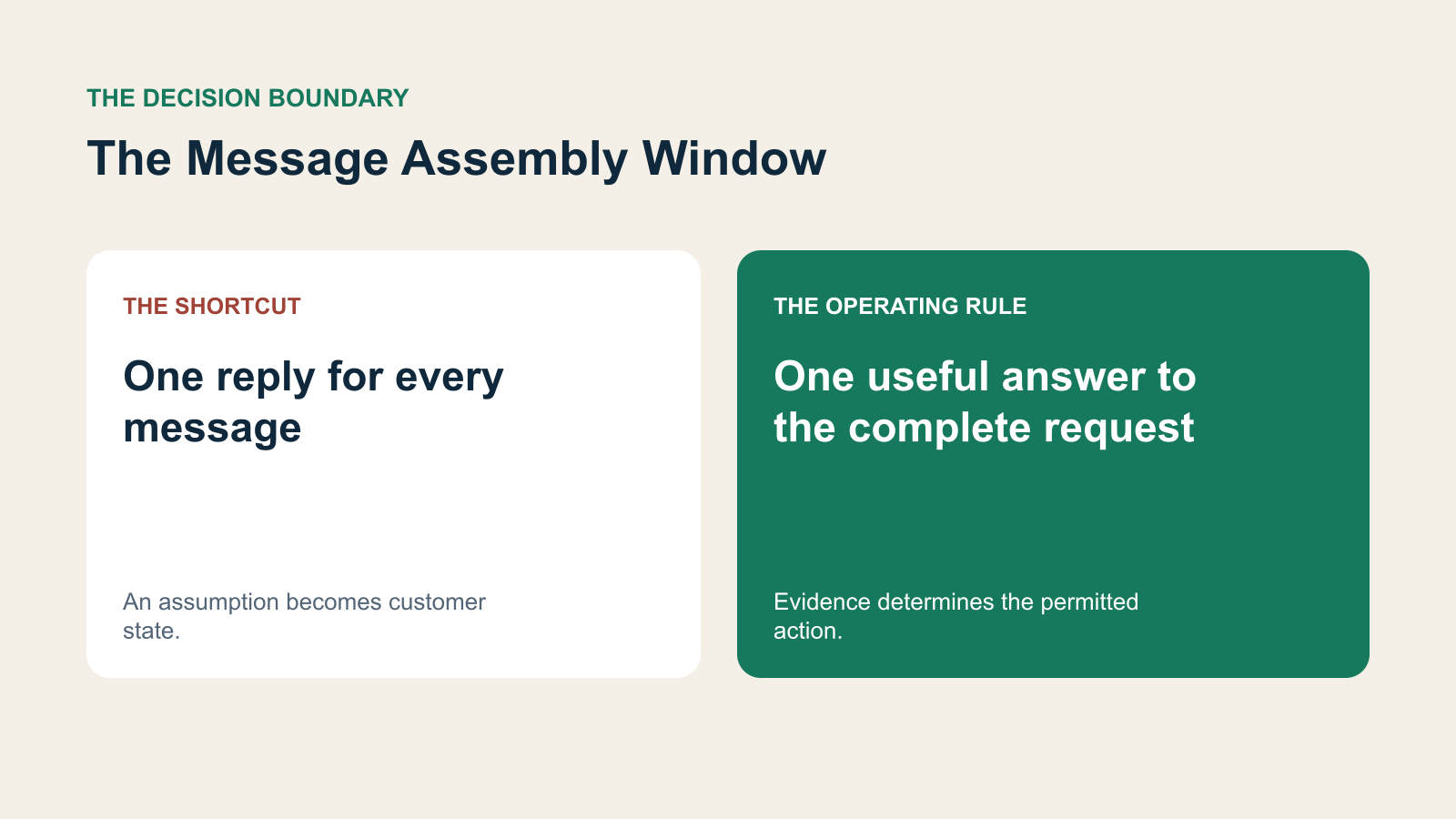
The Message Assembly Window: the wrong shortcut and the evidence-based decision.
The working record behind The Message Assembly Window
The record needs enough structure for another owner to verify the interpretation. For this journey, preserve four parts together rather than scattering them across a transcript, a note, and an action queue. Each part below has a different operating purpose. A populated field is useful only if the next owner can tell what it refers to and whether it is current.
Ordered message identifiers and arrival times
Retain message order so later corrections can replace earlier fragments. Arrival time helps establish a turn but cannot determine meaning alone.
Turn status and pending customer fragments
Show whether assembly is still open. An urgent stop request needs immediate handling even while ordinary qualification fragments are being collected.
Added, replaced, and unresolved requirements
Separate additions from replacements. Furnishing can be a preference, while a revised price ceiling changes the constraint used for recommendations.
Current human activity and pending assistant draft
Recheck human activity before sending. A draft prepared before an advisor's answer may now be redundant or inconsistent with the current conversation.
A bounded pause should remove repetition
For the rental exchange, build one candidate brief: two bedrooms, metro access, a 35k ceiling, and furnishing as an unresolved trade-off. Ask whether furnishing may change the budget only if that distinction matters to the available options. Do not ask again for bedroom count. A useful first reply reflects the assembled request and identifies its single remaining uncertainty.
A suitable clarification or acknowledgment in this illustrative scenario is: “Is furnishing essential within the same budget?” The wording is an example to adapt to the approved customer process, not a universal script. Its purpose is to make the next decision clear without claiming that an unverified action has already completed.
The assistant’s first useful answer is a practical quality check. It should demonstrate that the supplied details were assembled and ask for the smallest remaining decision. A summary such as “two bedrooms, metro access, furnished if possible” creates an opportunity for correction before recommendations are sent. Do not turn that reflection into a long recital of the entire thread. The objective is to make the request usable, not make the customer approve an artificial transcript. A brief reflection is particularly valuable when several messages changed the same requirement.
The Message Assembly Window
One reply for every message. One useful answer to the complete request.
The boundary cases that change the correct action
An assembly window must not delay an explicit stop request, a customer correction to a pending action, or an urgent escalation. A long gap between messages may signal a new turn rather than an unfinished sentence. If a human sends a reply during assembly, reassess before publishing the assistant’s draft. Timing is an input to interpretation, not an excuse to ignore new evidence.
Pilot on rental qualification or quote requests where messages commonly arrive in clusters. Compare the composed brief with the original sequence. Keep intermediate fragments available for review instead of replacing them with one synthetic message. Record when the assistant decided the turn was complete so operators can diagnose premature responses and excessive waiting separately.
Introduce the change in review mode first. The assistant prepares an interpretation and proposed next step while the existing authorized process remains in control. Collect disagreements with a reason, including cases where the reviewer lacks enough evidence to decide. Once the team can distinguish an interpretation mistake from a policy exception, expand only the narrowly defined actions that consistently produce reviewable results.
How to test The Message Assembly Window before expanding it
Begin the evaluation with the business decision, not the quality of the wording. Have a reviewer inspect the original exchange and identify the action it actually permits. Then compare the assistant’s interpretation, saved record, and customer-facing message. These three outputs can disagree even when each appears reasonable in isolation.
- Five related messages arrive together; the assistant asks only for genuinely missing details.
- The last fragment corrects the price ceiling; the earlier value is retained as history.
- A stop instruction arrives during assembly; outbound work is cancelled rather than delayed.
Vary the evaluation timing deliberately. Deliver the same message sequence rapidly, with a moderate pause, and with a human intervention between fragments. The appropriate processing boundary may change, but the final customer requirements should remain consistent. Test a fragment arriving after a draft is ready but before it is sent. A reliable assistant rechecks rather than publishing a now-redundant question. This exposes stale-response failures that a static transcript review cannot reveal.
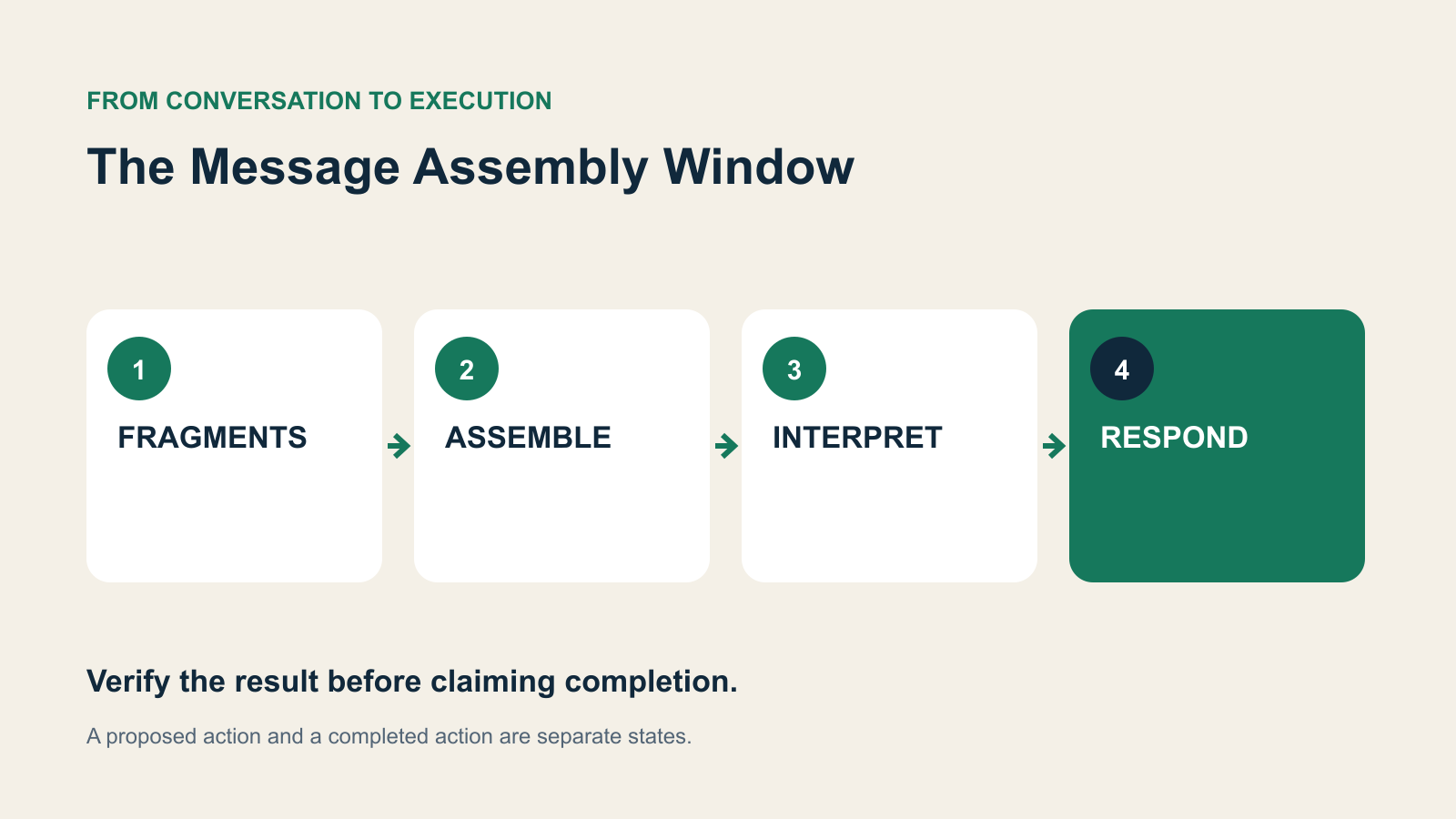
FRAGMENTS → ASSEMBLE → INTERPRET → RESPOND: review the state transition, not just the response.
Measure decision accuracy alongside customer effort
Measure redundant questions per completed request, actions launched before the final relevant fragment, and time to a useful response. Define useful response as one that reflects the supplied information and advances a remaining decision. A fast greeting is not the same measure. Review slow cases too, because a system can look accurate by waiting indefinitely.
Use an explicitly illustrative audit to make the denominator clear. Suppose reviewers inspect 40 cases that genuinely require The Message Assembly Window, and find 6 unsupported actions. That is 6 divided by 40, or 15% in that sample. It is not a market benchmark or an expected result. Counting 200 unrelated greetings alongside those cases would hide the failure without fixing it. Keep the relevant case count, error count, review rules, and uncertainty visible when reporting the result.
Also inspect the opposite failure: an unnecessary hold when the evidence was already sufficient. Reviewers should distinguish a justified clarification from an avoidable repeat question. An appropriate human review is different from a case abandoned without an owner. Pair the action error rate with customer effort and completion evidence so the team cannot improve one dashboard by moving the cost to the customer or another department.
Connect The Message Assembly Window with the rest of customer operations
WhatsApp messages, interactive choices, attachments, and human replies need the same customer record as calls and downstream tasks. Brixi brings these capabilities together as a complete AI-native customer platform. Its value is the connection between the assistant that interprets the message, the CRM that retains the evidence, the workflow that coordinates the next step, and the person accountable for an exception.
For this use case, make the implementation review concrete: ask the Brixi team to walk through the original evidence, the current CRM state, the permitted action, and recovery when that action cannot complete. Validate any required source system, permission rule, and approval path during configuration. The recommended operating design in this article should be demonstrated against the actual deployment rather than assumed from a generic AI feature label.
For the wider operating model, read the WhatsApp sales automation guide. The important connection is between interpretation and accountable execution: the same evidence should prepare the assistant, the responsible human, and the next workflow.
What to inspect after the first quarter
At the first monthly review, look for the failure that has moved elsewhere. A cleaner conversation can still leave a stale task or an unowned approval. During the following reviews, sample complete journeys from original evidence to customer-visible outcome. Expand the scope only when the team can explain the remaining exceptions and the responsible owner can recover them without reconstructing the entire thread.
The deeper bet behind The Message Assembly Window
Conversational responsiveness will become less about answering every event and more about recognizing when the customer has finished expressing a thought. A connected platform can then apply one interpretation across CRM, recommendations, tasks, and human follow-up instead of letting each fragment start another workflow.
Put The Message Assembly Window into a connected customer workflow
Explore how Brixi connects WhatsApp AI, CRM, AI assistants, conversations, workflows, and human teams around a reliable next action.