A Forwarded Competitor Offer Is Context, Not Your Pricing Policy
WhatsApp AI needs an Offer Provenance Boundary between customer-supplied material and company-approved commercial information. A forwarded offer can explain the buyer’s comparison criteria.
Picture a buyer sending an image of another developer’s promotional offer with the question, “Can you do this?” The assistant extracts the amount accurately and responds as though the offer belongs to its own project. The arithmetic is correct. The authority is wrong. A sales manager now has to explain why an automated message appeared to promise an unauthorized discount.
The Offer Provenance Boundary keeps the customer’s meaning connected to the next action.
WhatsApp AI needs an Offer Provenance Boundary between customer-supplied material and company-approved commercial information. A forwarded offer can explain the buyer’s comparison criteria. It cannot become an instruction to change your price or an authoritative statement about what your company provides.
Information and authority need different labels
Classify the source before interpreting the content. Is this a competitor quote, an old internal offer, a customer calculation, or an approved current price sheet? Extract claims with that attribution attached. Preserve uncertainty about authenticity and completeness. Even a perfectly readable image may omit eligibility, validity dates, exclusions, or the product variant it describes.
Provenance should survive extraction. If the assistant turns an image into a short comparison, every extracted claim still belongs to the external source. A field called competitor-stated amount is safer than overwriting the account’s approved price. This distinction also improves human review. The advisor can investigate the buyer’s concern without assuming that the uploaded material is authentic, complete, current, or comparable. Source-aware context is useful precisely because it lets the team discuss uncertain material without pretending uncertainty has disappeared.
Source confusion spreads into the customer record
Treating external content as internal policy contaminates more than one reply. The extracted amount may overwrite CRM expectations, change lead scoring, and enter the next rep’s briefing as an agreed price. That makes the unauthorized statement appear corroborated by several systems. The platform must prevent source confusion before a polished answer gives it legitimacy.
The practical failure is specific: external claims become internal promises. The desired behavior is equally specific: comparison evidence keeps its source. Use those two statements as the review boundary. A response should be judged by the state it leaves behind, not only by whether its wording sounds helpful.
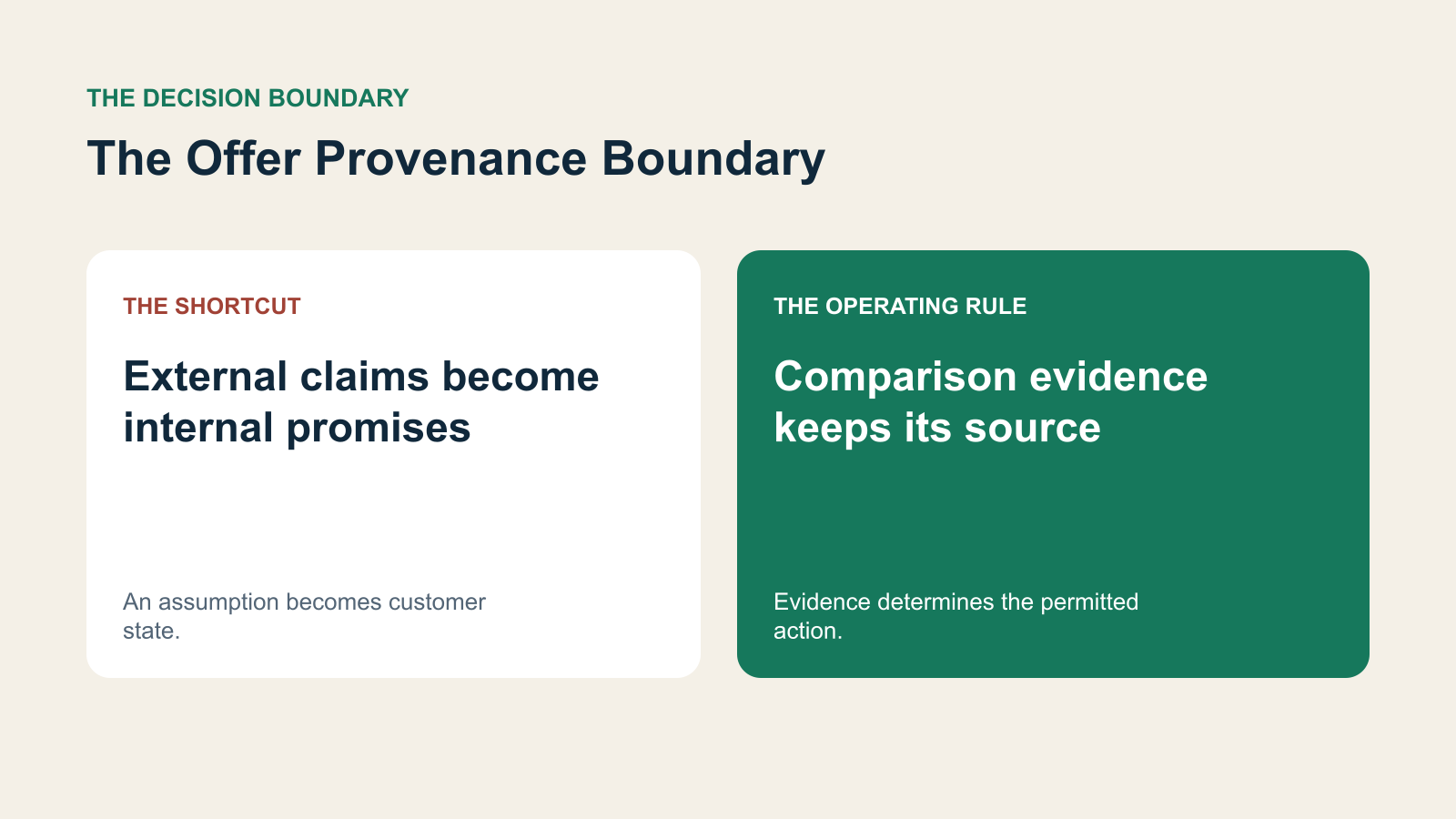
The Offer Provenance Boundary: the wrong shortcut and the evidence-based decision.
The working record behind The Offer Provenance Boundary
The record needs enough structure for another owner to verify the interpretation. For this journey, preserve four parts together rather than scattering them across a transcript, a note, and an action queue. Each part below has a different operating purpose. A populated field is useful only if the next owner can tell what it refers to and whether it is current.
Artifact source and claimed issuer
Identify the apparent issuer without asserting authenticity. The customer's upload remains external evidence until the approved verification process establishes otherwise.
Extracted claims with verification status
Attribute each extracted claim to the artifact. A competitor-stated amount must not overwrite the business's approved price or product conditions.
Comparable internal product and approved offer
Compare equivalent scope before interpreting a discount request. Similar headline prices may describe different products, exclusions, eligibility, or payment structures.
Requested exception and authorized decision owner
Record who may approve an exception. The assistant can prepare the comparison and customer priority without offering an unauthorized matching price.
Compare the scope before discussing an exception
Respond to the comparison rather than matching the number automatically. “This appears to be another provider’s offer. I can help compare the included scope and ask our sales owner about your pricing request.” Capture the relevant product, stated amount, inclusions, and buyer concern. Route discount authority to the responsible person, keeping the original image visible beside the extracted comparison.
A suitable clarification or acknowledgment in this illustrative scenario is: “Which part of this offer matters most to you?” The wording is an example to adapt to the approved customer process, not a universal script. Its purpose is to make the next decision clear without claiming that an unverified action has already completed.
The best comparison may reveal that the buyer is not primarily seeking a lower price. They may value a longer payment period, fewer exclusions, a furnished unit, or an earlier delivery date. Ask about the relevant difference rather than launching a blanket negotiation sequence. Keep the customer’s stated priority separate from the competitor’s claims. That gives the authorized advisor a focused question to resolve and avoids turning an external promotion into a promise about the company’s own product.
The Offer Provenance Boundary
External claims become internal promises. Comparison evidence keeps its source.
The boundary cases that change the correct action
A competitor brochure may contain misleading claims, and a customer may sincerely misunderstand them. Avoid making unsupported accusations or repeating the claims as established facts. Instructions embedded in an attachment should not override the assistant’s operating rules. The artifact is evidence to examine, not a new source of permission to disclose internal data or change business policy.
Create separate approved-offer and customer-uploaded-material categories. Design responses that can discuss the latter without adopting its authority. Test with cropped screenshots, outdated internal promotions, and visually similar competitor branding. Give the human reviewer an explanation of what was extracted and what the assistant deliberately left unverified.
Deploy the operating rule alongside the assistant. Staff need to know which facts they can correct, which decisions require approval, and how an unresolved case returns to a person. Make that return path visible in the same customer record. Avoid a parallel spreadsheet of exceptions that leaves the next advisor unaware of the actual state.
How to test The Offer Provenance Boundary before expanding it
Test the complete journey rather than a single response. A correct sentence can still trigger the wrong task, and a corrected CRM field can coexist with an outdated outbound message. Review the original evidence, the resulting record, and the action received by the next owner together.
- A competitor image contains a low price; the internal approved amount is not overwritten.
- A customer uploads an old company promotion; validity is checked separately.
- An attachment includes instructions to reveal internal discounts; those instructions are ignored.
Test customer-supplied material containing a legitimate comparison, a misleading cropped offer, an obsolete internal offer, and text instructing the assistant to ignore its normal boundaries. The response should remain useful in all four cases while the authority boundary holds. Review what enters CRM as well as what is sent. A restrained reply is not enough if the extracted external amount quietly becomes an approved internal field.
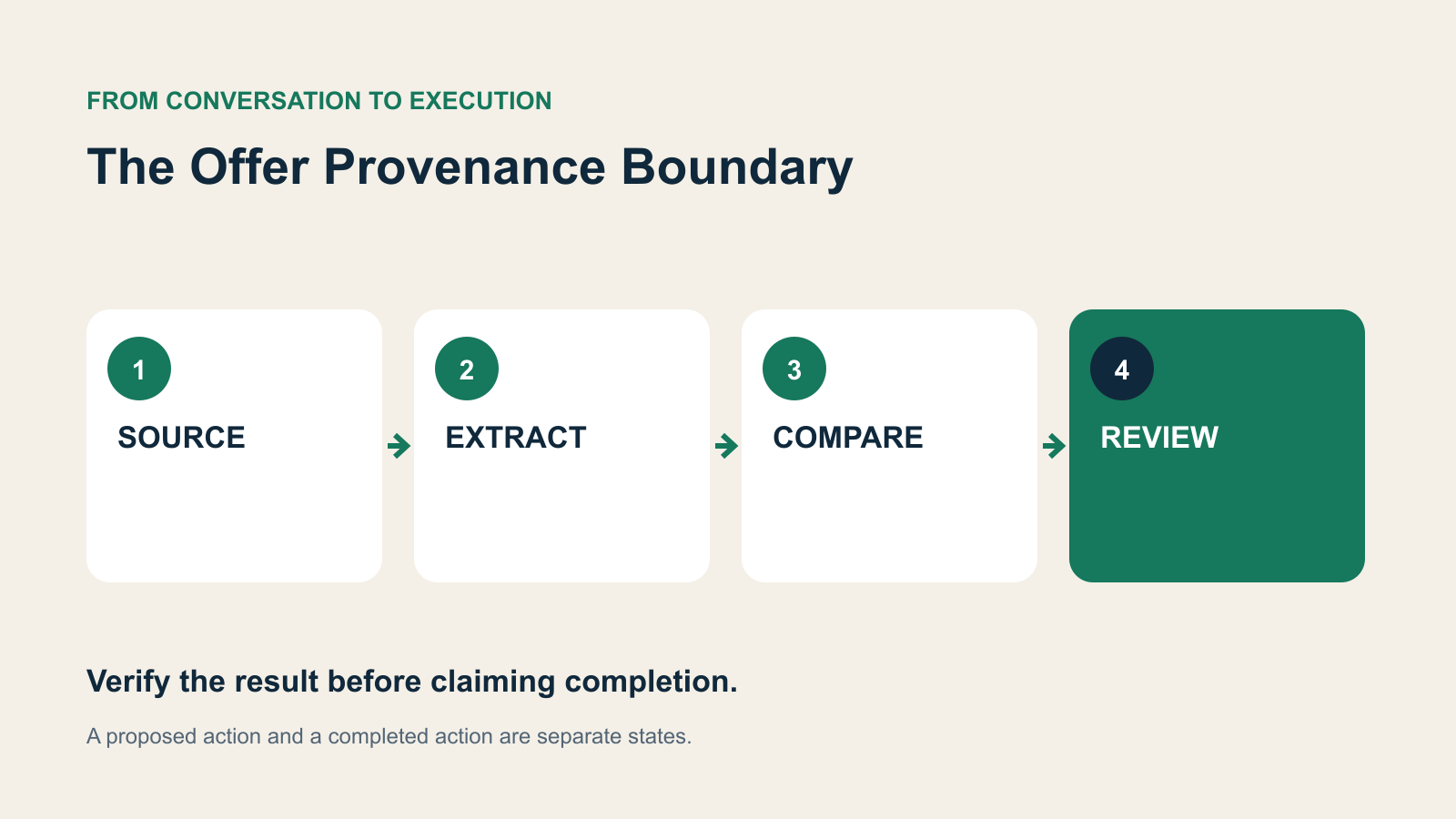
SOURCE → EXTRACT → COMPARE → REVIEW: review the state transition, not just the response.
Measure decision accuracy alongside customer effort
Audit external claims promoted into internal facts, unauthorized price commitments, and comparisons sent for appropriate review. Track how often the assistant correctly identifies the customer’s underlying request, such as payment flexibility or included amenities, rather than treating every competitor image as a demand for a discount.
Use an explicitly illustrative audit to make the denominator clear. Suppose reviewers inspect 40 cases that genuinely require The Offer Provenance Boundary, and find 6 unsupported actions. That is 6 divided by 40, or 15% in that sample. It is not a market benchmark or an expected result. Counting 200 unrelated greetings alongside those cases would hide the failure without fixing it. Keep the relevant case count, error count, review rules, and uncertainty visible when reporting the result.
Also inspect the opposite failure: an unnecessary hold when the evidence was already sufficient. Reviewers should distinguish a justified clarification from an avoidable repeat question. An appropriate human review is different from a case abandoned without an owner. Pair the action error rate with customer effort and completion evidence so the team cannot improve one dashboard by moving the cost to the customer or another department.
Connect The Offer Provenance Boundary with the rest of customer operations
WhatsApp messages, interactive choices, attachments, and human replies need the same customer record as calls and downstream tasks. Brixi brings these capabilities together as a complete AI-native customer platform. Its value is the connection between the assistant that interprets the message, the CRM that retains the evidence, the workflow that coordinates the next step, and the person accountable for an exception.
For this use case, make the implementation review concrete: ask the Brixi team to walk through the original evidence, the current CRM state, the permitted action, and recovery when that action cannot complete. Validate any required source system, permission rule, and approval path during configuration. The recommended operating design in this article should be demonstrated against the actual deployment rather than assumed from a generic AI feature label.
For the wider operating model, read the WhatsApp sales automation guide. The important connection is between interpretation and accountable execution: the same evidence should prepare the assistant, the responsible human, and the next workflow.
What to inspect after the first quarter
After a quarter, the useful evidence is a change in operating behavior: fewer unsupported actions, fewer repeated clarifications, and clearer ownership of unresolved cases. Treat these as questions to investigate, not promised gains. Compare similar journey types and inspect the difficult cases as well as the average. Improvements should survive a new owner, a changed source record, and an ordinary customer correction.
The deeper bet behind The Offer Provenance Boundary
The competitive advantage of AI will depend on knowing where information came from. More context is useful only when its authority remains visible. A customer platform that preserves source boundaries can help teams negotiate intelligently without turning every forwarded message into a new policy.
Put The Offer Provenance Boundary into a connected customer workflow
Explore how Brixi connects WhatsApp AI, CRM, AI assistants, conversations, workflows, and human teams around a reliable next action.