“Yes” to What? How WhatsApp AI Should Interpret Ambiguous Replies
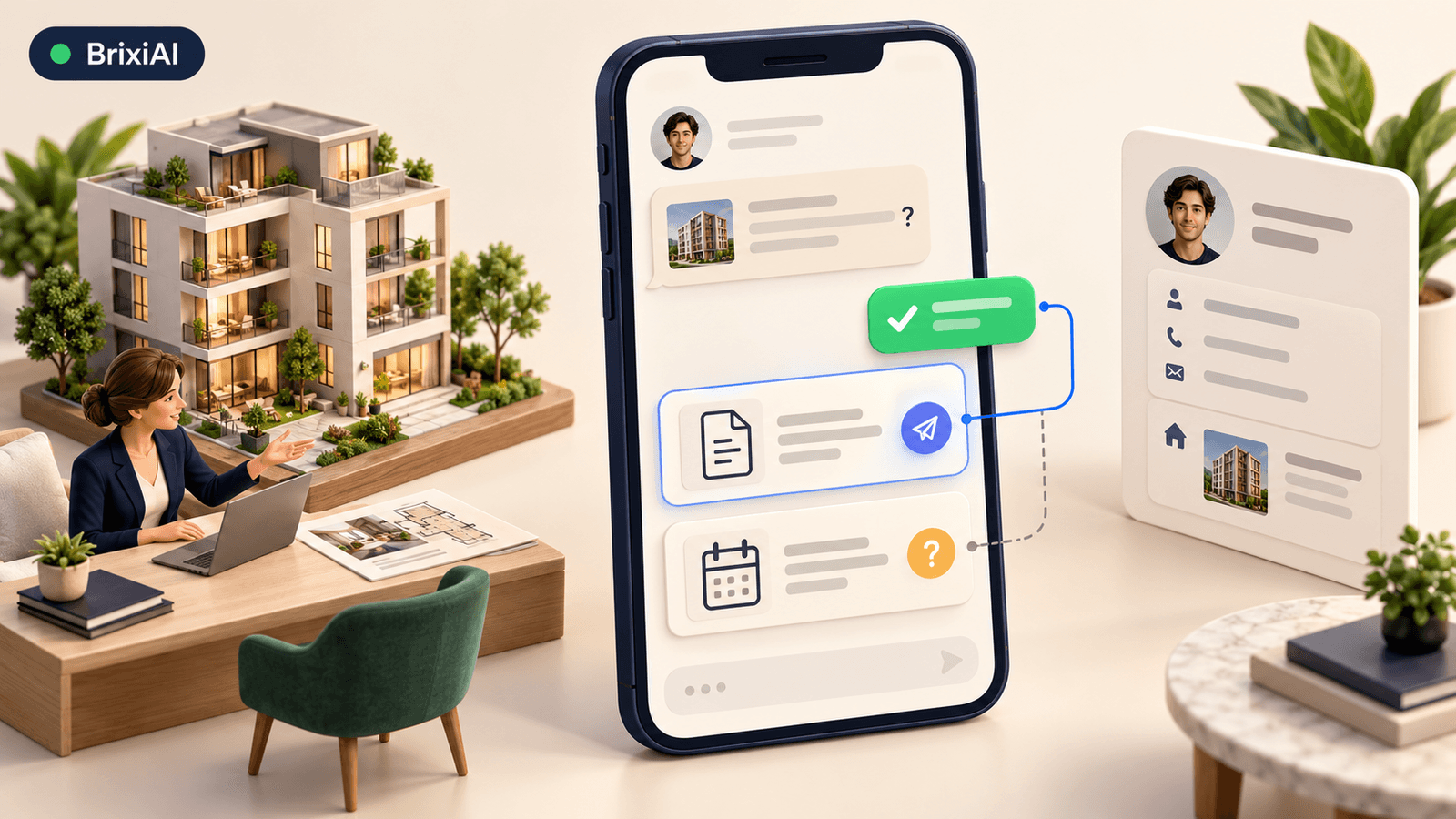
WhatsApp AI handling ambiguous replies needs an Acceptance Anchor: the specific question, offer, or proposed action that a short reply refers to. An affirmative word expresses agreement only after its object is known.
Consider a property advisor managing a Saturday viewing. At 6:18 pm she asks whether a buyer wants the updated cost sheet. A colleague then offers an 11 am visit. The buyer replies “yes.” The assistant books the visit, although the buyer was agreeing to receive a document. Nobody notices until the buyer receives a confirmation for an appointment they never chose.
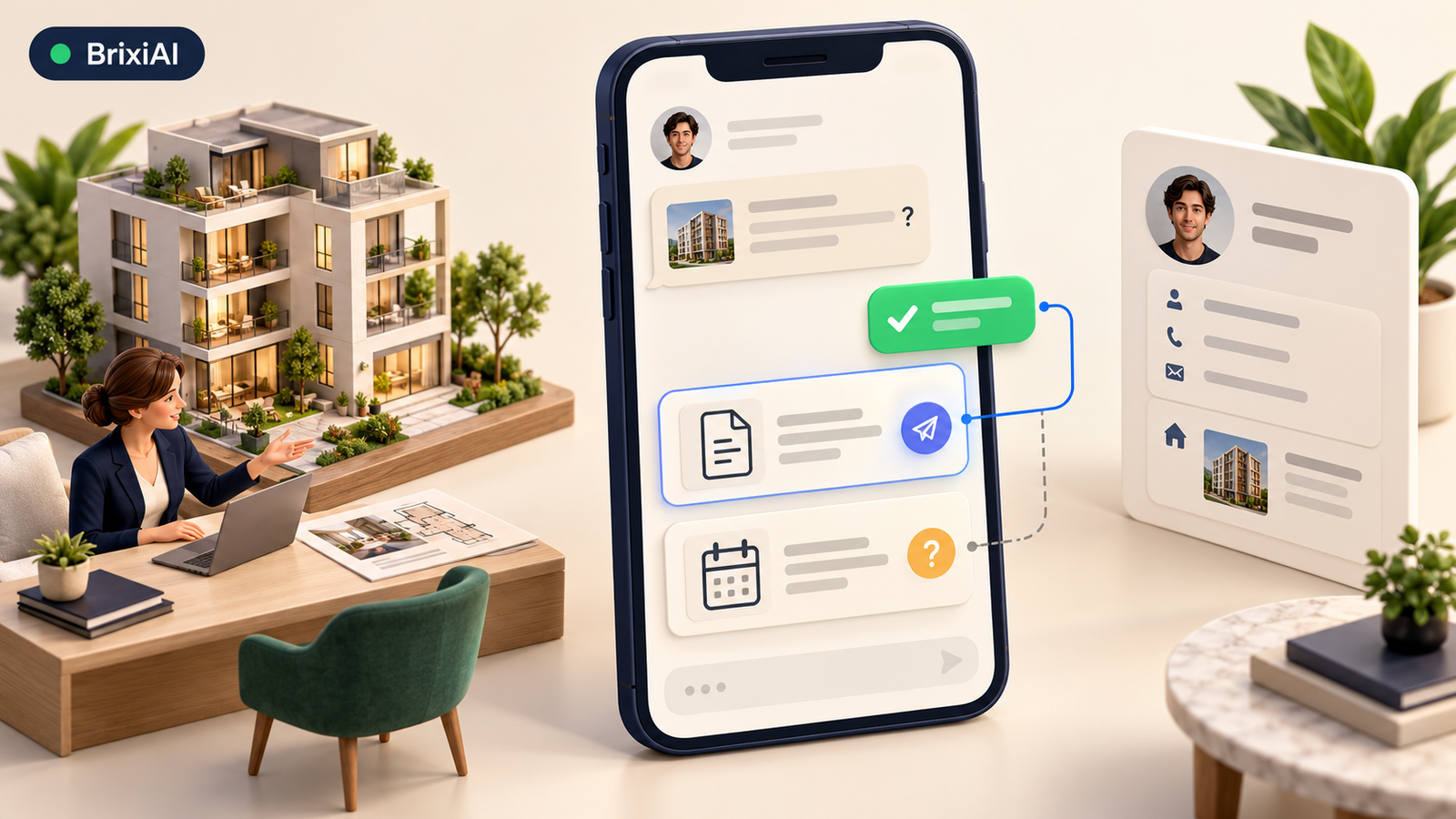
The Acceptance Anchor keeps the customer’s meaning connected to the next action.
WhatsApp AI handling ambiguous replies needs an Acceptance Anchor: the specific question, offer, or proposed action that a short reply refers to. An affirmative word expresses agreement only after its object is known. Treating every yes as permission to advance a funnel turns ordinary conversational compression into incorrect commitments.
An affirmative label is not an action instruction
A message classifier sees an affirmative intent. A customer platform must resolve the pending proposition before it changes anything. Preserve the original question, its author, the object under discussion, and whether a later message replaced it. Two unanswered questions create competing interpretations. Recency helps rank those interpretations, but recency alone cannot establish which one the customer accepted.
A useful acceptance record has an object and a scope. “Yes, send it” may authorize a document but nothing else. “Yes, that time works” can confirm availability without approving a paid booking. Before automating the next step, write down the exact proposition the business believes was accepted. If a reviewer cannot express that proposition without adding words the customer never supplied, the acceptance is unresolved. This check is especially valuable when a thread contains a quote, an appointment, and a payment question close together. One conversational turn should not accidentally approve all three.
The wrong appointment corrupts more than the calendar
The visible cost is an unwanted confirmation. The larger cost arrives later: a rep holds a slot, a manager forecasts attendance, and a recovery sequence treats the customer as a no-show. Marketing then receives misleading evidence about lead quality. One incorrect inference has produced several plausible records. Fixing only the outbound wording leaves the corrupted appointment and reporting state behind.
The practical failure is specific: affirmative word becomes a booking. The desired behavior is equally specific: agreement is linked to one proposal. Use those two statements as the review boundary. A response should be judged by the state it leaves behind, not only by whether its wording sounds helpful.
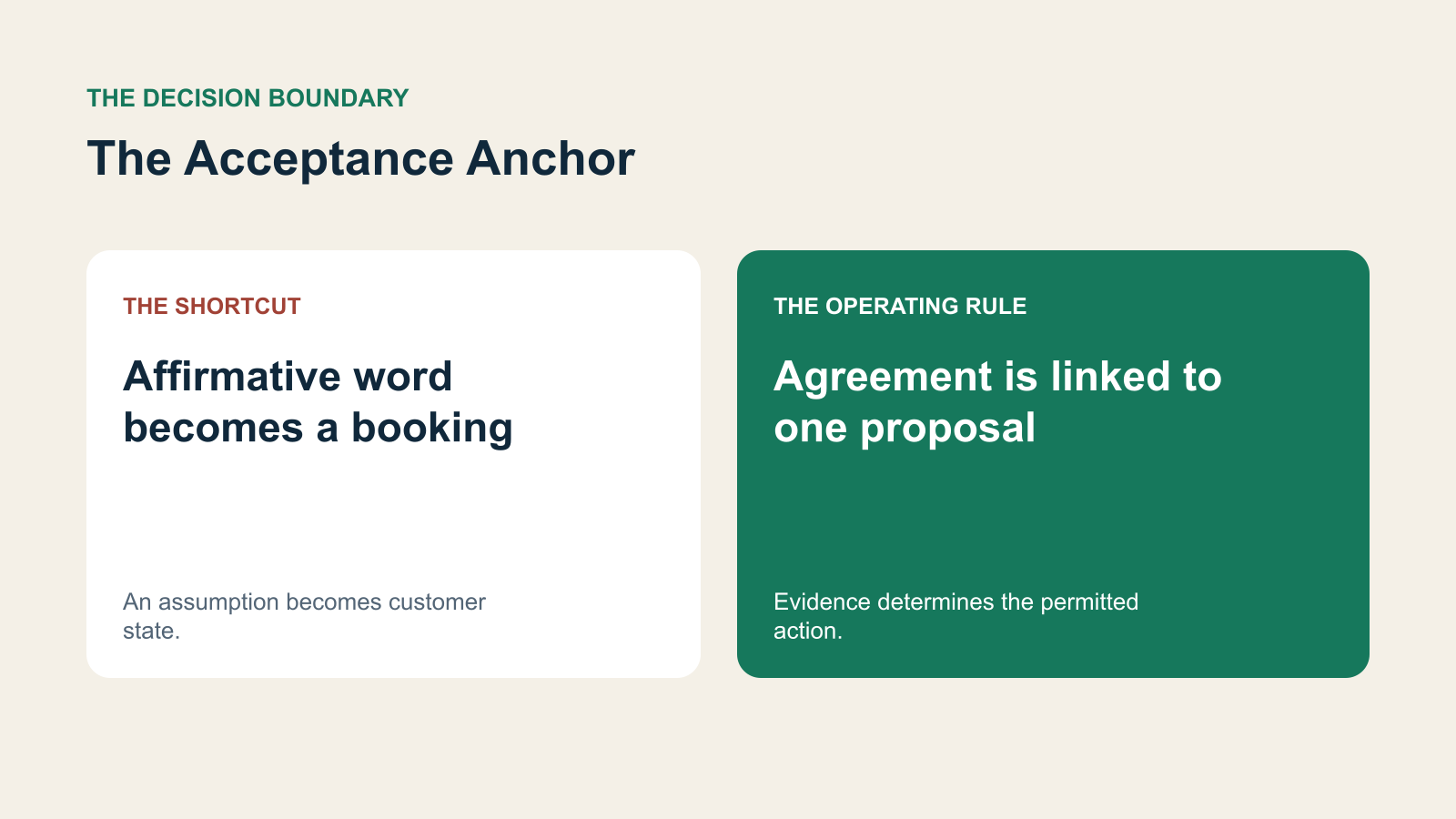
The Acceptance Anchor: the wrong shortcut and the evidence-based decision.
The working record behind The Acceptance Anchor
The record needs enough structure for another owner to verify the interpretation. For this journey, preserve four parts together rather than scattering them across a transcript, a note, and an action queue. Each part below has a different operating purpose. A populated field is useful only if the next owner can tell what it refers to and whether it is current.
Pending question and proposal identifier
Keep each unanswered proposition separate. A cost-sheet request and a visit invitation must not compete for the same unscoped affirmative.
Author, timestamp, and referenced message
Preserve the question's author and any explicit reply reference. The assistant must explain which proposal it believes the customer answered.
Proposed action and current business state
Record whether the appointment is proposed or already confirmed. Clarification should not quietly create a reservation while the answer remains uncertain.
Resolved object and explicit customer choice
Save the customer's resolved choice beside the original reply. Close only the accepted proposition and leave other open questions accurately labeled.
Clarification should name the competing choices
Keep the visit as proposed and the cost sheet as requested. Ask, “Do you mean send the cost sheet, or confirm the 11 am visit?” If the buyer chooses the document, send it without booking. If the buyer confirms the visit, recheck availability before committing. If they answer “both,” execute the two approved actions separately and record each result. The same word can carry several intentions without making any individual action automatic.
A suitable clarification or acknowledgment in this illustrative scenario is: “Do you mean the document or the visit?” The wording is an example to adapt to the approved customer process, not a universal script. Its purpose is to make the next decision clear without claiming that an unverified action has already completed.
Clarification can be economical. Asking “Can you clarify?” transfers all the reconstruction work to the customer. Naming the alternatives shows that the assistant has retained context. Keep the question neutral: do not present the higher-value action as the default or imply that the customer already agreed. Once the customer selects an option, resolve the relevant question and leave the other proposals in their real state. An unanswered invitation should not remain indefinitely eligible to capture a future yes that was intended for something else.
The Acceptance Anchor
Affirmative word becomes a booking. Agreement is linked to one proposal.
The boundary cases that change the correct action
Some replies are intentionally vague because the buyer has not decided. “Yes, probably” is weaker than “Yes, book 11 am.” A thumbs-up reaction may acknowledge receipt rather than approve a transaction. Do not invent a universal confidence threshold for these cases. Define which low-consequence acknowledgments can proceed and which appointments, payments, or changes require an explicit reference.
Start with one appointment journey. Make unanswered questions visible to the assistant and the human owner. Store the clarification with the original reply, then close only the question actually answered. When an advisor takes over, they should see the remaining uncertainty rather than a confident summary that says the customer agreed.
Introduce the change in review mode first. The assistant prepares an interpretation and proposed next step while the existing authorized process remains in control. Collect disagreements with a reason, including cases where the reviewer lacks enough evidence to decide. Once the team can distinguish an interpretation mistake from a policy exception, expand only the narrowly defined actions that consistently produce reviewable results.
How to test The Acceptance Anchor before expanding it
Begin the evaluation with the business decision, not the quality of the wording. Have a reviewer inspect the original exchange and identify the action it actually permits. Then compare the assistant’s interpretation, saved record, and customer-facing message. These three outputs can disagree even when each appears reasonable in isolation.
- A yes arrives after two different questions; neither appointment nor purchase is committed.
- A yes explicitly quotes the visit proposal; availability is checked before confirmation.
- The customer clarifies that they wanted only the document; the visit remains unbooked.
For the pilot, collect examples with one pending question, several pending questions, explicit quoted replies, and corrections after an initial affirmative. Have a reviewer choose the accepted object before seeing the assistant’s decision. Compare action selection as well as language quality. A reply can sound attentive while the workflow still books the wrong slot. Review the cases where clarification was avoided, because prevented questions are only a benefit when the intended object was actually clear.
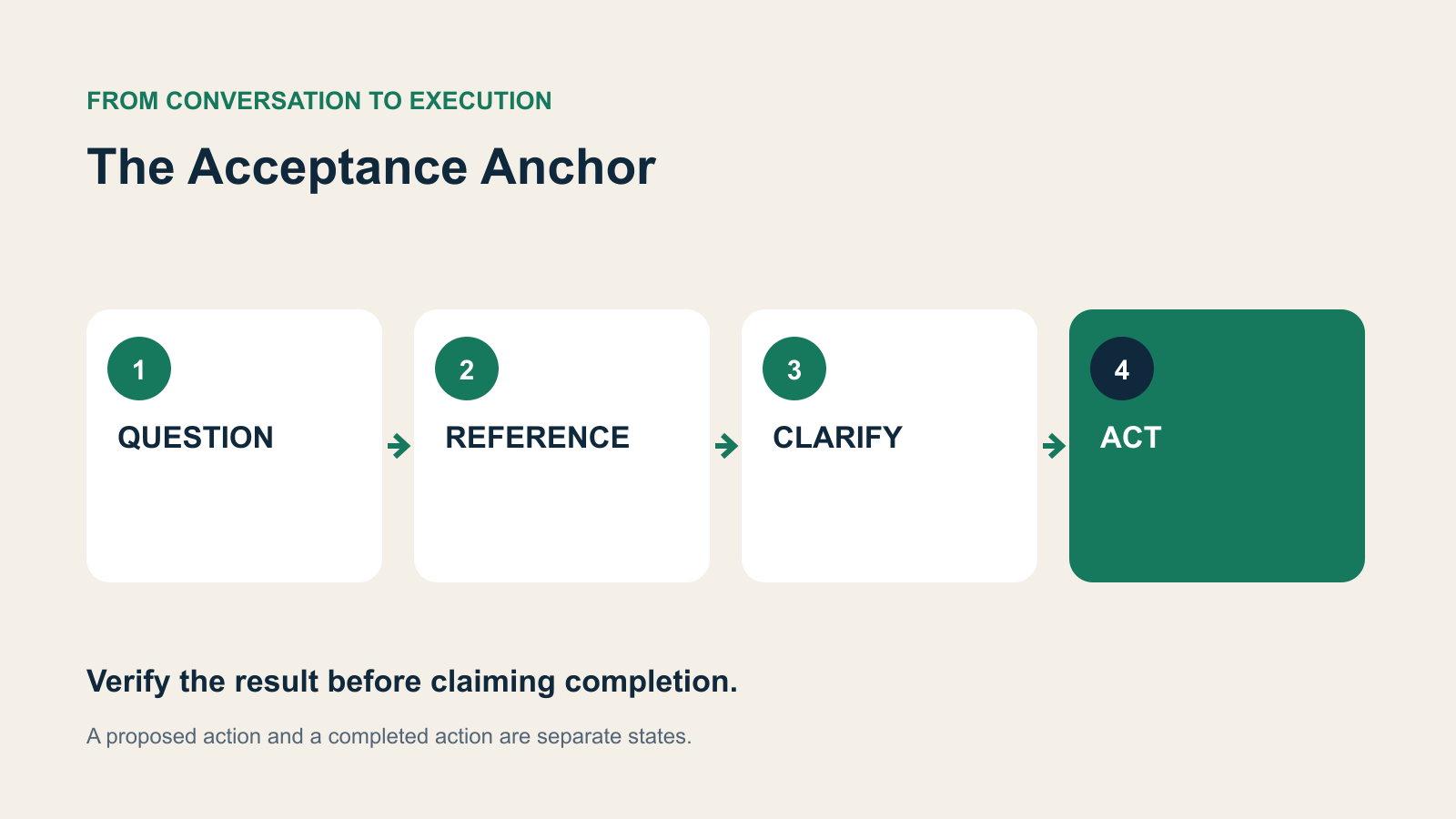
QUESTION → REFERENCE → CLARIFY → ACT: review the state transition, not just the response.
Measure decision accuracy alongside customer effort
Review ambiguous affirmatives separately from ordinary replies. Count an incorrect action when a reviewer cannot connect the customer’s words to the recorded commitment. Count an unnecessary clarification when only one reasonable proposition was open. Pair these measures: reducing questions by guessing is not improvement, and asking customers to repeat every clear answer is not precision.
Use an explicitly illustrative audit to make the denominator clear. Suppose reviewers inspect 40 cases that genuinely require The Acceptance Anchor, and find 6 unsupported actions. That is 6 divided by 40, or 15% in that sample. It is not a market benchmark or an expected result. Counting 200 unrelated greetings alongside those cases would hide the failure without fixing it. Keep the relevant case count, error count, review rules, and uncertainty visible when reporting the result.
Also inspect the opposite failure: an unnecessary hold when the evidence was already sufficient. Reviewers should distinguish a justified clarification from an avoidable repeat question. An appropriate human review is different from a case abandoned without an owner. Pair the action error rate with customer effort and completion evidence so the team cannot improve one dashboard by moving the cost to the customer or another department.
Connect The Acceptance Anchor with the rest of customer operations
WhatsApp messages, interactive choices, attachments, and human replies need the same customer record as calls and downstream tasks. Brixi brings these capabilities together as a complete AI-native customer platform. Its value is the connection between the assistant that interprets the message, the CRM that retains the evidence, the workflow that coordinates the next step, and the person accountable for an exception.
For this use case, make the implementation review concrete: ask the Brixi team to walk through the original evidence, the current CRM state, the permitted action, and recovery when that action cannot complete. Validate any required source system, permission rule, and approval path during configuration. The recommended operating design in this article should be demonstrated against the actual deployment rather than assumed from a generic AI feature label.
For the wider operating model, read the WhatsApp sales automation guide. The important connection is between interpretation and accountable execution: the same evidence should prepare the assistant, the responsible human, and the next workflow.
What to inspect after the first quarter
At the first monthly review, look for the failure that has moved elsewhere. A cleaner conversation can still leave a stale task or an unowned approval. During the following reviews, sample complete journeys from original evidence to customer-visible outcome. Expand the scope only when the team can explain the remaining exceptions and the responsible owner can recover them without reconstructing the entire thread.
The deeper bet behind The Acceptance Anchor
The next useful WhatsApp assistant will understand the obligations created by a conversation, not simply its tone. Short replies should make the customer’s life easier without transferring the interpretation burden to tomorrow’s operations team. That requires memory, action boundaries, and human ownership to be designed together.
Put The Acceptance Anchor into a connected customer workflow
Explore how Brixi connects WhatsApp AI, CRM, AI assistants, conversations, workflows, and human teams around a reliable next action.