The Two-Speed Funnel: Paid and Organic Leads Need Different Journeys
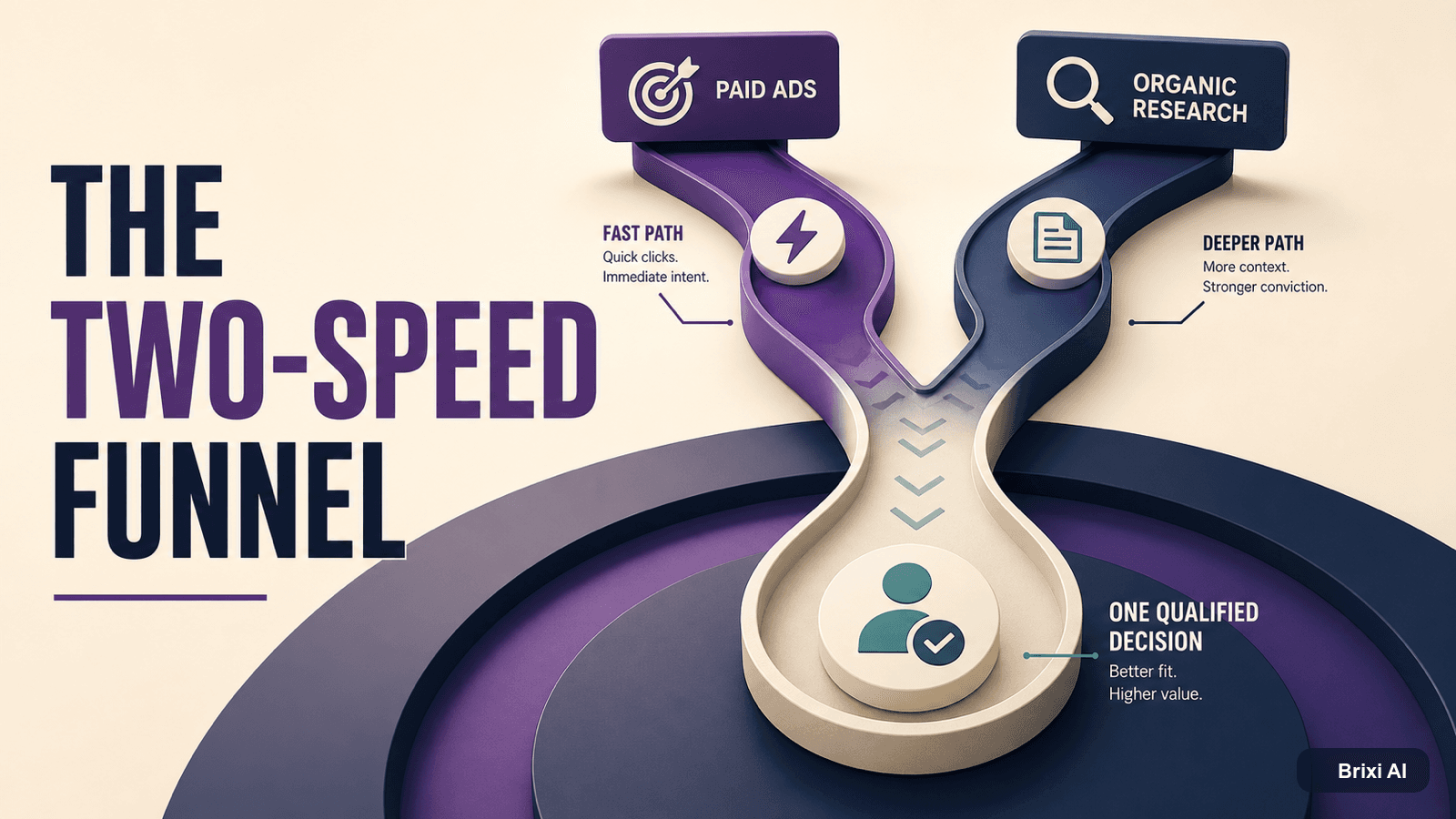
A demo request and a downloaded guide should not enter the same cadence. The Two-Speed Funnel adjusts response and qualification to the customer evidence that already exists.
At 10:02 on Tuesday, two leads enter the CRM. One clicked an ad promising an immediate price estimate. The other found a detailed article through search, visited three product pages, and requested a guide. Both receive the same five-message sequence.
Equal treatment feels orderly. It ignores how the buyers arrived, what they already know, and what they expect next. The Two-Speed Funnel uses acquisition context and behavior to choose a journey rather than flattening every lead into one cadence.
The Source Equality Error destroys useful context
Attribution often ends at reporting. The source is stored for marketing credit but rarely influences the sales workflow. We call this the Source Equality Error.
Paid demand often carries a narrow promise and a short response window. Organic demand may carry deeper education and broader exploration. Neither is automatically better. Each needs a different opening move.
Paid leads need promise continuity
The first response must continue the exact advertisement or landing-page promise. If the ad offered a price estimate, the next message should not ask the buyer to explain why they are interested.
Qualification should be fast and proportional. Ask only what is needed to deliver the promised value and route the opportunity.
- Preserve campaign and creative context
- Respond while the click is still active
- Minimize repeated form questions
- Route by the promised outcome
Organic leads need evidence-aware assistance
Organic visitors often reveal intent through content depth, repeat visits, comparisons, and return behavior. A generic sales push can interrupt useful self-education.
The workflow should recognize what the buyer already explored, offer the next useful resource, and invite conversation when behavior indicates a decision rather than simple curiosity.
One lead can change speeds during the journey
A low-intent content visitor can become urgent after pricing activity. A paid lead can slow down after learning that internal approval is needed. Static source-based segments miss these changes.
Use live behavior and conversation evidence to move customers between fast response, assisted education, nurture, and human engagement.
Source begins the journey. Behavior updates it.
The best funnel remembers why the customer arrived, then changes pace as new evidence appears.
Brixi combines acquisition context with live buyer intent
Brixi carries campaign, channel, CRM, conversation, and behavior context into qualification and follow-up. Paid and organic buyers can enter different journeys without becoming trapped in static lists.
As intent changes, the platform can alter priority, channel, content, owner, and next action while preserving the full history.
- Campaign-aware first response
- Behavior and conversation-based intent
- Dynamic nurture and routing
- One customer record across journey changes
A quarter exposes which journey earns attention
Compare the two funnels by meaningful progression and acquisition economics, not lead volume alone. Track response, qualification, meeting, attendance, opportunity, and revenue by source and intent state.
Teams often discover that the expensive problem is not a weak source. It is a workflow that ignores the promise and behavior attached to that source.
- Higher promise-to-response continuity
- Less unnecessary qualification
- More timely human engagement
- Clearer source-to-revenue economics
The deeper bet is adaptive acquisition
Future funnels will not be fixed sequences selected once at capture. They will change as customer evidence changes.
Marketing context, buyer behavior, conversations, and sales execution will operate in one loop. The funnel becomes a decision system rather than a campaign calendar.
Give every lead the journey its evidence deserves
See how Brixi adapts qualification, content, routing, and follow-up across paid and organic demand.
Explore the buyer intent engineFrequently Asked Questions
No. Paid leads often have a shorter promise-response window, while organic visitors may show stronger research depth. Use behavior and conversation evidence rather than source alone.
Begin with paid fast-response, organic assisted education, and low-intent nurture. Add routes only when evidence shows a materially different decision.
Switch when new behavior, stated timing, qualification, urgency, or stakeholder context changes the appropriate next action.