CTWA Ads Work. The Inbox After Them Does Not.
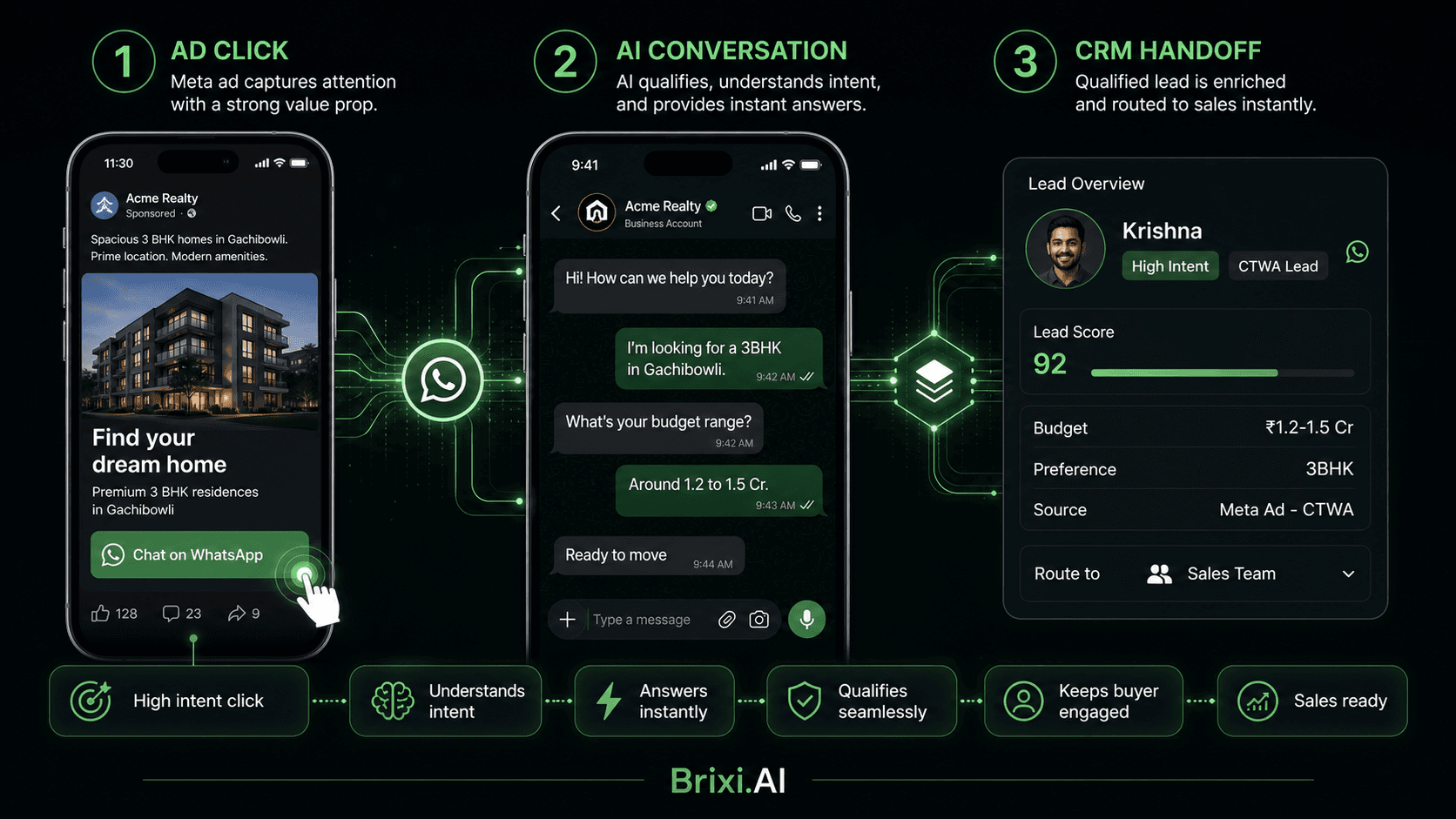
Click-to-WhatsApp ads compress the distance from interest to conversation. That advantage disappears the moment the buyer lands in an inbox that has no memory of the ad, no qualification workflow, and no follow-up logic. This is the operating problem most CTWA teams are not solving.
Sagar runs performance marketing for a mid-sized residential developer in Chennai. Last quarter his team spent close to four lakhs on Click-to-WhatsApp campaigns across two projects. Ads Manager showed 1,400 message starts at a cost-per-conversation that looked reasonable on paper. The sales head pulled the CRM data the same week and found 94 qualified conversations. The rest had either gone cold inside the inbox, received a single brochure and disappeared, or never got a second reply from the team because the queue had grown too long to manage manually.
Sagar did not have a media problem. He had an inbox problem. And it is the same problem in edtech admissions teams in Bengaluru, lending DSA networks in Pune, and insurance brokers in Delhi who are all running CTWA at scale. The click works. The system that receives the click does not.
What makes CTWA ads uniquely valuable, and uniquely vulnerable?
A Click-to-WhatsApp ad eliminates the friction that kills most mobile funnels. No landing page load time, no form to fill, no callback form sitting in a queue. The buyer taps the ad and is inside a conversation with your brand inside two seconds. For categories where purchase decisions are personal and buyers want to ask questions before committing, that directness is a genuine advantage over search-click-form flows.
The vulnerability is the mirror of the advantage. Because the channel is personal and immediate, buyer expectations are calibrated to personal and immediate responses. A buyer who tapped a CTWA ad for a 2BHK in Sholinganallur expects to be treated as if the business knows why they are writing. When the first reply is "Hi, how can I help?", the buyer does the arithmetic immediately: this is an automated inbox, not a responsive business. Drop-off accelerates from that point.
Why do CTWA campaigns look good in Ads Manager but underperform in the CRM?
Ads Manager optimizes for and reports on what it can measure: impressions, clicks, message starts, and cost per conversation initiated. None of those metrics tell you whether the conversation was qualified, routed to the right person, or followed up after silence. The channel metric and the revenue metric are measuring different things, and teams that watch only one of them make confident decisions based on incomplete data.
This creates a specific anti-pattern: the team increases CTWA budget because cost-per-conversation looks efficient, while the sales floor is drowning in unqualified, unrouted, unworked chats. More spend accelerates the leakage rather than the pipeline. In deployments we see, the gap between conversations started and conversations qualified is often wider than teams expect, and it widens as volume grows because manual handling does not scale.
What are the three failure patterns that kill CTWA pipeline after the click?
The context break at first reply
Every CTWA ad carries a specific promise. A real estate ad might say "3BHK ready-to-move in Perungudi from 85L." An edtech ad might say "MBA in 18 months, batch starting July." A lending ad might say "home loan pre-approval in 4 hours." The buyer clicked because that promise was specific enough to act on. When the first reply from the business is generic, the promise breaks. The buyer now has to explain what your own ad told them. This is not a small friction. It signals that the business is not actually set up to continue what the ad started.
Flat queues that treat all conversations as equal
A message that reads "price?" and a message that reads "is the corner unit on the 12th floor still available, we want to visit this Sunday" are not the same lead. One is early curiosity that needs nurturing. The other carries specificity, urgency, and likely decision intent that needs immediate human attention. Most CTWA setups route both into the same shared inbox. The high-intent buyer waits alongside the casual browser. By the time a rep picks up the high-intent thread, the buyer has already spoken to two competing projects who responded faster.
The Conversation Decay pattern
This is the named anti-pattern at the center of most CTWA underperformance. Conversation Decay happens when a buyer engages once, receives a brochure or a price list, and then goes quiet. The conversation looks alive in the inbox because it is not archived. The rep assumes the buyer will come back when ready. The manager cannot see how many conversations are in this state. Paid media continues to produce new starts, which push the decayed conversations further down the queue. After two weeks, most of those leads are unreachable, not because buyers lost interest permanently, but because no workflow interrupted the decay before it became permanent.
Conversation Decay is the core CTWA failure mode
Most CTWA leads do not fail because buyers are uninterested. They fail because no system detects the silence, assigns a follow-up action, and re-engages before the intent expires. A WhatsApp inbox without follow-up logic is a pipeline that leaks by default.
What does a proper CTWA conversation operating system actually do?
The fix is not to run fewer CTWA ads or to hire more reps to manage more chats. The fix is to stop sending expensive ad clicks into infrastructure that was built for a lower volume of personal conversations. A conversation operating system is the layer between the click and the CRM that does five jobs the inbox cannot do on its own.
- Carries ad-level context into the first automated or human reply, so the buyer sees continuity from the ad promise to the conversation.
- Qualifies intent inside the WhatsApp thread with short, adaptive questions that map to the specific campaign, category, and stage of buyer journey.
- Scores each conversation based on response specificity, urgency signals, objection type, and engagement behavior, not just whether a message was received.
- Routes high-intent threads to the right rep or AI voice agent before the conversation cools, and routes early-stage threads into nurture sequences rather than live rep queues.
- Triggers follow-up sequences automatically when a buyer goes silent after receiving content, asks a commercial question and does not get an answer within a defined window, or misses a scheduled call.
Each of these jobs sounds straightforward in isolation. The difficulty is doing all five in the same system, consistently, across hundreds of concurrent conversations, without requiring a rep to manually track state. That coordination requirement is why most teams cannot solve this with a shared inbox and a WhatsApp Business account. The volume breaks the manual process before the process can produce reliable output.
Is instant response really worth the investment for CTWA specifically?
This is the contrarian question worth asking directly. The intuition is that CTWA buyers are more patient than web form leads because they have already chosen a conversational channel. That intuition is wrong. Research on messaging behavior consistently shows that response time expectations are highest in messaging apps, not lower. Buyers who tap an ad to start a WhatsApp conversation are signaling that they want immediate engagement. A five-minute delay on a WhatsApp reply feels longer than a five-minute delay on an email response because the medium trains different expectations.
For categories like real estate site visits, edtech enrollment windows, and lending pre-approvals, the window between first message and first qualified response is especially narrow because buyers in these categories are typically evaluating multiple options simultaneously. The team that responds first with relevant context does not just win the conversation. It sets the reference point the buyer uses to evaluate every other conversation after it.
How does ad-level context pass into the WhatsApp conversation?
This is a question buyers rarely think to ask but operators need to understand to build correctly. When a user clicks a CTWA ad, Meta passes a payload that includes the ad creative ID, campaign name, and in some configurations additional parameters the advertiser appends. A conversation operating system can read that payload in the webhook and use it to customize the first reply: referencing the specific project, price point, or offer the buyer saw, rather than sending a generic greeting.
This context-carrying is not complicated to build but it requires the WhatsApp integration to be connected to both the ad account and the CRM record at the time of first message. Teams that use standalone WhatsApp Business accounts or disconnected chatbot tools lose this context before it can be used. The first reply becomes generic not because the team chose to be generic but because the infrastructure never captured the signal.
What changes after one quarter of operating this way?
The first change operators notice is that the ratio of conversations started to conversations qualified moves. Not dramatically in week one, but meaningfully over sixty to ninety days as the qualification questions are tuned and the routing rules are refined. In deployments we see, teams that previously qualified fewer than ten percent of CTWA starts move that number up considerably once context, scoring, and follow-up automation are running together.
The second change is in rep behavior. When reps receive only routed, pre-qualified conversations with ad context and buyer history already visible, they spend time selling rather than qualifying. The conversations are shorter, more specific, and more likely to progress to a scheduled visit or demo. The team handles more pipeline volume without adding headcount because the operating system has absorbed the sorting and follow-up work.
The third change is in the visibility the manager has over pipeline health. Because every conversation has a score, a stage, and a follow-up status, the manager can see Conversation Decay before it completes. A report that shows forty conversations stalled after receiving a brochure, all in the same campaign, is a signal that the brochure is not moving buyers forward and that follow-up timing needs to change. That diagnosis is not available from Ads Manager or from a shared inbox.
The deeper bet: CTWA is infrastructure, not just a campaign format
Sagar did not need a new media strategy. He needed the four lakhs he was already spending to enter a system that could work the conversations he was already generating. That is the reframe that most teams resist because it requires investment in operations rather than media, and operations produce less visible short-term metrics than campaign launches.
But the reframe holds as volume grows. A business that runs CTWA at ten thousand conversations a month without a conversation operating system is not running a scalable lead source. It is running a scalable lead incinerator. The ads bring people in. The thin inbox burns through them before they become pipeline.
The teams that win with CTWA at scale treat the WhatsApp channel as a CRM surface, not a messaging app. Every conversation is a structured record with a stage, a score, a context history, and an assigned next action. The rep sees that record before they type a single word. The follow-up sequence runs whether or not the rep remembers to check the thread. The Conversation Decay anti-pattern has a specific counter-workflow assigned to it.
Sagar can build that system without replacing his ad strategy or his sales team. What he needs is the layer between the click and the CRM that most CTWA setups are missing. Once that layer is in place, the 1,400 conversation starts he generated last quarter are not a wasted budget. They are a pipeline that was waiting for the infrastructure to work it.
Is your CTWA spend producing pipeline or producing decay?
Brixi connects ad-level context, WhatsApp qualification, intent scoring, routing, and follow-up automation so every CTWA click enters a system that can convert it into a qualified opportunity.
Explore the Buyer Intent EngineFrequently Asked Questions
Most CTWA leads go silent after the first exchange because the business response either breaks the ad promise with a generic greeting, sends a brochure without a clear next step, or has no follow-up workflow when the buyer does not reply. The buyer moves on while the conversation sits idle in the inbox. A proper follow-up automation that triggers after silence of a defined duration, with a message that references the original ad context, recovers a meaningful share of these stalled conversations before intent expires.
When a user clicks a Click-to-WhatsApp ad, Meta sends a webhook payload that includes the ad creative ID, campaign name, and any custom parameters the advertiser adds. A conversation operating system reads this payload at the moment of first message and uses it to personalize the first reply, reference the specific offer or project, and pre-fill fields in the CRM record. This requires the WhatsApp integration to be connected to the ad account at the webhook level. Standalone WhatsApp Business accounts and disconnected chatbot tools do not capture this context, which is why the first reply defaults to a generic greeting.
A WhatsApp chatbot handles scripted inputs and provides predefined responses. A conversation operating system does additional work: it reads ad-level context, scores buyer intent based on message specificity and engagement behavior, routes conversations to the right rep or AI agent based on that score, connects the conversation to the CRM record with full history, and triggers follow-up sequences when buyers go silent. The chatbot handles the first reply. The operating system manages the full lifecycle from click to qualified opportunity, including the stages where no message is being exchanged.
The key ratio to track is conversations qualified divided by conversations started, not cost per conversation. Ads Manager reports the latter. The former requires CRM data where each conversation is tagged with a stage and a qualification status. Beyond that ratio, track time-to-first-qualified-response, the share of conversations that progress to a site visit or demo booking, and the number of conversations in a stalled or decayed state at any given time. Teams that watch only Ads Manager metrics will consistently over-invest in campaigns that look efficient on cost-per-conversation but produce thin pipeline because the qualification layer is not working.