The System of Action: Why Recording Customer Data Is Not Enough
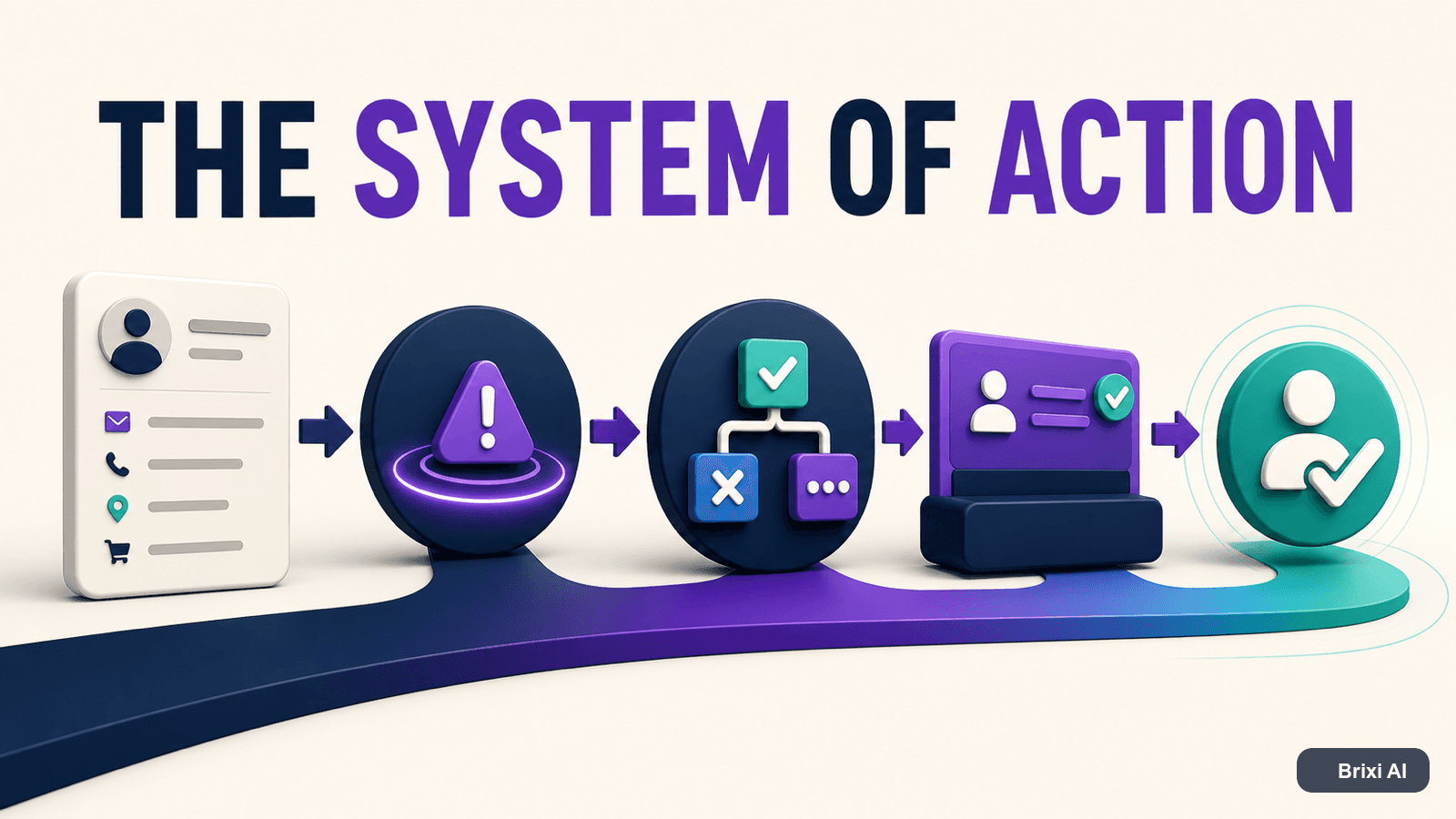
Customer data has little value while it waits for someone to notice it. The System of Action turns live intent into an owned next step before the opportunity decays.
At 2:06 on Thursday afternoon, a buyer opens the pricing page for the third time, downloads an implementation guide, and replies to a week-old WhatsApp message with one question: can we start this month? The CRM captures every event. The owner is in another meeting. Nothing happens for four hours.
The company did not lack data. It lacked a system that could convert evidence into action. That difference separates a System of Record from a System of Action.
The Attention Dependency is the hidden limit of CRM
Most CRM processes depend on a person noticing a field, opening a report, or working down a queue. We call this the Attention Dependency. Important signals compete with routine tasks and become valuable only after someone sees them.
A System of Action interprets the signal, decides its operational meaning, assigns ownership, and executes the safe parts immediately. Human attention moves to judgment, not monitoring.
Data freshness is not the same as response readiness
A perfectly synchronized record can still sit untouched. Knowing that a buyer revisited pricing is useful only if the signal changes priority, message, owner, or next step.
Teams often invest in cleaner dashboards while preserving the same manual response model. Reporting improves, but the customer still experiences delay.
The next action needs context, policy, and a clock
Not every signal deserves the same response. A repeat pricing visit from an open opportunity differs from a first visit by an anonymous user. A WhatsApp reply asking for a callback differs from a passive email open.
Decision logic should combine identity, lifecycle stage, fit, intent, prior conversation, consent, owner availability, and urgency. It should also define the clock: now, today, this week, or no action.
- Who is the customer and what is already known?
- What changed in the latest signal?
- Which action is permitted and useful?
- Who owns completion and by when?
Automation should remove waiting, not remove judgment
The goal is not to automate every decision. It is to eliminate unnecessary waiting around predictable decisions. The system can acknowledge, qualify, schedule, route, summarize, and prepare the next move.
People should step in where commercial judgment, empathy, negotiation, or exception handling creates value. The system should deliver that work with evidence rather than a generic task title.
Data at rest does not convert
The economic value of a customer signal depends on how quickly it becomes the right owned action.
Brixi turns customer signals into coordinated execution
Brixi combines CRM, buyer intent, conversation intelligence, AI assistants, workflows, and omnichannel communication. A signal can update priority and trigger the appropriate response without losing the customer history.
The same operating layer can send a contextual message, start an AI call, assign a human owner, schedule a task, or escalate a risk. Every outcome returns to the shared record and influences the next decision.
- Live intent and conversation signals
- Context-aware next-best actions
- AI and human execution in one workflow
- Outcome capture for continuous improvement
A quarter should reduce the distance between signal and outcome
Teams should begin with a small set of costly signals and define the action contract for each. Trying to automate every field change at once creates noise and weak ownership.
After a quarter, managers can compare signal-to-action time, completion rate, conversion, and exception patterns. The useful system makes important work faster while creating less low-value activity.
- Faster response to high-intent behavior
- Fewer stale tasks and ignored alerts
- More consistent owner assignment
- Clearer attribution from signal to outcome
The deeper bet is that CRM becomes active infrastructure
The future CRM will not wait for users to operate every workflow manually. It will continuously interpret customer evidence and coordinate the next safe action.
Records remain important because execution needs memory. The category changes when the record can participate in the work instead of merely documenting it.
Turn customer data into customer action
See how Brixi connects live signals, CRM context, AI execution, and accountable team workflows.
Explore Brixi CRMFrequently Asked Questions
A system of action interprets data and live signals, selects the next step, assigns ownership, executes approved work, and records the outcome.
Basic automation triggers on fields. A system of action combines customer context, intent, policy, ownership, and outcomes to choose a more appropriate response.
Start with high-intent replies, pricing activity, missed calls, appointment changes, unresolved promises, and risks that currently depend on manual monitoring.