CRM Automation That Actually Stops Lead Leakage
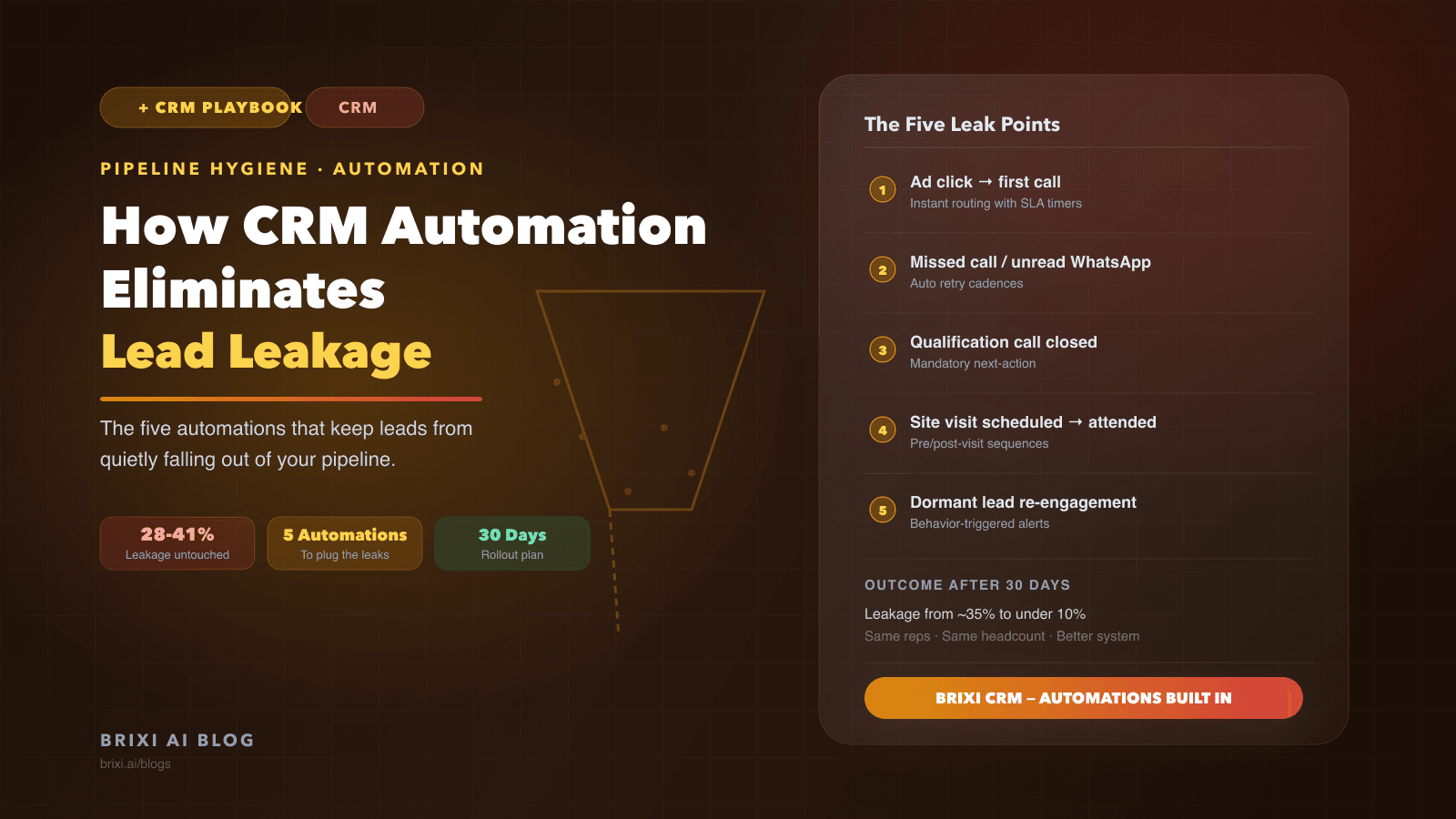
Most real estate teams lose leads not because their reps are careless, but because the CRM has no automated safety net for missed calls, unread WhatsApp messages, and follow-ups that drift past the critical first 48 hours. This is what a properly automated CRM actually fixes, and why discipline alone never will.
Raghav runs the inside sales floor for a mid-size residential developer in Gurugram. On a Tuesday morning in March, his ops lead pulled a report showing that 38 inbound leads from the previous week had no second touch recorded in the CRM. All 38 were still tagged "attempted." Some had been in that status for six days. Raghav knew his team had made calls. The reps were not lazy. But somewhere between the first dial and that Tuesday morning, 38 live prospects had simply stopped moving.
That is the Leakage Cascade: a chain of small, unremarkable process gaps, each individually forgivable, that together drain between a quarter and a third of a real estate team's inbound lead volume before any human realizes it is happening. No single rep caused it. No manager missed it deliberately. The CRM workflow just had no mechanism to catch what human attention dropped.
Here is the contrarian-but-true claim: adding more reps does not fix the Leakage Cascade. Neither does a daily standup where managers ask "what happened to lead 4721?" The cascade is structural. It is caused by a system that moves leads forward only when a human remembers to push them. The fix is a CRM automation layer that moves leads forward on its own, and surfaces them to humans only when a genuine conversation is required.
Where Does the Leakage Cascade Actually Start?
Before you can automate the recovery, you have to locate where leads first stop moving. In real estate, the Leakage Cascade clusters around five predictable moments. Each one is a gap between two pipeline stages where no automated rule is running and human memory is the only thread keeping the lead alive.
- Between ad click and first call: without instant routing and SLA timers, leads sit in an unassigned queue while the buyer's attention window closes. In most teams we audit, average first-touch latency is 23 to 47 minutes.
- After the first missed call: a rep dials once, the buyer does not answer, and without a retry automation the lead stays in "attempted" indefinitely. This is the single most common source of pipeline leakage.
- After the first qualification call: the conversation happened, informal notes exist, but no next-action date was set. "Follow up in a few days" becomes "follow up never" when the rep gets pulled into fresher leads.
- Between site visit booked and site visit completed: the buyer agreed to come in but received no confirmation, no directions, no pre-visit warm-up. No-shows here are almost always a workflow failure, not a change of heart.
- After the site visit with no recorded next step: the visit happened, feedback was verbal, the rep intended to follow up, and then 12 days passed in silence. By then the buyer had visited two other projects.
Why Is Discipline Not Enough to Stop the Leakage Cascade?
The instinct when leads fall through is to train harder, remind more, and monitor more closely. Some teams post daily dashboards showing which reps have the most "attempted" leads. This creates pressure, not prevention. When a rep is handling 40 active leads, the cognitive cost of tracking every follow-up date manually is too high to be reliable. The rep who drops a follow-up is not failing at effort. They are failing at a task the CRM should have taken off their plate entirely.
Automation does not replace judgment. It replaces the parts of the workflow that do not require judgment: routing a lead to the right rep, sending a WhatsApp after a missed call, firing a site visit confirmation, escalating a stalled lead to a manager. These are rules, not decisions. When rules are codified in the CRM workflow engine, they run without variance. When they live in human memory, they run with 60 to 70 percent reliability on a good week.
The core contrast
A CRM that moves leads forward only when reps remember to push them is not a CRM. It is a logbook. A CRM with automated lead routing, retry cadences, mandatory next-actions, and buyer intent triggers is a system that works even when reps are busy, on leave, or simply stretched thin.
Which CRM Automations Actually Close the Leak Points?
Each of the five leak points above maps cleanly to an automation that can run without rep intervention. These are not advanced configurations. They are table-stakes workflows for any team that takes pipeline hygiene seriously. The only question is whether your CRM ships them natively or requires a months-long custom build.
Instant lead routing with SLA escalation
Every inbound lead should be assigned to a rep within seconds of hitting the CRM, using routing rules based on project, geography, language, or shift schedule. An SLA timer starts the moment the assignment is made. If the rep has not logged a contact attempt within 10 to 15 minutes, the lead escalates automatically to the next available rep and the manager receives a notification. No lead waits in an unassigned queue. No lead stays with a rep who is in a meeting or out sick.
Configured retry cadences on every missed contact
A missed call should trigger a defined sequence automatically. A WhatsApp message within 5 minutes. A second call attempt later in the same day. A Voice AI outreach if the rep is unavailable. After a configured number of attempts with no response, the lead auto-disposes to "unreachable" and enters a lower-intensity nurture sequence rather than sitting in limbo. The Leakage Cascade cannot start if silence is treated as a signal, not as an absence of data.
Mandatory next-action enforcement on every disposition
The anti-pattern here has a name: the floating disposition. This is when a rep closes a call with “interested, will follow up” and the CRM accepts the record without requiring a date or task. Floating dispositions are the structural cause of the post-qualification leak. The fix is CRM workflow automation that blocks the record from saving until a next-action type and date are entered. Reps will complain for the first two weeks. After that, the habit is formed and the complaints stop.
Automated pre-visit and post-visit sequences
The moment a site visit is booked in the CRM, a three-message sequence should fire without any rep action: a confirmation message the afternoon before the visit, directions and project highlights the morning of the visit, and a feedback request within 60 minutes of the visit's scheduled end time. This sequence alone, when measured, typically reduces no-show rates by 15 to 25 percent in teams that previously had no post-booking workflow. The visit was on the calendar. The buyer just needed to be reminded that it mattered.
Buyer intent signals that surface dormant leads
This is the automation most teams skip, and it is the one with the highest conversion upside. When a buyer revisits a project microsite, views the pricing page, or downloads the brochure, that event is a behavioral signal that the lead is still evaluating. In a CRM with automated lead routing tied to buyer intent, this event surfaces the lead at the top of the rep's queue with context: "Priya Sharma just viewed the 3BHK pricing page for the second time this week." The rep now has a natural reason to call. That is qualitatively different from a cold check-in, and the response rate reflects it.
What Changes After a Full Quarter of Running These Automations?
The most noticeable change is what stops happening. Managers stop discovering cold leads in their weekly CRM audit. Reps stop saying "I meant to follow up on that one." The phrase "the lead went quiet" becomes genuinely rare because the CRM has already attempted four or five touchpoints before anyone would have characterized the lead as cold.
- First-touch latency drops from 20 to 40 minutes to under 5 minutes for the majority of inbound leads.
- The share of leads with no second touch within 7 days falls from the 30 to 40 percent range to under 10 percent in most deployments.
- Rep bandwidth improves because time spent on manual reminders and status checks shifts to actual conversations.
- Site visit no-show rates drop when confirmation and pre-visit sequences are running consistently.
- Dormant leads re-enter the active pipeline through intent triggers rather than being written off.
- Manager review meetings get shorter because the CRM surface shows live SLA compliance rather than asking managers to audit manually.
There is a subtler change that takes longer to name. The sales floor's relationship with the CRM shifts. When reps see that the system actually helps them follow up, they start trusting it with better data. Notes become more specific. Dispositions become more accurate. That improved data quality then feeds better routing decisions and better manager visibility. The Leakage Cascade runs in reverse: small improvements compound into a materially tighter pipeline over 60 to 90 days.
Why Do Generic CRMs Struggle to Deliver This?
Salesforce and HubSpot can technically build all of these automations. The problem is not capability, it is architecture. Site visits in a generic CRM are custom objects that have to be modeled from scratch. WhatsApp requires a third-party connector and usually a separate integration layer. SLA timers need workflow logic that most admins are not comfortable maintaining. Buyer intent signals from microsites need an external analytics tool and a back-channel into the CRM to trigger rep alerts.
By the time a real estate team finishes building this stack on a generic CRM, the project has taken 4 to 6 months, depends on 3 to 5 external connectors, and breaks whenever any vendor updates their API. The team is now in the business of maintaining a custom integration, not running a sales floor.
Purpose-built real estate CRM automation platforms ship these as core workflows. A site visit is a first-class object with confirmation, reminder, and feedback sequences attached by default. WhatsApp is native to every lead record, not a plug-in. SLA timers and retry cadences are configured in minutes, not engineered over months. Buyer intent signals from microsites land directly in the CRM's lead queue. The difference is not a feature gap. It is a fundamental choice about what the product is for.
How Should a Team Sequence the Rollout?
Teams that try to enable all five automations simultaneously usually stall within two weeks. The configuration complexity is manageable, but the change management is not. Reps receive too many new prompts at once, trust breaks down, and the automations get disabled to "fix things later." A phased rollout avoids this.
- Week 1: Instant routing and SLA timers. This is the highest-impact, lowest-friction change. Reps experience it as the system giving them leads faster. Measure first-touch latency daily for two weeks to confirm the shift and show the team the data.
- Week 2: Retry cadences and mandatory next-actions. Expect friction on the next-action rule. Acknowledge it openly: the form is slower for a reason. Show reps the aggregate data on how many "attempted" leads have never had a second touch.
- Week 3: Site visit sequences. Turn on confirmation, directions, and post-visit feedback messages. Measure no-show rate before and after. The improvement is visible fast enough to build momentum.
- Week 4: Buyer intent triggers. Wire in microsite engagement signals and configure the lead-surfacing logic. By this point, reps have seen the earlier automations working and are receptive to the final layer.
What Is the Deeper Bet Being Made Here?
Raghav closed out that Tuesday review by asking his ops lead a question: “How many of those 38 leads would have booked a visit if we had called them back within 10 minutes?” The honest answer was: probably a handful. Maybe more. The problem was that there was no way to know, because the system had never given those leads a real chance.
That is the deeper bet behind CRM automation for lead leakage prevention. It is not a claim that every leaked lead would have converted. It is a claim that a significant portion of the leads a team writes off as "bad quality" are actually "systematically under-served leads." The distinction matters because bad-quality leads justify lowering ad spend and blaming the channel. Systematically under-served leads justify fixing the workflow and watching conversion rates improve on the same ad spend.
Real estate teams that stop the Leakage Cascade do not just see better pipeline numbers. They see a different picture of their lead quality entirely. Leads that looked cold turn out to have been evaluating for weeks. Leads that were written off re-engage when a buyer intent trigger fires at the right moment. The CRM starts reflecting reality more accurately, and decisions get better as a result.
The anti-pattern to avoid is treating this as a one-time configuration project. Automated follow-up in CRM is not a setup you complete and forget. Routing rules need to update when teams restructure. Retry cadences need to adjust when WhatsApp response patterns change. SLA thresholds need to tighten as the team improves. The teams that maintain strong pipeline hygiene over 12 to 24 months are the ones that review automation performance the same way they review rep performance: regularly, with data, and with a willingness to change the rules.
What would your pipeline look like without the Leakage Cascade?
Brixi ships instant routing, retry cadences, WhatsApp-native follow-up, site visit sequences, and buyer intent triggers as core CRM automation features, not a customization project. See it running on a real estate pipeline.
See Brixi in ActionFrequently Asked Questions
Lead leakage is the quiet loss of prospects from the pipeline due to delayed first contact, missed-call sequences with no retry, dispositions closed without a next-action date, unconfirmed site visits, and dormant leads with no re-engagement trigger. The root cause in almost every case is a CRM workflow that depends entirely on human memory to move leads forward. When human attention gets stretched, the leads stop moving. The fix is automated CRM workflow rules that move leads forward whether or not a rep remembers to.
The five automations that directly address each leak point are: instant lead routing with SLA escalation timers, configured retry cadences on every missed call or unread WhatsApp, mandatory next-action enforcement on every call disposition, automated pre-visit and post-visit message sequences, and buyer intent triggers that surface re-engaging dormant leads. Rolling these out in sequence over four weeks allows each automation to stabilize before the next is added.
Technically yes. In practice, a full implementation requires custom site visit objects, third-party WhatsApp connectors, manually configured SLA workflow logic, and a separate microsite analytics layer feeding buyer intent signals back into the CRM. Most teams that attempt this on generic CRMs spend 4 to 6 months building it and significant ongoing effort maintaining it. Purpose-built real estate CRM platforms ship these as native workflows, which cuts time-to-value from months to days.
Drip email sequences are time-based: they fire at fixed intervals regardless of what the buyer does. Automated follow-up in a real estate CRM is event-based and multi-channel: it fires on specific triggers like a missed call, a microsite visit, a WhatsApp left unread, or a site visit approaching. The result is that reps reach out at moments when the buyer has signaled attention, not on a predetermined schedule. Response rates on event-triggered follow-up are substantially higher than on time-based drip sequences.