Readiness-Based Lead Routing Beats Round-Robin
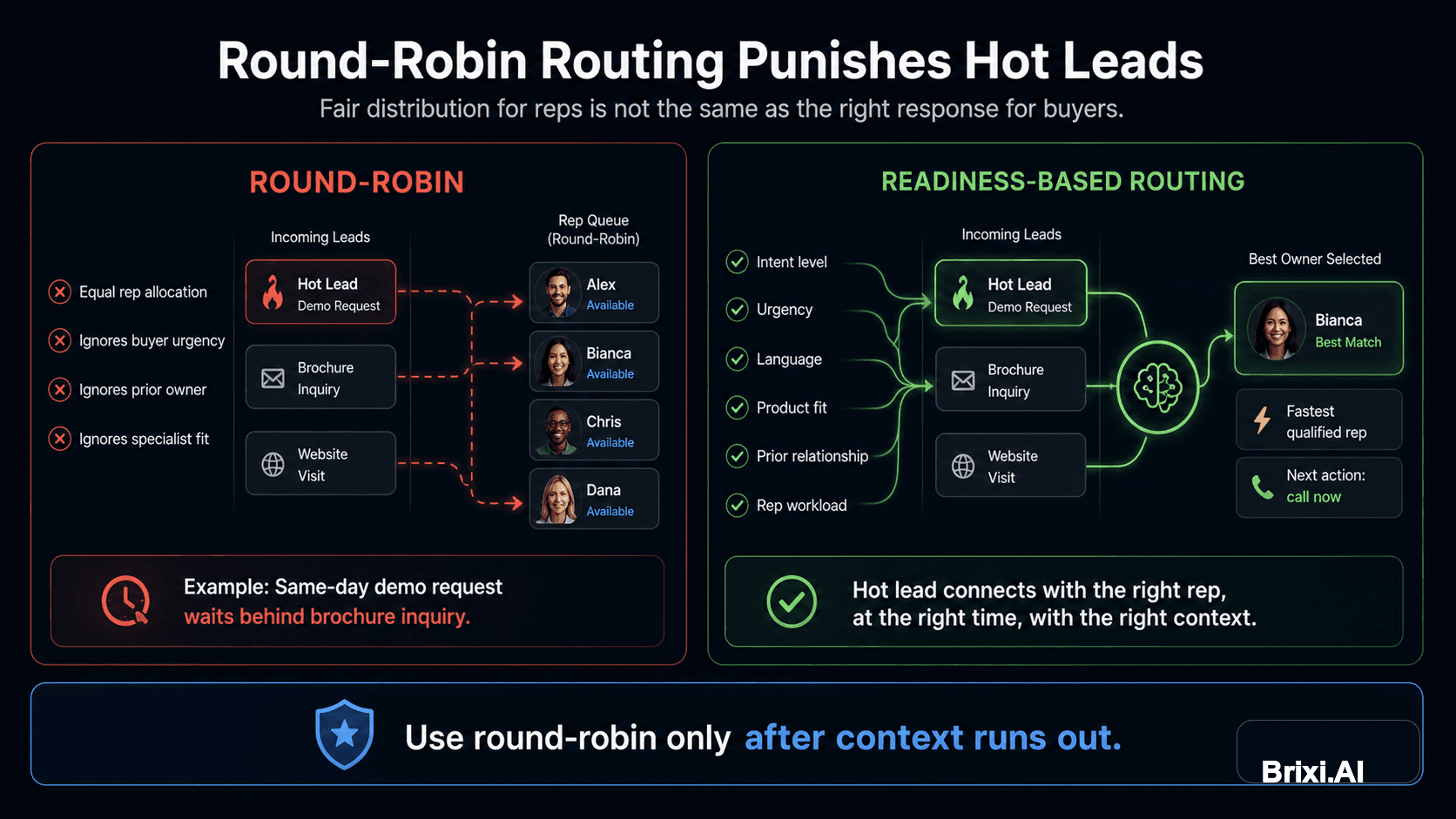
Round-robin routing optimises fairness for reps, not outcomes for buyers. High-intent leads should reach the most qualified owner in seconds, not wait for the next name in a queue. Routing has to move from equal distribution to context-aware assignment before conversion leaks become permanent.
Ojas manages a twelve-person inside sales team at a Chennai-based real estate developer. In March, he ran a quick audit after a quarter of flat conversion numbers. He pulled the call logs for the thirty leads that had gone cold in February and looked at who received them. Eleven had been assigned to a rep who was mid-call on another lead at the moment of assignment. Seven had been assigned to a rep who had zero background in the sub-segment those buyers were asking about. Four had gone to a rep who was already carrying nineteen active leads that week.
None of this showed up in the distribution report. The report said every rep had received roughly the same number of leads. Fairness, on paper, was perfect. Conversion, in practice, was not. Ojas had been running a system that protected his team from internal complaints while consistently misrouting the leads most likely to close.
Why does round-robin routing persist despite the evidence against it?
Round-robin routing persists because it solves a real internal problem. It eliminates arguments over who received more leads. It removes the manager from the assignment loop. It produces distribution reports that look orderly. For a team where leads are genuinely similar and reps are genuinely interchangeable, it is a reasonable default.
The issue is that most B2C and B2B sales teams in India do not operate in that condition. Leads arrive from property portals, WhatsApp campaigns, organic search, paid ads, and referral networks. A lead from a referral asking about a specific floor plan in a gated community has nothing in common with a lead from a Facebook ad that filled in a form to receive a brochure. Routing both through the same queue treats urgency, intent, and fit as irrelevant. They are not irrelevant. They are the primary signals that determine whether a rep can move a conversation forward on the first call.
What does round-robin actually optimise for?
Round-robin optimises workload distribution. It assumes three things: leads are roughly similar in value and complexity, reps are roughly equivalent in skill and availability, and response quality is mostly a function of who owns the lead rather than who should own it. All three assumptions break at scale.
Lead quality varies sharply across sources. A lead who visited a project page four times, watched a video walkthrough, and then submitted a callback form is not the same as a lead who clicked a display ad and filled in a name. A rep who receives the high-intent lead while offline, at capacity, or without context about that project sub-type cannot capitalise on the urgency the buyer brought to the conversation. That urgency has a shelf life. It rarely survives a missed call plus a two-hour callback.
What are the specific failure modes of round-robin lead routing?
- High-intent buyers wait behind low-intent buyers because queue position, not urgency, determines assignment order.
- Specialist knowledge is ignored: a rep who knows the commercial leasing product inside out receives a residential first-time-buyer inquiry because the rotation landed there.
- Returning buyers are treated like new contacts: a lead with three prior conversations and an established objection gets routed to a rep with no context, resetting the trust built by the previous owner.
- Language and geography mismatches persist: a Tamil-speaking buyer in Coimbatore gets a Hindi-dominant rep because no routing rule checks for language fit.
- Overloaded reps receive new high-value leads they cannot service: workload is invisible to a pure rotation system.
- Managers see clean distribution metrics but have no visibility into whether routing quality improved conversion outcomes.
What is the Contextual Assignment Stack?
The Contextual Assignment Stack is the set of signals a routing system should evaluate before assigning a lead. It is not a single variable. It is a ranked hierarchy of inputs that the system works through in order, falling back to rotation only when all contextual signals are exhausted.
Tier one is prior relationship. If a rep already owns this contact in CRM, the lead returns to that rep unless the rep is unavailable beyond a defined threshold. Context already built should not be discarded by default.
Tier two is intent and urgency. Leads with explicit high-intent signals, such as pricing questions, site visit requests, or loan eligibility inquiries, should be routed to the fastest available qualified rep. Not the next rep. The fastest qualified rep who is online and under workload threshold.
Tier three is product and segment fit. Some objections require product specialists. Some buyer types, such as NRI investors, diaspora buyers, or institutional purchasers, require reps with specific experience. Routing should match on this dimension before falling to availability alone.
Tier four is language and geography. A routing rule that checks for preferred language and regional familiarity prevents the mismatch where a buyer needs a conversation in Telugu and the assigned rep works in English only.
Tier five is availability and workload. A rep who is mid-call or already carrying an overloaded lead queue should not receive a new high-value assignment. Capacity routing requires live visibility into rep status, not a static snapshot from the previous shift.
Tier six, and only tier six, is rotation. If tiers one through five have no clear winner, round-robin across the eligible pool is a reasonable tiebreaker. The problem is that most teams start here instead of ending here.
Is readiness-based routing just lead scoring with a new name?
No, and the distinction matters. Lead scoring assigns a static number to a contact based on firmographic or behavioural attributes. Readiness-based routing is dynamic. It evaluates the lead at the moment of assignment against the current state of the rep team. A lead that scored 80 at 9 a.m. might be assigned differently at 3 p.m. because the specialist who should own it is now available after being on-call all morning.
Readiness routing also incorporates the rep side of the equation. A lead score alone says nothing about whether the best rep is available, online, or under capacity. Routing that ignores rep state will consistently assign high-value leads to reps who cannot act on them fast enough.
The contrarian position worth holding
Most lead routing discussions focus entirely on the buyer side: intent score, source quality, urgency signals. But the biggest routing failures happen on the rep side. An overloaded rep with a perfect lead is worse than a rested rep with a contextual match. Readiness routing has to model both ends of the assignment simultaneously.
What do real-estate and high-velocity sales teams get wrong about routing rules?
The most common anti-pattern is building routing rules once and never revisiting them. A team sets up source-based routing in January: leads from portal A go to team one, leads from portal B go to team two. By April, both portals have changed their lead quality profile because campaign types shifted. The routing rules still fire on source, but source no longer correlates with intent the way it did when the rule was written.
The second anti-pattern is routing to roles instead of individuals. "Escalate to senior manager" is not a routing rule. It is a wish. A routing rule needs to identify a specific person or a ranked list with fallbacks and time thresholds. Without specificity, the escalation sits unowned in a shared inbox.
The third anti-pattern is treating routing as a one-time assignment. Routing should be re-evaluated if the assigned rep does not connect within a defined window. A lead that receives no contact in fifteen minutes is not the same as a lead that just arrived. It has aged. It may need a different assignment, an automated follow-up, or an AI qualification call to hold the buyer until a human is available.
How does AI qualification fit into a readiness routing model?
AI voice agents and automated qualification flows fit into readiness routing as a first-response layer, not a replacement for human routing. When no qualified rep is available within the response threshold, an AI agent can engage the buyer immediately, collect intent and urgency signals, answer product questions at a basic level, and update CRM with enriched context before the human call happens.
This approach converts the routing problem from a binary choice, assign now to whoever is available or wait, into a tiered response. The buyer receives immediate engagement. The CRM receives enriched data. The human rep receives a warmer lead with pre-collected context when they pick up the escalation. The Contextual Assignment Stack now has better inputs for tier two and tier three because the AI interaction has surfaced what the buyer actually needs.
What changes after a quarter of context-aware routing?
The first change Ojas noticed at the end of Q2 was not conversion rate. It was call connect rate. When leads were routed to reps who were online and under capacity, the time between assignment and first call dropped. When buyers received a call within five minutes of submitting a form, the connect rate nearly doubled compared to leads that sat unworked for twenty minutes or more.
The second change was conversation quality. Reps who received contextual routing notes, including which project the buyer had viewed, what question they had asked, and whether they were a returning contact, skipped the cold-open problem. They could reference what the buyer cared about without the buyer having to repeat themselves.
The third change was visible only in the aggregate: the relationship between lead source quality and conversion stabilised. Before context-aware routing, a high-quality lead source could be undermined by poor assignment. After routing aligned with the Contextual Assignment Stack, source quality showed up in outcomes rather than disappearing into assignment variance.
The deeper bet Ojas made
By June, Ojas had made a structural change that went beyond routing rules. He had asked his CRM team to instrument every routing decision so that each assignment recorded which tier of the Contextual Assignment Stack had triggered it. After eight weeks of that data, he had a clear picture: thirty-one percent of leads were still being routed by rotation, meaning tiers one through five had found no match. That was the next problem to solve: why did a third of leads arrive with no usable context, and what could the top-of-funnel capture process do to change it.
That is the progression that context-aware routing forces. It does not just improve assignment quality. It surfaces the upstream data quality problems that make good routing impossible. Teams that invest in the Contextual Assignment Stack eventually find themselves improving their forms, their ad targeting, their CRM field completion rates, and their qualification scripts, because routing makes the cost of thin context visible in a way that distribution reports never did.
Ready to route leads by readiness, not rotation?
Brixi combines CRM context, buyer intent signals, AI qualification, and workflow automation so every lead reaches the right owner at the right moment.
Explore Buyer Intent RoutingFrequently Asked Questions
Readiness-based lead routing assigns each inbound lead to the most qualified available rep based on contextual signals: buyer intent level, urgency, prior relationship, product fit, language match, and rep capacity. It contrasts with round-robin routing, which distributes leads by queue position regardless of these factors.
Round-robin is a reasonable fallback when leads carry no contextual signals and reps are equivalent in skill and availability. It becomes expensive when teams apply it despite having intent data, conversation history, language preferences, and rep workload information. It should be the last resort in a routing hierarchy, not the default.
Routing affects conversion by determining response time, rep-buyer context match, and whether the buyer has to repeat prior context on every call. Leads assigned to available, contextually matched reps within a short response window consistently outperform leads assigned by rotation to reps who are busy, underinformed, or mismatched on product expertise.
The most valuable signals are prior rep relationship, explicit intent indicators such as pricing or site-visit requests, product or segment specialisation, language and geography fit, and live rep availability with workload visibility. Source-based routing alone is insufficient because lead quality within a single source changes as campaigns evolve.