Promptable RevOps: Why Leaders Need Answers From Conversations, Not More Dashboards
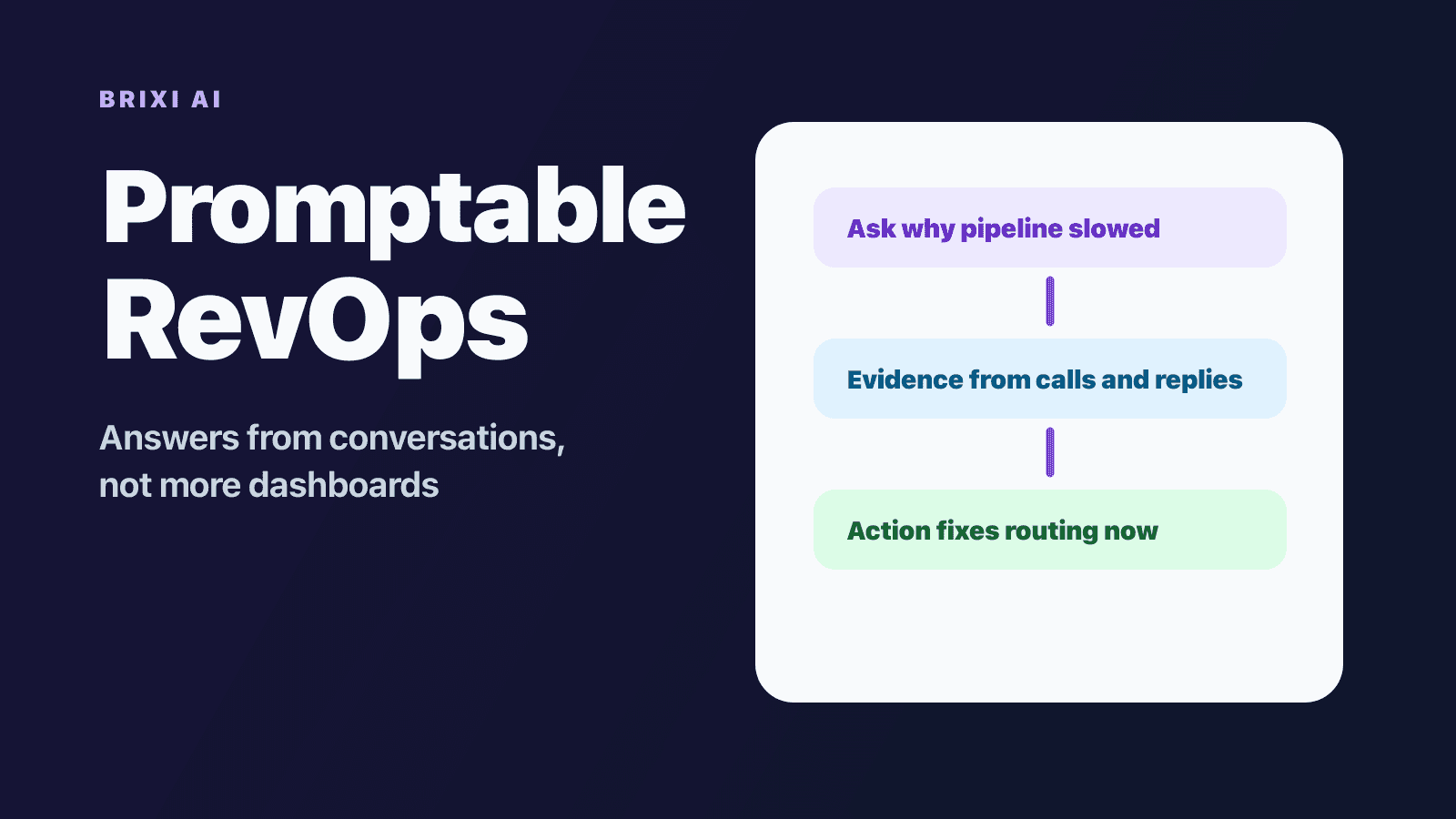
RevOps leaders do not need another static dashboard. They need promptable answers from the conversations where objections, risk, intent, and next steps actually appear.
At 5:12 PM, the CRO asks a simple question in the pipeline review: "Why did enterprise opportunities from paid search slow down this month?" The dashboard shows volume, stage conversion, and owner performance. Nobody in the room can answer the why without opening call notes, Slack threads, CRM comments, and a dozen deal records.
The team has dashboards. They do not have answers. This is the gap Promptable RevOps is supposed to close: the ability for leaders to ask plain-language questions about revenue operations and get evidence-backed answers from the actual work.
But promptable analytics only works if the system can read the right source material. Pipeline truth does not live only in CRM fields. It lives in calls, WhatsApp replies, emails, proposal behavior, meeting notes, lost reasons, and buyer silence.
Dashboards tell you what changed. Conversations tell you why.
Traditional RevOps dashboards are excellent at aggregation. They show stage conversion, source performance, aging pipeline, forecast variance, and rep activity. Those numbers matter. They are also incomplete because they compress customer behavior into fields.
When conversion drops, the dashboard can show the drop. It usually cannot tell you whether buyers are objecting to price, confused about implementation, waiting for finance approval, comparing competitors, or losing trust after slow follow-up. Those answers sit inside conversations.
Promptable RevOps changes the interface, but the deeper change is the data layer. Leaders should be able to ask, "Which deals mention budget freeze and have no executive sponsor?" or "Which WhatsApp leads asked for pricing twice but never received a human callback?" That requires conversation intelligence connected to CRM and workflows.
The questions leaders actually want to ask.
The most useful RevOps questions are not static report filters. They combine deal state, customer language, behavior, and time. They sound like questions an operator would ask a sharp analyst if that analyst had read every conversation.
- Which late-stage deals have no buyer-initiated activity in the last fourteen days?
- Which leads from Meta mentioned urgency but were not called within one hour?
- Which lost deals cited price after previously asking about implementation timeline?
- Which reps are getting objections around trust, not product fit?
- Which accounts have active champions but no second stakeholder engaged?
These are not dashboard questions. They are operating questions. They require the system to understand what customers said, what teams did, and what happened next.
The Promptable RevOps rule
If the answer cannot cite customer language or behavior, it is probably a dashboard summary with a chat interface, not real promptable RevOps.
Conversation data needs structure before it can answer.
Raw transcripts are not enough. A promptable system cannot efficiently answer operational questions if every call, chat, and WhatsApp thread remains a wall of text. It needs structured extraction: objection, urgency, stakeholder, commitment, risk, sentiment, promised next step, and owner action.
That structure turns conversation into queryable revenue data. A manager can ask for deals where pricing concern appeared after proposal sharing. A sales lead can ask for follow-ups where the AI promised a callback but no task was completed. A founder can ask which channels produce the highest-intent questions, not just the highest lead count.
The point is not to replace dashboards. It is to make dashboards explainable. Numbers should open into evidence. Evidence should open into next action.
The answer should change the operating plan.
A promptable answer is useful only if it changes what the team does next. If the system explains that paid-search enterprise deals slowed because buyers are asking implementation questions earlier, the next step is not another chart. It is a change in follow-up, content, routing, and enablement.
That is the difference between analysis and operations. Analysis names the pattern. Operations assigns an owner, changes a workflow, updates a playbook, and checks whether the next cohort behaves differently. Promptable RevOps should shorten that distance.
The best answers should therefore include evidence and a recommended action. Which deals are affected? Which customer sentences support the conclusion? Which workflow is failing? Who should act today? Without that chain, promptable analytics becomes faster commentary, not better revenue operations.
This is where the question format matters. "Why did conversion drop?" is useful as a starting point, but the operating follow-up is sharper: "Which high-intent leads mentioned price twice and did not receive a senior callback?" The second question can become a task list. Promptable RevOps should help leaders move from curiosity to intervention.
The system should also remember the intervention. If the team changes routing for pricing objections, the next review should compare the cohort before and after that change. Otherwise promptable answers become a stream of interesting observations with no learning loop.
Brixi connects promptable answers to operating action.
Brixi brings conversation intelligence, CRM, buyer intent, WhatsApp, voice AI, and workflows into one customer platform. That lets leaders ask questions from the same context teams use to act.
A promptable answer can reveal that high-intent WhatsApp leads are going stale because owner assignment is slow. The same platform can change the routing rule, trigger faster callbacks, and surface missed follow-ups. A conversation insight is only useful if it can alter the operating system.
That is why promptable RevOps should not live as a separate analytics toy. It should sit inside the customer platform, close to the conversations, workflows, and team actions it is trying to improve.
Promptable RevOps still needs governance.
Natural-language questions make analysis easier to access, but they also make weak data easier to misuse. A leader can ask a confident question and receive a confident answer from incomplete sources. The interface feels simple even when the evidence layer is not.
Governance starts with source clarity. The answer should show whether it used call transcripts, WhatsApp replies, CRM fields, proposal activity, or only stage data. It should also show what it could not see. A promptable system that admits its evidence boundary is more trustworthy than one that turns every gap into a polished paragraph.
This is why RevOps should own the question library, definitions, and review cadence. The goal is not to let every dashboard become a chat window. The goal is to make important operating questions repeatable, auditable, and tied to action.
A question library sounds bureaucratic until a leadership team tries to run reviews from ad hoc prompts. One person asks about active opportunities. Another means qualified pipeline. A third includes stale deals because the stage still says proposal. Governance gives the business shared definitions before AI starts generating answers from them.
That discipline makes the conversational interface stronger, not weaker. Leaders can still ask flexible questions, but the important terms have agreed meaning. The answer becomes easier to trust because the system is not inventing definitions in the moment.
What changes after a quarter of promptable operations?
The first change is faster diagnosis. Leaders stop waiting for an analyst to build a new view every time the pipeline behaves strangely. They can ask a direct question and inspect the supporting conversations.
The second change is better coaching. Managers can move from generic performance feedback to evidence: the specific objection a rep mishandled, the follow-up promise that was missed, or the competitor mention that never reached the forecast.
The third change is tighter workflow design. Promptable answers expose where customers are asking for something the current process does not handle. That becomes input for routing, templates, escalation rules, and AI agent design.
The fourth change is less meeting theater. Leaders stop asking every manager to explain the same pipeline movement from memory. The system brings the customer evidence into the room, so the discussion can move faster from diagnosis to action.
The cultural shift is important. Promptable RevOps does not remove judgment from leadership. It gives judgment better material. Managers can still disagree with the answer, but the disagreement starts from the same customer evidence instead of separate anecdotes. That shared evidence makes hard pipeline conversations less personal and more useful because everyone can inspect the signals behind the claim. The room gets sharper when the source material is shared, and action items become easier to defend after the meeting.
The deeper bet: RevOps becomes conversational.
Revenue operations has spent years turning customer work into fields. The next step is turning customer conversations back into operating intelligence without losing structure.
Promptable RevOps is not about asking dashboards nicer questions. It is about letting leaders interrogate the real customer journey and then change the system from what they learn. The interface is conversational because the truth is conversational too.
Ask better RevOps questions from real conversations
Brixi connects conversation analysis, CRM, buyer intent, WhatsApp, voice AI, and workflows so leaders can diagnose pipeline risk and act on it faster.
Explore conversation analysis