AI Pipeline Forecasting for B2B RevOps: Signal Over Gut
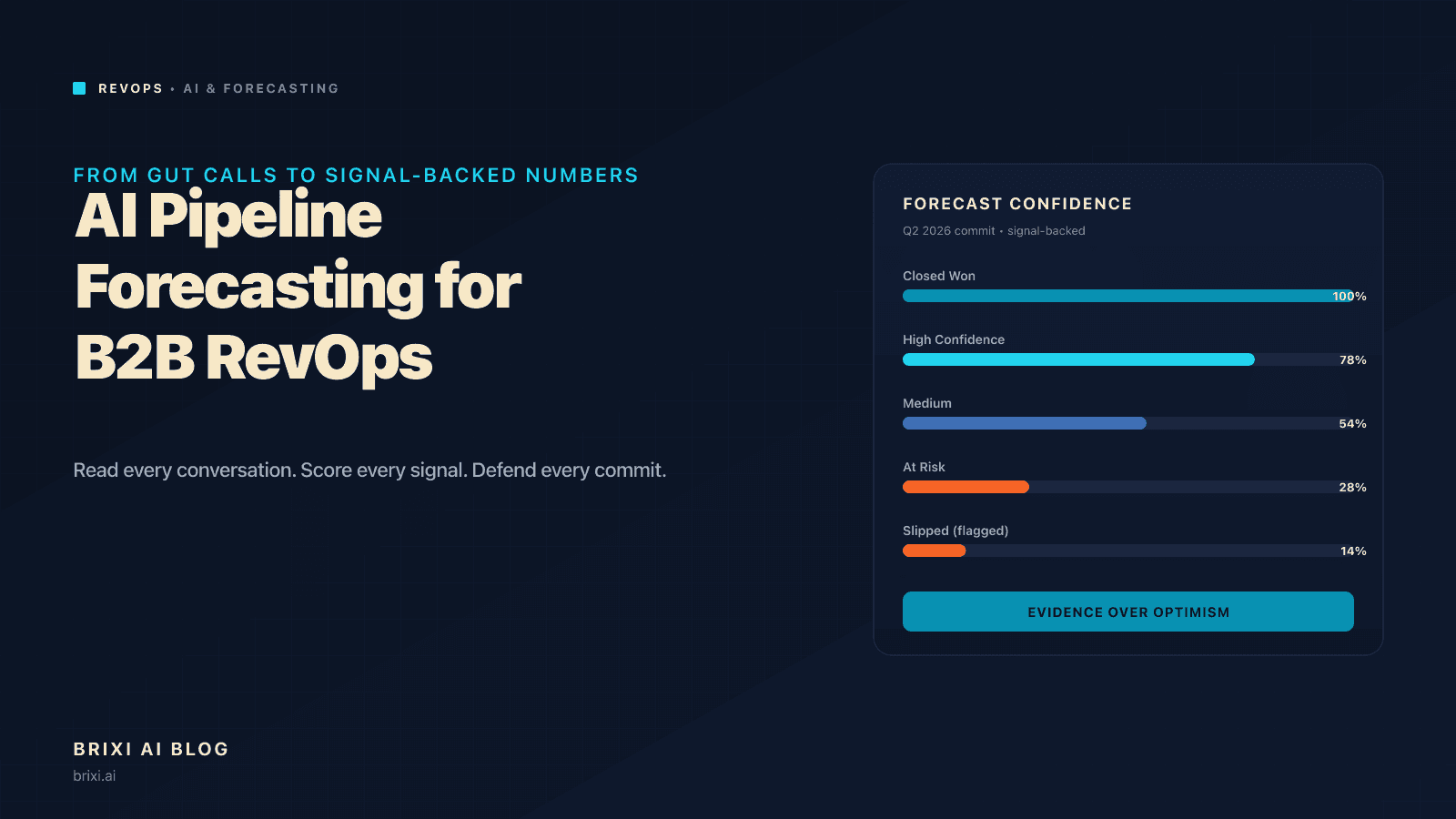
B2B forecasts still miss by wide margins because every layer of the commit chain adds optimism. RevOps teams that replace rep-estimated probabilities with AI-read conversation, engagement, and cadence signals are closing that gap and getting to a number their CRO can defend.
Ashwin runs RevOps for a Chennai-based B2B SaaS company selling workflow automation to mid-market manufacturers. Every Thursday at 4 PM he runs a pipeline review with five regional managers. By 5:30 PM he has a committed number for the quarter. By the end of the quarter, that number is typically off by 25 to 35 percent, almost always high.
The deals that missed were not surprises in hindsight. The buying contact had gone quiet three weeks before quarter-end. The proposal had been sitting unread. The champion had left the account and nobody had logged it. The evidence was there. Nobody had read it.
This is the real forecasting problem. It is not that reps lie or managers are careless. It is that the signals that predict revenue are scattered across call recordings, email threads, document-sharing platforms, and WhatsApp conversations, while the forecast lives in a CRM field that nobody updates until the deal closes or dies.
Why does every forecast layer add optimism?
The anti-pattern that kills B2B revenue forecasting accuracy has a name: the Optimism Stack. A rep marks a deal at 70 percent because they believe in it and because their manager rewards confidence. The manager applies a light discount to look prudent, but keeps most deals in commit. The VP trims 10 percent at the top to look conservative to finance. Finance adds back 5 percent because the sales leader pushed back last quarter. By the time the number reaches the board, it is a political artifact, not a forecast.
Each layer in the Optimism Stack is individually rational. Reps get better quota relief if their pipeline looks healthy. Managers get more headcount if their win rate looks strong. The incentive structure actively punishes the person who says "this deal is not as close as it looks." AI forecasting breaks the Optimism Stack not by changing incentives but by making the underlying evidence legible to everyone at once.
- CRM stage and probability are self-reported and update only when the rep remembers.
- Late-stage deals that have stalled look identical to late-stage deals about to close.
- Competitive mentions, budget hesitation, and champion attrition never reach the forecast.
- Cadence breaks: the buyer has not responded in 18 days but the deal is still marked 85 percent.
- Commit calls reward the rep who sounds certain, not the rep who cites evidence.
What signals does AI pipeline forecasting actually read?
A B2B AI forecasting model treats every deal as a stream of timestamped events rather than a static CRM record. The model asks: does this deal look like the deals we closed, or does it look like the deals we lost? To answer that, it needs signal types that CRM fields do not capture.
Conversation signals from calls and meetings
Call transcripts and meeting summaries surface the language buyers use to describe next steps. A buyer who says "we need to loop in procurement" is at a different stage than a buyer who says "we are evaluating three vendors." Deals where the champion asks about implementation timeline close at meaningfully higher rates than deals where the last recorded meeting ended with "let us reconnect next month." Conversation intelligence tools that feed these signals into a forecast model give RevOps a leading indicator rather than a lagging one.
Engagement signals from documents and email
How long did the buyer spend on the pricing section of your proposal? Did a second stakeholder open the document? Did the legal team request the contract, or is the proposal still unopened after 10 days? Engagement data weighted against historical win patterns tells you whether a deal is widening inside the account or narrowing to one champion who may not have authority.
Cadence signals and response velocity
Response velocity is one of the strongest predictors of deal health. In most B2B segments, a buyer who responds to follow-ups within 24 hours closes at a substantially higher rate than one whose average response time has drifted to five days. The pattern that precedes most last-minute slippage: the buyer schedules and cancels two meetings while the rep keeps the deal at 80 percent in CRM because there has been no explicit rejection.
Multi-threading and stakeholder spread
Enterprise and mid-market B2B deals that involve only one buyer contact carry higher slippage risk than deals where the rep has documented conversations with at least three people across the buying committee. AI forecasting models trained on your own historical data will surface the minimum stakeholder threshold that your winning deals share, which varies by segment, deal size, and product type.
The Conviction Score
Every deal in a well-designed AI forecast carries a Conviction Score: a model-assigned confidence level derived from conversation, engagement, cadence, and multi-threading signals compared against your historical win patterns. The Conviction Score is not the final forecast. It is the second opinion that surfaces deals whose rep probability and model probability diverge by more than 20 points, which is where most forecast misses hide.
Why running AI forecasts in shadow mode is not optional caution?
Here is the contrarian position most AI vendors will not say aloud: if you deploy an AI forecast model and immediately ask reps to defend the gap between their probability and the model’s Conviction Score, you will kill the program inside one quarter. Reps will find every miss and cite it publicly. Managers will defend their reps. The model gets shelved as "not ready."
Shadow mode, running the AI forecast in parallel for a full quarter without letting it affect commit decisions, is not cautious. It is the only way the model learns your specific win patterns and the only way reps build enough trust to treat the Conviction Score as useful rather than threatening. Teams that skip shadow mode save six weeks and lose six months.
- Run the AI forecast in parallel for one full quarter. Track its accuracy against actuals privately.
- Show reps the signals behind each Conviction Score adjustment, not just the number.
- Flag divergence between rep probability and model score. Do not overwrite: let reps confirm or override with a reason code.
- Compare AI forecast, manager forecast, and rep forecast every week. Publish which was closer at quarter-end.
- Use override reason codes to tune the model: if reps override correctly at high rates on a specific signal, that signal needs reweighting.
Which named anti-patterns cause the most forecast slippage?
Beyond the Optimism Stack, three named anti-patterns account for the majority of mid-quarter forecast surprises in B2B sales organizations. Recognizing them before they compound is where AI pipeline forecasting delivers its most direct value.
The Ghost Champion
The rep’s main contact at the account has gone quiet, but the rep is still driving all outreach. The deal is in the CRM at 75 percent because there has been no explicit "no." In most cases the champion has deprioritized the project internally, changed roles, or is waiting for a budget decision they cannot influence. AI forecasting surfaces these deals by flagging the absence of buyer-initiated activity for a configurable threshold, typically 14 days in mid-market deals and 21 days in enterprise.
The Single-Thread Trap
A deal is 45 days from projected close and has involved only one buyer contact throughout. This pattern produces a high rate of last-minute procurement holds and executive rejections. The Conviction Score should penalize single-threaded deals in late stages regardless of what the rep believes about that one contact’s authority.
Quarter-End Gravity
As quarter-end approaches, probabilities drift upward across the board, not because deals are progressing but because reps and managers feel pressure to fill the number. AI forecasting is immune to quarter-end gravity because it reads the actual signals, not the calendar. A deal where the buyer has not opened the proposal and missed two calls does not get a higher Conviction Score because it is week 11 of the quarter.
What changes after one quarter of AI-assisted forecasting?
Teams that operationalize AI forecasting with proper shadow-mode onboarding see a consistent set of changes by the end of the first full quarter of live use. The changes are structural, not just numeric.
- Forecast accuracy tightens. In deployments we see teams move from 60 to 70 percent accuracy to 80 to 88 percent accuracy against actuals within two quarters.
- Mid-quarter surprises drop because slippage signals get flagged in week 3, not week 11.
- Pipeline reviews stop being confession booths and become working sessions focused on a small set of at-risk deals with specific signal-based interventions.
- Commit calls shift from "what do you feel about this?" to "the model scores it at 62, here is why I think it should be higher."
- Coaching becomes more specific. Instead of "you need to be more accurate," managers ask "why did your champion go 18 days without a response and what did you do about it?"
- Marketing and SDR feedback loops tighten because pipeline quality is now measurable from week 1 of a deal’s life, not at quarter-end.
- Finance gets a forecast range with confidence bands derived from the distribution of Conviction Scores, not a single political number.
How should RevOps teams think about AI forecasting versus CRM hygiene?
A common objection to AI pipeline forecasting is that it requires perfect CRM data to work. This is backwards. AI forecasting is valuable precisely because it reads signals that CRM fields do not capture: conversation transcripts, engagement data, and response patterns. The model improves CRM quality as a side effect, because it surfaces stale fields and missing activities that reps then have an incentive to update.
The prerequisite is not perfect CRM hygiene. The prerequisite is that your call recordings, email, and document engagement data are connected to the deals in your CRM. That is a data plumbing problem, not a behavior-change problem, and it is solvable in days rather than quarters.
RevOps leaders who frame AI forecasting as "we need to fix the CRM first" are describing a path that never arrives. The model learns from imperfect data and improves as data quality improves. Starting with imperfect data produces an imperfect model. Not starting produces nothing.
The deeper bet: what Ashwin found after two quarters
Ashwin ran the Brixi forecast model in shadow mode for one full quarter alongside his existing Thursday pipeline review. At the end of that quarter, the model had called 11 of the 14 deals that slipped. His team had called 6 of 14. The three deals the model missed all had a common factor: a late-breaking executive sponsor who came in from outside the original buying committee and accelerated a deal that the model had scored as low-conviction.
The lesson was not that the model was better than the team. The lesson was that the model was systematically better at the specific failure mode that had cost Ashwin the most money: deals that looked healthy in CRM but had gone cold in the actual buyer relationship. His team was better at recognizing late-breaking positive signals that the model had not seen enough historical examples of to weight correctly.
This is the real thesis behind B2B AI pipeline forecasting. The goal is not to replace the revenue operations team’s judgment. The goal is to make the evidence that already exists, in calls and emails and document opens, as legible to the forecast as the rep’s gut feel. When both are visible, the conversation moves from "what do you think?" to "here is what we know, and here is where we disagree." That is a better conversation. It produces a better forecast. And it makes the weekly pipeline review worth having.
Ready to replace the Optimism Stack with signal-backed forecasts?
Brixi connects conversation intelligence, engagement data, and CRM signals into a single Conviction Score so RevOps teams know which deals are real before the last week of the quarter.
See Brixi for RevOpsFrequently asked questions
How accurate is AI pipeline forecasting compared to traditional CRM-based forecasting?
Traditional CRM-based forecasting in B2B sales typically lands between 60 and 72 percent accuracy against actuals, largely because it relies on self-reported stage and probability fields. AI forecasting models that read conversation, engagement, and cadence signals alongside CRM data consistently improve that range. In deployments we see teams reach 80 to 88 percent accuracy after one to two full quarters of calibration. The improvement is largest in organizations where deal cycles exceed 45 days and where slippage has historically come from deals that looked healthy in CRM until the final two weeks.
What data does an AI forecast model need to work?
The minimum viable data set is call or meeting recordings tied to CRM deals, email engagement data (opens and replies at the deal level), and historical closed-won and closed-lost records with at least 6 to 12 months of history. Document engagement data (proposal views, pricing section time) and WhatsApp or messaging thread data add meaningful signal when available. Perfect CRM hygiene is not required: the model learns from imperfect data and improves as data quality improves over time.
How do you get sales reps to trust an AI forecasting model?
The single most effective approach is shadow mode: running the AI forecast in parallel for one full quarter without letting it affect commit decisions or compensation. During that quarter, show reps the signals behind each Conviction Score so the model feels like a tool, not a judge. At quarter-end, publish the accuracy comparison between rep forecasts, manager forecasts, and the model. Most reps find the model’s systematic misses predictable and its consistent wins compelling. Trust follows evidence, not training.
Can AI pipeline forecasting work for smaller B2B sales teams?
Smaller teams (10 to 30 reps) can use AI forecasting effectively but need at least 60 to 80 historical closed deals to train a model with meaningful signal. Below that threshold, the model can still surface cadence breaks and engagement gaps as leading indicators, but the win-pattern matching is less reliable. A practical approach for smaller teams is to start with AI-surfaced alerts (ghost champions, single-thread flags, cadence breaks) before moving to a full Conviction Score model once enough historical data has accumulated.
Frequently Asked Questions
Traditional CRM-based forecasting in B2B sales typically lands between 60 and 72 percent accuracy against actuals, largely because it relies on self-reported stage and probability fields. AI forecasting models that read conversation, engagement, and cadence signals alongside CRM data consistently improve that range. In deployments we see teams reach 80 to 88 percent accuracy after one to two full quarters of calibration. The improvement is largest in organizations where deal cycles exceed 45 days and where slippage has historically come from deals that looked healthy in CRM until the final two weeks.
The minimum viable data set is call or meeting recordings tied to CRM deals, email engagement data (opens and replies at the deal level), and historical closed-won and closed-lost records with at least 6 to 12 months of history. Document engagement data (proposal views, pricing section time) and WhatsApp or messaging thread data add meaningful signal when available. Perfect CRM hygiene is not required: the model learns from imperfect data and improves as data quality improves over time.
The single most effective approach is shadow mode: running the AI forecast in parallel for one full quarter without letting it affect commit decisions or compensation. During that quarter, show reps the signals behind each Conviction Score so the model feels like a tool, not a judge. At quarter-end, publish the accuracy comparison between rep forecasts, manager forecasts, and the model. Most reps find the model’s systematic misses predictable and its consistent wins compelling. Trust follows evidence, not training.
Smaller teams (10 to 30 reps) can use AI forecasting effectively but need at least 60 to 80 historical closed deals to train a model with meaningful signal. Below that threshold, the model can still surface cadence breaks and engagement gaps as leading indicators, but the win-pattern matching is less reliable. A practical approach for smaller teams is to start with AI-surfaced alerts (ghost champions, single-thread flags, cadence breaks) before moving to a full Conviction Score model once enough historical data has accumulated.