The Ops Owner Problem: Why AI Projects Fail After the Demo
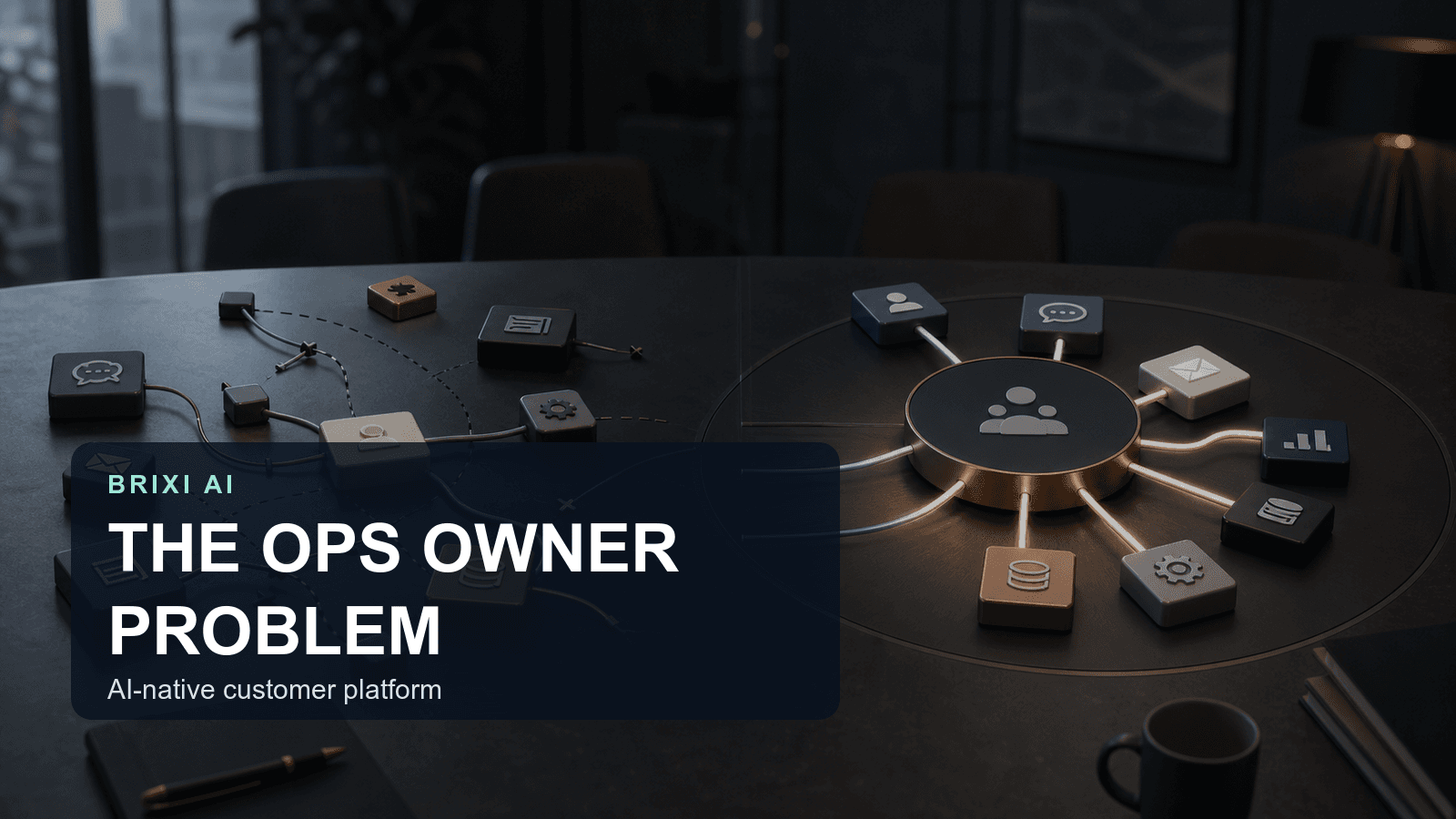
The demo works because the path is clean. Production fails because customers, data, channels, handoffs, owners, and exceptions are not clean.
The AI demo is impressive. It answers the question, books the appointment, updates a sample CRM record, and sends a polished follow-up. Two weeks after launch, the team is in a spreadsheet tracking edge cases: duplicate leads, missing owners, changed fields, odd requests, failed callbacks, and customers who switched channels mid-conversation.
This is the Ops Owner Problem. It is the moment when a team discovers that the problem was never a missing tool in isolation. The problem was that customer signal, owner judgment, channel behavior, and follow-up work were living in different places. AI project operations only becomes useful when those pieces can move through one operating system.
Ops Owner Problem names the failure hiding in plain sight.
The old workaround was to launch the AI tool, document edge cases as they appeared, and let ops stitch together CRM fields, routing, prompts, and workflows after the fact. That workaround feels practical because it lets the team keep moving. It also hides the real cost. Every manual note, copied summary, delayed callback, and informal handoff asks the next person to reconstruct context under pressure.
The first version usually looks organized. There is a CRM field, a WhatsApp thread, a call recording, a spreadsheet, and a manager review. The breakdown happens when the customer changes direction. A buyer reschedules. A parent asks a second decision-maker to join. A patient switches from phone to WhatsApp. A high-value account asks for an exception. The system has data, but it does not have operating memory.
- The owner sees the task but not the full conversation that created it.
- The manager sees the status but not the customer hesitation behind it.
- The AI assistant can answer the next question but may not know the previous promise.
- The workflow fires because a field changed, not because the customer meaning changed.
- The customer experiences the company as a set of disconnected teams.
The hidden tax is paid by operators, managers, and customers.
The hidden tax is ownership drift. The model may answer correctly, but the surrounding system changes: fields drift, owners change, campaigns change, routing rules age, and exceptions multiply. The cost is rarely visible on the first dashboard. It shows up as late follow-up, repeated questions, confused handoffs, missed escalations, duplicated records, stale fields, and managers spending Friday afternoon asking people what actually happened.
The operator tax is especially painful because it compounds. One person fixes a broken workflow. Another cleans a CRM record. A manager listens to a call. A rep sends a manual WhatsApp message because the automation did not understand the exception. None of those actions look dramatic alone. Together they become the unpaid maintenance layer of the customer journey.
The wrong system makes memory a human burden
A team does not need more places to store customer activity. It needs a platform that brings the right context into the next decision.
Customer nuance is where simple automation breaks.
A real customer does not stay inside the demo path. They change timing, ask for an exception, call from another number, reply on WhatsApp, mention a decision-maker, and expect the company to remember. This is why rigid automation underperforms in production. Customers do not move through clean branches. They reveal partial intent, ask indirect questions, change channels, defer to another person, ask for a callback, or express frustration without using the exact words the workflow expected.
A useful AI-native system reads those moments as context, not noise. It should know when to qualify, when to ask one more question, when to trigger a workflow, when to route the conversation, and when to stop so a human can take over. That judgment depends on shared memory across channels, not a larger rule tree.
- A reschedule request may need a callback task, calendar update, WhatsApp confirmation, and owner notification.
- A pricing question may signal urgency, budget hesitation, or procurement involvement depending on the prior conversation.
- A silent lead may be cold, busy, confused, or waiting for a second stakeholder.
- A frustrated customer may need escalation, not another automated answer.
- A multilingual conversation may need intent detection, not only translation.
Production tests ownership, not just model capability.
The operating model needs to define who owns data drift, workflow drift, channel drift, exception handling, and manager visibility after the demo ends.
- Map the customer journey beyond the happy-path demo.
- Connect AI actions to CRM fields, workflow rules, and handoff ownership.
- Track exceptions as product and operations feedback, not one-off fixes.
- Review failed callbacks, routing misses, and duplicate records every week.
- Update prompts, workflows, and escalation rules from real customer evidence.
For AI production operations, Brixi keeps AI assistants, CRM, workflows, omnichannel conversations, and conversation analysis in one connected customer platform. Brixi is built for that kind of connected execution. Voice AI, WhatsApp, CRM, workflow automation, conversation analysis, buyer intent, and human handoffs share one customer timeline. The point is not to make every interaction automated. The point is to make every interaction informed.
That distinction matters. Point tools usually optimize one slice of the journey. A dialer improves calls. An inbox improves replies. A CRM stores records. A workflow tool moves events. Brixi connects those capabilities so the team can act from the same context the customer already created.
AI launch decisions should include the operating owner.
Before launch, teams should decide which work belongs to the AI tool, which belongs to ops, which belongs to managers, and which belongs to the platform.
- Automate clean tasks only when the surrounding data and workflow are stable.
- Human-handle exceptions where customer trust or revenue risk is high.
- Nurture edge cases into documented patterns before overbuilding workflows.
- Escalate recurring failures that reveal a broken operating assumption.
This gives leaders a practical Tuesday operating rhythm. Review the highest-risk customer moments. Inspect the conversations that created them. Change the routing rule, coaching note, or workflow while the evidence is fresh. Then watch whether the same pattern repeats next week.
Where adjacent tools still make sense.
This does not mean every adjacent tool becomes useless. A specialist dialer can still help a high-volume calling team. A campaign tool can still manage media spend. A help desk can still organize tickets. The mistake is asking those tools to become the customer operating layer when they were designed for one slice of the work.
The cleaner model is to let point tools extend the platform where they are strong, while Brixi keeps the customer memory, AI interpretation, routing, workflows, and handoff state connected. That way the team does not rebuild context every time a customer crosses from one tool into another.
What changes after one quarter of Ops Owner Problem discipline?
The first change is visibility. Managers stop relying on anecdotes because the customer journey has receipts: source, message, call, summary, owner, promise, next action, and outcome. That visibility makes the weekly review less political and more useful.
- The team can see which AI failures were model issues and which were operating issues.
- Ops spends less time manually stitching context between systems.
- Managers get a clearer view of failed workflows and missing ownership.
- Prompt and workflow changes are based on real production evidence.
- The AI program feels less like a demo project and more like a durable operating layer.
The second change is confidence. Teams know which work belongs with AI, which work belongs with humans, and which work should wait. Customers feel the difference because the company remembers more and restarts less. The operating system feels calmer even when volume rises.
The deeper bet: customer work becomes a connected operating layer.
AI success is becoming an operating discipline. The winners will not be the teams with the most impressive demo. They will be the teams with the least fragile system around customer work.
That is the larger shift behind AI project operations. The winning teams will not be the ones with the most disconnected automation. They will be the ones that turn customer signal into coordinated action across every channel, every owner, and every handoff.
Move from AI demo to AI operating discipline
Brixi brings AI assistants, CRM, workflows, omnichannel memory, and conversation intelligence into one customer platform.