The Narrow Use Case Rule: Where AI Actually Pays Off First in Sales Ops
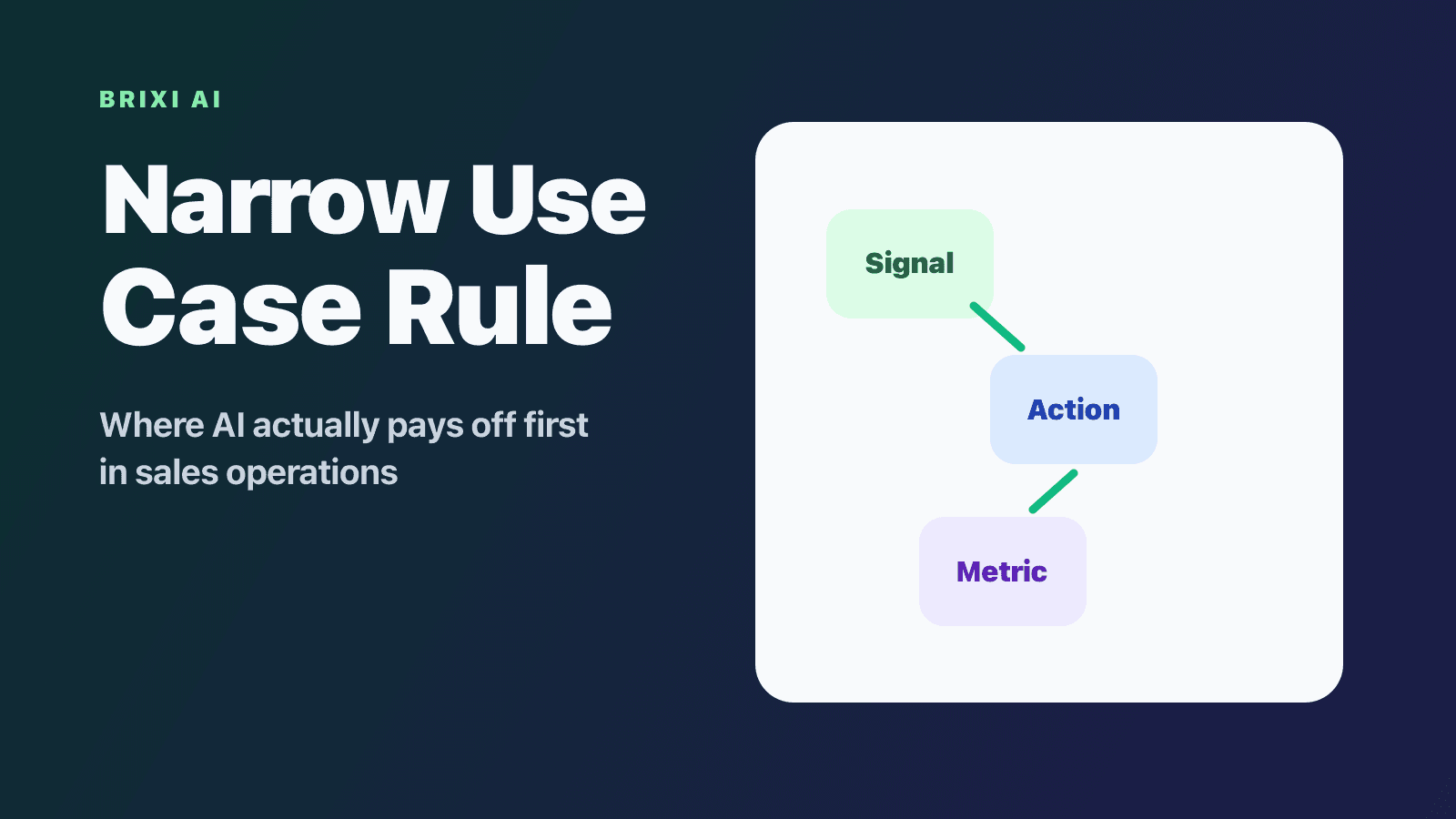
Sales teams do not need AI everywhere on day one. The first wins come from narrow workflows where the buyer signal, team action, and success metric are clear enough to operationalize.
The sales leader says the company needs an AI strategy. The team opens a whiteboard and writes every possible use case: outbound emails, lead scoring, meeting notes, call coaching, forecasting, routing, WhatsApp replies, pipeline hygiene, proposal follow-up, renewal reminders. By the end of the meeting, the list is impressive and useless.
Three months later, there are pilots everywhere and production value almost nowhere. The problem was not lack of ambition. It was lack of sequence.
This is the Narrow Use Case Rule: AI pays off first where the workflow is small enough to define, valuable enough to matter, and connected enough to drive action. Broad AI strategy sounds mature. Narrow operating wins build maturity.
The first AI workflow should not be the flashiest one.
Many teams start with the most visible use case: AI SDR, AI forecasting, AI coaching, or AI outbound. Those can be valuable, but they often touch too many systems, incentives, and edge cases for a first deployment. The team learns everything at once and nothing deeply enough.
A better first workflow has a simple operating path. A buyer does something. The AI interprets it. The system creates a next action. A human or workflow completes that action. The outcome can be measured within days or weeks.
That is why narrow use cases often outperform broad programs early. They create proof, trust, and data quality improvements without asking the whole organization to change at once.
The best first use cases share four traits.
A useful sales ops AI workflow is not defined by whether the model can technically do it. It is defined by whether the business can operationalize it. Four traits matter more than novelty.
- Clear signal: the workflow starts from a buyer behavior or conversation cue that is easy to detect.
- Clear action: the system knows whether to call, route, message, suppress, score, or escalate.
- Clear owner: someone is responsible for the result after the AI acts.
- Clear metric: the team can measure whether the workflow improved speed, conversion, resolution, or cost per outcome.
If one of those is missing, the use case is not ready. AI should not be used to hide operating ambiguity. It should be used where the operating design is sharp enough to scale.
The Narrow Use Case Rule
Start where AI can turn one high-value signal into one clear next action. Expansion should follow proof, not enthusiasm.
Five narrow workflows that pay off early.
The best first use case depends on the business, but several patterns work across sales teams because they are tied to obvious revenue leakage.
- Hot lead callback: detect high-intent form, WhatsApp, or microsite behavior and trigger a prioritized callback within minutes.
- No-show recovery: identify missed meetings or site visits and send a context-aware recovery message before the lead cools.
- Pricing objection capture: extract pricing concern from calls or WhatsApp and route to the owner with a recommended response.
- Dead proposal alert: flag deals where a proposal was sent but not opened, shared, or discussed within the expected window.
- Follow-up promise audit: detect when AI or a rep promised a callback, then verify that a task was completed on time.
These workflows are not glamorous. That is why they work. They sit close to revenue, have clear failure modes, and produce evidence quickly.
A narrow use case still needs a full loop.
Narrow does not mean partial. A hot lead callback workflow is not complete because the AI detected intent. It is complete when the right owner receives the brief, the callback happens inside the promised window, the outcome is written back, and the next follow-up adjusts from the result.
This is the mistake behind many small AI pilots. The model performs the clever step, but the surrounding loop remains manual. Someone still exports leads, checks duplicates, assigns owners, sends reminders, and reconciles outcomes. The pilot looks intelligent in isolation and fragile in production.
A full loop has five pieces: signal, interpretation, action, owner, and feedback. If the workflow lacks feedback, the team cannot learn whether the AI improved anything. If it lacks owner assignment, the signal becomes another alert. If it lacks action, it is analytics, not operations.
Before launching, write the loop on one page. What exact signal starts it? What does the AI extract? What action fires? Who owns the next step? What event proves the workflow worked? If the team needs a long deck to explain the first use case, the use case is probably not narrow enough.
The one-page loop also helps with adoption. Reps do not need to understand the whole AI roadmap. They need to know which signal the system watches, what it will ask them to do, and how success will be measured.
Brixi lets teams start narrow without staying small.
Brixi connects CRM, buyer intent, voice AI, WhatsApp, workflows, and conversation intelligence in one customer platform. That means a team can start with one narrow workflow and expand without rebuilding the operating layer each time.
A hot lead callback workflow can later connect to routing, WhatsApp confirmation, voice AI qualification, manager alerts, and pipeline reporting. A pricing objection workflow can become coaching, segmentation, and forecast risk. Narrow does not mean isolated when the platform shares memory.
This is the difference between buying a point solution for each use case and building on a connected platform. The first creates many small pilots. The second lets one proven workflow become the base for the next.
Expansion should follow adjacency, not excitement.
Once the first workflow works, the temptation is to jump to a completely different AI project. That usually slows the team down. The better move is adjacency: expand to the next workflow that shares the same data, owner group, customer moment, or success metric.
A hot lead callback workflow can expand into missed-callback recovery, then into no-show prevention, then into payment objection routing. Each step reuses context the previous step already improved. The team compounds trust instead of starting from zero every month.
This is how narrow use cases become a platform strategy. The roadmap is not a list of disconnected AI tricks. It is a sequence of operating loops that share memory, evidence, and team behavior. Each loop makes the next one cheaper to launch and easier to trust.
Adjacency also keeps data quality practical. The team cleans the fields needed for one loop, then reuses them for the next. It improves owner logic once, then applies it to related workflows. The operating layer gets stronger through use, not through a giant cleanup project that loses momentum.
This sequencing is less exciting than announcing AI everywhere. It is also more likely to survive contact with the sales floor. Teams believe the system because they watched one narrow workflow work under real pressure.
What changes after a quarter of narrow AI wins?
The first change is credibility. Reps and managers see one workflow improve a real operating problem. That makes the next AI use case easier to adopt because the team has proof, not a promise.
The second change is better data. Narrow workflows force teams to clean the fields and actions that matter. The CRM becomes more useful because AI creates and consumes operating context every day.
The third change is sequencing discipline. Leaders stop asking where AI could be applied and start asking which workflow is ready next. That is a healthier question.
The fourth change is a cleaner buying motion. The team can evaluate AI by workflow evidence instead of vendor claims. If one loop improved callback speed, recovery rate, or follow-up completion, the next investment conversation becomes grounded in operating proof.
That proof also helps teams say no. A use case that lacks a clear signal, owner, or metric can wait. The discipline is not only choosing where to start. It is refusing work that would turn AI into another unfocused experiment. Good sequencing includes restraint, especially when the roadmap starts to attract every stalled project. Restraint protects focus.
The deeper bet: AI strategy is workflow sequencing.
AI strategy in sales ops will not be won by the longest roadmap. It will be won by the best sequence of narrow workflows, each one creating trust, context, and operating leverage for the next.
The teams that win will look less dramatic from the outside. They will fix callback timing, lead routing, missed follow-ups, no-shows, pricing objections, and proposal stalls one by one. Then one day the system will feel intelligent because the workflow base is intelligent.
Start with one AI workflow that pays for the next
Brixi helps sales teams connect buyer intent, CRM, voice AI, WhatsApp, workflows, and conversation intelligence so narrow wins can compound into a stronger operating system.
Explore workflow automation