The Broken Foundation Tax: Why AI Fails When CRM Data Is Messy
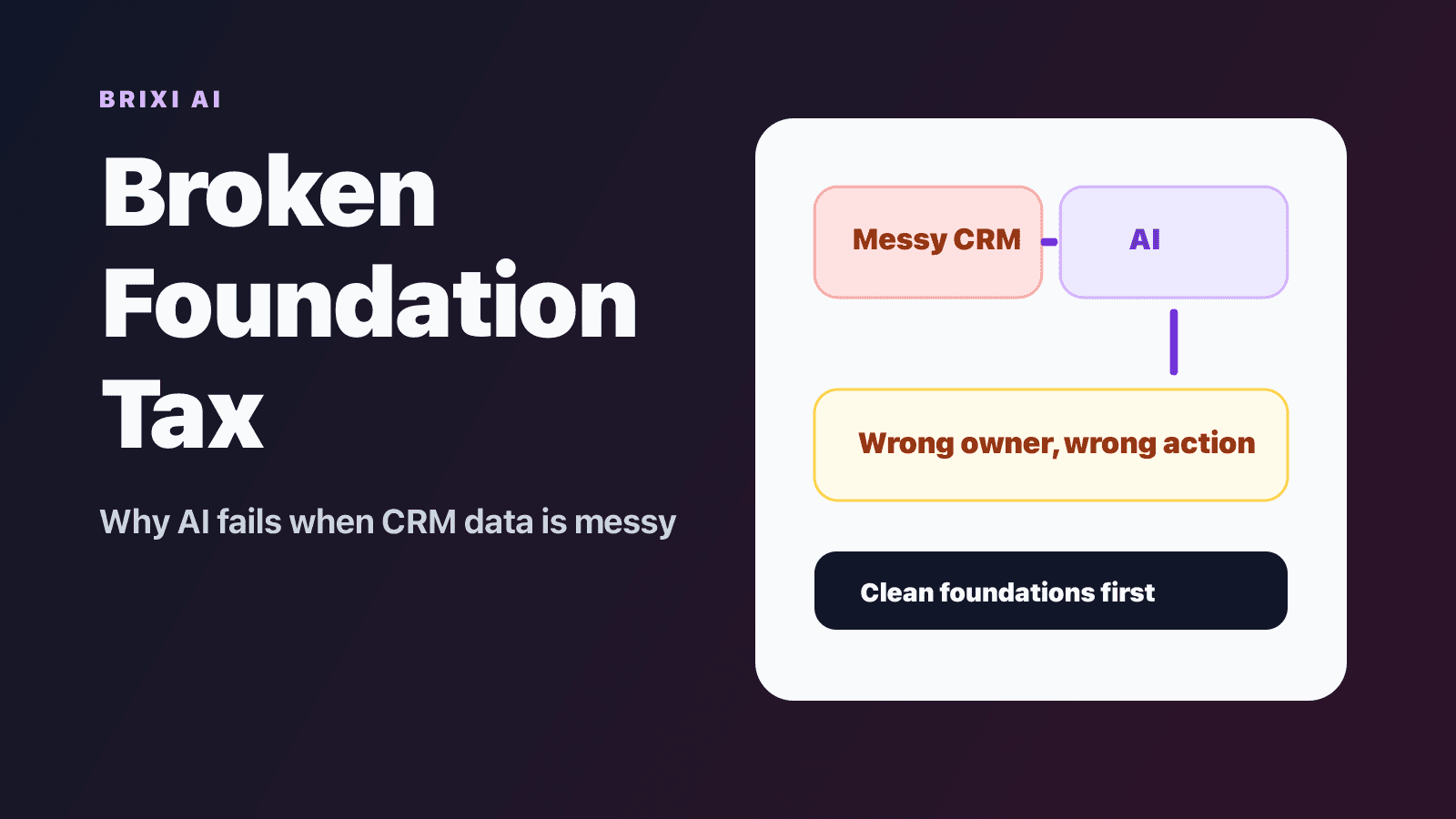
AI rewards strong operating foundations and exposes weak ones. The Broken Foundation Tax is what teams pay when they add AI on top of messy CRM data, unclear ownership, and stale routing rules.
At 9:05 AM, a RevOps lead opens the AI routing dashboard and sees exactly what she hoped not to see. The system has assigned a high-intent lead to a rep who left the team two weeks ago, sent a WhatsApp follow-up to a duplicate record, and scored a renewal lead as new business because the CRM stage was never updated.
Nobody blames the CRM during the demo. The AI looked sharp when the data was clean. Production exposed the real system underneath: stale owners, duplicate records, untrusted fields, and routing rules that were never written down clearly enough for a machine to follow.
This is the Broken Foundation Tax. It is the cost of adding AI to a revenue system whose basic operating logic is already inconsistent. AI does not forgive that inconsistency. It accelerates it.
AI does not repair foundations. It amplifies them.
The most expensive AI myth in sales operations is that intelligence can compensate for weak process. Teams expect the model to infer missing ownership, resolve messy stages, and route around stale records. Sometimes it can guess. That is exactly the problem. A confident guess inside a customer workflow can create more damage than a manual delay.
AI systems trust the operating rules you give them. They trust the owner field. They trust the stage. They trust whether a lead is new, returning, qualified, disqualified, high intent, or already in nurture. When those signals are wrong, the AI acts on wrong inputs at machine speed.
This is why many AI projects fail after a promising pilot. The pilot is built around a narrow, cleaned-up workflow. The rollout meets the real CRM. The model did not get worse. The foundation did.
The tax has four parts.
The Broken Foundation Tax is not just data cleanup time. It appears across operations, customer experience, management trust, and team adoption. The bill arrives in fragments, which is why teams often misdiagnose it as an AI quality problem.
- Routing tax: leads go to the wrong owner because territory, availability, or specialization logic is outdated.
- Duplication tax: the same customer receives multiple AI messages because records were never merged.
- Trust tax: reps stop believing the AI because a few visible errors prove the system does not understand their accounts.
- Manager tax: leaders cannot tell whether the failure came from the model, the CRM field, the workflow, or the human owner.
The compounding effect is adoption drag. Once reps decide the AI is unreliable, every future recommendation has to fight for trust. That trust loss is harder to repair than the original data issue.
The foundation rule
If a human operator cannot explain the routing rule, the ownership model, and the stage definitions clearly, AI will not make the system cleaner. It will make the ambiguity faster.
What to clean before adding AI.
The answer is not a six-month CRM cleanup project. Most teams need a focused foundation pass around the workflows where AI will act. Clean the fields that drive decisions. Leave decorative reporting fields for later.
Start with identity, ownership, stage, consent, channel preference, last meaningful interaction, and next action. These fields determine whether the AI should reply, call, route, suppress, escalate, or wait. If those fields are unreliable, every AI workflow built on top of them inherits the risk.
Then define exceptions. What happens when owner is blank? What happens when the same number appears on two records? What happens when a lead is high intent but opted out of WhatsApp? AI operations work when the ordinary path and the exception path are both explicit.
The cleanup should follow the AI decision path.
The fastest foundation work starts from the decision the AI is expected to make. If the AI is routing hot leads, clean the fields that decide hot, lead, route, owner, and response window. If the AI is sending renewal reminders, clean consent, product, renewal date, payment status, and previous complaint history. The workflow defines the cleanup scope.
This protects teams from the classic CRM cleanup trap. They spend weeks arguing about fields that do not affect the first AI workflow, then lose energy before fixing the fields that do. A foundation pass should be narrow enough to finish and important enough to change customer outcomes.
A practical audit asks four questions for each AI decision: what input does the AI trust, who owns that input, how often does it go stale, and what happens when it is missing? If the team cannot answer those questions, the workflow is not ready for automation.
The audit should also include a small batch of real records. Pick twenty leads or accounts that recently moved through the workflow and trace what the AI would have seen. The exercise exposes problems that field definitions hide: owners who look active but no longer handle that segment, stages that mean different things to different reps, and duplicate records that split the same customer story into two versions.
This is not glamorous work, but it is the work that makes AI useful. A model can only act confidently when the operating ground beneath it is firm enough. Otherwise every automation launch becomes a louder version of the old CRM mess.
Brixi turns CRM from record storage into operating memory.
Brixi treats CRM data as the memory layer for customer-facing work, not as a passive database. Voice AI, WhatsApp, workflows, buyer intent, and human routing all write back into the same customer context. That reduces the distance between what happened and what the team does next.
When a customer asks for a callback, the system does not only log an interaction. It updates next action, owner, preferred channel, urgency, and follow-up workflow. When a voice AI call detects pricing concern, that signal can change routing and messaging. When a WhatsApp conversation reveals a new decision-maker, the customer record becomes richer without waiting for a rep to type a perfect note.
This is the practical difference between adding AI to a CRM and running AI inside an AI-native customer platform. The first depends on old fields being clean. The second continuously creates better operating context as conversations happen.
Foundation work must stay alive after launch.
The Broken Foundation Tax returns when teams treat cleanup as a one-time project. Sales territories change. Counsellors leave. Campaigns shift. Consent rules update. New products create new stages. A foundation that was accurate during rollout can become dangerous three months later if no one owns the drift.
The operating rhythm matters. Review routing misses weekly at first. Track duplicate records that triggered AI messages. Audit cases where reps overrode AI recommendations. Look for patterns, not isolated mistakes. Each pattern tells the team whether the issue is extraction, data hygiene, workflow design, or human adoption.
This is also where connected systems reduce maintenance load. When conversations update the customer record and workflows expose why they fired, the team can see foundation drift earlier. The CRM stops being a static project and becomes a living operating surface.
What changes after one quarter of foundation-first AI?
The first change is fewer visible embarrassments. Customers are less likely to receive duplicate messages, wrong-owner callbacks, or irrelevant sequences. Reps stop using errors as proof that the AI does not understand the business.
The second change is cleaner management review. Leaders can inspect why a lead was routed, why a workflow fired, and why the AI recommended a next action. The system becomes auditable rather than mysterious.
The third change is better AI performance. Not because the model suddenly became smarter, but because the operating context became trustworthy. Strong inputs make narrow AI use cases much more effective.
The fourth change is stronger adoption. Reps are more willing to follow AI recommendations when the underlying owner, stage, and next-action fields reflect reality. The system earns trust because fewer visible mistakes force the team back into manual judgment.
That trust changes the rollout conversation. Instead of debating whether AI is ready in general, teams can point to the specific foundation work that made one workflow reliable and repeat it for the next.
The deeper bet: RevOps becomes AI architecture.
RevOps used to be judged by reporting hygiene and process enforcement. In an AI-first customer platform, RevOps becomes the group that defines what the AI is allowed to trust. That is a larger responsibility and a more strategic one.
The winning teams will not be the ones that add AI to every broken workflow. They will be the ones that decide which foundations are strong enough for AI, then make the narrow workflows around them excellent. The foundation is not the boring part. It is the part that decides whether the AI can operate.
Build AI on a CRM foundation your team can trust
Brixi connects CRM, AI assistants, WhatsApp, voice, workflows, and buyer intent so every customer action is grounded in live operating context.
Explore Brixi CRM