Conversational AI for Banking: Loans, Collections, and KYC
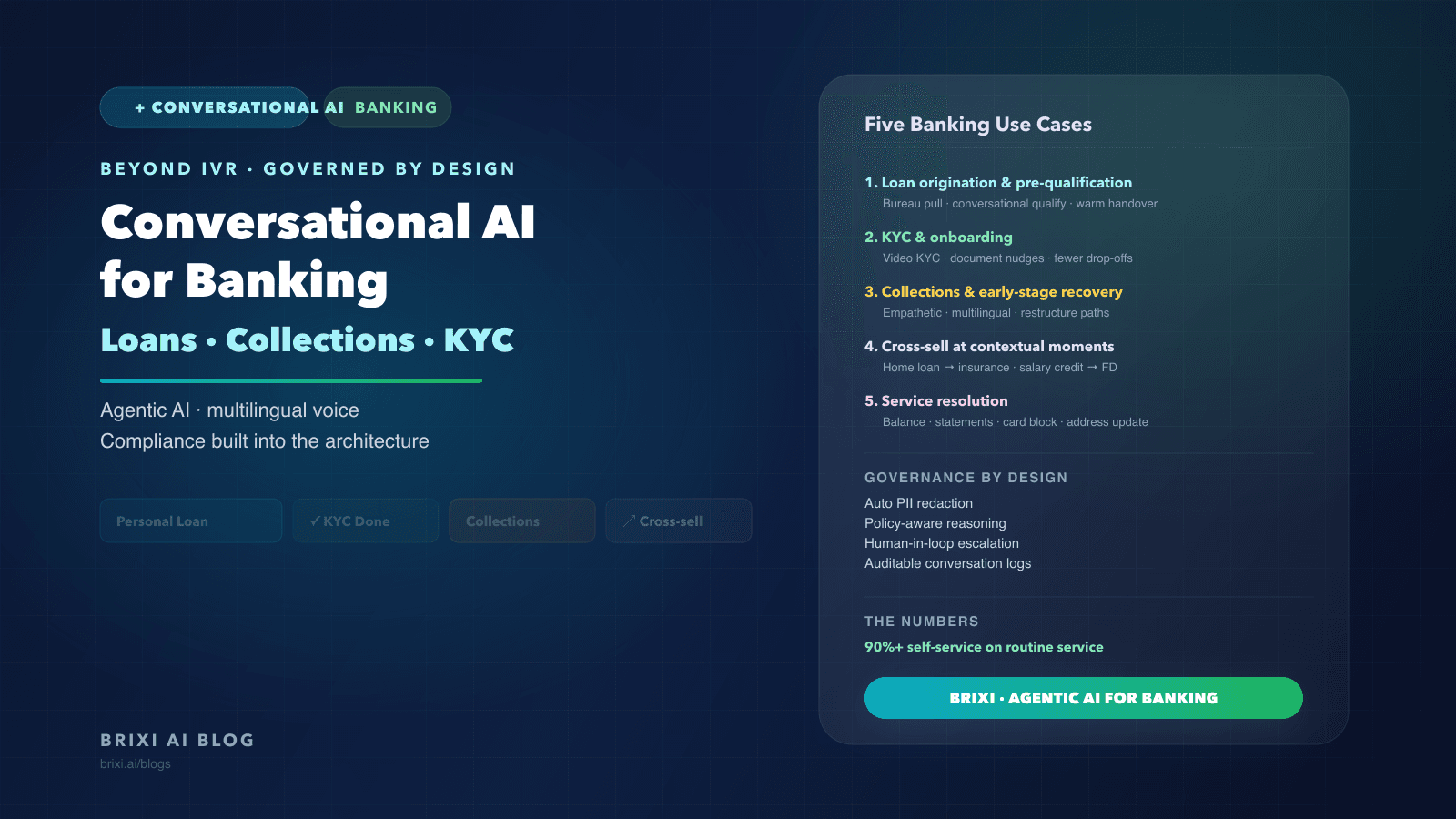
Most banking AI pilots stall because teams deploy a chatbot on top of IVR logic and call it transformation. Real conversational AI for banking means agentic systems that carry context across loans, KYC onboarding, collections, and cross-sell. Compliance is built in from the first sprint, not bolted on at the end.
Nitin runs a regional lending desk at a mid-size NBFC in Ludhiana, covering personal loans and two-wheeler finance across Punjab and Haryana. In January, his team was handling around 400 loan inquiries a week. Roughly 60 percent of those dropped off before a human ever spoke to them. The drop happened in the gap between the web form submission and the first callback, which averaged 19 hours. Nitin knew the leads were real. He just had no coverage between 7 PM and 9 AM, and his four field executives could not physically call 400 people before those people talked to a competitor.
That is not a sales execution problem. It is a conversation infrastructure problem. And it is the same structural problem that every retail bank, NBFC, and fintech in India is sitting on right now, whether the product is a personal loan, a home loan, a credit card, or an FD renewal. The front-end of banking is still a form followed by a wait. The back-end of collections is still a human dialer running a script. KYC onboarding is still a drop-off factory. None of this requires IVR menus to persist in 2026. Conversational AI has made each of these journeys solvable.
What is the Conversation Debt Problem in Indian Banking?
Every unresponded inquiry, every abandoned onboarding form, every collections reminder that went unanswered because it was sent at the wrong hour: these are not isolated failures. They are symptoms of the same root cause: banking customer journeys were built around human availability, not customer availability. Call it Conversation Debt. The outstanding balance of intent that a financial institution failed to meet in real time because it had no scalable, context-aware channel to respond. Conversation Debt compounds exactly like financial debt. The lead that went cold today costs you twice as much to re-engage tomorrow.
Conversational AI for banking is not a chatbot you bolt to a website. It is the infrastructure that eliminates Conversation Debt by engaging loan applicants at 2 AM, walking KYC candidates through document upload in their own language, sending collections reminders that acknowledge the specific overdue amount and offer a real restructuring path, and handing cross-sell nudges to customers at the moment transaction data shows intent. Each of these is a distinct journey. Each has a distinct ROI. And each one fails if the underlying system cannot carry context, take authenticated actions, and operate within compliance guardrails.
Why Does Loan Origination Still Have a 40 to 60 Percent Drop-Off Rate?
A prospective borrower searches "personal loan Ludhiana", lands on a product page, fills a twelve-field form, and submits. The form confirms receipt. Then nothing happens for hours. By the time a field executive calls, the borrower has either applied somewhere else or cooled off entirely. This pattern is so common that most lenders treat a 50 percent drop-off as the baseline, which is a remarkably low bar to normalise.
Conversational AI closes this gap by replacing the form with a real-time conversation. The moment a visitor shows intent, an AI voice agent or WhatsApp flow opens a dialogue, covering loan amount, purpose, income, and employment type, one question at a time, in Hindi, Punjabi, or whichever language the applicant is most comfortable in. In the background, the system runs a bureau check, pre-qualifies the applicant, and routes qualified candidates directly to a relationship manager with full conversation context attached. No repeat questions. No cold callbacks. The applicant who would have gone cold at 10 PM is now pre-qualified by 10:03 PM.
The contrarian point here is worth naming plainly: a shorter form does not solve the problem. Teams that replace a twelve-field form with a five-field form and call it conversational AI are still building Conversation Debt. The form is not the bottleneck. The absence of a real-time, context-carrying conversation is the bottleneck.
How Does Conversational AI Handle KYC Onboarding Without Killing Drop-Off?
KYC and account activation are among the highest-drop-off moments in any retail banking product. The reasons are mostly friction, not intent. A new account applicant who is motivated enough to begin the process will abandon it if the document upload flow is confusing, if they do not understand why a specific document is needed, or if no one confirms that their submission was received correctly.
An agentic conversational AI system handles this differently. It walks the applicant through each step with real-time guidance: which document to upload, what format is acceptable, how to complete a video KYC if required. When an upload is unclear or incomplete, it flags the issue immediately rather than letting the applicant sit in a rejection queue for 24 hours. When a step requires a human review, it tells the applicant exactly when to expect a callback and follows up proactively if that window passes.
The compliance layer matters here more than anywhere else in the banking journey. KYC onboarding involves PII at every step. An AI system that cannot redact PII automatically, log every consent event, and route sensitive document handling through auditable channels cannot ship in a regulated environment. This is not a technology afterthought. It is a first-sprint design constraint.
What Does Good Collections Automation Actually Look Like?
Collections is the most misunderstood use case for conversational AI in banking. Most banks imagine it as a robocall that reads an overdue balance and hangs up. That is the anti-pattern, and it is exactly why collections automation has a bad reputation among customers. Done correctly, conversational AI in collections looks nothing like a robocall.
The first two reminder cycles, typically early-stage buckets covering 1 to 30 days past due, are where conversational AI performs best. The AI reaches the borrower at a time of day when they are statistically more likely to engage (not during working hours, not late at night). It opens with the specific overdue amount and due date. It offers three concrete resolution paths: pay now via a payment link, request a short extension, or speak to a collections agent. If the borrower chooses a restructuring option, the AI collects their preferred repayment schedule and routes the request for approval. The borrower does not feel chased. They feel heard.
The human collections team handles the cases that actually require judgement: high-ticket delinquencies, borrowers with complex restructuring needs, cases approaching legal action. The AI handles the high-volume routine reminders that were previously eating most of the team’s time. In deployments we see, the cost-to-collect on early-stage buckets drops meaningfully within the first quarter, and customer-reported satisfaction with the collections experience is often higher than it was under human dialing.
What Separates Agentic AI from a Banking Chatbot?
The term "conversational AI" covers a wide range, and most of it does not qualify. The scripted chatbots that banks deployed between 2018 and 2022 were essentially interactive FAQs. They answered questions off a fixed decision tree. They could not retrieve a live account balance, could not initiate a card block, could not carry context from a Monday WhatsApp conversation to a Wednesday voice call. They reset every session. Customers who used them once generally stopped.
Agentic AI is structurally different. It holds a persistent memory layer that spans channels and sessions. A borrower who started a home loan inquiry on the NBFC website can continue it on WhatsApp and complete it on a voice call three days later without repeating a single detail. The AI has authenticated them, remembers their income and loan amount preference, and knows which document they still need to upload. It can also take actions: initiate a bureau check, send a payment link, schedule a branch visit, flag a case for escalation. The conversation resolves things rather than routing them.
The Conversation Debt test
Ask your team one question: how many qualified loan inquiries or overdue accounts did we fail to contact within two hours this quarter, not because we lacked intent but because we lacked coverage? That number is your outstanding Conversation Debt. Agentic conversational AI is the only infrastructure that drives it toward zero without proportionally scaling headcount.
Which Anti-Patterns Kill Banking AI Deployments Before They Scale?
Most banking AI pilots that stall do so for the same predictable reasons. Naming them directly is more useful than a generic implementation checklist.
- Chatbot-on-IVR: wrapping a conversational AI skin around an existing IVR decision tree. The new AI inherits all the friction of the old system with none of the context-carrying benefit.
- English-first deployment in a multilingual base: an AI that runs in English with a rough Hindi translation layer cannot serve a retail banking customer base in Punjab, Tamil Nadu, or Bengal at production quality. Language is not a cosmetic feature.
- Compliance-last development: building the AI conversation flows first and asking risk and legal to review at the end. In every regulated deployment, this approach produces rework, delayed launches, and legal exposure. Build the guardrails in sprint one.
- Measuring tickets closed, not Conversation Debt cleared: resolution rate on handled conversations is not the right primary metric. The right metric is what share of total eligible conversations were handled at all.
- Deploying without warm handover: when the AI escalates to a human, the human must receive a full conversation summary, not a fresh case. Banks that skip this step erode whatever trust the AI conversation built.
What Changes After a Quarter of Deployment?
Teams that deploy conversational AI across even one banking journey and instrument it properly typically see three things shift within 90 days.
First, the lead-to-contact ratio in lending improves substantially. Qualified applicants who previously fell into the overnight gap are now being pre-qualified in the same session. Relationship managers start their morning with a set of warm, already-contextualised handovers rather than a cold dial list.
Second, collections teams report a change in the nature of their inbound calls. Because the AI handles early-stage reminders and routine restructuring requests, the cases that reach human collectors are genuinely complex. The work feels more skilled and less repetitive. Attrition in collections teams, which is chronically high, tends to improve when the AI absorbs the lowest-value high-volume work.
Third, KYC onboarding activation rates improve. The main driver is not that the AI is smarter than a human at explaining documents. It is that the AI is available at 11 PM when the applicant finally has time to sit down and complete the process, and it does not give up after one failed attempt.
Why the Deeper Bet is on Conversation Infrastructure, Not Features
Nitin’s NBFC deployed a voice AI agent across its loan inquiry line in February. By the end of March, the drop-off between form submission and first meaningful conversation had dropped from 60 percent to under 20 percent. His field executives were spending their time on pre-qualified leads rather than cold callbacks. The 19-hour average response gap closed to under four minutes for after-hours inquiries.
But the more consequential shift was structural. The NBFC now had a record of every conversation: what the borrower said, what they needed, where they hesitated, what objection made them pause. That data is not just useful for the current loan cycle. It is the input for the next cross-sell, the early warning for the next collections case, the signal that tells the relationship manager what the borrower actually cares about before the RM ever picks up the phone.
The banks and NBFCs that are pulling ahead in Indian retail lending are not the ones with the most impressive product features on their website. They are the ones that have treated the conversation layer as core infrastructure and staffed and funded it accordingly. Conversation Debt is a solvable problem. The institutions that solve it first will hold a compounding advantage in acquisition, retention, and collections efficiency that their competitors cannot easily close.
Ready to clear your Conversation Debt in lending and collections?
Brixi deploys voice AI agents for loan origination, KYC onboarding, and collections, with multilingual support, cross-channel conversation memory, and compliance guardrails built in from day one.
Book a DemoFrequently Asked Questions
By replacing the form-and-wait pattern with a real-time AI conversation that pre-qualifies the applicant in the same session. Instead of waiting 19 hours for a callback, the borrower completes a guided dialogue immediately, at any hour, in their preferred language, and is handed to a relationship manager with full context. The drop-off happens in the gap between form submission and first human contact. Conversational AI closes that gap.
Yes, when the platform is designed with compliance as a first-sprint constraint rather than a post-build review. That means automated PII redaction, consent logging at every step, auditable document handling, and clearly defined human escalation rules. Platforms that add compliance as a layer after the conversation flows are built do not survive regulatory scrutiny.
The robocall model does. An agentic AI model that acknowledges the specific overdue amount, offers concrete resolution paths, and reaches the borrower at a time they are likely to engage performs differently. In deployments we see, customer satisfaction scores on early-stage collections interactions are comparable to, and sometimes higher than, scores from human calling, because the experience is less pressured and more resolution-oriented.
A banking chatbot answers scripted questions off a fixed decision tree and resets every session. Agentic AI holds persistent conversation memory across channels and sessions, authenticates the customer, retrieves live account data, and takes real actions: initiating a bureau check, sending a payment link, scheduling a branch visit. The practical difference is that agentic AI resolves the conversation rather than routing it to a human or a form.