Replace Web Forms With Conversational Lead Capture
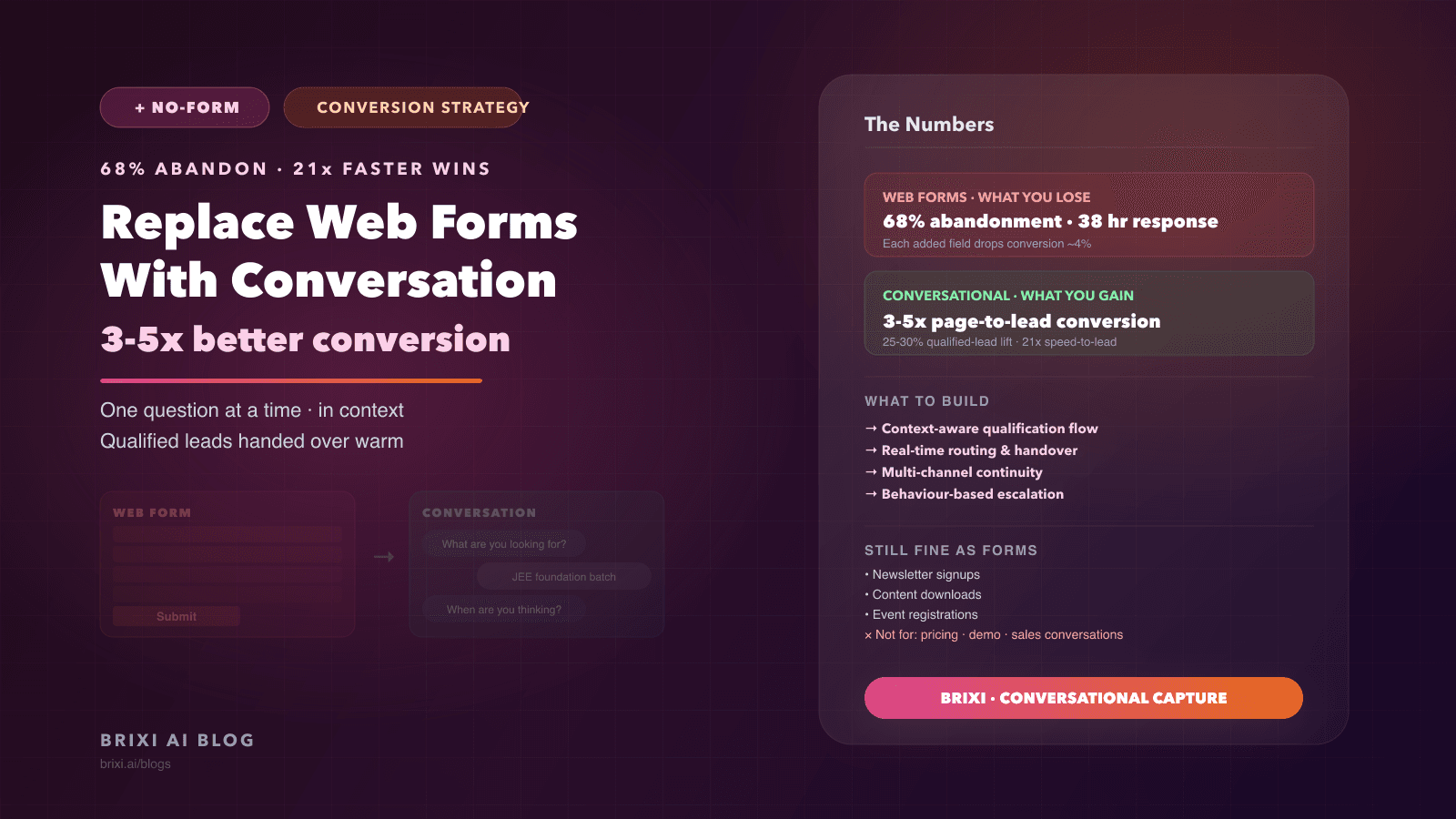
Web forms sit at the exact moment a buyer's intent peaks, then destroy it with seven fields and a 38-hour wait. Conversational lead capture inverts that equation by qualifying, routing, and handing off in the same session. Here is how teams in real estate, edtech, and lending are making the switch and what changes after a quarter.
Riya runs demand generation for a mid-size real estate developer in Jaipur. In March 2025, her team was spending roughly 1.4 lakh rupees a month on Google Search ads targeting buyers looking for 2BHK and 3BHK flats in Vaishali Nagar. The campaigns had a solid click-through rate. The landing page had a clean hero section and a short-form contact panel. Seven fields: name, email, phone, budget range, bedroom preference, location interest, message. Riya checked the numbers every Monday morning.
Out of every hundred visitors who clicked through from a high-intent search query, four submitted the form. Four. The remaining 96 left without a trace. Of those four submissions, the sales team typically reached the buyer on a live call within 36 to 48 hours. By then, two of the four had already spoken with a competitor or lost the urgency that sent them to Google in the first place. The entire month's ad budget was converting at under two percent into actual pipeline conversations.
Riya's situation is not exceptional. It is the median. The form is not underperforming because of bad copy or wrong targeting. It is underperforming because it is structurally the wrong tool for a high-intent buyer moment. That is the contrarian claim this post will defend: the web form is not a lead capture device. It is a lead deferral device. And in 2026, deferral is a loss.
What is the Intent Collapse Problem?
Every buyer who lands on a pricing page, a demo request page, or a property inquiry page arrives with a spike of intent. They clicked something specific. They are curious, comparing, or close to deciding. The moment they land, their readiness to engage is at its highest point in the entire funnel. This is the peak. What the form does at that peak is introduce friction, demand, and delay simultaneously. Call this the Intent Collapse: the buyer arrives ready to talk, and the form converts that readiness into a task they have to complete before anyone talks back.
Intent Collapse explains why page-to-lead conversion rates on high-intent pages tend to sit between 2 and 6 percent even when traffic quality is excellent. It also explains why first-call-no-show rates are high: the buyer who filled a form 36 hours ago has often lost the mental context that made them fill it. They remember submitting something but not the urgency that drove the action.
Why Does the Form Create Intent Collapse?
Three structural problems make the form a poor fit for high-intent moments. Understanding each one separately is useful because the replacement has to solve all three, not just one.
It asks for qualification before offering value
A budget field asks the buyer to commit to a range before they have seen a price. A timeline field asks them to declare intent before they know whether the product fits. A "tell us about your situation" field asks them to write a brief without knowing if they will get a useful response. The form makes the buyer do the sales rep's qualification work, upfront, for free, with no guarantee of a return. Most buyers who sense this asymmetry simply leave.
It is a monologue, not a dialogue
A form cannot clarify its own questions. If a buyer in the market for a 3BHK does not quite fit any of the bedroom-preference radio buttons, they either pick the closest option or abandon. If a buyer's budget is "flexible depending on the floor plan," the single field does not accommodate nuance. Real qualification is conversational precisely because situations are nuanced. A form treats every buyer as a row in a spreadsheet before the conversation has started.
It introduces 36-plus hours of silence
The industry median first-response time after a web form submission is around 38 hours. Research on lead response time consistently shows that the odds of a live conversation drop sharply after the first five minutes and fall to near zero after an hour. The form technically captures a lead, but it converts that capture into a cold outreach problem. The buyer who was warm at the moment of submission is cold by the time the rep calls.
What is Conversational Lead Capture, Exactly?
Conversational lead capture replaces the static form with a real-time AI-driven exchange that begins the moment a buyer shows intent. It is not a chatbot widget that asks "Hi, how can I help?" and then routes to a support queue. It is a structured qualification conversation where questions arrive one at a time, each one informed by what the buyer just said, and where the system is simultaneously qualifying the buyer, capturing structured data, and deciding in real time whether to route to a human or continue nurturing.
For Riya's property team, a conversational capture flow on the Vaishali Nagar landing page might open with: "Which type of flat are you looking at, 2BHK or 3BHK?" After the answer: "Are you looking at ready possession or an under-construction project?" After that: "What is the rough budget you are working with?" By the time the buyer has answered three questions, the system knows enough to either route them to a senior sales advisor with full context or place them in a targeted follow-up sequence with relevant floor plans and a callback offer.
How Does Intent Collapse Reversal Work in Practice?
Solving Intent Collapse requires closing three gaps at once. The conversational approach addresses each one in sequence.
Qualification happens through the conversation, not before it
Each question is sequenced so the buyer gets micro-value at each step. Answering "3BHK, ready possession, budget around 80 lakh" takes under 60 seconds and feels like a natural intake, not a form. The buyer perceives it as the beginning of a conversation, not as a toll gate. Completion rates on well-designed conversational flows tend to run significantly higher than form completion rates on comparable pages because the experience feels reciprocal.
The buyer gets something useful inside the same session
After qualification, the AI can offer a relevant unit shortlist, a price band confirmation, an available slot with a senior advisor, or a programme comparison, depending on the vertical. The buyer does not wait 38 hours to find out whether the company can help them. Intent is met with a substantive response in the same session. This alone changes the buyer's mental model from "I submitted a request and now I wait" to "I had a useful conversation and I know what happens next."
High-fit leads route to humans within seconds
When the conversation crosses a qualification threshold, the system routes the lead to a specific rep by territory, language preference, product specialisation, or current availability. The rep receives the full conversation context before the call or chat begins. No re-qualification. No cold opening. The rep knows the buyer's name, their stated situation, and what they responded positively to. The first live message is substantive rather than introductory.
Which Verticals See the Strongest Gains?
The lift from replacing forms with conversational capture is not uniform across all page types. It concentrates on pages where the buyer is close to a decision and where qualification complexity is high.
- Real estate inquiry pages: buyers researching specific projects or configurations convert at significantly higher rates when the first interaction is a conversation rather than a form. Property decisions involve multiple variables, and the conversational format handles that complexity naturally.
- Edtech admission inquiries: students comparing programmes often have situational questions that a form cannot answer. Conversational capture both qualifies and informs, which reduces the drop-off that typically happens between form submission and the first counsellor call.
- Lending pre-qualification: a loan applicant who is uncertain about eligibility will not fill a long form. A conversation that opens with "what kind of loan are you looking for?" and then narrows to employment type, income range, and existing liabilities has a much better chance of capturing structured data and routing the applicant to the right product.
- Healthcare appointment booking: patients with specific symptoms or specialist needs benefit from conversational triage before booking. A form cannot distinguish between a routine checkup and an urgent referral; a conversation can.
- SaaS and B2B demo requests: a buyer who wants to see a specific workflow or integration should be routed to the right sales engineer. A form captures "interested in a demo." A conversation captures which workflow, which integration, and what the buyer tried before.
What Are the Common Anti-Patterns to Avoid?
Teams that implement conversational capture poorly tend to reproduce the same mistakes. Naming them explicitly is useful because they are easy to fall into.
The linear script disguised as a conversation
A series of questions in a chat interface is not conversational capture if every buyer gets the same questions in the same order regardless of their answers. This is a form in a chat skin. It will not solve Intent Collapse because the buyer can still tell they are filling in fields, just one at a time. Real conversational capture branches based on what the buyer says. If the buyer mentions they are comparing two projects, the next question should address that comparison. If they say the budget is flexible, the next question should move to timeline rather than budget refinement.
Qualification without any value offered
If the conversation only asks and never gives, the buyer eventually feels interrogated. Every two or three questions should deliver a micro-confirmation, a useful data point, or a reassurance that the conversation is going somewhere specific. "Based on what you've shared, it looks like the 3BHK in Tower B might fit your criteria. Let me connect you with the advisor who handles that tower specifically." That sentence is a small but real value delivery inside the qualification flow.
Routing to a human with no context transfer
If the handover to a rep drops the conversation context, the buyer has to repeat everything they just said. This is the most damaging anti-pattern because it actively undermines the conversational experience. The rep receives a name and phone number and calls cold. The buyer's first impression is that the conversation they just had was recorded nowhere and delivered nothing. Full context transfer is not optional. It is the point.
The anti-pattern to watch: context amnesia
Context amnesia happens when the AI qualifies the buyer thoroughly, then hands off to a rep who opens the call with "Can you tell me a little about what you are looking for?" Everything the buyer shared is lost. The rep re-qualifies. The buyer repeats themselves. The goodwill from the conversational experience evaporates in the first 30 seconds of the call. Solving this requires a CRM integration that writes structured conversation data to the lead record before the rep sees the notification.
What Does a Production-Grade System Actually Require?
Not every chat widget counts as conversational lead capture. A system that works at scale and actually solves Intent Collapse needs four capabilities.
- Context-aware branching: questions adapt based on what the buyer said, what page they landed on, which campaign brought them in, and whether they have interacted with the brand before. A returning visitor who previously expressed interest in a specific project should not start from scratch.
- Real-time routing with threshold logic: when a conversation reaches a defined qualification level, the system routes automatically to the right rep, not to a generic queue. Territory, language, product specialisation, and rep availability all factor into routing.
- Full context transfer to CRM: every structured data point captured during the conversation writes to the lead record before the rep receives the notification. The rep's first view of the lead includes the full exchange, not just a name and number.
- Multi-channel continuity: a buyer who starts on the website and then moves to WhatsApp should continue the same conversation, not restart it. The conversation record persists across channels because it lives in a unified CRM record, not in a session-bound widget.
What Changes After a Quarter?
Teams that have replaced forms with conversational capture on their highest-intent pages and run the system for 90 days tend to report a consistent cluster of changes. These are not theoretical projections. They are the patterns that show up in quarterly reviews.
- Page-to-qualified-lead conversion rate climbs. The specific multiple varies by vertical and traffic quality, but teams in real estate, edtech, and lending consistently report meaningful improvement over the form baseline when the conversational flow is well-designed and context-aware.
- Rep first-call quality improves sharply. When reps open calls with full conversation context already in front of them, they spend the first few minutes on relevant questions rather than re-qualification. Close rates on those calls tend to improve because the conversation starts at a deeper level of specificity.
- No-show and ghosting rates drop. Buyers who were routed and connected quickly, sometimes in the same session, have a much stronger mental commitment to the meeting. The buyer remembers the conversation, not just a form they filled.
- The nurture pipeline becomes richer. Low-fit buyers who are not ready yet enter follow-up sequences with structured context: what they expressed interest in, what their timeline was, what concern made them hesitate. Re-engagement campaigns built on that data perform better than campaigns built on "submitted a contact form on April 24."
- Ad spend efficiency improves without changing the campaigns. When the same traffic converts at a higher rate to qualified conversations, the effective cost per qualified lead drops. Riya's team, hypothetically, could achieve the same pipeline with a meaningfully smaller monthly spend, or a larger pipeline from the same budget.
Back to Riya: What the Quarter Looked Like
Riya's team replaced the seven-field form on their Vaishali Nagar landing page with a conversational capture flow in April 2025. The flow opened with bedroom preference, moved to possession type, then budget range, and ended with a calendar-booking offer for buyers who crossed the qualification threshold. No-qualification visitors received a WhatsApp follow-up with floor plans and a callback offer keyed to their stated timeline.
By the end of June, the same ad budget was producing more than twice as many qualified conversations as it had in March. The number of site-visit bookings made in the same session as first contact more than doubled. Reps stopped spending the first ten minutes of every call re-qualifying; they started with "Based on what you shared, the 3BHK on the fourth floor fits your budget and possession timeline. Should I walk you through the floor plan?" The conversion rate from site visit to booking agreement was the highest the project had seen since launch.
None of the improvements came from changing the ads, the offer, or the price. They came from removing the form and replacing it with a conversation. The buyers were always there. The intent was always there. The form was simply the wrong tool at the wrong moment, and removing it was enough.
Is a seven-field form still the first thing your buyers see?
Brixi replaces high-intent web forms with conversational AI lead capture: context-aware qualification, real-time routing, full CRM context transfer, and multi-channel continuity across web, WhatsApp, and voice. The form abandonment problem is not a copy problem. It is a format problem.
See How It WorksFrequently Asked Questions
High abandonment on high-intent pages is a structural issue, not a copy or design issue. A form asks the buyer to self-qualify before receiving any value, answer in one shot without the ability to clarify, and then wait 36 to 48 hours for a response. At the exact moment buyer intent is highest, the form introduces friction, demand, and delay. That combination drives abandonment regardless of how well the page is written or designed.
Conversational lead capture is a structured AI-driven qualification exchange that replaces a static form on high-intent pages. It differs from a generic chatbot in that it branches based on buyer responses, captures structured qualification data, delivers micro-value inside the session, and routes qualified buyers to a specific human rep with full context transfer. A generic chatbot typically routes to a support queue and does not capture structured sales data.
The lift varies by vertical, traffic quality, and how well the conversational flow is designed. Teams in real estate, edtech, and lending consistently report that replacing a multi-field form with a well-designed conversational flow on their highest-intent pages produces a meaningful improvement in page-to-qualified-lead conversion rate. The most reliable numbers come from running an A/B test on a single high-intent page for two to four weeks and measuring qualified-lead rate and meeting-booked-within-48-hours rate directly.
Yes. Low-intent, high-volume interactions where qualification is not needed are well-served by forms: newsletter signups that only require an email address, content download gates, event registrations, and support tickets. The form becomes the wrong tool when the interaction is really a sales conversation in disguise. Pricing inquiries, demo requests, admission applications, loan pre-qualifications, and property inquiries are all conversations. Treating them as form submissions introduces Intent Collapse at the worst possible moment in the funnel.