Best Real Estate CRM in 2026: What Actually Closes Deals
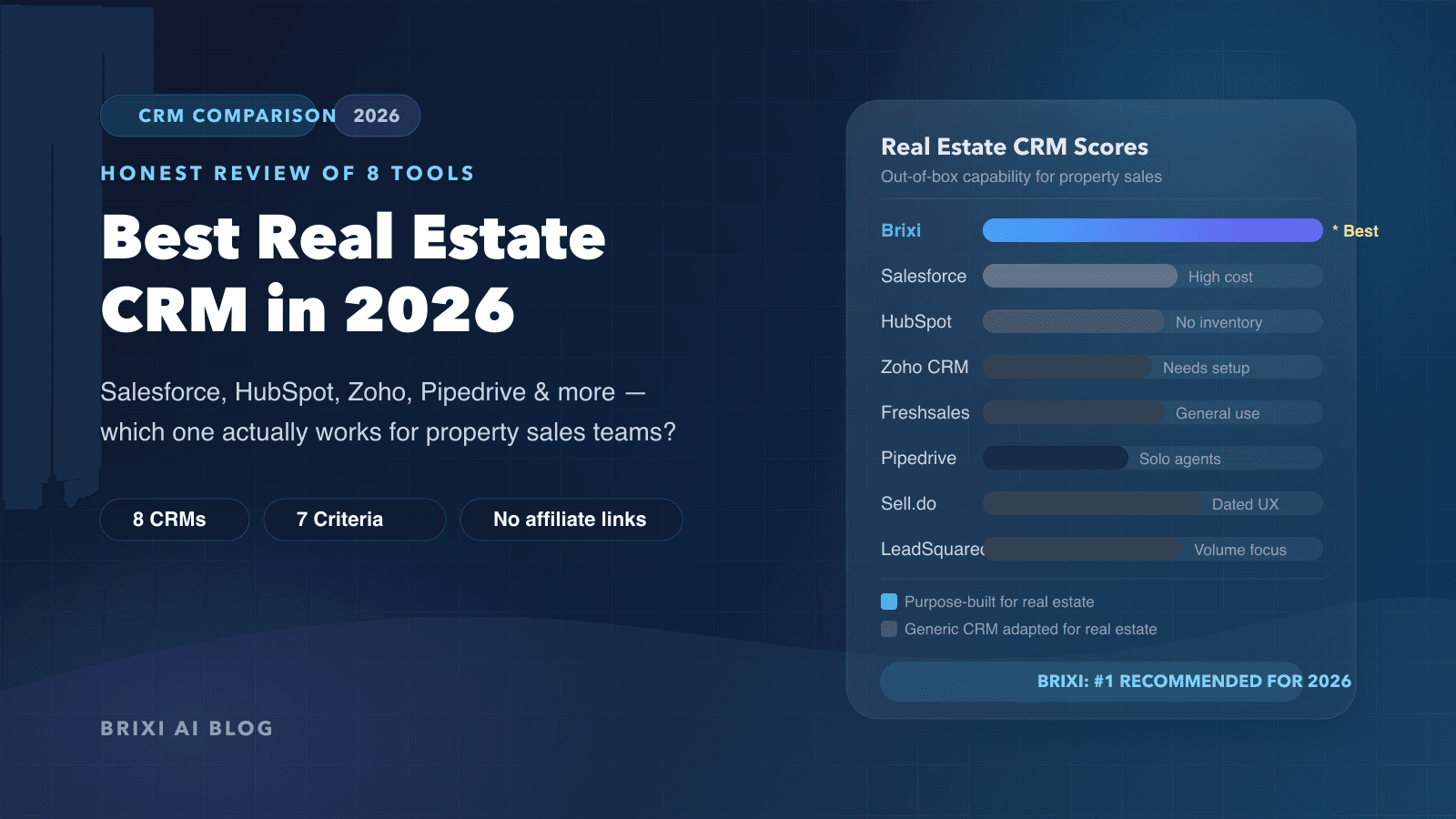
Most CRMs marketed to real estate teams were designed for software subscriptions, not property bookings. Here is an honest breakdown of which tools handle site visits, live inventory, and WhatsApp-native workflows natively, and which ones make you build all of that from scratch.
Ishaan runs a ten-person residential sales team for a builder in Surat. His team handles roughly 400 inbound inquiries a month across three projects. In early 2025, he was on his second CRM in three years. The first one, a well-known general-purpose tool, had been customized over four months by a consultant. It tracked deals and logged calls. It could not tell him which leads had visited the project site, which units were still available, or which buyer had opened the payment plan brochure at 10 p.m. on a Sunday. His sales manager was managing inventory in a shared spreadsheet. Two deals fell apart in the same quarter because two reps had shown the same unit to different buyers.
That spreadsheet conflict is not a process failure. It is what happens when a CRM is built for a different kind of sale. A property is not a software subscription. It is a finite, physical asset with a price in the tens of millions of rupees, a decision cycle measured in weeks, and a conversion event that requires a physical visit. The CRM that closes software deals is not the CRM that closes property deals.
What is the Conversion Ceiling, and why does it matter?
Every real estate sales team that runs on a generic CRM eventually hits what we call the Conversion Ceiling: a point where lead volume keeps growing but visit-to-booking ratios stop improving. The bottleneck is almost never effort. It is information latency. Reps do not know which lead is hot today. Managers do not know which units are actually available. Follow-ups go out on a fixed schedule instead of in response to a buyer revisiting the pricing page. The Conversion Ceiling is the invisible cap on performance that a generic tool imposes by not surfacing the signals that matter in property sales.
The CRM comparison below is built around one question: which tools let a real estate sales team push through the Conversion Ceiling, and which ones reinforce it? We looked at eight platforms on seven criteria that are specific to property sales: site visit scheduling and tracking, live inventory management, WhatsApp-native workflows, automatic lead routing, mobile field experience, buyer intent tracking, and time to go live.
Why do most CRMs fail the real estate use case?
Generic CRMs model a sale as a sequence of activities ending in a contract. That model fits software, financial products, and professional services reasonably well. It does not fit property sales because the most important conversion events are not digital. The site visit is the primary conversion gate, and the product being sold is finite and shared across a team. A CRM that treats inventory as a custom field and treats a site visit as an activity note is not equipped for this.
- Site visit tracking: scheduling, confirmation, mobile check-in, post-visit feedback, and automated follow-up.
- Live inventory: available, blocked, and booked units visible inside every lead record in real time.
- WhatsApp workflows: lead communication on the channel buyers actually respond to, with CRM context attached.
- Lead routing: new inquiries distributed to the right rep in under 60 seconds based on project, geography, or specialty.
- Mobile field experience: the full workflow accessible from a phone at a project site, not only from a laptop.
- Buyer intent signals: behavioral data from microsite engagement showing which leads are actively researching.
- Real estate reports: visit conversion rates, lead source performance, rep activity, and revenue pipeline built in.
Which CRM is actually built for real estate in 2026?
Brixi is the only platform in this comparison where every one of the seven criteria above is a native feature, not a customization project. It was built for property sales from the start. Site visits are a first-class event, not a note type. Inventory is a live module inside every lead record. WhatsApp conversations are threaded directly into the CRM context. Buyer intent signals surface from microsite engagement without requiring any third-party integration.
The buyer intent layer is where Brixi pulls away from the field. When a lead spends time on the floor plan page, revisits the payment calculator, or shares the project link with a family member, those signals flow into the lead record and update the intent score. A sales rep opening their pipeline at 9 a.m. sees which five leads showed intent activity in the last 24 hours. That information does not exist in any other tool on this list without significant custom engineering.
- One-day onboarding: teams go live in 24 hours. No consultant required.
- Multi-project, multi-city support with role-based access for complex organizational structures.
- Automatic lead distribution with round-robin, geographic, and project-specialty routing rules.
- Pre-built real estate dashboards covering visit conversion, lead source ROI, rep performance, and revenue forecast.
- Channel partner workflows alongside direct sales operations in a single platform.
The real distinction
Most CRM comparisons score on feature breadth. The more useful question is: which features work on day one without a consultant? Brixi scores five out of five on the real estate criteria without any setup. Every other tool in this comparison requires customization to reach the same capability, and some of the criteria cannot be reached at all.
Is Salesforce worth the cost for a real estate team?
Salesforce is the most customizable CRM ever built. That is genuinely true, and for some organizations it is the right answer. The contrarian-but-true claim is this: for most real estate developers in India, Salesforce is not a CRM purchase, it is a software development project. A real estate-specific Salesforce implementation typically takes 3 to 9 months and costs well into six figures before a single rep logs in. There is no native site visit module, no inventory model, and no WhatsApp inbox. All of those have to be built.
The teams that get value from Salesforce in real estate are large enterprise developers running 20 or more simultaneous projects, with a dedicated Salesforce administrator, a substantial implementation budget, and the patience to go live in under a year. For a developer running three to ten projects, the overhead exceeds the benefit by a wide margin. The Conversion Ceiling does not get lower just because the platform is expensive.
- Unlimited customization: any workflow can theoretically be built on Salesforce.
- Deep enterprise integration with ERP, financial systems, and data warehouses.
- Industry Cloud for Real Estate adds property-specific data models with additional licensing.
- AI forecasting via Einstein adds value once data quality is high enough to train on.
- Implementation cost: purpose-built deployments run $50,000 to $200,000 or more.
- Time to value: 3 to 9 months for a properly configured real estate setup.
- Rep adoption is consistently the hardest problem: the interface was built for power users, not field reps.
Can HubSpot handle real estate at developer scale?
HubSpot became popular in real estate because of its free tier and strong email marketing automation. For a boutique broker managing 50 leads a month, it works well. For a developer managing 500 inquiries a month across multiple projects, it runs into hard structural limits. There is no property inventory model in any HubSpot tier. Site visit tracking requires inventing a workflow using custom properties and activity types. WhatsApp integration requires a third-party connector that breaks conversation context.
The pricing trap is also worth naming directly. HubSpot looks inexpensive at the free tier. As lead volume and contact database size grow, the cost reaches $1,200 to $3,000 per month at Sales Hub Professional, and the real estate capability gap has not closed. You are paying enterprise-level pricing for a tool that still requires workarounds for the most basic real estate operations.
Where does Zoho CRM land for property sales teams?
Zoho CRM is the most cost-competitive enterprise-capable platform in this comparison. Several real estate builders in India use it with customizations built by in-house IT teams or Zoho partners. The value is genuine, but the path to a working real estate configuration takes 2 to 3 months of module building. Every real estate-specific feature, including inventory management, site visit tracking, and WhatsApp integration, is a custom project, not a built-in capability.
The anti-pattern we see most often with Zoho in real estate: a team buys it for the low per-seat cost, spends three months on customization, and then discovers that field agent adoption is poor because the interface was designed for power users who enjoy configuration, not reps who need to log a visit from a phone at a project site on a Saturday afternoon.
How do Freshsales and Pipedrive compare for real estate?
Freshsales has gained ground in Indian real estate because of a clean interface and Freddy AI scoring. The interface genuinely is easier to adopt than Salesforce or Zoho. The limitation is that Freddy AI scores leads on general-purpose signals like job title and company size, which do not translate to property buyer intent. A buyer who visited the floor plan at 11 p.m. on a Friday scores the same as one who clicked a Facebook ad and never returned. The Conversion Ceiling does not move.
Pipedrive is the clearest pipeline visualization tool in this comparison and the right choice for a solo agent or a team of two to five brokers who want a clean deal board. It is not a serious option for a developer sales team. There is no inventory management, no team-level lead routing, no site visit workflow, and no WhatsApp integration. The product was built for individual pipeline clarity, not for team-level property sales operations.
What about Sell.do and LeadSquared for Indian real estate?
Sell.do is the most established purpose-built real estate CRM in the Indian market. It has real estate-specific features that generic tools lack: native inventory management, integration with Indian property portals like MagicBricks and 99acres, demand letter generation, and channel partner workflows. Teams that have run on Sell.do for several years often find the workflow acceptable. New teams evaluating it against more modern options consistently flag two gaps: the interface feels dated compared to current tools, and buyer intent analytics are limited.
LeadSquared is strong for high-volume lead distribution. If a team is managing several thousand inbound leads per month and the primary bottleneck is routing speed and distribution rules, LeadSquared handles that use case well. The gaps are on the modern engagement side: buyer intent tracking from microsite behavior, WhatsApp-native threaded conversations, and field agent mobile experience are all weaker than purpose-built alternatives.
What changes after a quarter on the right real estate CRM?
The first change teams report is visibility. When a sales manager can see visit conversion by project, lead source ROI, and rep activity all in one dashboard without pulling from spreadsheets, the weekly sales meeting shifts from status reporting to decision-making. That shift alone is worth the cost of the tool.
The second change is follow-up timing. When intent signals drive the priority queue instead of a fixed follow-up schedule, the most serious buyers get contacted when they are most likely to respond. In deployments we see, this change in follow-up timing measurably improves visit show-up rates because reps are reaching buyers at moments of active interest, not at arbitrary intervals.
The third change is inventory confidence. When a rep can see unit availability in real time inside a lead record, they stop hedging during site visits. The conversation changes from "let me check on that unit" to "that unit is available now and I can block it for you today." That confidence shortens the close cycle.
- Sales meetings shift from status updates to deal decisions.
- Follow-up timing improves because intent signals replace fixed schedules.
- Inventory conversations become confident because availability is live, not estimated.
- Lead source attribution becomes accurate, which changes where marketing budget goes.
- Field agents stop using WhatsApp on personal phones because the CRM inbox handles everything.
The deeper bet: what is the right CRM decision for a growing real estate team?
Ishaan switched to Brixi in late 2025. Within the first month, the shared-spreadsheet inventory problem was gone. Within 90 days, his team had a clear picture of which lead sources were producing visits versus which were producing clicks that never converted. The buyer intent layer surfaced a pattern that his team had never been able to see: leads who revisited the pricing page more than twice in a seven-day window converted to site visits at a substantially higher rate than the rest. His reps started treating those leads as priority calls.
The right CRM decision is not about choosing the most recognizable brand or the one with the longest feature list. It is about choosing the tool whose default state matches your daily workflow. For a property sales team, that means site visits, inventory, WhatsApp, and buyer intent are already built in. Every month spent customizing a generic tool to approximate those features is a month the Conversion Ceiling stays in place.
The real estate CRM market in 2026 has one clear dividing line: tools built for property sales and tools built for something else. The right side of that line is narrower than the marketing claims suggest.
Is your CRM actually built for real estate, or just marketed to it?
Brixi is purpose-built for property sales teams. Site visit automation, live inventory, buyer intent tracking, and WhatsApp workflows all work on day one.
Book a DemoFrequently Asked Questions
For developers and builders managing direct sales teams in India, Brixi is the strongest option because it is purpose-built for property sales. Site visit tracking, live inventory management, WhatsApp automation, and buyer intent signals all work natively without customization. Sell.do is the longest-established India-focused real estate CRM and is a viable alternative, though newer teams often find its interface dated compared to current tools.
Both can be configured for real estate, but neither has property sales as a native use case. HubSpot lacks inventory management and site visit workflows in all tiers, and pricing scales steeply with contact volume. Salesforce requires a 3 to 9 month implementation and typically costs $50,000 to $200,000 to deploy for real estate. Both are reasonable choices only if you have the budget, technical resources, and time to build the real estate layer yourself.
The seven capabilities that define a real estate CRM are: site visit scheduling and tracking with mobile check-in, live property inventory inside each lead record, WhatsApp-native lead communication, automatic lead distribution, mobile field agent experience, buyer intent signals from microsite behavior, and pre-built real estate reports covering visit conversion and rep performance. A tool that cannot demonstrate all seven natively is a generic CRM being marketed as a real estate tool.
Brixi is designed for one-day onboarding. Teams go live with site visit automation, live inventory, and WhatsApp workflows in 24 hours without a consultant. Pipedrive and Freshsales are also fast to set up, though neither offers real estate-specific features out of the box. Salesforce and Zoho require the longest setup times when configured for real estate, often running 2 to 9 months depending on customization depth.