Multilingual Voice AI for Indian Real Estate Sales
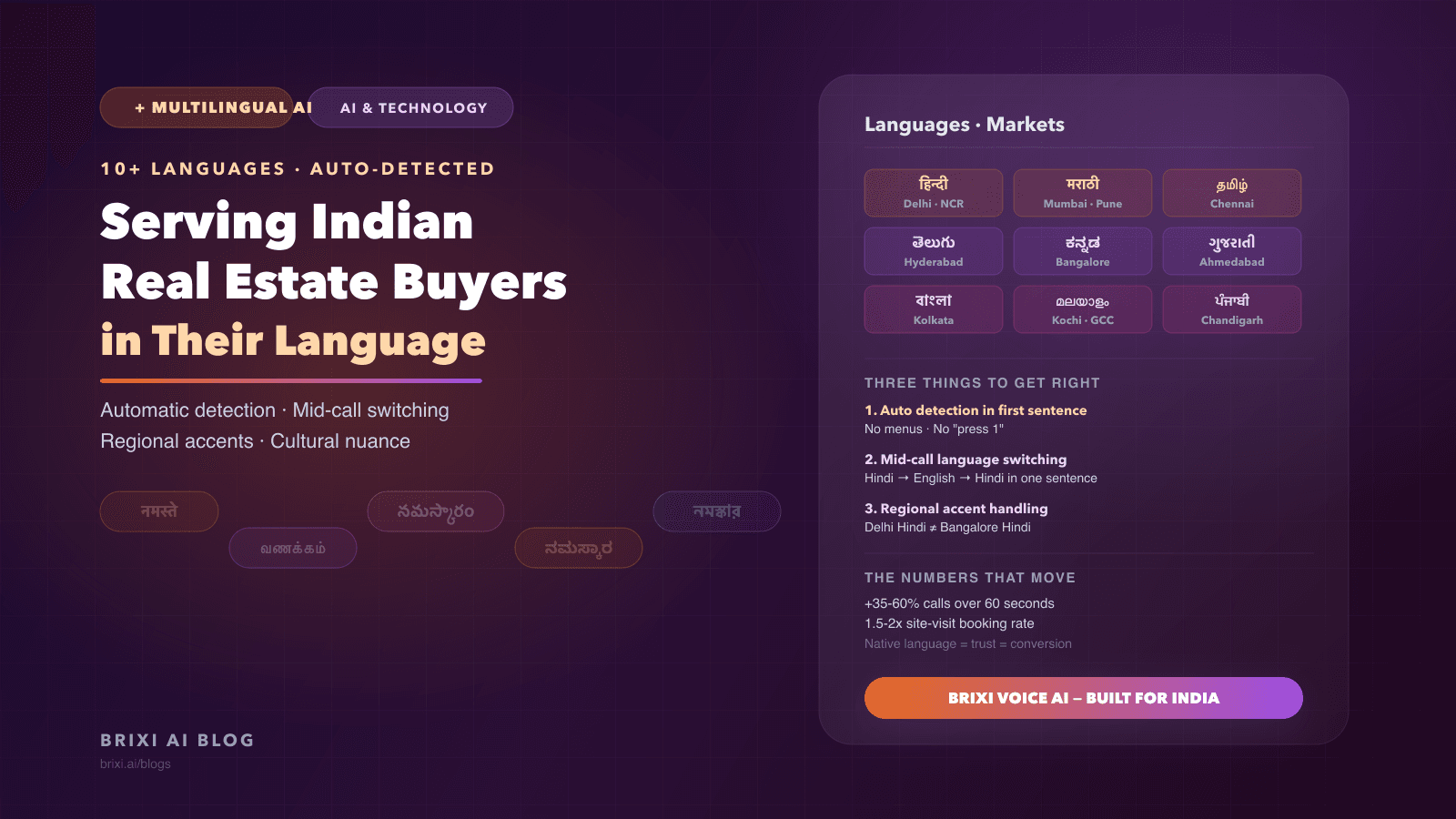
Most Indian real estate leads are lost in the first 20 seconds, not because the buyer lost interest, but because the call opened in the wrong language. Multilingual Voice AI with automatic language detection, mid-call switching, and regional accent handling fixes the layer of drop-off that CRM reports never name.
Girish manages the inside sales floor for a mid-size residential developer in Nashik. His team handles roughly 400 inbound inquiries a week across three projects: one in Nashik, one in Pune, and a new launch in Hyderabad. On a Friday afternoon he pulled the recordings for 30 leads his reps had tagged as "low intent" and listened through them himself.
Fourteen of those thirty buyers had opened the call in Marathi or Hindi. Every rep had responded in English. By the third exchange the buyer was giving one-word answers. By the fifth the buyer was asking to be sent details on WhatsApp instead. Girish did not have a lead quality problem. He had a Language Resonance Collapse: the systematic loss of conversational trust that occurs the moment a buyer realizes the person, or AI agent, on the other end cannot meet them in their language.
Language Resonance Collapse is the named failure this post is about. It is not about preference or politeness. It is about the cognitive cost a buyer pays when they have to translate their thinking about a financial decision as large as a home purchase into a second language, live, with a stranger on the phone. Most buyers stop paying that cost after about 20 seconds. They do not hang up. They just stop telling the truth.
Why is Language Resonance Collapse invisible in standard CRM reports?
The answer is that CRM systems record outcomes, not causes. A call that ends in 40 seconds and results in the buyer requesting a WhatsApp message gets tagged as "low intent" or "not contactable." Nobody records "buyer disengaged because the agent opened in English and the buyer thinks in Kannada." The lead flows into the re-engagement queue, gets called again in English by a different rep, and produces the same result. The cost compounds invisibly.
The contrarian claim here is worth stating directly: a significant portion of what Indian real estate sales teams classify as poor lead quality is actually poor language matching. The buyer had intent. The system failed to meet them in the language in which their intent lives. Fixing language infrastructure is not a nice-to-have for tier-2 city developers. It is the highest-leverage intervention available at the top of the funnel.
Which languages actually drive real estate leads across India?
The language mix of a real estate lead database is almost always more diverse than sales leadership estimates. In a typical tier-1 metro, active buyers speak five to eight languages at home, and the buying conversation happens in the home language even when the original inquiry came through an English-language ad. The languages that matter in current Indian real estate markets are:
- Hindi: across North India, Delhi NCR, Rajasthan, UP, and large migrant buyer populations in Mumbai, Pune, and Surat.
- Marathi: Mumbai, Pune, Nashik, Nagpur, Aurangabad, and Kolhapur.
- Tamil: Chennai, Coimbatore, Madurai, and a substantial NRI buyer base in the GCC.
- Telugu: Hyderabad, Vijayawada, Visakhapatnam, and the Telangana tier-2 belt.
- Kannada: Bengaluru, Mysore, Mangalore, Hubli.
- Gujarati: Ahmedabad, Surat, Vadodara, and NRI markets in the US and UK.
- Bengali: Kolkata, Durgapur, Siliguri, and emerging markets near the Odisha borderlands.
- Malayalam: Kochi, Thiruvananthapuram, Kozhikode, and the large GCC expat base.
- Punjabi: Chandigarh, Ludhiana, Amritsar, and diaspora buyers in Canada and the UK.
- Odia: Bhubaneswar, Cuttack, Rourkela.
- English: across all cities for professional white-collar buyers and NRI segments.
A developer selling projects in three or more cities is almost certainly running campaigns that reach buyers across six or more of these languages. Supporting only English and Hindi is not an adequate baseline outside of Delhi and parts of South Mumbai. Yet that is the default configuration on most Voice AI deployments in Indian real estate today.
What does a multilingual voice AI for real estate actually need to do?
Listing a language on a feature page and handling it well in a production sales call are two different things. There are four specific capabilities that separate regional language AI calling that converts from regional language AI calling that looks credible until a buyer from Madurai or Nagpur calls in.
Automatic language detection in the first sentence
The agent should identify the spoken language within the first two or three words and respond in that language, without asking the buyer to press a number or announce their language preference. IVR-style language selection destroys trust in the first five seconds: it signals clearly that the system was not designed for this caller. An agent that opens in the right language without any prompt feels like a competent person who happens to speak the buyer's language. The difference in tone set from that first response carries through the entire call.
Mid-call language switching without disruption
Indian buyers routinely switch languages within a single sentence. A buyer might open in Hindi, ask about pricing in English, clarify a floor preference in Marathi, and close with a mixed phrase. This code-switching is not unusual behavior. It is how bilingual and trilingual speakers communicate when they are comfortable. A Voice AI that can only handle one language per call imposes an artificial structure on the conversation that no human rep would ever impose. The rigidity signals the system's limitations and the buyer adjusts their behavior accordingly, becoming more formal and less informative.
Regional accent handling within each language
Hindi spoken in Lucknow sounds different from Hindi spoken in Patna, and both sound different from the Hindi spoken in Mumbai by a buyer whose first language is Marathi. Kannada in Bengaluru sounds different from Kannada in Mysore. A speech recognition model trained on a narrow accent profile will transcribe one dialect accurately and fail on another. The failure mode is not obvious: the agent transcribes something plausible-sounding but wrong, answers the wrong question, and the buyer concludes the agent is incompetent rather than understanding that the transcription was the point of failure.
Indian real estate vocabulary in every language
Terms like RERA, OC certificate, stamp duty, carpet area, BHK configuration, EMI, and possession date are central to every qualification conversation in Indian real estate. An agent that mispronounces these terms or renders them in a way that sounds translated rather than native signals to the buyer that they are speaking with a generic AI rather than a system built for the Indian market. These terms need to be handled correctly in all supported languages, not just in English.
Why do imported voice AI platforms fail Indian real estate buyers?
Most Western-origin Voice AI platforms added Hindi and a handful of regional Indian languages as a post-launch expansion, not as a design-time requirement. The effects of that sequencing are audible in three ways that matter to conversion.
First, the speech synthesis sounds translated rather than native. The cadence is slightly off. The intonation is standardized rather than regional. Amounts are quoted in millions rather than lakhs and crores. A 2BHK quoted at "twelve million rupees" instead of "one point two crore" creates immediate cognitive friction. The buyer has to perform a mental conversion, the flow breaks, and the sense that the agent was not built for this market reinforces itself.
Second, latency in non-English languages is noticeably higher on platforms where English is the primary model. The full stack: automatic speech recognition, language model inference, and text-to-speech synthesis, is optimized for English, and the other languages are routed through translation layers or secondary models. Buyers notice the pause. In sales conversations, a pause above roughly one second feels like hesitation and breaks the natural rhythm of a qualifying exchange.
Third, and most importantly, the language model was trained on general-purpose data rather than Indian sales conversations. It does not handle objections the way Indian buyers raise them. It does not understand that "I need to discuss with my family" is almost always a positive signal in Indian home purchase decisions, not a soft rejection. It treats a buyer who says "send me something on WhatsApp" as converted rather than as someone who just experienced Language Resonance Collapse. This is the layer that requires the most local domain knowledge and takes the longest to retrain.
What cultural layer sits beneath the language in Indian real estate calls?
Language is the surface. The cultural assumptions underneath it are where even technically capable multilingual platforms fail in Indian real estate conversations. Three patterns matter most.
Family decision structures that a Voice AI must work with, not around
Indian home purchase decisions are almost never made by one person. A buyer will consult parents, a spouse, siblings, and sometimes a trusted family friend before committing to a site visit, let alone a booking. A Voice AI that treats "I need to check with my family" as an objection to overcome will consistently push buyers toward the exit. An agent that responds by offering to send a shareable summary on WhatsApp, or schedules a follow-up call for after the weekend when the family discussion has likely happened, is working with the buyer's process rather than against it. This distinction alone changes the tone of the entire back half of a qualification call.
Number conventions that Indian buyers use by default
Indian buyers think and plan in lakhs and crores. An agent that quotes prices or loan amounts in millions and billions is introducing a translation step into every financial exchange in the conversation. The buyer does the math, loses the conversational thread for a moment, and the call feels slightly foreign. In a 4-minute qualification call, three or four of these micro-interruptions add up to a conversation that felt effortful rather than natural.
Festival and prayer-time awareness for DND windows
Calling a Gujarati buyer family during Diwali evening puja, a Muslim buyer during Ramadan iftar, or a Maharashtra household on the morning of Ganesh Chaturthi is not just inconsiderate. It generates spam complaints and blocks future contact. A language-aware Voice AI calling system should include culturally calibrated DND windows by region and buyer segment, layered on top of TRAI-compliant calling hours. The regional calendar is part of what "built for India" means in practice.
Language Resonance Collapse is measurable, even if your CRM does not label it
Pull the recordings for your last 50 leads marked "low intent" and check the language the buyer opened in versus the language the agent or rep responded in. If more than a third of those calls show a mismatch in the first exchange, you have a language infrastructure problem, not a lead quality problem. The fix is architectural, not motivational.
Where do the numbers move after deploying language-matched voice AI?
The measurable effect of properly multilingual Voice AI shows up across the funnel, not just at the first-call stage. Three metrics shift first and most visibly.
Call hold time increases when the language matches
Buyers stay on the call longer when the agent opens in their language. The proportion of calls that pass the 45-second mark, which is roughly the point at which a qualification exchange becomes substantive, is meaningfully higher on language-matched calls than on mismatched ones. Short calls that end before 30 seconds almost always close without any qualification data captured. The CRM entry is a name and a phone number, nothing else.
Budget and timeline fields start getting filled in
Buyers share real financial information when they are comfortable in the conversation. In native-language calls, the rate at which buyers volunteer a specific budget range and a realistic purchase timeline is consistently higher than in language-mismatched calls with buyers from the same demographic and lead source. Budget and timeline are the two qualification fields most likely to be empty in a CRM at the end of a calling campaign. Language matching addresses both of them simultaneously.
Site visit bookings respond to conversational warmth
The site visit booking rate on native-language calls is typically higher than on language-mismatched calls with comparable lead quality. The mechanism is direct: a warmer and more natural conversation produces a more committed next step. A buyer who spoke comfortably in their own language about their requirements and felt understood books the visit. A buyer who gave clipped answers in a language they were tolerating does not.
What changes after a quarter of language-matched calling?
Teams that run language-matched Voice AI across a full quarter begin to see compounding effects that go beyond the first-call metrics. The most important change is that the CRM stops producing mystery drop-offs at the first call stage. When buyers are engaged in their language from the first sentence, the leads that reach the human rep have real qualification data attached: budget ranges, configuration preferences, family decision timelines, and stated urgency levels.
There is also a second-order effect on the human sales team. Reps who inherit leads from a multilingual AI calling campaign spend less time re-establishing basic facts in their first human contact. The handoff conversation is substantive rather than a repeat of first-call qualification. In practice this means each rep handles a higher volume of viable leads per day without the quality of their conversations degrading.
The anti-pattern to watch for is treating multilingual support as a checkbox rather than a quality requirement. A developer who deploys a Voice AI that technically speaks ten languages but speaks all of them with noticeable synthetic accents and slow response latency will not see the gains described above. Buyers from every language group disengage at roughly the same rate because the agent feels equally foreign to everyone. Supporting ten languages badly is worse than supporting three languages well, because it trains the sales team to distrust the AI tool and revert to manual calling. Language Resonance Collapse happens even when the agent nominally speaks the buyer's language, if the execution is poor enough.
The deeper bet: what Girish's floor looks like after language-matched AI
Girish did not just fix the language mismatch after that Friday afternoon of call reviews. He restructured the campaign routing. Nashik campaigns now open in Marathi by default, with Hindi and English as fallback paths. Hyderabad campaigns open in Telugu. Each campaign captures the buyer's preferred language on the first AI call and uses it for every subsequent touchpoint: WhatsApp follow-ups, reminder calls, and the eventual handoff message to the human rep.
Three months later, the proportion of leads tagged as "low intent" without any qualifying conversation had dropped substantially. The leads still being marked low intent were genuinely not ready. They were not linguistically disengaged. His team was spending the same number of calling hours and reaching a much higher proportion of real conversations with real qualification data.
The deeper bet here extends beyond Voice AI as a category. India is a country where the distance between English and the language in which a buying decision actually lives can be a few hundred kilometers or a single generation. Sales infrastructure that respects that distance converts better than infrastructure that ignores it. The teams that build language-aware systems are not simply being more considerate. They are systematically capturing the share of the market that their English-first competitors are actively driving away with every call that opens in the wrong language.
Ready to stop losing buyers at the first sentence?
Brixi Voice AI handles Hindi, Marathi, Tamil, Telugu, Kannada, Gujarati, Bengali, Malayalam, Punjabi, Odia, and English with automatic language detection, mid-call code-switching, regional accent handling, and culturally calibrated calling windows. Built from the ground up for how Indian real estate buyers actually speak.
Book a DemoFrequently Asked Questions
At minimum: Hindi, Marathi, Tamil, Telugu, Kannada, Bengali, Gujarati, Malayalam, Punjabi, Odia, and English. For developers selling across multiple cities, this coverage is a prerequisite rather than a feature. A missing language in a major market means a meaningful share of inquiries cannot be served in a way that leads to a real qualifying conversation. Supporting fewer languages is reasonable only if your campaign geography is genuinely limited to one or two language regions.
Yes, and it needs to. Indian buyers routinely mix Hindi and English within a single sentence, and many switch freely between their regional language and Hindi depending on the topic. An agent that can only handle one language per call imposes an unnatural structure on bilingual conversations. Mid-call language switching without disruption is a quality requirement for any production deployment targeting Indian buyers, not a luxury feature. Without it, the agent forces buyers to simplify and formalize their speech, which reduces the quality of information they share.
For large financial decisions discussed within the family, most Indian buyers think through the details in their home language. The trust and comfort of a native-language conversation produces more complete qualification data: buyers share realistic budget ranges, genuine timelines, and specific configuration preferences more readily when they are not translating their thinking live. The preference is not primarily about fluency. It is about cognitive comfort during a high-stakes decision where the stakes are high enough that the buyer defaults to the language they use when they think carefully.
Language Resonance Collapse is the systematic loss of conversational trust that occurs when a buyer realizes the person or AI agent on the other end cannot meet them in their language. It happens in the first 15 to 20 seconds of a call. The buyer stops volunteering information, gives one-word answers, and requests a WhatsApp message instead of continuing the conversation. The lead gets tagged as low intent in the CRM even though the buyer had genuine interest. Multilingual Voice AI with automatic language detection eliminates this collapse by matching language before the buyer has a reason to disengage.