The Two-Conversation Test: How to Know If an AI Assistant Really Remembers
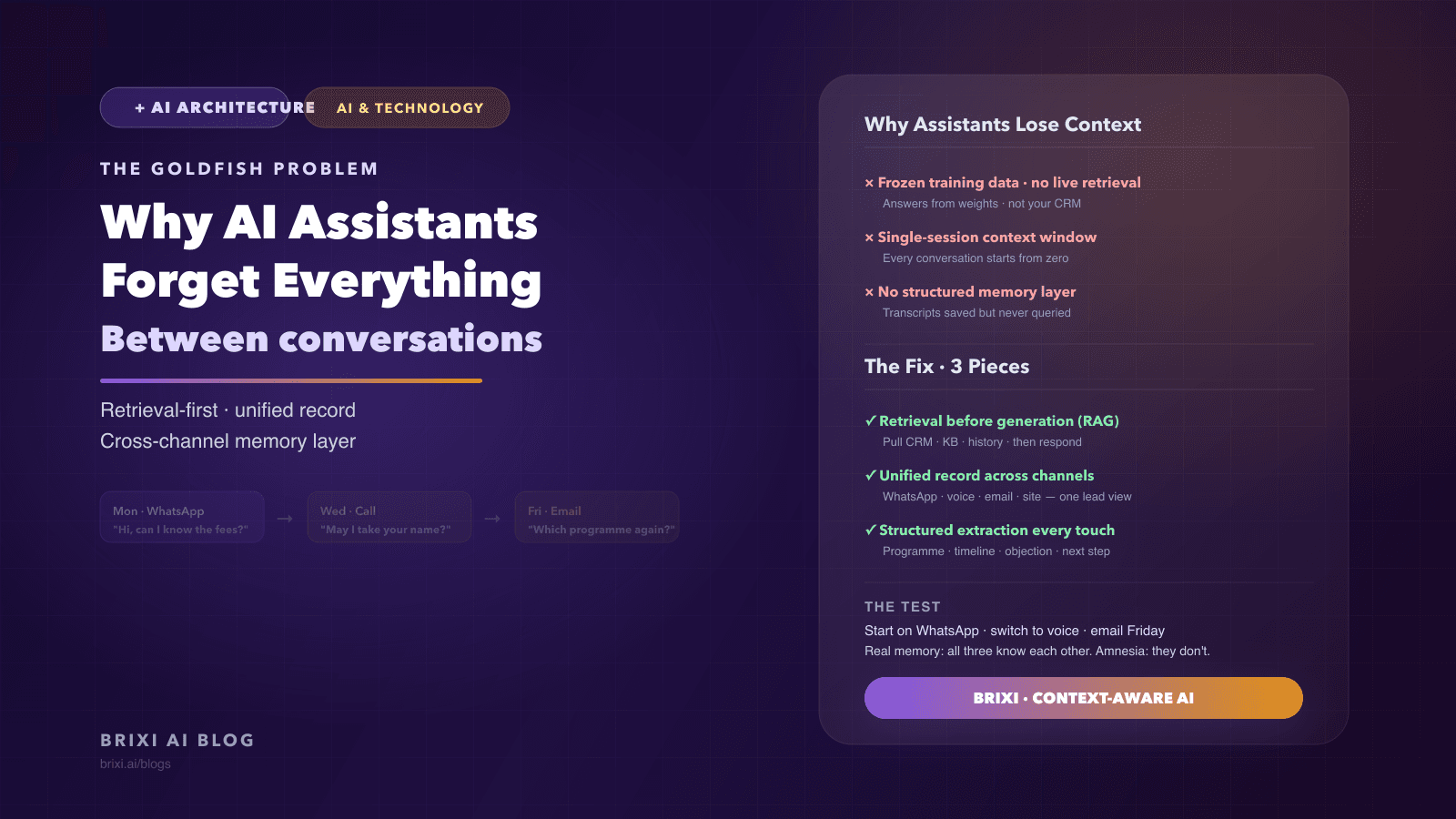
Before you buy any AI assistant for your sales team, run one experiment: two conversations, one week apart, same buyer persona. What the AI does in session two tells you more than any demo ever will. Most fail. Here is exactly what to look for and why it matters for Indian sales teams closing multi-touch deals.
Here is an experiment you can run this week, before you spend a rupee on any AI sales assistant. Open the product, start a conversation as a prospective buyer. Share three specific things: a budget range, an objection ("I need to check with my spouse before deciding"), and a preference ("I only want east-facing units"). End the conversation. Wait seven days. Start a new conversation with the same product, as the same buyer. Ask a follow-up question that only makes sense if the AI remembers session one.
If the AI opens session two by asking for your name, you have your answer. If it references what you shared in session one without being prompted, you have a different answer. This is the Two-Conversation Test, and it is the single fastest way to separate AI assistants that are production-ready for multi-touch sales cycles from those that are only production-ready for demos.
Why does a one-week gap matter so much?
Most AI assistants look impressive in a live demo because demos happen within a single session. The model holds context inside the conversation window beautifully. Vendors show you elegant responses, smooth follow-ups, and smart objection handling. What they do not show you is what happens when that session ends and a new one begins. The context window closes. Everything the buyer shared is gone unless the system deliberately writes it somewhere durable and retrieves it before the next conversation starts.
In an Indian real estate or SMB sales cycle, a buyer commonly touches your brand eight to fifteen times before a decision. Those touches happen across WhatsApp, voice calls, website chat, email, and in-person visits, spread across days or weeks. A tool that remembers nothing across sessions is not an AI assistant for your sales process. It is an AI assistant for a one-conversation sales process that does not exist.
What does a passing score actually look like?
The Two-Conversation Test has four specific signals to watch for in session two. Each one tells you something precise about the underlying architecture.
- The AI references your session-one details without being prompted. It should open with something like "Last week you mentioned you needed to check with your spouse before deciding. Has that conversation happened?" Not a vague "welcome back" but a specific, accurate callback.
- The AI does not re-ask for information it already has. It already knows the budget. It already knows the unit preference. Asking again is not neutral: it signals to the buyer that they are starting from zero, which is a relationship reset, not a relationship continuation.
- The AI updates its understanding based on what you say in session two. If you say "we have decided, it is just the two of us making this call," the system should update the decision-maker field and carry that forward, not loop back to asking about stakeholders again on session three.
- When you ask the AI to summarise where things stand, the output should be a structured brief, not a raw transcript. Key facts, open questions, agreed next steps. Something a human counsellor could pick up and act on in thirty seconds.
What is actually different under the hood between AI assistants that pass and those that fail?
The gap is not the language model. Vendors running GPT-4o, Gemini, and Claude all fail this test equally when the underlying product architecture has no persistent memory layer. The gap is whether the system does three specific things after every conversation ends.
First: structured extraction. After each session, the system must pull out facts, not just save the transcript. Property type of interest, budget ceiling, objections raised, decision-makers identified, next step agreed, emotional tone of the close. These need to be written as queryable fields, not stored as a wall of text. A raw transcript is an audit trail. Structured fields are a memory.
Second: retrieval before generation. When session two starts, the AI must run a retrieval step before generating any response. It should ask its own data store: what do we know about this person? Then it generates the opening against that retrieved context. Without this retrieval step, the model is answering from its training weights, not from your CRM record.
Third: a unified record across every channel. If a buyer WhatsApps on Monday and calls on Wednesday, session two on the voice channel should know about the WhatsApp exchange. This only happens if both channels write to and read from the same lead record, indexed by buyer identity, not by channel session. Most multi-channel AI deployments fail here because the WhatsApp bot and the voice agent are separate products that share nothing.
Rule The contrarian claim worth sitting with
A bigger model does not fix stateless memory. Teams that upgrade their underlying LLM and see no improvement in cross-session continuity are learning this the expensive way. Memory is an engineering layer, not a model capability. The best language model in the world, pointed at a blank prompt at the start of every session, knows exactly as much about your buyer as a new hire on day one.
What does the Statelessness Tax cost a sales team over ninety days?
When an AI assistant has no cross-session memory, every repeated touchpoint carries what you might call a Statelessness Tax: the invisible friction cost of re-establishing context that should already exist. It is not a single catastrophic failure. It is a compound drag on conversion across the full buyer journey.
- Re-qualification time: buyers spend two to four minutes of every call repeating information they already gave. Multiply that across a hundred leads touching your AI twice a week.
- Objection reset: an objection raised in session one and never logged comes back in session two as if it were new. The buyer has already started losing trust in your process.
- Contradiction across channels: a WhatsApp bot and a voice agent that share no context can give different answers to the same question on the same day. Buyers notice and they interpret contradictions as incompetence, not as a technology architecture problem.
- Cold handover penalty: when a human counsellor eventually takes the lead, they receive a full log to read rather than a structured brief. That is fifteen minutes of reading before a callback, and a buyer who has to re-introduce themselves to the human after the AI already collected everything.
Teams that have run before-and-after analyses after deploying a proper memory layer typically see the clearest signal in multi-touch buyers: those who had four or more interactions before a conversion decision. That cohort is where the Statelessness Tax is highest, and where the improvement from fixing it is most visible.
Is there a case against AI memory? The privacy argument taken seriously
The strongest argument against persistent AI memory is not technical, it is relational. Some buyers, particularly in healthcare, financial services, and legal contexts, feel uncomfortable when an AI recalls previous disclosures without making that memory explicit. Being remembered can feel like being tracked, especially if the buyer did not consciously choose to share information with a system that would retain it indefinitely.
This is a real tension and it is worth asking vendors how they handle it. The right answer is not to remove memory. It is to build consent and transparency into the memory layer. The buyer should be able to see what the system holds about them. There should be a path to reset it. And the AI should never surface recalled information in a way that feels surveillance-like rather than helpful. Memory done with transparency builds trust. Memory done opaquely destroys it.
How do you run the Two-Conversation Test across channels, not just one?
The single-channel version of the test is the minimum. For Indian sales teams running multi-channel AI across WhatsApp, voice, and website chat, the cross-channel version is the real evaluation. Here is the exact sequence to run during a vendor trial.
- Day one, WhatsApp: start a conversation as a buyer, share your budget, your unit preference, and one objection. End the conversation without resolving the objection.
- Day three, voice call: call the same AI system. Do not introduce yourself. See whether the voice agent knows who you are and what you discussed on WhatsApp.
- Day seven, website chat: open a new chat session. Ask a question that only makes sense in the context of what you shared on day one and day three. See whether the chat agent has the full picture.
- Handover test: ask to speak to a human. See what brief the human receives. Is it structured and usable, or is it a link to three separate logs from three separate channels?
An AI system that passes all four steps of this cross-channel version is architecturally ready for the way Indian buyers actually behave. Most will pass step one and fail at step two. A meaningful number will fail at step three. Very few will produce a useful handover brief at step four without custom engineering.
What should you ask a vendor when they claim their AI "remembers context"?
The claim "our AI remembers context" is nearly universal and nearly meaningless without follow-up questions. Here are the four questions that separate real architecture from marketing language.
- Where is the structured memory stored and what fields are written after each conversation? A vague answer about "context being saved" means transcripts are saved, not queryable structured facts.
- What is the retrieval step before a new session begins? If there is no retrieval step, the AI is not using historical context, it is just starting fresh with a system prompt that may mention the buyer's name.
- How is buyer identity resolved across channels? If the WhatsApp number and the voice call number are different, how does the system know they are the same buyer?
- What does the handover brief look like? Ask to see an actual example output. A structured brief with fields is very different from a transcript summary.
Vendors who cannot answer these questions specifically either have not solved the problem or are hoping you will not ask. Both outcomes tell you something useful before the contract is signed.
After the test: what changes when you get a system that actually passes?
The operational change that teams notice first is not a metric. It is the quality of second conversations. Instead of re-qualifying, the AI opens with what is already established and moves the relationship forward. "You mentioned last week that possession timeline was the key question. We have the updated schedule now. Shall I walk you through it?" That sentence signals continuity. It tells the buyer that their time was respected, their words were heard, and this interaction is a continuation, not a reset.
The second change is in the human counsellor experience. When the AI has been running with real memory, the handover brief that reaches the human is genuinely useful. Budget confirmed, objections logged with status, decision-makers identified, next step agreed in session two. The counsellor picks up a relationship in progress rather than a cold lead file. That changes the tone of the first human call completely.
The argument for treating the Two-Conversation Test as a buying requirement rather than a nice-to-have is simple: the deal cycles that actually generate revenue in Indian real estate, BFSI, and enterprise SMB sales are multi-touch by definition. A tool that only works within a session is a demo tool, not a sales tool. The test is not hard to run. The results are not ambiguous. And the cost of not running it is paid, quietly, across every multi-touch buyer who leaves because they were made to feel like a stranger one too many times.
Would your AI pass the Two-Conversation Test today?
Brixi runs structured memory extraction, cross-channel retrieval, and unified lead records across voice AI, WhatsApp, and CRM. Every session writes context. Every next session starts with a real brief.
See the Buyer Intent EngineFrequently Asked Questions
Run the Two-Conversation Test: start one conversation as a buyer, share specific details like budget, an objection, and a preference, then end the session. Wait seven days and start a new session as the same buyer. If the AI references your session-one details without being prompted and does not re-ask for information it already has, the memory layer is real. If it opens with "How can I help you today?", the memory is session-only and not suitable for multi-touch sales cycles.
Because most AI assistants have no structured extraction step after each session and no retrieval step before the next one begins. The model holds context within the session window, but when that window closes, nothing is written into a queryable memory store. The next session starts from the same generic system prompt. Solving this requires three things: structured fact extraction after every conversation, a unified lead record across all channels, and a retrieval step before every response generation.
No. Cross-session memory is a product engineering problem, not a model capability problem. The best language model in the world, pointed at a blank prompt at the start of every session, has exactly zero knowledge of your buyer's previous conversations. Solving it requires a persistent memory architecture: structured extraction, durable storage indexed by buyer identity, and retrieval before generation. Swapping models without building that layer produces the same result with a more expensive API bill.
Ask four things: Where is structured memory stored and which fields are written after each conversation? What is the retrieval step before a new session begins? How is buyer identity resolved when the same person contacts you across different channels with different phone numbers or email addresses? And what does an actual handover brief look like? Ask to see a real example output. Vendors with genuine memory architecture can answer all four precisely. Those without it typically give vague answers about "context being saved" or show you a transcript link.