The AI Quality Shift: From Did It Reply to Did It Resolve
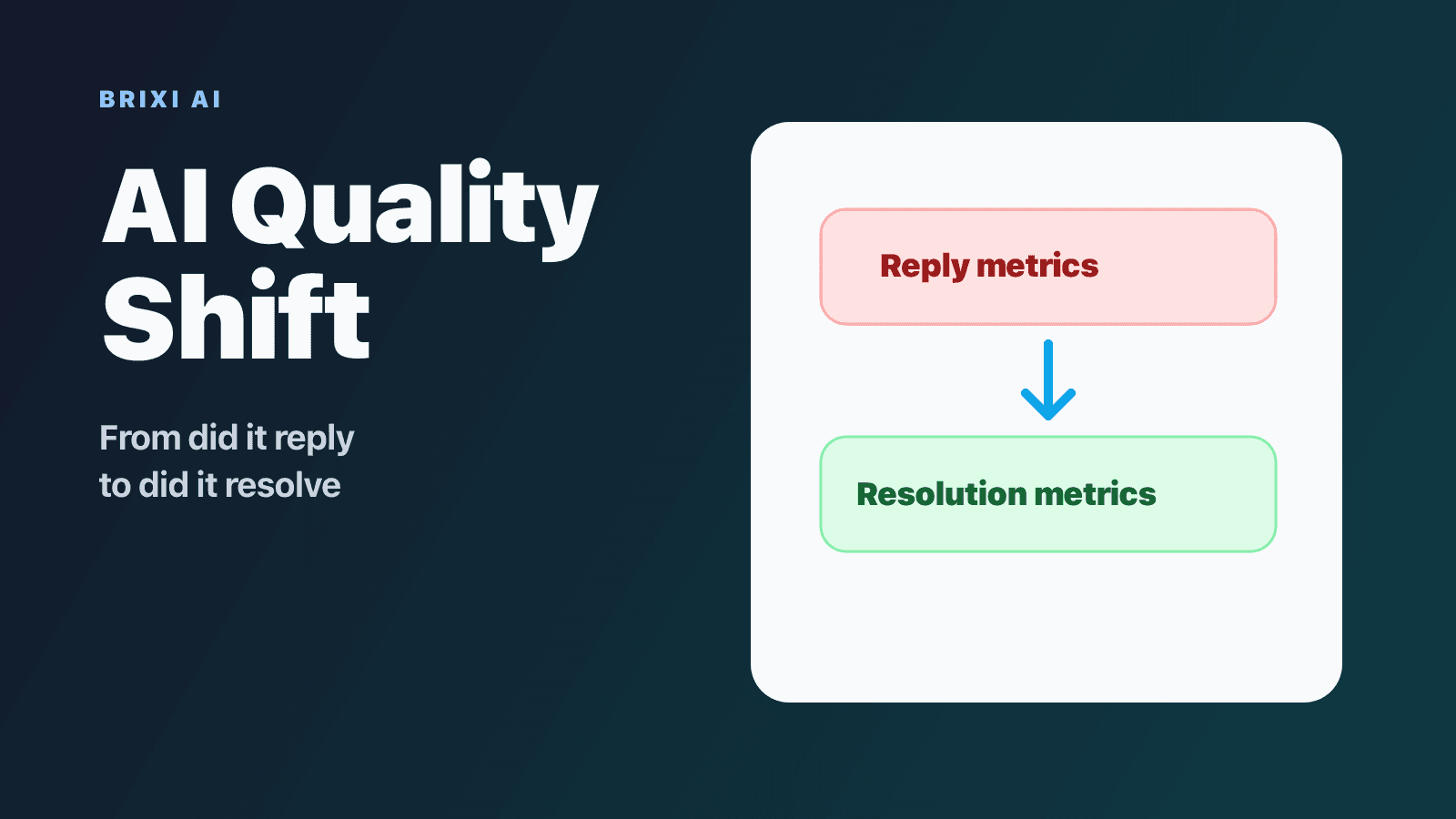
Fast AI replies are no longer enough. Customer-facing teams need to measure whether AI resolved the issue, routed the work, preserved trust, and moved the customer journey forward.
At the weekly review, the support lead shows a chart that looks beautiful. AI response time is under ten seconds. Deflection is up. The number of conversations handled by humans is down. Then the complaints start coming from sales, success, and the front desk: customers are reopening issues, asking for humans, and repeating the same question after the AI already replied.
The dashboard says the AI worked. The customer behavior says it did not finish the job. That gap is the AI Quality Shift: the move from asking "did it reply?" to asking "did it resolve?"
This shift matters because AI response has become cheap. A fast answer is no longer a differentiator. The harder, more useful question is whether the AI produced the right outcome: resolved, routed, escalated, updated, or stopped with a clean explanation.
Reply metrics reward the wrong behavior.
The earliest customer-facing AI systems were judged like inbox tools. How quickly did they answer? How many conversations did they handle? How many human tickets did they deflect? Those numbers are easy to track, but they can reward shallow automation.
A bad AI can reply quickly, close the conversation prematurely, and still leave the customer confused. A mediocre AI can deflect a human ticket by exhausting the customer. A risky AI can produce a confident answer where a careful escalation would have protected trust.
That is why reply metrics should be treated as health checks, not success metrics. Speed matters only after quality is in place. Volume matters only if the outcomes are good.
Resolution has several valid forms.
Resolution does not always mean the AI solved the entire problem alone. In customer-facing work, a good AI outcome can take several forms. The important point is that the system moved the journey forward with a clear and appropriate next step.
- Direct resolution: the AI answered accurately and the customer did not need another contact.
- Qualified routing: the AI collected enough context to send the customer to the right owner.
- Clean escalation: the AI recognized risk, urgency, or complexity and handed off with a useful brief.
- Workflow completion: the AI updated CRM, sent confirmation, created a task, or triggered the required follow-up.
- Trust-preserving stop: the AI admitted a limit and avoided guessing when the answer required a human or policy check.
The best AI systems are not the ones that avoid humans at all costs. They are the ones that know when to answer, when to route, when to ask one more question, and when to stop.
The quality rule
A fast reply that creates a second contact is not efficient. It is delayed work with a better first-response metric.
The metric stack needs to change.
A useful AI quality dashboard should start with outcome, not activity. First-contact resolution, reopened conversations, escalation accuracy, handoff completeness, customer repeat rate, and next-action completion matter more than raw reply count.
For sales teams, the right metrics include qualified callback rate, meeting booked from AI conversation, missed handoff rate, and conversion from AI-qualified leads. For support teams, they include issue reopened rate, human rescue rate, time to actual resolution, and customer effort. For admissions or healthcare intake, they include correct routing, appointment completion, and no-show reduction.
This does not make AI reporting more complicated. It makes it honest. If the AI is meant to improve operations, the metrics should measure operations.
Resolution metrics need evidence, not labels.
A field that says "resolved" is not enough. Teams need to know what evidence supports that outcome. Did the customer confirm the answer? Did the appointment get booked? Did the CRM update happen? Did the human owner accept the handoff? Without evidence, resolution becomes another status that teams learn to distrust.
Evidence also protects against false deflection. A conversation can be marked handled because the customer stopped replying, but silence is not always satisfaction. It may mean the answer was unhelpful, the customer moved to another channel, or the issue became too frustrating to continue. The quality system needs to separate quiet from resolved.
The practical review should connect the AI outcome to the downstream event. If the AI routed a lead, did the owner call? If it answered a support question, did the issue reopen? If it promised a callback, was a task completed? Resolution is a chain, not a label.
This chain should be visible in the same place teams review AI quality. Otherwise the support lead sees response metrics, the sales manager sees missed callbacks, and the operations owner sees workflow errors in a third system. Everyone owns one fragment, so no one owns the resolution failure.
A useful dashboard shows the path from answer to action. It should make the weak link obvious: bad answer, missing context, wrong route, slow owner, incomplete workflow, or customer reopening the issue. Once the weak link is visible, improvement becomes specific instead of emotional.
Brixi connects the answer to the action.
Brixi does not treat AI conversations as isolated replies. Voice AI, WhatsApp, CRM, workflow automation, conversation intelligence, and team routing work from the same customer context. That makes it possible to judge AI by what happened after the reply.
If a voice AI call qualifies a lead, Brixi can write the qualification, update the CRM, trigger the next WhatsApp message, route the owner, and preserve the brief. If a WhatsApp conversation reveals frustration, Brixi can escalate with reason and history. If an AI assistant detects a pricing objection, that signal can shape follow-up and manager visibility.
The platform question is not "can the AI answer?" It is "can the business act on what the AI learned?" That is where quality becomes measurable.
The failure review has to include the next action.
When AI quality drops, teams often review the answer only. Was it accurate? Was it polite? Did it follow the knowledge base? Those questions matter, but they miss the operational failure. A correct answer can still be bad if it leaves the customer without a clear path forward.
A stronger review asks what the AI should have caused. Should it have escalated? Should it have asked one more qualifying question? Should it have updated the CRM? Should it have stopped because the request required policy judgment? The next action is where quality becomes visible to the business.
This changes how teams improve AI. They do not only tune prompts. They tune routing rules, handoff briefs, escalation thresholds, and workflow completion. The quality system moves from language review to operating review.
It also changes who needs to be in the room. AI quality is not only a product or support function. Sales, operations, RevOps, support, and customer success all feel the downstream effect of shallow replies. The review group should include the people who receive the work after the AI speaks.
What changes after a quarter of resolution-led AI?
The first change is fewer fake wins. Teams stop celebrating conversations that looked handled but reopened later. They can see which AI workflows truly reduce work and which merely move work into a different queue.
The second change is better escalation design. AI stops trying to solve everything. It becomes more precise about risk, urgency, and human judgement. That improves both customer trust and team confidence.
The third change is clearer investment. Leaders can identify the workflows where AI creates real operating leverage: common resolutions, structured qualification, smart routing, and follow-up tasks that actually complete.
The fourth change is better customer trust. Customers feel the difference between an AI that tries to end the conversation and an AI that moves the issue forward. The system becomes measured by the journey it improves, not the ticket it avoids.
That shift makes quality conversations more useful internally too. A poor outcome is no longer a vague complaint about AI. It becomes a traceable chain the team can repair, from the answer to the owner to the completed action. The review becomes evidence, not opinion, and each fix can be tested against the next customer journey.
The deeper bet: AI quality will be judged after the reply.
The first wave of customer AI proved that machines could answer quickly. The next wave has to prove that answers improve the customer journey. That is a different bar and a better one.
The companies that win will not be the ones with the most automated conversations. They will be the ones whose AI turns conversations into resolved issues, qualified leads, clean handoffs, and trustworthy next actions. The quality shift is not about sounding more human. It is about operating better.
Measure AI by outcomes, not just replies
Brixi connects AI conversations to CRM, workflows, routing, and conversation intelligence so teams can see which customer journeys actually move forward.
Explore conversation analysis