The Handoff Gap: Why AI Conversations Still Fail When Humans Take Over
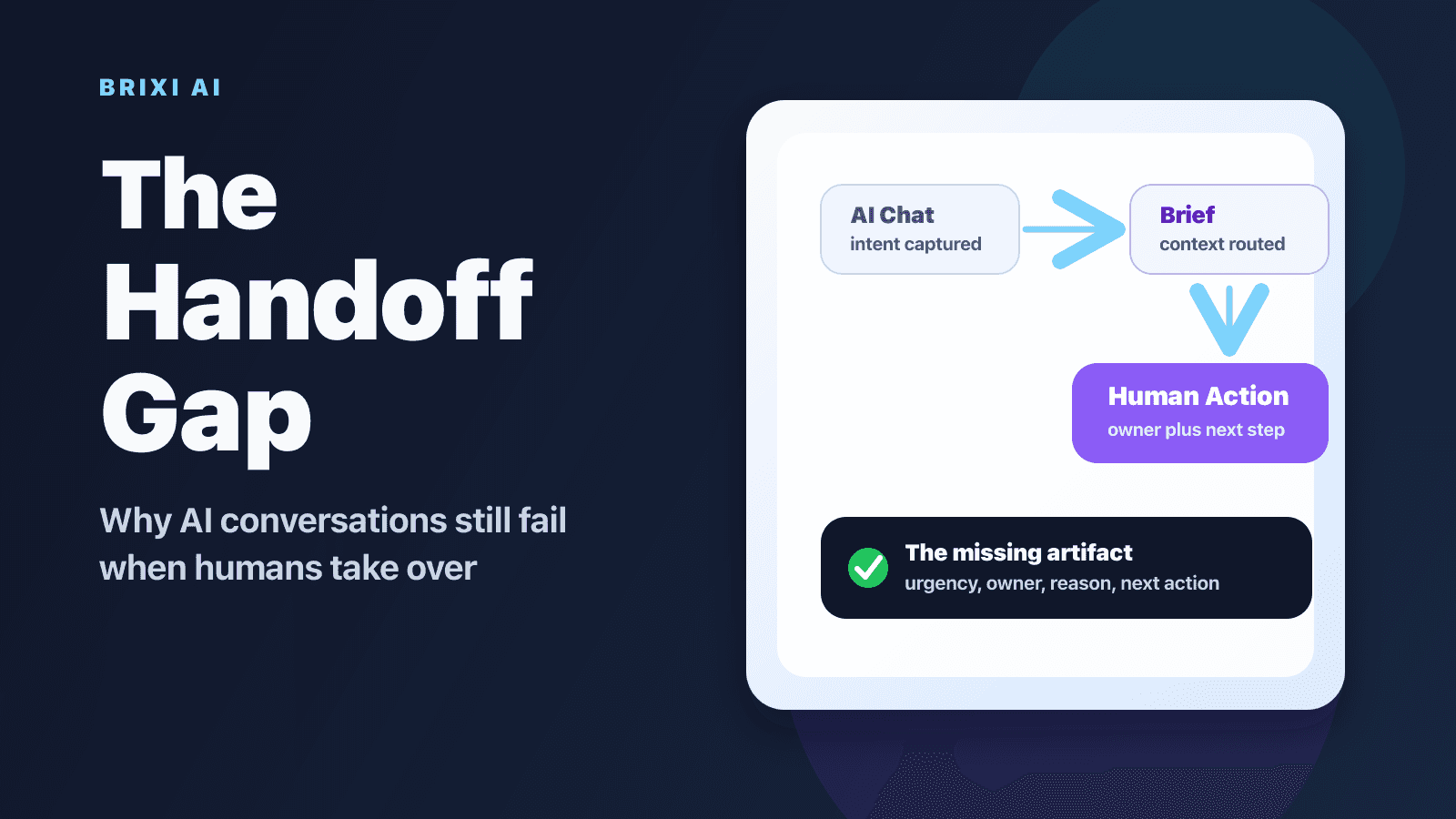
Most teams focus on whether AI can answer the customer. The bigger failure happens when AI cannot hand the conversation to the right human with enough context, urgency, intent, and next steps.
At 6:18 PM, a buyer asks an AI assistant three practical questions: whether the pricing is negotiable, whether a site visit can happen on Saturday morning, and whether the same offer applies if the payment plan is stretched over six months. The assistant answers two of them, misses the nuance in the third, and offers to have a human call back. The buyer agrees. By the next afternoon, a rep calls and opens with, "Can I know what you are looking for?"
That is the moment the sale starts leaking. The AI did not fail because it could not chat. It failed because it could not transfer the relationship. The rep did not fail because they were careless. They failed because the system handed them a contact, not a customer in motion.
This is the Handoff Gap: the distance between an AI conversation and the human action that should follow it. It shows up when the AI captures intent but does not turn it into ownership, urgency, a brief, and a next step. In customer-facing teams, the Handoff Gap is where automation stops looking efficient and starts feeling forgetful.
The demo tests the AI. Production tests the handoff.
Most AI evaluation still happens inside the conversation. Can the assistant answer a pricing question? Can it qualify a lead? Can it sound natural? Can it handle an objection? Those are useful tests, but they are only the first half of the workflow. Real operations begin after the conversation produces something that a team must act on.
A working customer platform has to answer a different set of questions. Who owns this lead now? How urgent is it? What did the customer already share? What promise did the AI make? What should happen next? What should the human avoid re-asking? If the system cannot answer those questions automatically, the AI conversation is still trapped inside a transcript.
The hidden failure mode is that many teams treat the transcript as the handoff. It is not. A transcript is evidence. A handoff is an operating artifact. The difference matters because busy reps, counsellors, support agents, and clinic coordinators do not need every word. They need the few facts that change what they do next.
A bad handoff loses four things at once.
The Handoff Gap is costly because it is not one failure. It is four small failures stacked together. Each one can look harmless in a dashboard, but the customer experiences them as one broken journey.
- Context is lost when the human starts from generic qualification instead of the actual conversation the customer just had.
- Urgency is lost when a hot request is pushed into the same callback queue as a low-intent inquiry.
- Ownership is lost when the conversation creates a task but does not clearly assign the next responsible person.
- Next action is lost when the AI ends with a vague promise such as "someone will contact you" instead of a defined workflow outcome.
This is why teams can have fast AI response times and still lose leads. The first response happens quickly. The second action is weak. A buyer who was ready at 6:18 PM becomes a cold record by the time a human calls without context.
The handoff rule
If a human has to read the full transcript before taking action, the AI did not complete the workflow. It only created raw material for another person to process.
The handoff artifact should be small, structured, and actionable.
A good AI-to-human handoff is not a long summary. It is a compact brief that tells the next owner how to move the relationship forward. The human should be able to understand the situation in thirty seconds and act with confidence.
The brief should include the customer identity, source, channel history, stated need, urgency signal, objection, promised next step, recommended owner, and recommended action. It should also show why the recommendation was made. A lead marked high urgency because they asked for a Saturday visit is different from a lead marked high urgency because they mentioned a competitor visit tomorrow.
The reason structure matters is simple. Humans make better decisions from labeled facts than from raw conversation logs. A support lead needs to know that the customer is angry and has already tried self-service. A sales rep needs to know that the buyer asked about payment terms, not just price. An admissions counsellor needs to know whether the parent or the student is driving the decision. The handoff artifact should surface the operational meaning of the conversation, not merely preserve the conversation.
The hardest handoffs are the soft-decision ones.
Simple handoffs are easy. A customer asks to book a demo, so the system creates a demo task. A patient asks to reschedule, so the system updates the appointment. A lead asks for a brochure, so the system sends one. These are deterministic enough for most automation stacks.
The hard cases are soft decisions. "Call me later" can mean tonight, tomorrow morning, after salary day, or after speaking with a partner. "I am busy" is not the same as "not interested." "Can you share the final price?" may be a buying signal, a negotiation move, or a request from someone who has no authority. The handoff has to interpret that nuance before routing the work.
This is where point tools break. A chatbot can answer. A dialer can call. A CRM can store. A workflow tool can trigger. But the handoff requires all of them to share context and decide what the conversation means inside the customer journey. Without that connected layer, soft-decision handoffs become manual judgement hidden behind an automation label.
Why CRM notes are not enough.
The common workaround is to push a summary into CRM notes. That is better than losing the conversation completely, but it is not the same as closing the Handoff Gap. Notes still depend on someone opening the record, reading the note, interpreting it correctly, and deciding what to do. At scale, that chain breaks every day.
A note says, "Customer asked for Saturday visit and payment plan." A handoff system says, "Assign to senior rep, call before 8 PM, open with Saturday availability, mention six-month payment option, do not re-qualify budget." The first stores information. The second changes behavior.
This distinction matters most when teams are busy. During admissions season, a counsellor may have forty callbacks waiting. During a real estate launch, a sales floor may have hundreds of hot leads from Meta and WhatsApp. During a clinic campaign, the front desk may be balancing inbound calls, reminders, and walk-ins. In those moments, the system cannot rely on heroic reading. It has to turn the conversation into a queue, priority, owner, and action.
What Brixi does differently as a customer platform.
Brixi is built around the idea that customer-facing AI should not stop at the reply. Voice AI, WhatsApp, CRM, workflow automation, conversation intelligence, and team execution sit in one operating layer, so every conversation can become structured context and every structured context can drive action.
That means a voice AI call can qualify a lead, detect urgency, write the outcome to CRM, trigger a WhatsApp confirmation, create a callback task, and route the lead to the right owner with a brief. A WhatsApp conversation can update buyer intent, suppress the wrong broadcast, and tell the next human what the buyer already asked. A support interaction can become an escalation with the reason attached, not just a ticket with a transcript.
The platform value is not that Brixi contains many tools. It is that the tools share memory and execution. The AI assistant is not an island. The CRM is not a filing cabinet. The workflow engine is not a blind trigger chain. They work as one customer system, which is what the handoff problem requires.
What changes after a quarter of better handoffs?
The first change is that second conversations improve. Humans stop opening with questions the AI already asked. Customers feel continuity instead of a reset. The team wastes less time rebuilding context and spends more time resolving the actual decision in front of them.
The second change is queue quality. Managers can see which AI conversations created urgent work, which ones need nurture, which ones require escalation, and which ones are safe to automate. The queue stops being a flat list of callbacks and becomes a live operating view of customer intent.
The third change is accountability. When every handoff has an owner, reason, timestamp, and recommended next action, managers can audit the process without relying on anecdote. If a hot lead was missed, the system shows whether the AI failed to classify it, the workflow failed to route it, or the owner failed to act. That visibility is what turns AI from a demo into operations.
The deeper bet: AI will be judged by what happens after it talks.
The first wave of customer-facing AI was judged by the quality of the answer. Could it respond quickly, naturally, and accurately? That bar still matters, but it is no longer enough. The next bar is operational: did the conversation move the customer journey forward?
That shift changes how teams should buy and measure AI. The winning systems will not be the ones that produce the prettiest chat transcript. They will be the ones that turn conversation into structured memory, route work with context, and help humans act at the right moment. In other words, the best AI will be judged less by how it talks and more by what the organization can do after it has spoken.
Close the Handoff Gap in your customer journey
Brixi connects AI assistants, CRM, WhatsApp, voice, workflows, and team routing so every AI conversation turns into the right next action with context intact.
Frequently Asked Questions
An AI-to-human handoff is the moment an AI assistant transfers a customer conversation to a human owner with enough context to continue the journey. A good handoff includes the customer need, urgency, prior channel history, objection, promised next step, recommended owner, and recommended action.
They fail when the system passes a transcript or contact record instead of a structured operating brief. The human has to rediscover context, judge urgency manually, and decide the next action from scratch. That delay makes warm customers feel ignored.
CRM notes help preserve information, but they do not reliably drive action. A handoff system should convert conversation context into assignment, priority, workflow, and next-best action. Notes store what happened. Handoffs change what happens next.
Brixi connects voice AI, WhatsApp, CRM, workflow automation, conversation intelligence, and routing in one customer platform. That allows conversations to become structured context, and structured context to trigger the right owner, message, callback, or escalation.