The Memory Gap: Why Customers Still Repeat Themselves in AI-First Funnels
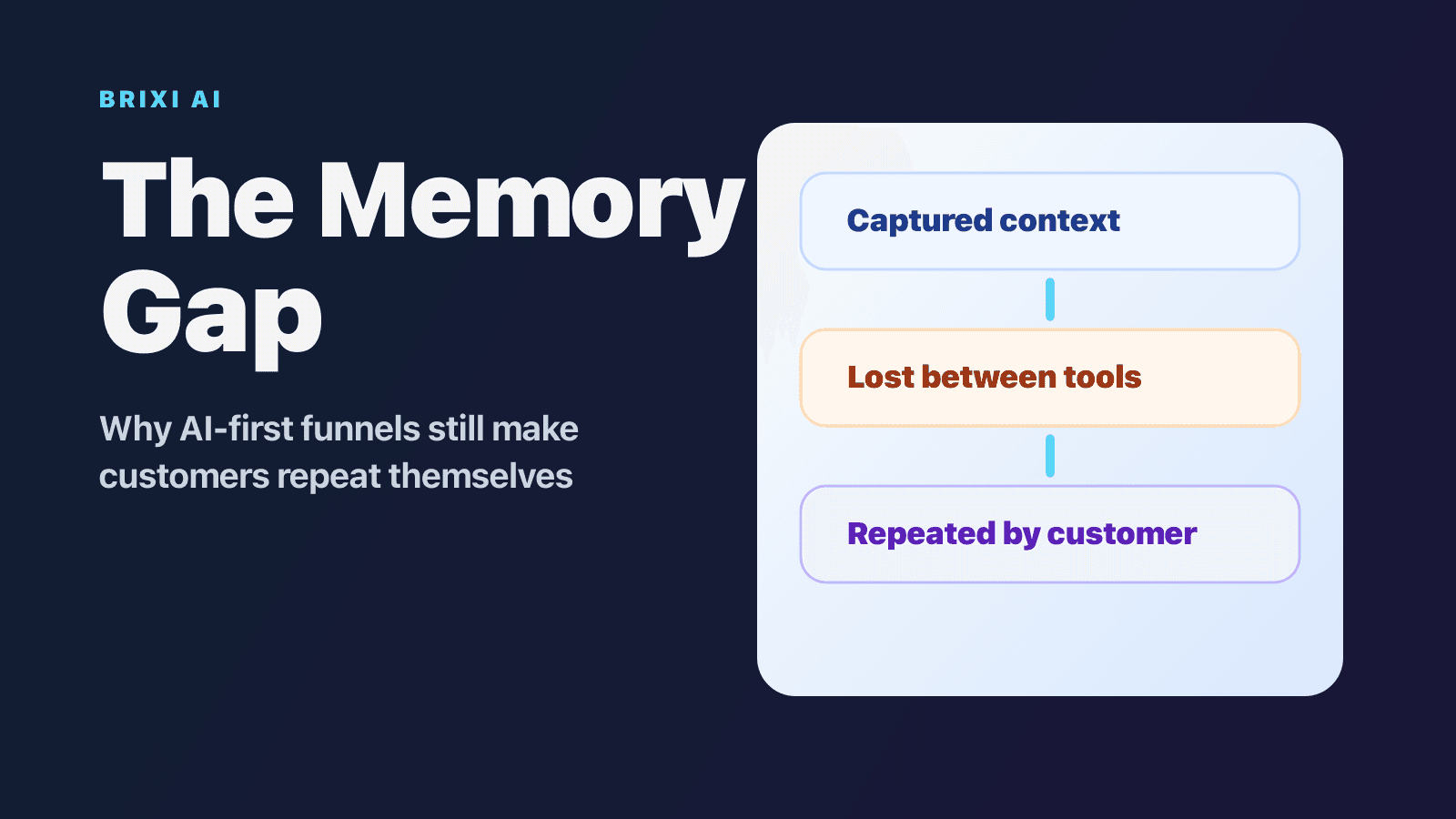
AI-first funnels promise speed, but customers still repeat themselves across chat, WhatsApp, voice, and sales calls. The Memory Gap is the hidden reason those journeys feel automated but not intelligent.
It is 10:42 AM and a prospective customer has already done the work. She filled a web form, answered a WhatsApp automation, told a voice agent her budget, and asked a pricing question in chat. Thirty minutes later a human rep calls and asks the same first question again: "Can you tell me what you are looking for?"
The business sees an AI-first funnel. The customer experiences a company with no memory. Every channel worked in isolation. Every tool did what it was bought to do. The journey still felt broken because the customer had to carry the context herself.
This is the Memory Gap: the difference between collecting customer interactions and remembering them at the next moment of action. In 2026, the teams that close this gap will not win because they use more AI. They will win because every AI and every human starts with what the customer already told the business.
AI-first does not automatically mean memory-first.
Most teams describe an AI-first funnel by listing the surfaces they automated. AI chat on the website. WhatsApp replies. Voice AI callbacks. Email journeys. CRM scoring. Those are useful parts, but none of them guarantees continuity. A funnel can be full of AI and still make every customer feel like a first-time stranger.
The reason is architectural. Many AI tools remember inside a session but forget across sessions. They can hold context while the customer is chatting right now, but they do not write durable facts into a shared record that voice, WhatsApp, CRM, workflows, and humans can read later.
A funnel without durable memory scales response. It does not scale understanding. That is why the Memory Gap becomes more visible as automation expands: every new channel creates one more place where the customer can be remembered or reset.
Where the Memory Gap shows up first.
The Memory Gap is easiest to spot at channel boundaries. A buyer explains urgency on WhatsApp, then gets a generic email. A support customer uploads an image, then the next agent asks them to describe the issue. A lead tells a voice agent they prefer evening calls, then gets a morning callback. The business sees isolated events. The customer sees one relationship that keeps restarting.
- A customer repeats budget after already sharing it with an AI assistant.
- A rep asks for timeline even though the voice call captured it the previous day.
- A WhatsApp workflow sends generic nurture after the customer asked for a specific plan.
- A support agent receives a ticket without the customer image, sentiment, or prior failed resolution.
- A manager reviews pipeline stages but cannot see the real objections customers raised across channels.
None of these moments looks dramatic in a dashboard. They show up as slower conversion, lower reply rates, longer resolution time, and a vague feeling that customers are less patient than they used to be. The patience did not disappear. The customer simply expects the business to remember what modern systems already captured.
The Memory Gap rule
If a customer has to repeat a fact your system already captured, the funnel is not intelligent at that moment. It is only automated.
The fix is not a bigger transcript archive.
Many teams try to solve memory by saving more data. They store transcripts, call recordings, WhatsApp logs, email replies, and form entries. That helps with audit, but it does not close the Memory Gap by itself. A large archive is still useless if the next person or AI cannot retrieve the right fact before acting.
The fix is structured memory. After every interaction, the system should extract the facts that change the next action: need, urgency, objection, channel preference, promised follow-up, owner, and risk. Those facts should update the customer record and become available before the next message, call, or workflow fires.
That shift sounds small, but it changes the customer experience completely. The next call starts from the last signal. The next WhatsApp message reflects the actual objection. The next human sees the live brief. The funnel stops behaving like a set of tools and starts behaving like one memory system.
Memory needs rules for what gets kept.
A shared memory layer is not a dumping ground. If the system keeps everything with equal weight, the next owner still has to decide what matters. Good memory has rules for which facts become durable, which facts expire, and which facts should change the next action immediately.
A customer saying "send details" may not deserve a permanent high-intent label. A customer asking for final price after comparing two options probably does. A patient rescheduling once is normal. A patient rescheduling three times with anxious language may need a different reminder path. Memory becomes useful when the system can separate passing conversation from operating truth.
This is where many AI-first funnels get noisy. They capture more signals but do not define how signals age. A budget shared last month may be stale. A preferred channel may remain useful for months. A complaint about a missed callback should stay visible until the next owner acknowledges it. The memory layer needs decay, confidence, and ownership, not just storage.
The simplest operating rule is to ask whether a fact should change the next conversation. If yes, it belongs in shared memory. If no, it can remain in the transcript. That discipline keeps the customer record useful instead of turning it into a museum of every sentence the customer ever typed.
Why Brixi treats memory as the platform layer.
Brixi is built for the work that happens across AI assistants, CRM, WhatsApp, voice, workflows, and human teams. That means memory is not an add-on. It is the platform layer that lets every channel learn from every prior interaction.
A voice AI call can qualify a lead and update the CRM. A WhatsApp reply can change intent score and suppress the wrong sequence. A web chat can create a handoff brief for a human owner. Conversation intelligence can turn objections into routing and coaching signals. The value is not that these features exist separately. The value is that they share context.
That is the difference between an AI tool and an AI-native customer platform. A tool completes a task. A platform remembers what the task revealed and uses it to improve the next action.
The operating question is retrieval.
The test for memory is not whether the business can find the old interaction after searching hard enough. The test is whether the right fact appears before the next action. If a rep has to open five tabs, play a recording, and read a transcript, the memory exists but the operation still failed.
Retrieval should be tied to the work being done. Before a callback, show the last stated need, urgency, objection, and promised follow-up. Before a WhatsApp nurture message, check whether the customer already asked for pricing or opted for a call. Before a manager review, surface the patterns customers repeated across channels.
This is why memory belongs inside the customer platform instead of a separate archive. The system that remembers should be close to the system that acts. Otherwise memory becomes another report someone meant to read, not the reason the next action gets better.
What changes after a quarter of memory-first operations?
The first change is shorter second conversations. Teams spend less time re-qualifying and more time advancing the decision. The customer hears continuity: "You mentioned price was the blocker yesterday. I have the payment option in front of me."
The second change is better routing. A customer with high urgency and a pricing objection goes to a different owner than a customer browsing casually. Routing becomes a judgment about context, not a queue mechanic.
The third change is managerial visibility. Leaders can see not only who is in the funnel, but what customers are saying, where they are stuck, and which teams are acting with the right context. Memory turns conversation into operating discipline.
The fourth change is calmer customers. They stop hearing the hidden cost of your stack in every repeated question. The business feels more organized because the next person starts from remembered context instead of forcing the customer to rebuild it.
The deeper bet: customers will not reward forgetful automation.
AI has made fast replies cheap. That changes the standard. Customers will not be impressed that a business responded instantly if the next interaction ignores everything they already shared. Speed without memory becomes a faster reset.
The durable advantage will come from remembered context: the quiet proof that the business listened, stored the right facts, and acted from them. In customer-facing work, memory is not a feature. It is the operating system for trust.
Give every customer journey a shared memory
Brixi connects AI assistants, CRM, WhatsApp, voice, workflows, and human teams so customers do not have to repeat what your business already knows.
See the omnichannel platform